

Frs Schreiber, Goldade, Poinsinet de Sivry and Hanappier are to be concsecrated to the episcopate on 1 July 2026 by the SSPX.
The names
The SSPX has announced that it will be consecrating the following men to the episcopate on 1 July 2026:
Fr Pascal Schreiber
Fr Michael Goldade
Fr Michel Poinsinet de Sivry
Fr Marc Hanappier
All these men were formed at SSPX seminaries and ordained by SSPX bishops.
The communiqué stated that the names had been submitted to Leo XIV’s Vatican, along with an explanation as to why these consecrations were necessary. It also stated the the consecrations “do not proceed from any desire to claim a power of jurisdiction or to establish a parallel authority within the Church” – nor a “denial of, refusal of, or challenged to the supreme, full, and immediate power of jurisdiction of the Vicar of Christ over the universal Church.”
“The ceremony of July 1st,” it stated, “will have no other purpose than to ensure the continued administration of the sacraments of Holy Orders and Confirmation, together with those sacramentals reserved to bishops, according to the traditional rite of the Holy Roman Church and the immemorial Faith.”
It also contained brief biographies of each candidate.
Fr Pascal Schreiber
Swiss
53 years of age
Entered the Zaitzkofen seminary in 1992, before moving to the Écône seminary
Ordained 1998
Bursar of the Swiss district for two years from 2014, then made District Superior
Rector of Zaitzkofen since 2020
Speaks German, French and English.
Fr Michael Goldade
American
45 years of age
Studied at the Winona seminary
Ordained 2004
Ministered in Armada, Michigan
Directed the retreat house in Ridgefield
Prior in Kansas City from 2014
Official assistant to District Superior from 2021
Rector of St Thomas Aquinas Seminary (Virginia) from 2023
Speaks English, has studied French, and has some Spanish.
Fr Michel Poinsinet de Sivry
French
42 years of age
Studied at Flavigny and Écône
Ordained 2008
Worked in French SSPX schools and at Saint Nicolas-du-Chardonnet, Paris
Directed Saint Jean-Baptiste de La Salle secondary school in Camblain-l’Abbé, Arras from around 2016
Superior of Benelux District since 2022
Speaks French and English, and is studying German and Dutch.
Fr Marc Hanappier
French
35 or 36 years old (born in 1990)
Studied at Flavigny and Écône
Ordained 2013
Began his ministry in French SSPX schools
Spent a year perfecting his English in Scotland (!)
Seminary professor in Virginia in 2020, teaching metaphysics and dogmatic theology
Continues with pastoral ministry on Sundays
Speaks French and English, studied German, has some Spanish.
Some background to the SSPX and episcopal consecrations
In 1988, Archbishop Marcel Lefebvre consecrated the following men to the episcopate against the will of John Paul II:
Bernard Tissier de Mallerais (French)
Richard Williamson (English)
Bernard Fellay (Swiss)
Alfonso de Galarreta (Spanish/Argentine)
Archbishop Lefebvre’s 1987 letter to the four future bishops gives a succinct account of his rationale for this momentous act:
Following the death of Bishop Tissier de Mallerais in 2024 (and also Bishop Williamson in 2025 – who was expelled in 2012), the Society of St Pius X (SSPX) announced on 2 February 2026 that it would be following in his footsteps and consecrating bishops, apparently without the permission of Leo XIV, on 1 July 2026.
This will mark the second time – and not the first, as many think – that the Society of St Pius X’s bishops have conferred episcopal consecration since 1988.
Excommunications – What happened in 1988
According to canon law, consecration of a bishop without pontifical mandate carries a latae sententiae excommunication for the consecrating and consecrated bishops.
In 1988, the Vatican responded within hours, stating that the six bishops involved (Lefebvre, de Castro Mayer, Fellay, Williamson, de Galarreta and Tissier de Mallerais) had indeed excommunicated themselves. This statement was formalised by the Congregation of Bishops on 1 July 1988.
In response, the District Superiors of the SSPX issued a powerful Open Letter, which stated:
“[W]e have never wished to belong to that system which styles itself the ‘Conciliar Church,’ and which defines itself by the Novus Ordo Missæ, by indifferentist ecumenism, and by the secularisation of the whole of society.
“Yes, we have no part — nullam partem habemus — with the pantheon of religions of Assisi; our own excommunication by a decree of your Eminence or of another dicastery would be only the irrefutable proof of this.
“We would ask for nothing better than to be declared ex communione from the adulterous spirit which has blown through the Church for twenty-five years, excluded from the impious communion with unbelievers. […]
“To be therefore publicly associated with the sanction which strikes the six Catholic bishops, defenders of the faith in its integrity and totality, would be for us a mark of honour and a sign of orthodoxy before the faithful.
“For these faithful indeed have a strict right to know that the priests to whom they turn do not belong to the communion of a counterfeit Church”
While we agree with the sentiment, we cannot agree with the idea that an excommunication by a true Pope can serve as a badge of honour. The following propositions of the English heretic John Wycliffe were condemned in the letter Super periculosis in 1377:
“A curse or excommunication does not bind absolutely except when it is given against an opponent of the law of Christ.” (DH 1131)1
The true reason – regrettably not recognised – that such excommunications are to be despised, or treated as badge of honours, is that they proceed from men who do not hold papal authority.
Reactions, defections and reconciliations
The consecrations also prompted a number of defections from the SSPX ranks. Aided by former SSPX and former “sedevacantist” Fr Louis-Marie de Blignières (of the Fraternity of St Vincent Ferrer), a number of priests reconciled themselves with the Vatican – and thus, the Fraternity of St Peter was born.
Lefebvre himself focused a lot of attention on the reconciliation of Dom Gerard Calvet and the Benedictine monastery of Le Barroux, who had previously been a collaborator, and Le Barroux was made an Abbey. In one of his denunciations of Dom Gerard, Archbishop Lefebvre said:
“Dom Gérard has always seen only the liturgy and monastic life. He does not see clearly the theological problems of the Council, of religious liberty. He does not see the malice of these errors. He has never been greatly concerned with that. What affected him was the liturgical reform, the reform of the Benedictine monasteries. He left Tournay saying: “I cannot accept that.” So he re-established a community of monks with the liturgy, in the Benedictine spirit. Very well, it was splendid.
“But I think he did not sufficiently measure that those reforms which had led him to leave his monastery were the consequence of the errors that are in the Council. Provided that he is granted what he was seeking, that monastic spirit and the traditional liturgy, he has what he wants and the rest is indifferent to him. But he falls into a trap, for the others have conceded nothing on those false principles.
“It is a pity, for it still involves sixty monks, about twenty priests among them, and thirty nuns. There are almost a hundred young people there, completely disoriented, and whose families are worried or even divided.
“It is disastrous.”
In another address, he said:
“The more one analyzes the documents of Vatican II, and the more one analyzes their interpretation by the authorities of the Church, the more one realizes that what is at stake is not merely superficial errors, a few mistakes, ecumenism, religious liberty, collegiality, a certain Liberalism, but rather a wholesale perversion of the mind, a whole new philosophy based on modern philosophy, on subjectivism.”
38 years of operating in this paradigm makes it unlikely that many priests or religious will cease collaborating with the SSPX following these consecrations, even if another excommunication is alleged to have been incurred. It has been suggested that this may not hold so consistently for those ordained since the “lifting of the excommunications” in 2009.
However, the lifting of the excommunications legitimised the SSPX in the eyes of many, leading to an influx of a certain number of persons seeking the Latin Mass, without sharing the SSPX’s perspective on the Crisis in the Church. It seems probable that at least some of these persons will detach themselves from the SSPX if excommunications are indeed declared.
Archbishop Lefebvre spoke of such departures, both lay and clerical, in 1990:
“And we must not waver for one moment either in not being with those who are in the process of betraying us. Some people are always admiring the grass in the neighbor’s field. Instead of looking to their friends, to the Church’s defenders, to those fighting on the battlefield, they look to our enemies on the other side. ‘After all, we must be charitable, we must be kind, we must not be divisive, after all, they are celebrating the Tridentine Mass, they are not as bad as everyone says’—but they are betraying us—betraying us! They are shaking hands with the Church’s destroyers. They are shaking hands with people holding modernist and liberal ideas condemned by the Church. So they are doing the devil’s work.
“Thus those who were with us and were working with us for the rights of Our Lord, for the salvation of souls, are now saying, ‘So long as they grant us the old Mass, we can shake hands with Rome, no problem.’ But we are seeing how it works out. They are in an impossible situation. Impossible. One cannot both shake hands with modernists and keep following Tradition. Not possible. Not possible.
“Now, stay in touch with them to bring them back, to convert them to Tradition, yes, if you like, that’s the right kind of ecumenism! But give the impression that after all one almost regrets any break, that one likes talking to them? No way! These are people who call us corpse-like traditionalists, they are saying that we are as rigid as corpses, ours is not a living Tradition, we are glum-faced, ours is a glum Tradition! Unbelievable! Unimaginable! What kind of relations can you have with people like that?
“This is what causes us a problem with certain layfolk, who are very nice, very good people, all for the Society, who accepted the Consecrations, but who have a kind of deep-down regret that they are no longer with the people they used to be with, people who did not accept the Consecrations and who are now against us. ‘It’s a pity we are divided’, they say, ‘why not meet up with them? Let’s go and have a drink together, reach out a hand to them’—that’s a betrayal! Those saying this give the impression that at the drop of a hat they would cross over and join those who left us. They must make up their minds.”
Not the first time
This will be the second time the SSPX have consecrated bishops since 1988 – a little known fact, that is forgotten in much of the discussion.
In 1991, soon after the first consecrations, three of the SSPX bishops consecrated Fr Licínio Rangel for the Catholic remnant in the Dioceses of Campos. Both the fourth bishop (Bishop Fellay), and the Superior General (Fr Schmidberger), were in attendance. It is unclear whether permission was sought from the Vatican for this consecration.
Bishop Rangel died in 2002, having come to an agreement with the Vatican in 2001.
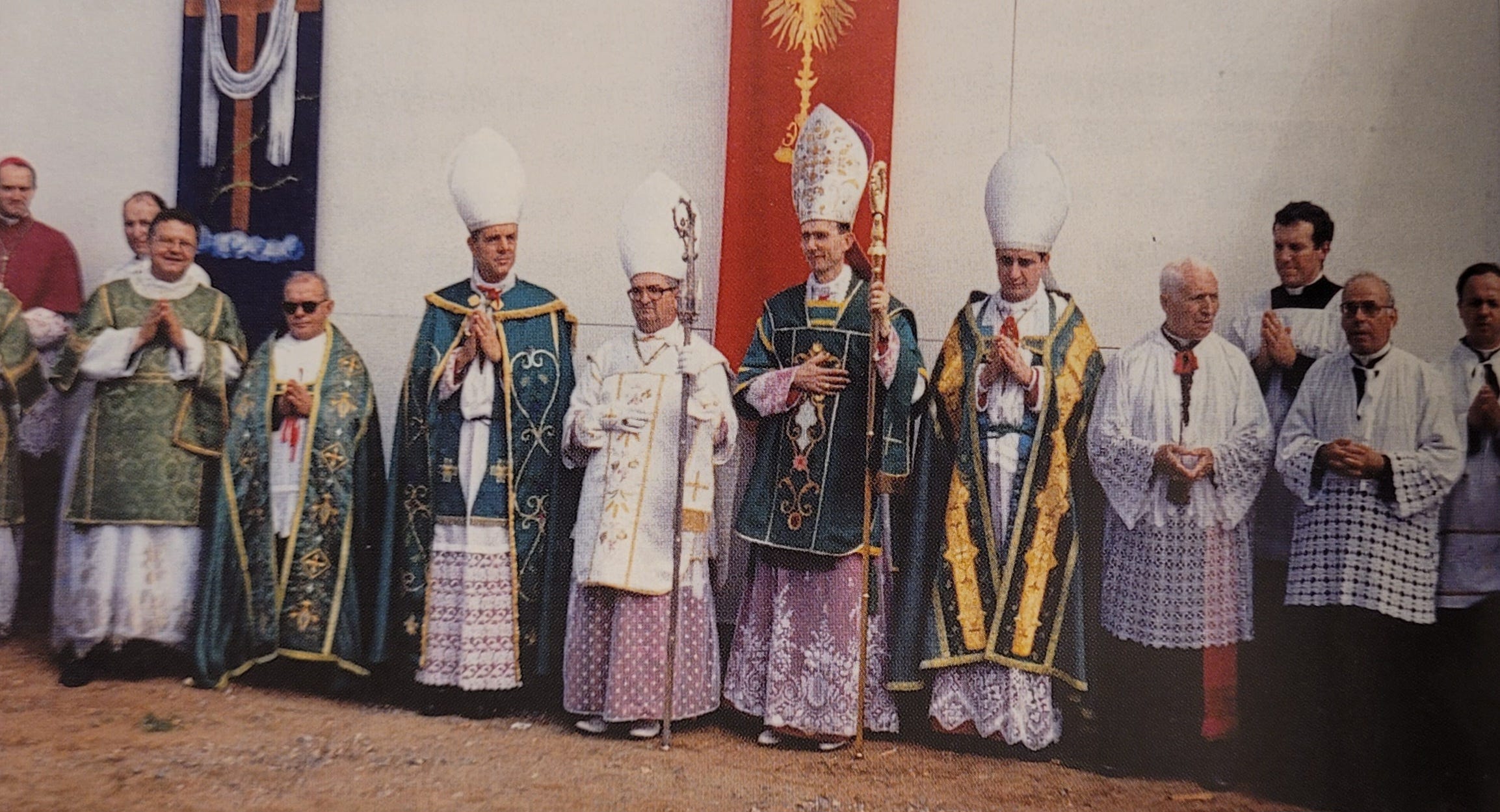
Rangel was succeeded, within those structures, by Fernando Arêas Rifan, whose consecration by Cardinal Darío Castrillón Hoyos was rendered certainly valid by Rangel’s presence as co-consecrator. Although he was one of the most stalwart defenders of tradition under de Castro Mayer, and assisted him in 1988, Rifan was pictured concelebrating the Novus Ordo Mass with Francis at Casa Santa Marta.
This consecration almost seems to have been forgotten – although not by the priests whom Rangel himself ordained for the SSPX. It was not mentioned in the 2009 decree purporting to remit the alleged excommunications of the four bishops – although in 2001, the Vatican did refer to “the excommunication incurred on 28 July 1991.”
Validity of orders
In February, we noted the possibility that the SSPX would consecrate men who had putatively received their Holy Orders prior to joining the SSPX. This announcement confirms that this will not be the case.
A small number of SSPX members and collaborators were ordained using Paul VI’s new rite of priestly ordination, or by men whose own priestly or episcopal orders also depended on the validity of the reformed rites – and not all of them have been conditionally ordained.
For reasons explained elsewhere, supported by much of what Archbishop Lefebvre said and did, orders putatively conferred using these rites are at best doubtful.2
Such doubt is precisely what Archbishop Lefebvre stated that he was trying to avoid by the 1988 consecrations, both at the ceremony itself and on other occasions.
Potential Excommunications
In the lead up to July 2026, the Vatican issued warnings to the SSPX. On 13th May 2026 – a date which may have been deliberately chosen – Cardinal Víctor Manuel Fernández issued the following statement:
“With regard to the Priestly Fraternity of Saint Pius X, we reiterate what has already been communicated. The episcopal ordinations announced by the Priestly Fraternity of Saint Pius X do not have the requisite papal mandate. This act will constitute “a schismatic act” (John Paul II, Ecclesia Dei, no. 3) and “formal adherence to the schism constitutes a grave offence against God and entails the excommunication established under Church law” (ibid., 5c; cf. Pontifical Council for Legislative Texts, Explanatory Note, 24 August 1996).”
The announcement of the four future bishops comes less than two weeks after this statement.
In the meantime, we encourage readers to pray for all involved – and for the greater recognition of what alone can truly justify these episcopal consecrations and protect the work of the Society of St Pius X, namely the extended vacancy of the Holy See.
Further reading:

Archbishop Lefebvre and the Conciliar Church
An updated edit of John Lane’s classic study:
What did Archbishop Lefebvre really think about the ‘Conciliar Church’?
Did Lefebvre see the Conciliar Church as a separate society to the Catholic Church?
Where is the Church today? Archbishop Lefebvre and the Conciliar Church
Archbishop Lefebvre and the Sacraments
Our series examining Archbishop Lefebvre’s words, ideas and deeds in relation to the Novus Ordo sacramental rites:
Archbishop Lefebvre & Conditional Confirmations—His pastoral practice explained
Archbishop Lefebvre & Conciliar Sacraments—Do they ‘come from the Church?’
Further material:
‘I do not hesitate to administer conditional confirmation when asked’—Archbishop Lefebvre
Classic study radically overstates Lefebvre’s position on holy orders
Is desiring the sacraments individualistic and emotional? Lefebvre and others answer
Archbishop Lefebvre and ‘The Pope Question’
A series of talks given in 1986 to seminarians and priests:
Archbishop Lefebvre: Three dispositions needed by priests and seminarians today
Archbishop Lefebvre: ‘Who is this man on the throne of Peter?’
+Lefebvre: ‘Any sensible man must ask’ if a heretic is still pope, can discuss with others
Summarised (and some what softened) in an English publication from the time:
Further material:
+Marcel Lefebvre’s glowing tribute to ‘sedevacantist’ Fr Henri Mouraux
‘Medieval peasants didn’t know the pope’s name, why should we care?’ +Lefebvre answers
Various Addresses
Post-Suspension
Lead-up to the Consecrations
(See also above under “The Pope Question”)
Post-Consecrations
Articles by our friends
Archbishop Lefebvre and Sedevacantism (John Daly)
Archbishop Lefebvre and The Sedevacantist Thesis (John Lane)
Archbishop Lefebvre and The Conciliar Popes (John Lane)
Fr. Celier’s Interpretation of Archbishop Lefebvre (John Lane)

HELP KEEP THE WM REVIEW ONLINE!
As we expand The WM Review we would like to keep providing free articles for everyone.
Our work takes a lot of time and effort to produce. If you have benefitted from it please do consider supporting us financially.
A subscription from you helps ensure that we can keep writing and sharing free material for all. Plus, you will get access to our exclusive members-only material.
(We make our members-only material freely available to clergy, priests and seminarians upon request. Please subscribe and reply to the email if this applies to you.)
Subscribe now to make sure you always receive our material. Thank you!
In addition, the same document condemned the following:
“Excommunication by the pope or by any prelate is not to be feared, because it is the censure of the Antichrist.” (DH 1180)
Wycliffe, like many Protestants, believed the papacy to be an Antichrist institution. Notwithstanding certain comments made by Lefebvre about recent claimants being “antichrists”, this is clearly not what the SSPX believe.
However, Pope Clement XI condemned the following propositions of the Janesnists in the Bull Unigenitus:
91. The fear of an unjust excommunication should never hinder us from fulfilling our duty; never are we separated from the Church, even when by the wickedness of men we seem to be expelled from her, as long we are attached to God, to Jesus Christ, and to the Church herself by charity. —Jn 9:22-23.
92. To suffer in peace an excommunication and an unjust anathema rather than betray truth is to imitate St. Paul; it is far from rebelling against authority or destroying unity. —Rom 9:3
The global censure given the various condemned propositions is as follows:
“We declare, condemn, and reject ... the preceding propositions, as the case may be, as false, fraudulent, evil-sounding, offensive to pious ears, scandalous, pernicious, rash, injurious to the Church and her practice, insulting not only to the Church but also the secular powers, seditious, impious, blasphemous, suspect of heresy, and having the flavor of heresy itself, and, besides, favoring heretics and heresies and also schisms, erroneous, close to heresy, many times condemned, and finally heretical, clearly renewing many heresies respectively and most especially those that are contained in the infamous propositions of Jansen and, indeed, accepted in that sense in which these have been condemned.”
(Denzinger-Hünermann, nn. 2491–2, 2502).
Pope Pius IX later referred to these texts in the following terms:
10. Since this does not please the neo-schismatics, they follow the example of heretics of more recent times. They argue that the sentence of schism and excommunication pronounced against them by the Archbishop of Tyana, the Apostolic Delegate in Constantinople, was unjust, and consequently void of strength and influence. They have claimed also that they are unable to accept the sentence because the faithful might desert to the heretics if deprived of their ministration. These novel arguments were wholly unknown and unheard of by the ancient Fathers of the Church. For “the whole Church throughout the world knows that the See of the blessed Apostle Peter has the right of loosing again what any pontiffs have bound, since this See possesses the right of judging the whole Church, and no one may judge its judgment.”
The Jansenist heretics dared to teach such doctrines as that an excommunication pronounced by a lawful prelate could be ignored on a pretext of injustice. Each person should perform, as they said, his own particular duty despite an excommunication. Our predecessor of happy memory Clement XI in his constitution Unigenitus against the errors of Quesnell forbade and condemned statements of this kind. These statements were scarcely in any way different from some of John Wyclif’s which had previously been condemned by the Council of Constance and Martin V.
Through human weakness a person could be unjustly punished with censure by his prelate. But it is still necessary, as Our predecessor St. Gregory the Great warned, “for a bishop’s subordinates to fear even an unjust condemnation and not to blame the judgment of the bishop rashly in case the fault which did not exist, since the condemnation was unjust, develops out of the pride of heated reproof.”
But if one should be afraid even of an unjust condemnation by one’s bishop, what must be said of those men who have been condemned for rebelling against their bishop and this Apostolic See and tearing to pieces as they are now doing by a new schism the seamless garment of Christ, which is the Church?
Pope Pius IX, Quartus Supra, n. 10. 1873.
Although there will be arguments to the contrary, let us repeat what was stated above:
We cannot agree with the idea that an excommunication by a true Pope can serve as a badge of honour. […] The true reason – regrettably not recognised – that such excommunications are to be despised, or treated as badge of honours, is that they proceed from men who do not hold papal authority.
In the article in February, we noted that “Per saltum” consecrations to the episcopate (i.e., consecration of a man who is not a priest) are themselves doubtful at best. St Thomas Aquinas states:
“But the episcopal power depends on the priestly power, since no one can receive the episcopal power unless he have previously the priestly power.” (Suppl. Q. 40, A. 5)
The same position is taken by the Dictionnaire de Théologie Catholique, in John Daly’s translation (with his comment):
“It must be recognized that the almost unanimous response of modern theologians is affirmative: ‘All authors consider the Consecration of a bishop to be invalid unless it is preceded by the priesthood.’”
[Emphases added, and the article goes on to quote various authorities for this assertion, including St. Alphonsus Liguori, Book 6, n. 793 of his Theologia Moralis].
(Vol. XI, col. 1388)
Being himself doubtfully consecrated (at best), such a man’s confirmations would also be doubtful, and thus impossible for Catholics to receive in good conscience. The holy oils consecrated would also be doubtful, leading to problems of validity for Confirmation and Extreme Unction. But this is nothing compared to the chaos that would be caused with regards to this bishop’s own ordinations (or even episcopal consecrations). The men ordained by such a doubtful bishop would themselves be doubtful priests, conferring doubtful sacraments.
This problem will not be applying to these four future bishops.
One can read a further overview of the per saltum issue in John Daly’s Michael Davies: An Evaluation, pp. 323-348. One can find more on Archbishop Lefebvre’s positions on this issue in the series below:
Archbishop Lefebvre & Conditional Confirmations—His pastoral practice explained
Archbishop Lefebvre & Conciliar Sacraments—Do they ‘come from the Church?’
Further material:
The list includes none of the prominent liberal priests, which is a relief. Does anyone have any information on the candidates? Any positive or negative indications?
I was expecting someone from Switzerland, but I was not expecting two Frenchmen, one of whom comes from a notable family, possibly French nobility (Bp. de Galarreta comes from Spanish nobility). Also, they all come from large (probably all Traditional Catholic) families.
Why only four?