

The point here is not documenting a meaningless Twitter drama, but drawing out the interesting questions and principles behind it.
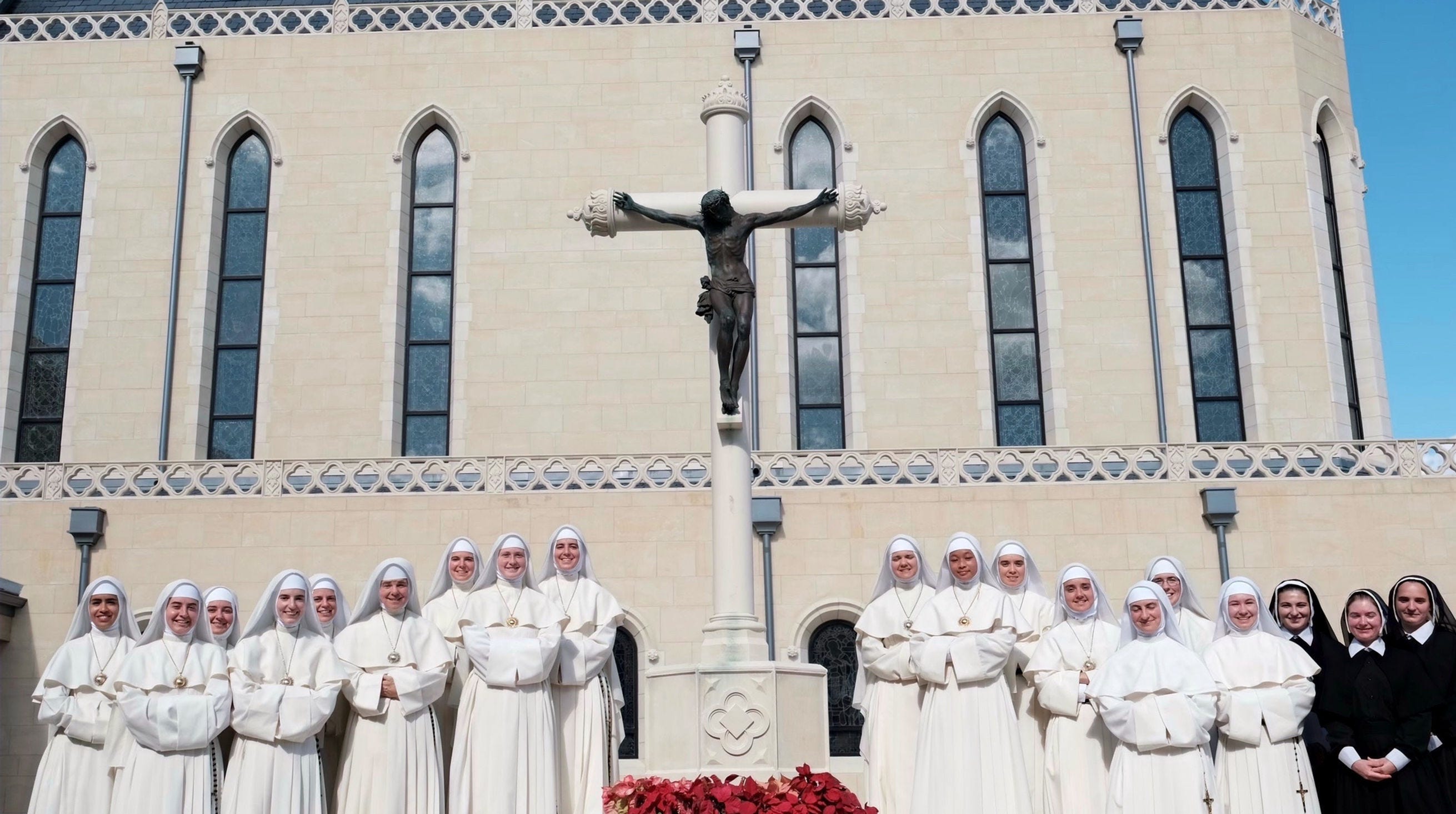
(WM Round-Up) – For several months, X has seen a few viral videos of white-habited Sisters singing Gregorian chant in a high gothic church.
These videos garner much admiration, for the beauty of the singing and the architecture, and appreciation for a young religious order of Sisters.
The current controversy
But admiration is not the only response, for this is not just any religious order. The Sisters of St Thomas Aquinas, Florida, are what others call “sedevacantists.”
They hold that:
“… the members of the Novus Ordo hierarchy, despite any and all appearances of authority, are not true Catholic popes nor true Catholic bishops, and do not possess the authority to rule, for they are the authors of the doctrinal, disciplinary and liturgical abominations which have invaded our holy places.”
The congregation was founded by Bishops Donald Sanborn and Joseph Selway, and is affiliated with the Roman Catholic Institute and Most Holy Trinity Seminary.
Recently, the Sisters published a short video advertising a three-day vocational retreat for young women:
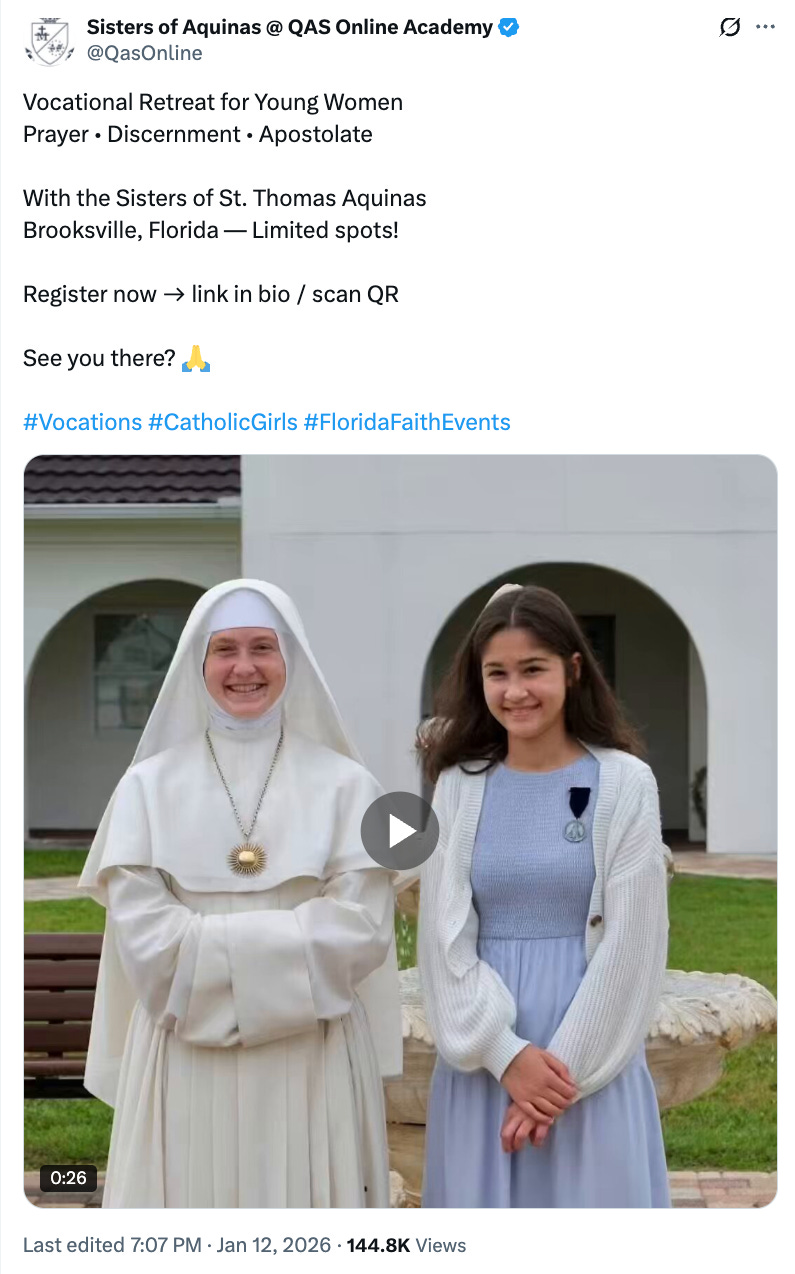
In addition to the usual low-level noise, this prompted some notable interventions on the part of clerics of the Conciliar/Synodal Church.
The Sisters have not engaged with the negative comments, and one would assume will not do so.
But the clergy who intervened have tens of thousands of followers on Twitter. Their comments are likely to be diffused far and wide, and so a response seems proportionate.
The point here is not what some persons said on Twitter, but rather the interesting questions and theological principles which arise from their comments.
Fr Aquinas Guilbeau OP
Fr Aquinas Guilbeau OP is a Dominican Friar of the Province of St Joseph, USA. His X biography informs us that he is also the chaplain and vice president of Catholic University of America, and an instructor at the Pontifical Faculty at Dominican House of Studies. Fr Aquinas’ account on X appears to be dignified and serious (unlike some of his fellow Novus Ordo Dominicans on the platform), making the potshot taken at the Sisters appear somewhat out of character.
Here’s what he said, in his quote-tweet:
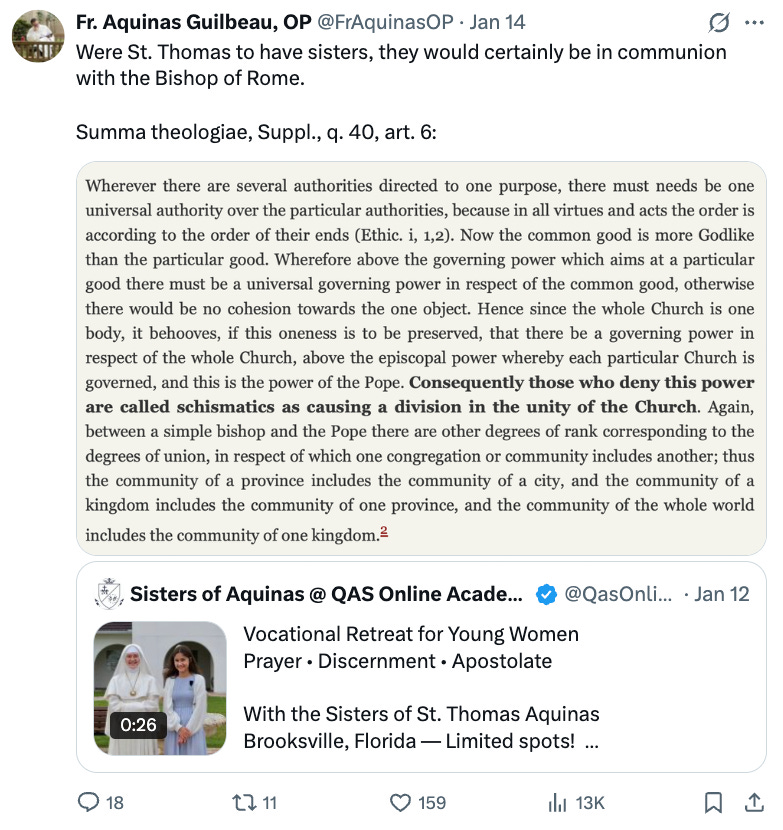
Fr Aquinas directly insinuates, in a rather catty way, that the Sisters of St Thomas Aquinas are not “in communion with the Bishop of Rome.” According to Catholic ecclesiology – though not Conciliar/Synodal ecclesiology – this would mean that they are not Catholic. To prove his point, he provides a text from St Thomas about those who deny the power of the Roman Pontiff.
Unfortunately, cattiness seems to have overtaken clear thinking in this post. Whether by confusion, or by a sleight of hand, Fr Aquinas conflates a) being outside of communion with the Roman Pontiff, with b) denying the power of the Pope.
First, it is bearing false witness to state, or to insinuate, that groups like the Sisters – who hold the post-conciliar claimants have not been true popes – deny the power of the pope. They do not; in fact, that power is itself a key part of the argument that has led them to their conclusion. At worst, the Sisters, and those of us who have reached the same conclusion, would be wrong about a question of fact (whether these men have been true popes) rather than one of doctrine (the nature of the papacy).
Further, even those who disagree should concede that the post-Vatican II epoch makes a conclusion like this reasonable, even if wrong. For these reasons, being mistaken under these circumstances would not result in schism, even if it might have done so under “normal” papacies which were not subject to the same extreme turbulence. This is established by Catholic authorities. The canonists Wernz and Vidal write:
“They cannot be numbered among the schismatics, who refuse to obey the Roman Pontiff because they consider his person to be suspect or doubtfully elected on account of rumors in circulation […]”1
The canonist Szal writes:
“Nor is there any schism if one merely transgress a Papal law for the reason that one considers it too difficult, or if one refuses obedience inasmuch as one suspects the person of the Pope or the validity of his election, or if one resists him as the civil head of a state.”2 (Emphasis added)
The theologian Juan de Lugo SJ cites another author supporting this view:
“Third, he will not be a schismatic who denies submission to the Pope because he doubts probably about his legitimate election or his authority: see Sanchez, who discusses others in Book I of the Decalogue, Chapter 35, in the third and fourth numbers, in the fourth disputation, in the fifth point.”3 (Emphasis added)
Let’s note that doubts about elections are not limited to rumours of skulduggery and so on, but include the ineligibility of a non-Catholic for the papacy – although, as adherents to the Cassiciacum Thesis, the Sisters of St Thomas Aquinas have particular views about this.
Finally, from Cajetan:
“If someone, for reasonable motive, holds the person of the pope in suspicion and refuses his presence and even his jurisdiction, he does not commit the delict of schism, nor any other whatsoever, provided that he be ready to accept the pope were he not held in suspicion.”4
There is not a single “sedevacantist” who would not be ready to accept these men if they were not held in suspicion.
If the “sedeplenist” analysis was correct, then such groups would at worst be in a situation similar to what is improperly called the “material schism” of the Great Western Schism – in which theologians hold that the various obediences (or at least, most of their members) remained in communion with each other, in spite of the appearance of schism.
Communion is not created by verbal formula by magic words (or destroyed by harsh ones), but by reality. If, although impossible, Leo XIV was indeed the pope (and he is not), then we who are “mistaken” about this in good faith and for very good reasons, would already be in communion with him – even though we hold otherwise. This is the case, notwithstanding how strange it this may sound.5
We have addressed this topic in greater detail here, albeit more with regard to the material divisions between those who profess the traditional faith of the Church:

As such, even on his own presuppositions, it is highly regrettable for Fr Aquinas to present this text from his holy namesake as an authority for his potshot at the Sisters.
Fr Matthew Schneider LC
Fr Matthew Schneider is a member of the Legionaries of Christ, the congregation founded by the disgraced priest, drug addict, sexual offender (of individuals of both sexes) and a father of six illegitimate children, Marcial Maciel.
Schneider is the host of SPQN’s podcast “Vatican II in a Year,” and became well-known during the COVID period as an apologist for the vaccines.
The Sisters’ video prompted several reactions from Schneider:
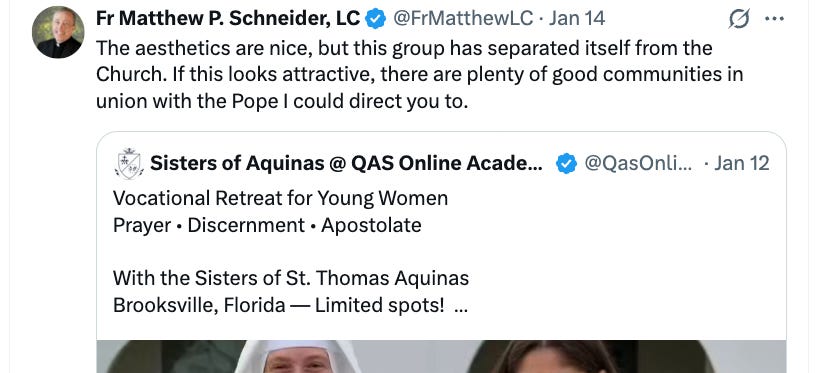
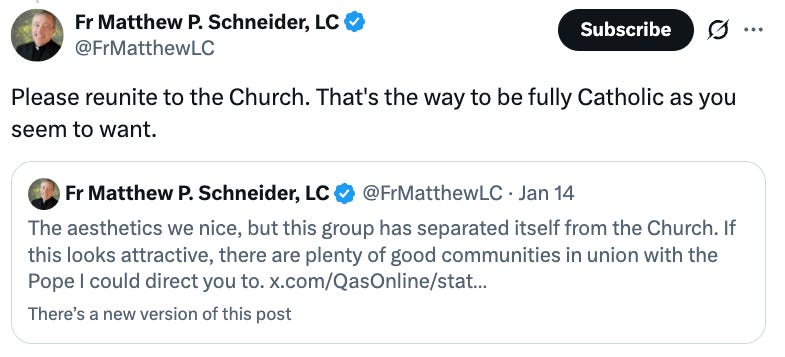
Schneider responded extensively to those who engaged with his comments. For example, recommending conservative religious orders in the Conciliar/Synodal milieu.
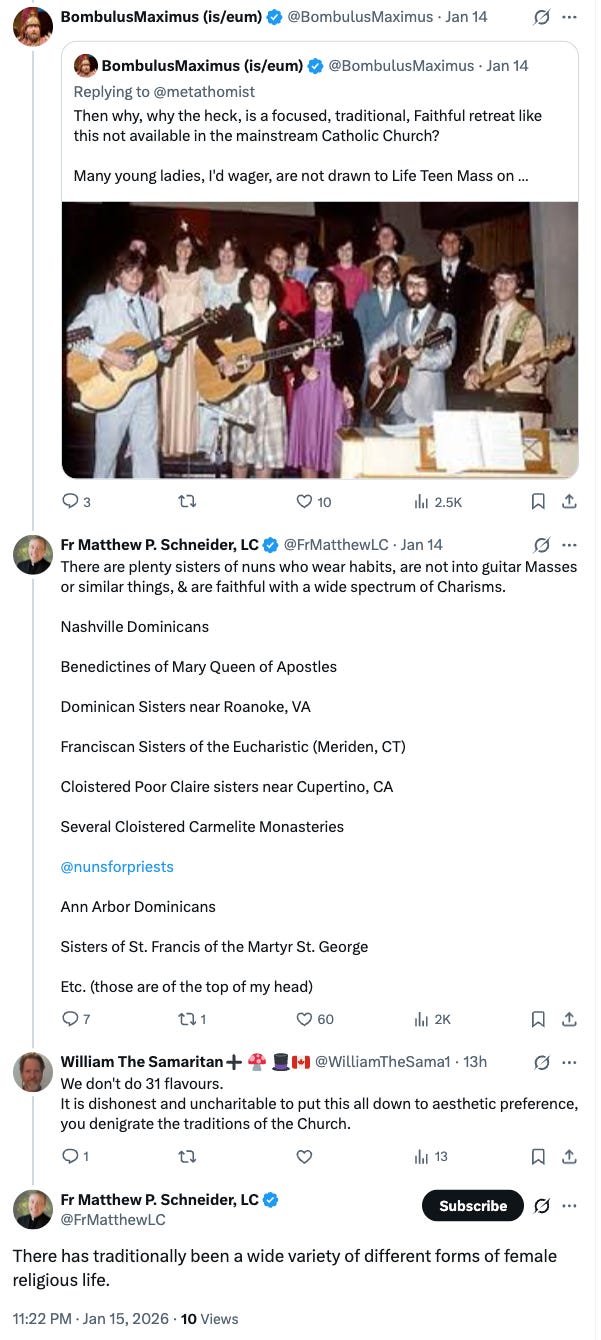
As the last message above shows, however, Schneider’s suggestion of more conservative religious orders is accompanied by an acceptance of the legitimacy of what he called “guitar Masses and similar things.” This suggests that he either sees such things as acceptable, and part of the “wide variety of different forms of female religious life” – which is hardly credible. Alternatively, it suggests that he considers the Catholic Church to be a “big tent” of multiple religions and beliefs, some of which being acceptable and others unacceptable. But this is contrary to Catholic ecclesiology, as we discussed recently in relation to Fr de Blignières’ “proposal.” No Catholic should accept a side-chapel in this Anglicanised “broad Church.”
Others challenged Schneider on the idea that such persons separate themselves from the Church:
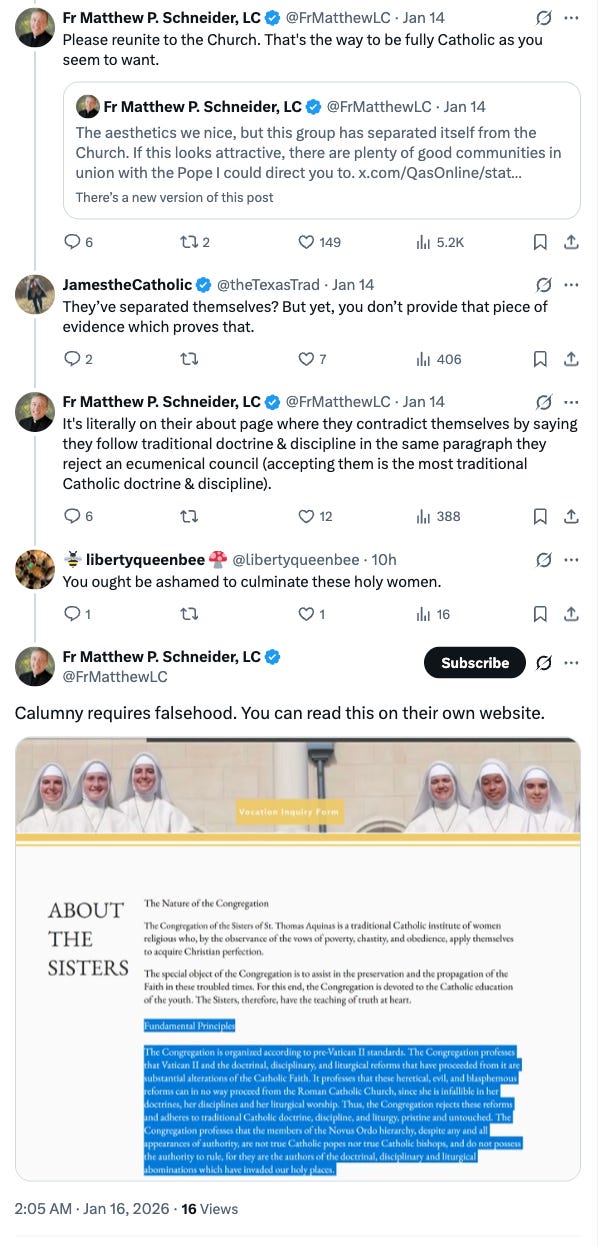
As we have seen above in relation to Fr Aquinas, it is not the case that those who adopt this conclusion separate themselves from the Church.
Unfortunately, Schneider had to really scrape the barrel in some of his replies – accusing strident anti-modernists of being “the real modernists”:
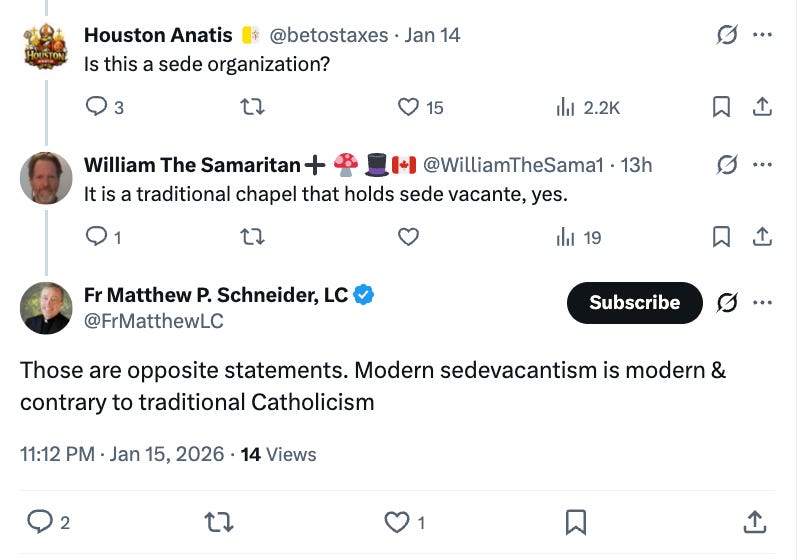


The grave error of ‘sedevantism’
Intriguingly, he adopted a particular spelling mistake of the word “sedevacantist” – namely, “sedevantist.” This spelling has, over the last year, become something of a shibboleth for highly emotional anti-sedevacantists who have no idea what they are talking about:
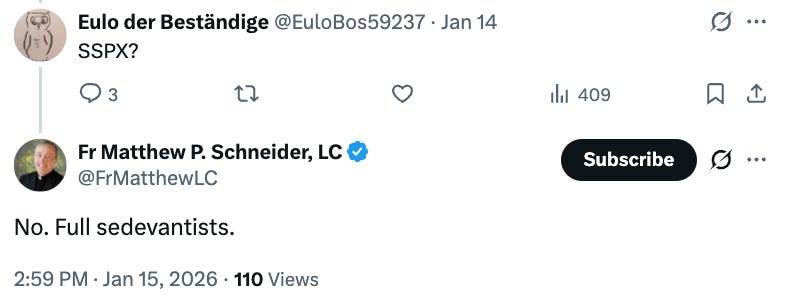
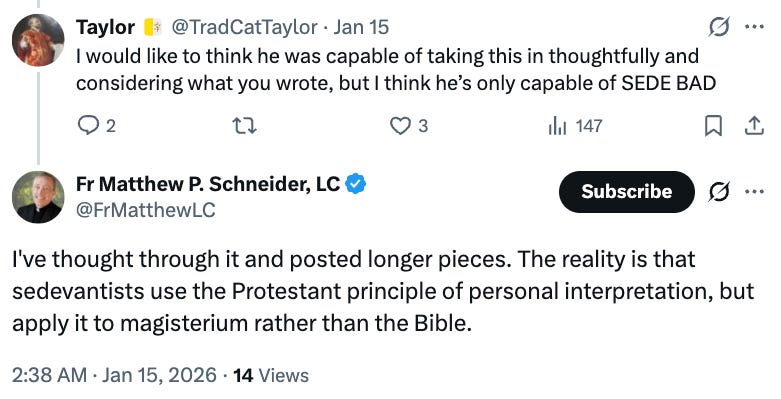
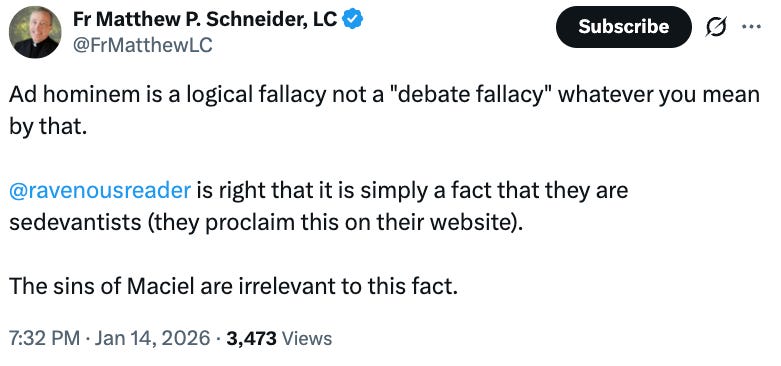
I am in no position (at all) to be criticising others for typos. But the frequency of this particular typo suggests something more: ignorance of the subject at hand.
But this is enough Twitter nonsense. Let us turn to the key point: Why it is that Schneider is doing what he is doing?
‘Pretending to be Catholic’
He tells us directly:
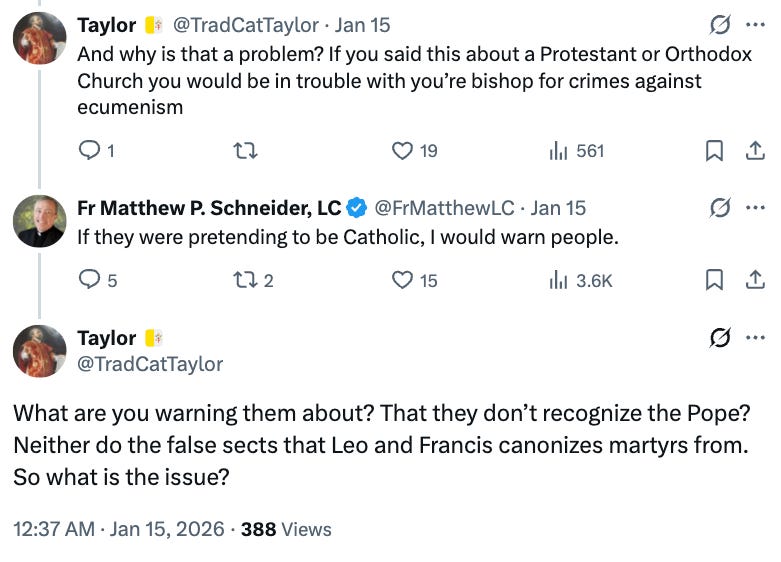
In other words, Schneider tries to distinguish his poor treatment of the Sisters from the greater tolerance offered to Protestants and Orthodox on the grounds that the Sisters (and other “sedevantists”) are “pretending to be Catholic.”
But this distinction is subject to some serious problems:
The Orthodox and Anglicans also claim to be Catholic.
As such, this distinction is inadequate, and needs more argumentation to actually do anything.
Perhaps he means, we pretend to be Roman Catholic – or that our “pretence” is more convincing than theirs. But I don’t think it’s our job to finish Fr Schneider’s arguments for him. As it stands, this is a failed distinction.
The distinction would not do the work it needed to do
Fr Schneider leads with innuendo in this argument. The obvious rejoinder to his distinction – if we accepted it for the sake of argument – is: “So what?” We know what difference “pretending to be Catholic” (whilst not being so) would make in Catholic ecclesiology: that much is clear. But what difference does it make under the “ecclesiology” of the Conciliar/Synodal Church, which Schneider would have us all enter?
Assuming the position of the Conciliar/Synodal Church, all the positive ecumenical comments apply to “sedevacantists” as much as they do to genuine heretics and schismatics. As Mark Escobar wrote:
“Recently, some defenders of the Novus Ordo sect, with boldness and unjustly and without any legitimate cause, have claimed with the intention of humiliating loyal Catholics, that the Sedevacantists are “Protestants” and “Schismatics” just because they reject the heresies of the Novus Ordo sect and do not recognize its leaders as the pope!
“In this article, we aim to see, even if we were to accept their claim that we are Protestants or Schismatics, what status and dignity we hold in the eyes of their sect! For this purpose, we have extracted texts from the leaders of this sect, and wherever they refer to Protestants and Schismatics, we have replaced those terms with Sedevacantists or Sedevacantism.”
Here is one such example:
3. … the Sedevacantists have been by no means deprived of significance and importance in the mystery of salvation. For the Spirit of Christ has not refrained from using the Sedevacantist Churches as means of salvation … all who have been justified by faith in Baptism [Includin[g] Sedevacantists] are members of Christ’s body, and have a right to be called Christian.
- Second Vatican Council, Unitatis Redintegratio, 21 November 1964
Now, in the course of this discussion, Schneider denied the idea that “everyone is going to heaven anyways” in the following way:
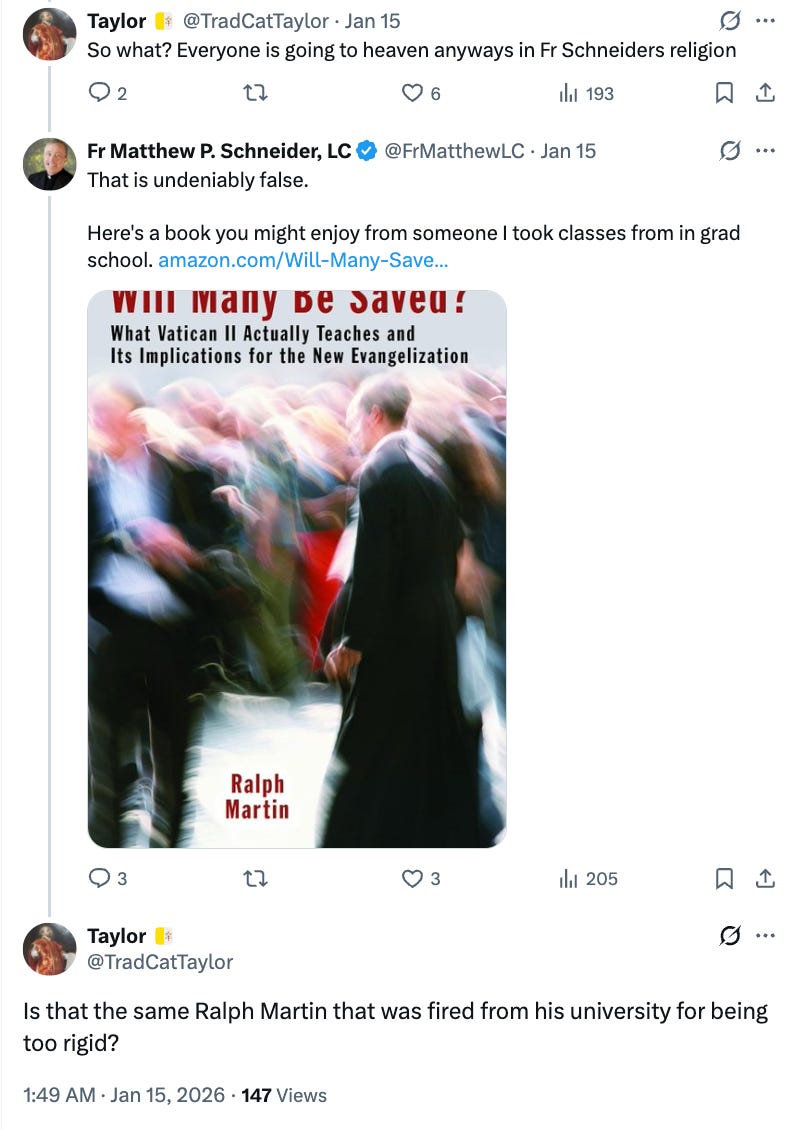
But denying that everyone is going to Heaven is not the same as affirming the dogma outside the Church there is no salvation – and in any case, Fr Schneider may say what he wants: the Vatican II document already cited, and the many “papal” remarks on the subject documented by Escobar, make clear that while Schneider’s views may be tolerated in the Conciliar/Synodal milieu, they are not the only perspective there – or even the prevalent one. This is because, as is notorious, the Conciliar/Synodal structure lacks a necessary property of the Catholic Church, namely unity of faith.
(And, as Taylor points out above, the author of the book in question was removed from his post.)
It is quite clear that the ecclesiology of the Conciliar/Synodal Church lacks any strong reason for condemning “sedevacantists” like the Sisters of St Thomas. To attempt to use Catholic ecclesiology against real Catholics, as a means of pressuring others to accept the Conciliar/Synodal Church, is a classic example of what we have called “weaponized orthodoxy.”

Conclusion: The real problem
The bottom line is that clerics of the Conciliar/Synodal Church have no business or grounds to pass negative judgements on groups like the Sisters of St Thomas Aquinas. The principles of the Vatican II religion do not permit it. Something like Pascal’s Wager could be applied here: if we are right, then there are serious consequences to accepting the Conciliar/Synodal religion and authorities; whereas if the Conciliar/Synodalists are right, then there are no such consequences to adopting our conclusion anyway.
However, we should assent to propositions about the crisis in the Church because they are true, discerned via reason and faith, and not out of scrupulous attempts to minimised risk – as discussed in response to Kennedy Hall’s “sedevacantist wager” written below:

But while I have made these arguments by pointing out the contradictions on the part of those enmeshed in the Vatican II milieu, we must be clear. Vatican II inaugurated a new religion different to the Catholic religion. Those who attempted and attempt to impose this new religion on the Church prove themselves not to be Catholics, and to be deprived of the authority which they claim. Those who defend this religious revolution should look to themselves: it is they who should be worried about communion with the Catholic Church, and not us.

There is a final point to make.
The internet is full of videos of “sedevacantist” and “traditionalist” clergymen offering beautiful ceremonies and preaching sermons. These rarely provoke a response from the Conciliar/Synodalists. And yet the Sisters provoke the responses we have seen above. Why is this?
The answer is clear. It is the power and glory of the religious life. St Alphonsus writes:
“Virgins who have the happiness of dedicating themselves to the love of Jesus Christ by consecrating to him the lily of their purity, are, in the first place, as dear to God as his angels. They shall, says the Redeemer, be like the angels of God in heaven.”6
These orders provide outstanding benefits for the Church as a whole, as Pope Clement XIV taught:
“It is indubitable that among those elements which work most effectively for the good and the well-being of Christian society, the first place must be given to the religious Orders from which the Universal Church of Christ has received in every age assistance, help, and adornment.
“That is why this Apostolic See, not content with approving and encouraging them, has showered benefits upon them—exemptions, privileges, and powers—in order to incite them by these means to constant progress in piety and holiness, in the moral instruction of the faithful by word and example, in maintaining and strengthening the unity of the faith among believers.”7
This is why Pope Pius XII said:
“[C]ontemplative religious orders are in a certain sense necessary to the Church, for which they remain a perpetual adornment and a source of heavenly graces.”8
The Devil also hates such orders, as is clear from the nature of things, and from the satanic revolutions of history, which have always struck at the religious orders with great brutality. No doubt he stirs up animosity towards traditional religious orders too – even amongst men of good intentions.
The Conciliar/Synodal Church has beautiful ceremonies and sermons in its “big tent” and “broad Church” – but not so many young and thriving traditional religious orders. Yes, groups like this do exist – and Fr Schneider provided links to some. But the reality is that such orders, wherever they are found, hold a powerful attraction. These clergymen know it, and so they have to warn the world against them when they see them outside the Conciliar/Synodal hellscape.
There is no need to fight against something that is not a threat: and what is fought against is thereby revealed a perceived threat on the part of the aggressor. It is clear that the edifice of the Vatican II religion is crumbling, and more and more persons are waking up to the reality that something is badly wrong – and finding the answer.
And that cannot be allowed.
PS: About the Sisters of St Thomas Aquinas
Here are some details about the congregation, as found on their site:
The Nature of the Congregation
The Congregation of the Sisters of St. Thomas Aquinas is a traditional Catholic institute of women religious who, by the observance of the vows of poverty, chastity, and obedience, apply themselves to acquire Christian perfection.
The special object of the Congregation is to assist in the preservation and the propagation of the Faith in these troubled times. For this end, the Congregation is devoted to the Catholic education of the youth. The Sisters, therefore, have the teaching of truth at heart.
Fundamental Principles
The Congregation is organized according to pre-Vatican II standards. The Congregation professes that Vatican II and the doctrinal, disciplinary, and liturgical reforms that have proceeded from it are substantial alterations of the Catholic Faith. It professes that these heretical, evil, and blasphemous reforms can in no way proceed from the Roman Catholic Church, since she is infallible in her doctrines, her disciplines and her liturgical worship. Thus, the Congregation rejects these reforms and adheres to traditional Catholic doctrine, discipline, and liturgy, pristine and untouched. The Congregation professes that the members of the Novus Ordo hierarchy, despite any and all appearances of authority, are not true Catholic popes nor true Catholic bishops, and do not possess the authority to rule, for they are the authors of the doctrinal, disciplinary and liturgical abominations which have invaded our holy places.
The Life of the Sisters
The life in the community is not purely active nor purely contemplative, but rather a vita mixta, or mixed life. The Sisters practice a life of common prayer, especially mental prayer and the recitation of the Divine Office. At the same time they carry on an active apostolate, especially giving themselves to the education of the youth.
An important part of the congregation’s activity is running Queen of All Saints Academy – an in-person and online school.
For more on the congregation, see Kevin Davis’ interview with three of the Sisters here:
The registration deadline for the vocational retreat which prompted this controversy has passed – nonetheless, you can see further details here.
HELP KEEP THE WM REVIEW ONLINE WITH WM+!
As we expand The WM Review we would like to keep providing free articles for everyone.
Our work takes a lot of time and effort to produce. If you have benefitted from it please do consider supporting us financially.
A subscription gets you access to our exclusive WM+ material, and helps ensure that we can keep writing and sharing free material for all.
You can see what readers are saying over at our Testimonials page.
And you can visit The WM Review Shop for our ‘Lovely Mugs’ and more.
(We make our WM+ material freely available to clergy, priests and seminarians upon request. Please subscribe and reply to the email if this applies to you.)
Subscribe to WM+ now to make sure you always receive our material. Thank you!
Read Next:

Follow on Twitter, YouTube and Telegram:
Twitter (The WM Review)
Francisco X. Wernz, Petri vidal, Ius Canonicum, Vol vii, 1937, n. 398.
Rev. Ignatius J. Szal, The Communication of Catholics with Schismatics, p 2. The Catholic University of America Press, Washington DC, 1948. Available at: https://archive.org/details/communicationofcatholicswithschismaticsrev.szal/page/n11/mode/2up
Juan de Lugo: Disp., De Virtute Fidei Divinae, pp 646-7, Disp xxv, sect iii, nn. 35-8, in Disputationes scholasticae et morales de virtute fidei diuinae, 1696. Translation by ChatGPT. Available at: https://archive.org/details/bub_gb_0SMTVLujVlUC/page/645/mode/2up
Cajetan, Commentarium, 1540, II-II, 39, 1.
I previously wrote elsewhere:
“To our mind, examples of ‘material divisions’ may include things like being recognised or not by putative authorities (a possible material breach of unity of government) or having disagreements about religious matters which are not settled by the Church. Such divisions that may exist between various groups that continue to profess the true faith are at least comparable to those existing between the obediences in the Great Western Schism (1378-1417).
“In this period, it appeared that the Church’s unity of government had broken down. Salaverri gives an overview of three different perspectives on this, one of which holds that the schism between the obediences was merely material, and another clarifies further that it was an ‘apparent schism in the improper sense’, such that ‘the visibility of unity was obscured’, denies that it was destroyed. (1280). Salaverri’s own conclusion is that this was not a true schism, as…
‘… no one refused to submit to the Sovereign Pontiff, and in fact everyone was trying to find out who really was the legitimate Sovereign Pontiff, so that they could be obedient to him. Therefore there was not a voluntary separation from unity, but merely a disagreement concerning a question of fact, namely, whether this man or that man was the true Sovereign Pontiff. This controversy surely obscured the visibility of unity, but it by no means destroyed it, because it openly revealed the desire for unity common to all’ (1281).
“While this applies readily to the division amongst true Catholics in terms of unity of government, the ‘desire for unity’ is not a solution for the disunity of faith in the conciliar church – not least because there is very little evidence of such a desire existing. Salaverri also concludes that in spite of these material divisions ‘unity in faith and worship was evident.’”
This is not all directly applicable in terms of details, but the application of principles should be clear. The doctrine which we profess is the same as that of our grandparents and the Church of all time; the only way that Leo XIV could be the true pope is if (somehow!) he also professes this same doctrine.
That said, these points are more indicative of why “sedevacantists” and “sedeplenists” who are “traditionalists” cannot be said to be in schism with each other.
St Alphonsus, The True Spouse of Jesus Christ, Chapter I.
Pope Clement XIV Apostolic Constitution Dominus ac Redemptor, July 21, 1773, Papal Teachings: The Church, n. 16.
Pope Pius XII, Allocution to the first international congress of religious, December 8, 1950, in Ibid, n. 1301.
Very helpful in clarfying the issues and arguments. May God bless and protect these Sisters as they sincerely strive for holiness, living out their charism and vocations in the Roman Catholic faith. And may God have mercy on us all, until, with God's intervention, this Crisis in the Church is resolved.
Thank you for this article. I am now at peace regarding myself as a sedevacantist.
Praise be to God.