

Guest Post: There are many striking parallels between the Passion of Our Lord and the current crisis, sometimes called the ‘Passion of the Church.’
Parallels between Our Lord’s Passion and the Passion of the Church, the Mystical Body of Christ
By Peregrinus
The Conspiracy Against Our Lord
Our Lord’s Passion
A secret conspiracy of the Jewish clergy against Our Lord Jesus Christ
Passion of the Church
A secret conspiracy of the Modernist clergy against the Mystical Body of Jesus Christ
Further Explanation
The faithless and corrupt Jewish clergy could not act openly against Christ because He had the support of the people, so they sought a traitor amongst His own disciples to try to destroy Him.
We know from The Permanent Instruction of the Alta Vendita that, to destroy the Mystical Body of Christ, the Freemasons sought and worked for a generation of liberals imbued with revolutionary ideas, creating the Modernists – members of the Church and the clergy turned traitors and enemies within.
After Pope St. Pius X condemned Modernism in 1907 and put measures in place to thwart it, the Modernists changed their tactics from openly propagating their ideas to working in secret to advance to high positions from which they could act against the doctrines, liturgy and discipline of the Church.
The Agony of Our Lord
Our Lord’s Passion
The apostles are asleep, but Our Lord is perspiring blood in the Garden of Gethsemane, with His enemies closing.
Passion of the Church
In the 1950s in many places all seemed to be going well for the Church, but Pope Pius XII was suffering in seclusion, with his enemies close.
Further Explanation
In the peace of the Garden, the apostles fell asleep, and did not seem to appreciate the danger of Christ’s enemies closing, and His impending arrest, trial and execution, just as people in the Church’s growth and peace of the 1950s (excluding Communist countries) did not see the danger of the coming assault on the Papacy, and the religious, moral and societal disaster in the following decade.
As Christ went into seclusion in the Garden, Pope Pius XII decided to go more and more into seclusion in the 1950s and he suffered due to health issues (exacerbated by his physician), while some of those closest to him were later revealed to be Modernists, such as his Pro-Secretary Montini (later Paul VI), or his personal confessor, Card. Bea, later the author of Conciliar ecumenism.
The Betrayal of Our Lord
Our Lord’s Passion
One of the apostles betrayed Our Lord.
Passion of the Church
Some of the bishops (who are the successors of the apostles) betrayed the Church.
Further Explanation
Declassified US intelligence reports [Ed.: allegedly] say that there were irregularities at the 1958 Conclave: [Ed.: allegedly] Card. Siri was elected, but he was threatened by some of the Cardinals, and so he refused. (Apparently some of the Cardinals betrayed the Church [Ed., if so], because otherwise how would outsiders know of these things which are strictly secret under penalty of excommunication?) It is interesting that the person who exited the Conclave as pope, John XXIII, chose the exact name and number of a previous (anti)pope of disputed legitimacy.1
The Arrest of Our Lord
Our Lord’s Passion
The faithless Jews seize Our Lord and hit Him many times and mock Him.
Passion of the Church
The perverse Modernists seize the Church under John XXIII and start tearing her down and humiliating her.
Further Explanation
The liberal John XXIII laid the groundwork for the later acts of Montini, by changing the liturgy, including the Canon, removing various saints and important feasts from the Calendar, instituting false ecumenism, religious liberty, rapprochement with Communism, honoring representatives of false religions…
The Scattering of the Apostles
Our Lord’s Passion
The apostles and most of the disciples scatter; until the Resurrection, only St. John and a few women remain.
Passion of the Church
During the wicked Council only a small number of bishops fought the Modernists, and after the Council the number was reduced to just a few bishops, a few priests and a number of the laity.
Further Explanation
Only about 70–250 bishops (out of the attending 2,500–2,900) during the Council defended the Mystical Body of Christ from the assaults of the Modernists, and after the Council only Archbishop Lefebvre, Bishop de Castro Mayer, Cardinal Ottaviani, Siri, and a few other bishops kept fighting against the destruction inflicted by the Modernists, along with priests like Fr. Sáenz y Arriaga, Fr. Guérard des Lauriers, Abbé de Nantes, and others.
The Denial of St. Peter
Our Lord’s Passion
When the Jews ask him in the court of the High Priest, Peter denies Our Lord three times.
Passion of the Church
Some say that Cardinal Siri was elected in three Conclaves (1958, 1963, and in the first Conclave of 1978), but that he refused every time because he was threatened by Freemasons among the Cardinals, or that the first time he accepted the election but when threatened, out of fear withdrew his acceptance (according to Canon Law, such a resignation would be invalid).
Further Explanation
Peter was not yet Pope when he thrice denied Our Lord. Our Lord promised him that he would be the Pope (“thou art Peter; and upon this rock I will build my church”), but only after the Resurrection at Lake Tiberias did He give Peter the Papacy, when He told him: “Feed my sheep” etc. (First Vatican Council, Pastor Aeternus, ch. 1).2
Because of a lack of any incontrovertible evidence, even if Cardinal Siri was elected, which we cannot categorically claim, he could at most be considered a doubtful pope.
Our Lord Questioned by the High Priest
Our Lord’s Passion
Our Lord is taken to Annas, who was the High Priest several years ago and was the father-in-law of the High Priest Caiphas. Annas interrogates Him and his servant strikes Jesus, but Annas does not give any judgment, but sends Our Lord to Caiphas.
Passion of the Church
John XXIII starts the Council, immediately lets the orthodox preparatory schemas be rejected and lets the Modernists assume leadership in the committees, but dies before any errors are proclaimed.
Further Explanation
Just as Annas’ servant strikes Our Lord, John XXIII strikes the Mystical Body of Our Lord by rejecting the orthodox schemas and letting Modernists decide on what will be passed.
The wicked Council, called first by John XXIII and then by Paul VI, in which the Catholic doctrine was repudiated, is a parallel to the gathering called by Annas and then by Caiphas, in which Our Lord was repudiated.
The Council of Caiphas
Our Lord’s Passion
Caiphas calls a council of priests and rejects Our Lord’s doctrine, showing this first by rending his garments, by which he loses his authority and the chair of the High Priest is vacant. (See explanation).
Passion of the Church
At the Council, Paul VI rejects Catholic doctrine to replace it with Modernist errors and heresies. Before first promulgating heresy, he renounces the papal tiara, ring and pectoral cross with the design that they be sold – and thus shows that he lost his power and that the Papal See is vacant (for neither a true Pope nor a true ecumenical council, which only exists if there is a pope, could promulgate heresy).
Further Explanation
The great Doctor and Father of the Church, St. Jerome, comments:
“And by this rending his garments, he [Caiphas] shews that the Jews have lost the priestly glory, and that their High Priest’s throne was vacant. For by rending his garment he rent the veil of the Law which covered him [God had forbidden the High Priests to rend their clothes in Lev. 21:10].”3
Before renouncing God’s revealed Truth publicly with words, both Caiphas and Paul VI first renounce their authority with external gestures. The chronology:
13 November 1964 – Paul VI renounces the tiara and wants to sell it
21 November 1964 – First batch of heretical documents of Vatican II
4 October 1965 – Paul VI gives ring and pectoral cross to the UN to sell
28 October 1965 – Second batch of heretical documents of Vatican II
Our Lord Before the Civil Power
Our Lord’s Passion
The Jewish priests take Our Lord to Pilate and ask that He be condemned for claiming to be King. Pilate questions Him about His Kingdom and sends Him to the Jewish ruler Herod. Neither wants to sentence Him to death.
St. Luke writes that the Jew Herod and the pagan Pilate, who were enemies until then, that day became friends.
Passion of the Church
After the Council, the Modernists demand of Catholic states to cease confessing the Faith and to recognize also the false religions – so, to reject the Catholic teaching that Jesus Christ is and must be King over every government and every society. Then formerly Catholic states become friends with the unbelieving world. However, even though the Modernists openly persecute the faithful, neither former Catholic states nor unbelieving states begin to do so.
Further Explanation
As the unbelieving Jews rejected the kingship of Jesus, the Messiah that generations of their ancestors prayed for and expected, the unbelieving Modernists rejected the rule of Christ as King, in a Catholic society that the ancestors of many of them worked to create and sustain.
The states that thus rejected the sweet yoke of Our Lord became friends with the fallen world that does not know Christ.
The Modernists instituted an open and still continuing persecution of Catholics faithful to the True Church, with condemnations of disobedience and schism, ejection out of churches, suspensions of clergy, excommunications. It is analogous to many persecutions endured by the faithful from the hands of heretics in the past, but without the shedding of blood. Yet the civil power has not taken part in that persecution, and has sometimes even helped faithful Catholics, such as in the famous case of the church of Saint-Nicolas-du-Chardonnet in Paris.
The Scourging and Carrying of the Cross
Our Lord’s Passion
Christ is scourged and forced to carry the Cross to Mount Calvary.
Passion of the Church
After the Council, the Modernists abolish or drastically change most Church institutions, laws, sacraments etc. Many priests are heartbroken.
Further Explanation
Resembling the brazen acts of the Protestant rebellion, the destructive changes from 1964 to 1969 moved at a very fast pace, with a great fervor to destroy in that short time what had been built for millennia, and to reduce the Church’s glorious liturgy, doctrine and discipline to the debased level of the barren heretical sects, thus acting to effectively Protestantize the faith of the people and the clergy. There is nothing which parallels more these afflictions and humiliations of the Mystical Body than the scourging and many humiliations Our Lord endured in His Passion on Good Friday.
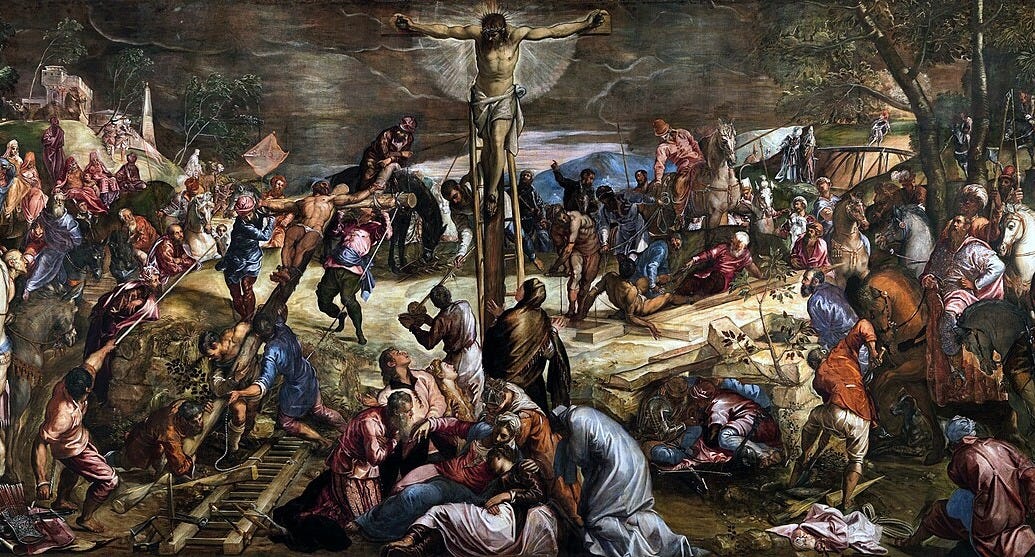
The Crucifixion
Our Lord’s Passion
Christ is crucified, He has mercy on the good thief, He dies on the Cross.
Passion of the Church
As the pinnacle of their destruction, the Modernists forbid the Catholic Mass of the Roman rite and introduce a counterfeit; they change the Words of Consecration, introduce sacrilegious communion in the hand, new tables of Luther with the priest turning his back to the Altar and the Blessed Sacrament. The faithful lose access to many graces and unquestionably valid Masses that confess the Catholic Faith. But just as with the good thief, even in such a time there are converts who accept the True Faith and are saved.
Further Explanation
That was the pinnacle of destruction because, just as with Christ’s death the thing most precious to His disciples was taken away from them - His sweet Presence – so too, in 1969, the Modernists took away that which was the most precious to the faithful – the True Mass, in which Christ is truly present and the faithful are nourished with His Most Holy Body and Blood, and with His heavenly doctrine.
The Burial of Christ
Our Lord’s Passion
Christ is placed in the sepulchre; the apostles are hiding from the Jews.
Passion of the Church
The Church appears as if in a sepulchre: most valid bishops have either defected or died, the rest are silent and hiding from the Modernists (and similarly with priests), most Catholics have defected, and those who have not are mostly in great ignorance about the Faith and often live like pagans; the True Faith and the True Mass are present in very few places…
Further Explanation
We are living the Good Friday (after Christ was placed in the sepulchre) and Holy Saturday of the Mystical Body of Christ. Though the Church cannot truly die, she has come as close as possible to death and interment. Most of her churches are empty or stages of desecrations and non-Catholic rites performed “upon the altar over against the altar of God” (super aram, quæ erat contra altare), a parallel to the desecration of the Temple by King Antiochus (1 Macc. 1:62).
With the false words of consecration used in Novus Ordo Masses, and with the doubtful validity of their ordinations, we wonder whether Our Lord is present there anymore. Those faithful to the True Mass and the True Church are not welcome there, and are forced to assemble mostly in previously secular places not intended for public worship, lamenting the loss of our churches and praying and hoping for a restoration.
The Resurrection
Our Lord’s Passion
Christ is risen in glory; the apostles gather and He appears to them, and after that He gives St. Peter the Papacy at Lake Tiberias.
Passion of the Church
A time of restoration, when a Pope will be elected either through the conversion of the current pretender, through a direct intervention from Heaven,4 or by all the bishops of the world who survive the devastation and persecutions mentioned in Catholic prophecies and, no longer afraid or deceived, provide the Church with the long-awaited Supreme Pontiff, who will restore the Church to an even greater glory than before.
Further Explanation
What can parallel the Resurrection of Christ after His Passion and interment but the Resurrection of His Mystical Body after its Passion and interment?
Commentary on the Resurrection of the Church
Some Traditional Catholics would not perhaps agree with the last parallel, the Restoration of the Church, because some believe that it will not occur before the End of the world, or that it will only occur after the defeat of the Antichrist.
It is easy to answer those who say the last. We know from the teaching of the Fathers that the time between the death of the Antichrist and the Last Judgment will be very short, measured in days or weeks, not years – which is not enough time for the Glorious Restoration from Catholic prophecy.
While we cannot provide definitive answers, we can draw parallels and try to ask the right questions.
During Our Lord’s Passion, almost all the apostles and disciples fled and hid. They forgot or doubted what He told them beforehand about His Resurrection on the third day. It must have seemed so incredible to them that one whom they saw humiliated, tortured and killed could rise from the grave. The situation seemed so utterly hopeless. They thought Death had won. Our Lady, however, knew the prophecies from the Old Testament and she firmly believed what Our Lord said would happen. And it did.
We were also told beforehand that the Church would be attacked and brought very close to destruction (e.g. in the apparitions of Our Lady of Good Success, and in the conversation that we are told Pope Leo XIII heard between Our Lord and Satan), but also that she would be restored and triumph over all of her enemies. Most of the successors of the apostles, as well as most of the faithful, left the Church or hid, and are still hiding. It seems so hopeless for the restoration of the Church. Should we believe that Death will win against the Mystical Body?
One might object that the Church will be restored after the end of the world. If someone told the apostles hiding on Holy Saturday that Christ will rise from the dead at the end of the world, they would certainly have had no problem accepting that, because faithful Jews believed in the Resurrection of the Dead on the last day. But Our Lord did not wait for eternity for His victory. Why should His Mystical Body have to wait for eternity?
Looking with the eyes of the world, after the death and burial of Christ, who appeared more foolish: the one who thought that Jesus of Nazareth was dead and buried, and his sect destroyed without hope of being restored, or the one who believed that Jesus would rise from the grave, and that that defeated Jewish sect would convert the whole Roman world?
Certainly the latter would have been called completely crazy. After all, who can rise from the grave? How could some minuscule marginal sect conquer the mighty Roman Empire? But it did.
And today, who seems more foolish in the eyes of the world: the one who thinks that the pre-Conciliar Church is dead and buried, never to return again, and that Traditional Catholics are a minuscule marginal sect that will never be able to do anything to change the world, or the one who believes the prophecies that the pre-Conciliar Church will not just be restored but be even more glorious than ever before, that it will convert the world, defeat all heresies and paganism, and that everyone will be a Traditional Catholic?
Those of us who believe the latter must seem so foolish to the world. But is that something we should care about?
“Hath not God made foolish the wisdom of this world? ... For the foolishness of God is wiser than men; and the weakness of God is stronger than men.
“... But the foolish things of the world hath God chosen, that he may confound the wise; and the weak things of the world hath God chosen, that he may confound the strong. And the base things of the world, and the things that are contemptible, hath God chosen, and things that are not, that he might bring to nought things that are: That no flesh should glory in his sight.” (1 Cor. 1)
To reject the Restoration, one must reject many Catholic prophecies, including the apparitions of Our Lady of Good Success, the prophecies of Bl. Anna Maria Taigi (whose body is incorrupt), St. Francis of Paola (also found incorrupt), St. Hildegard, St. Louis-Marie Grignion de Montfort, and many others. Would that not be excessive?
Could they have all made a mistake? Perhaps, but why should we think so without solid evidence to the contrary?
These questions seem especially important today, when many doubt the triumph of the Church, or despair at the length of her mystical Passion – thinking that perhaps with human means we might conquer, as if on Holy Saturday Our Lady or St. John might have tried to raise Christ themselves.
But He alone – the Alpha and the Omega, who laid down His life for us had the power to take it up again; and He alone who permitted His Mystical Body to undergo this painful Passion – has the power to give the Victory, through the intercession of Our Lady, to whom He has reserved the glory of destroying all heresies in the whole world.
May Her powerful intercession be with us all in these dark times, and may we all, regardless of the many views and opinions on the controversies of our times, keep always the bonds of unity in Christ as members of His Mystical Body.
Updated 20th May 2026 with three editor's interpolations marked as such and in square brackets and italics.
HELP KEEP THE WM REVIEW ONLINE WITH WM+!
As we expand The WM Review we would like to keep providing free articles for everyone.
Our work takes a lot of time and effort to produce. If you have benefitted from it please do consider supporting us financially.
A subscription gets you access to our exclusive WM+ material, and helps ensure that we can keep writing and sharing free material for all.
You can see what readers are saying over at our Testimonials page.
And you can visit The WM Review Shop for our ‘Lovely Mugs’ and more.
(We make our WM+ material freely available to clergy, priests and seminarians upon request. Please subscribe and reply to the email if this applies to you.)
Subscribe to WM+ now to make sure you always receive our material. Thank you!
Read Next: from John Lane:

Follow on Twitter, YouTube and Telegram:
Twitter (The WM Review)
Regarding the conclaves and Card. Siri:
https://en.wikipedia.org/wiki/Giuseppe_Siri_conspiracy_theory
From the collection of commentaries to the Gospel arranged by St. Thomas Aquinas, p. 926.
https://archive.org/stream/p3catenaaureacomm01thom#page/926/mode/2up
For example, Bl. Anna-Maria Taigi says that St. Peter and St. Paul will come down from Heaven and designate the new Pope.
Some reject this possibility, on the grounds that the Church is governed by law, rather than by divine intervention. Further, it is objected that such a divine intervention would a) constitute a new public revelation, which is impossible; b) destroy the visibility of the Church, if her head is selected by Heaven; c) break legitimate succession from St Peter, as the succession would not take place according to law or established custom.
These are serious objections. However, they would seem to be bypassed if a divine intervention were understood as a designation or indication of a man to be elected, and to be followed by the legitimate election/acceptance of this man by the Church, according to law or custom.

My thanks to Mr. Wright for publishing the article, and also for providing links to other articles where we can read more about a particular topic, as well as for his input and comments.
Even though I am not a theologian, I would like to try to offer a reply to the objections he wrote in footnote no. 4.
Objection: "Some reject this possibility [of St. Peter and St. Paul coming down from Heaven and designating the new Pope], on the grounds that the Church is governed by law, rather than by divine intervention."
Reply: Christ is the head of the Church and may choose His Vicar in what ever way He sees fit. After all, He chose St. Peter not by a vote, He personally gave him that authority.
Objection: "Further, it is objected that such a divine intervention would a) constitute a new public revelation, which is impossible"
Reply: An election of a new Pope is not a revelation of new doctrine, in the same way as the canonization of a new saint is not a revelation of new doctrine, but we are still bound to accept them both as dogmatic facts.
Objection: "... b) destroy the visibility of the Church, if her head is selected by Heaven"
Reply: The Pope is the Successor of St. Peter. Who would argue that St. Peter doesn't have the right to choose his successor, if Our Lord commands him to?
Objection: "... c) break legitimate succession from St Peter, as the succession would not take place according to law or established custom."
Reply: How could it break the succession from St. Peter, when he himself chooses his successor?
I agree that the adhesion of the Church to the Pontiff and all the bishops of the world confirming that election would give further certainty. Perhaps it is not by accident that Bl. Anna Maria Taigi uses the word "designate" instead of elect. But of course, if St. Peter himself designates his successor, which bishop would have the temerity not to confirm that in a formal election?
There is currently the temptation to see the Church as merely a human institution, and to despair of its ever returning to normality. Like the friends of Job, many want to ascribe the current crisis strictly as a punishment for the sins of Catholics, especially her clergy and religious; and neglect to see that all sufferings and crosses are sent by God as a means to purify and sanctify us.
As the reading in today's Gospel reminds us:
Jn. 15.
1 I am the true vine; and my Father is the husbandman 2 Every branch in me, that beareth not fruit, he will take away: and every one that beareth fruit, he will purge it, that it may bring forth more fruit.