
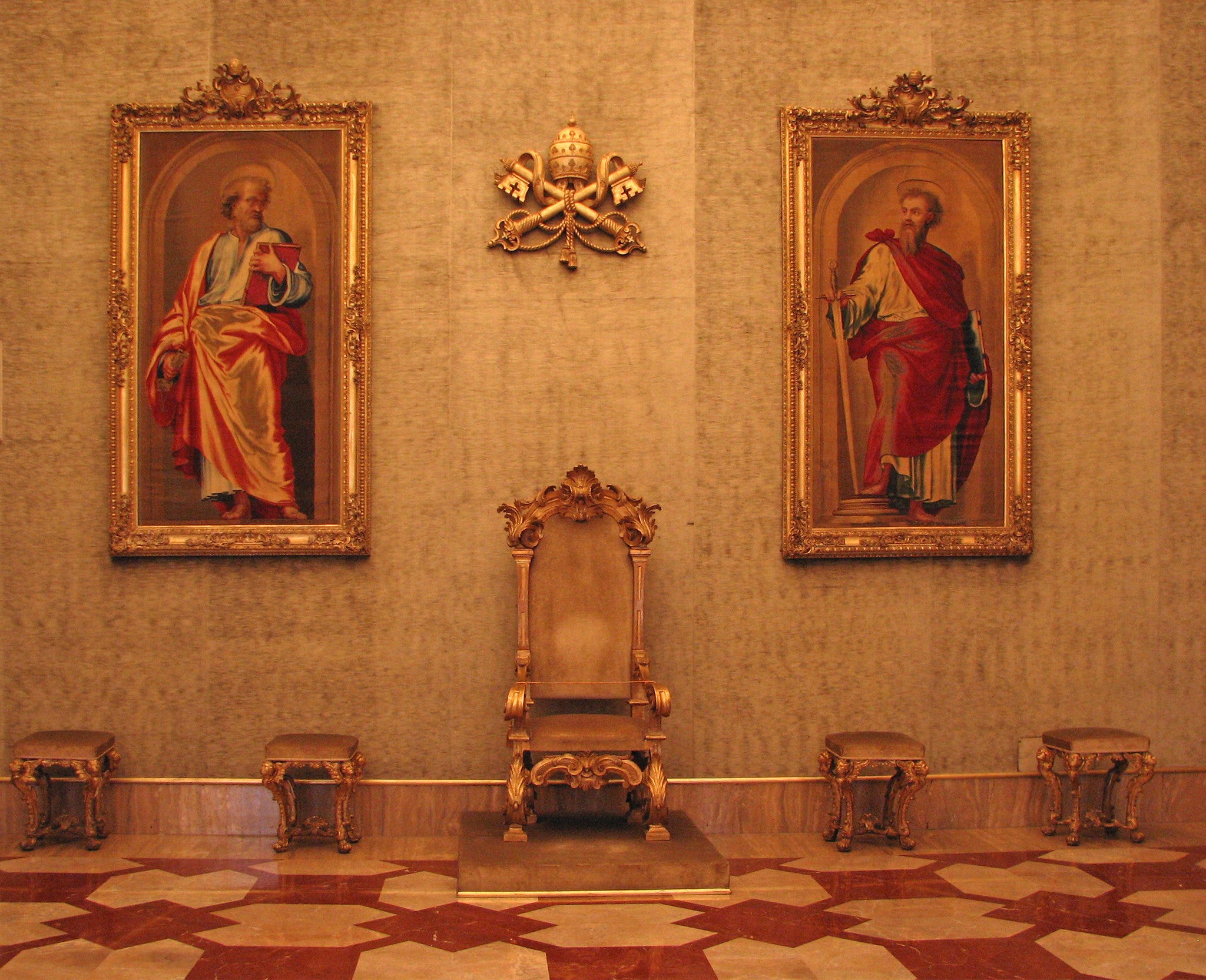
Fr Dominic Palmieri sets the grounds for a devastating refutation of the Gallican conception of the Papacy – and its descendants today.
Editor’s Notes
Fr Domenico Palmieri SJ was an Italian Jesuit theologian. Born in 1829, he was ordained a priest in 1852 and entered the Society of Jesus in the same year. As a Jesuit he taught a number of subjects, and spent sixteen years as a professor in the Roman College. He also held a position in the curia from 1893, and was one of the first opponents of the modernist Alfred Loisy. He also wrote a commentary on Dante Alighieri’s Divine Comedy.
Palmieri has recently been cited as an authority for the so-called “recognise and resist theology”, which holds (a) that a true Pope may teach error and even heresy, and promulgate universal disciplinary laws which are harmful to souls; and that in response, Catholics should (b) continue to recognise him as Pope, whilst (c) resisting his harmful teaching and universal laws. For instance, Palmieri wrote:
“In the event that the Pontiff behaves badly, unjustly inflicts harm, and persecutes the Church, it is permissible to resist the Pontiff.”
In this context, Palmieri cites St Robert Bellarmine; but, as we have discussed elsewhere, Bellarmine’s “resistance quotes” do not provide any grounds for the modern “recognise and resist theology”. Bellarmine himself cites both Cajetan and Torquemada, both whom make clear that their conception of “destroying the Church” excludes the teaching of error or promulgation of evil laws.
Palmieri’s theology also excludes such an interpretation. The extract below is the first half of Thesis XXX of his work on the Roman Pontiff, Tractatus de Romano Pontifice cum prolegomeno de Ecclesia. This extract amply demonstrates that Palmieri cannot be marshalled as an authority for this theology. In this first part, he explains how the See and the “Seated” occupant may be distinguished – and how they may not be distinguished. He proceeds to explain how and why the rights of the See are indeed the rights of the Seated, and then considers how a vacancy of the Holy See affects the preceding points.
All this is a preparation for the final point, which he summarises as follows:
“Therefore those men miserably deceive themselves who think that they can adhere to the Roman See and the Roman Church while resisting the Pontiff.”
His treatment of this final point will form the following part.
Let us proceed to the first part of Thesis XXX.
Tractatus de Romano Pontifice cum Prolegomeno de Ecclesia
Fr Dominico Palmieri SJ
Editio Altera Aucta Et In Nonnullis Emendata
Prati, 1891, pp. 704–709
Available at Archive.org
THESIS XXX
Every prerogative of the Roman See resides in the very person of the Roman Pontiff as in its subject; and therefore these prerogatives are most truly called personal, and the same prerogatives belong equally to each of Peter’s successors. Hence, although it is lawful in one respect to distinguish between the See and the Seated [inter sedem et sedentem], nevertheless such a distinction must be utterly rejected as false and absurd when it is directed to this end, namely, that the prerogatives and rights of the See should be different from the prerogatives and rights of those occupying it, and that the Roman See, or the whole series of the succession, should indeed enjoy the privilege of indefectibility or infallibility in faith, but not each individual successor of Peter separately.
Note that the distinction between the See and the Seated [the occupant of the See] can be applied to all the jurisdiction and rights of the Primacy. Nevertheless, it was devised in the question concerning infallibility, and therefore we speak of it here in that connection. Yet what we say on the occasion of this question can easily be adapted to the other prerogatives of the Primacy.
The following comments about are for WM+ members.
The WM Review is free for readers. This is because we believe these ideas must reach as many people as possible.
However, we also provide WM+ articles – additional material for those who choose to support this work financially.
This helps us continue producing serious Catholic research, while ensuring that the main body of material remains accessible for all.
If you want to ensure that this continues, join WM+ today.
(Clergy and seminarians can contact us for free membership.)