
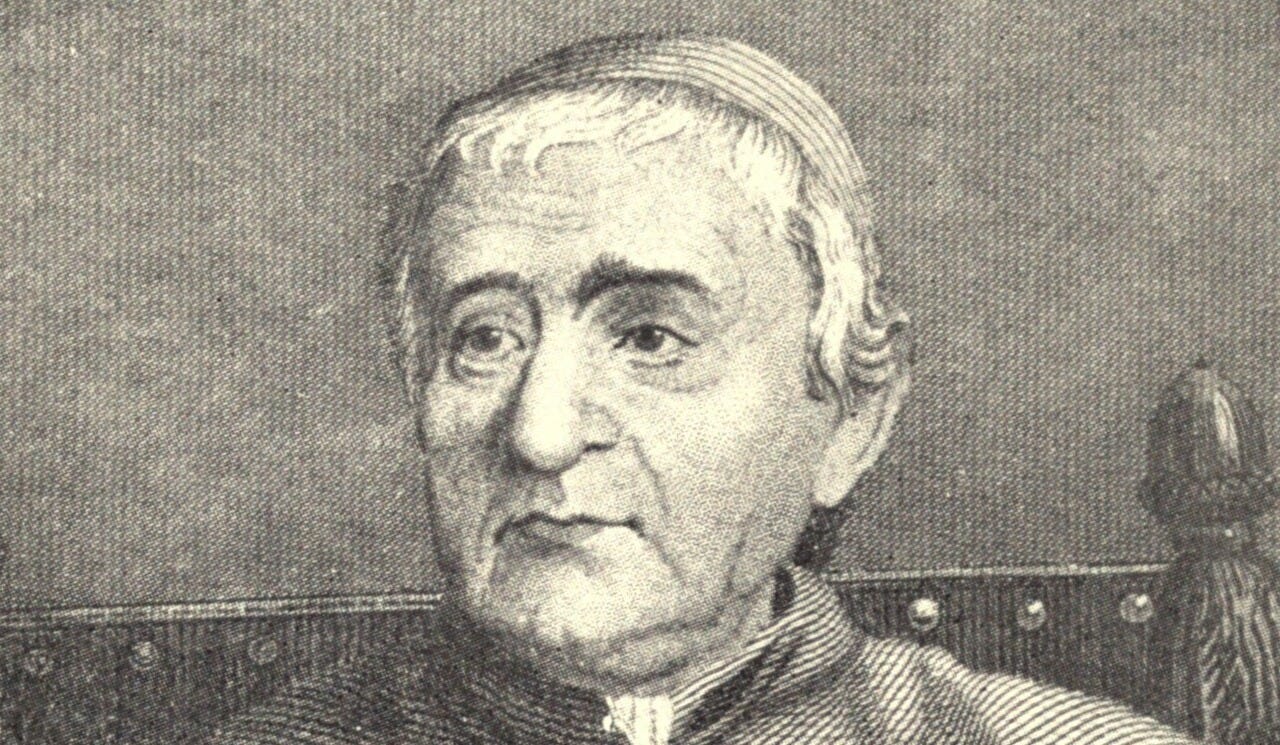
Fr Domenico Palmieri SJ explains that while the ‘merely authentic’ magisterium may theoretically teach error, its exercise was not to be publicly contradicted even if assent is suspended. Here’s why.
Editor’s Notes
This is another text in our series of extracts drawn from Fr Domenico Palmieri SJ’s Treatise on the Roman Pontiff.
This text is Scholion II of Thesis XXXII, which deals with the exercise of the “merely authentic” (viz. authoritative, but not definitive or infallible) Papal magisterium.
We have already seen that Fr Palmieri is cited as an authority for the “recognise and resist movement”, even though his references to such resistance pertain to matters other than teaching and governance,1 and even though he explicitly condemns those “who think that they can adhere to the Roman See and the Roman Church while resisting the Pontiff”, and holds that a Pope who obstinately falls into heresy is “stripped of jurisdiction by God.”
The merely authentic magisterium
Elsewhere in his work, Fr Palmieri writes:
“[I]t is the right and office of the Roman Pontiff to feed all: and the obligation of all is to follow him and obey him.”2
While he was speaking here in the context of his teaching with the highest authority, he was also speaking in general terms – pointing to the merely authentic exercise of the magisterium.
The topic of the merely authentic magisterium is important, because it is precisely to this exercise of the magisterium that the advocates of the “recognise and resist theology” point. It is claimed that the problems that have arisen since Vatican II all pertain to such non-infallible acts, and thus they may be resisted.
However, the problems in need of explanation do not pertain to the “merely authentic” magisterium at all. For example, Dignitatis Humanae’s erroneous doctrine of religious liberty is presented in language indicative of an infallible definition; the Novus Ordo missal and certain provisions of Amoris Laetitia appear to be examples of universal disciplinary laws (whose infallibility is beyond question, being taught by the Church’s magisterium and theologians alike). Papal canonisations are themselves a kind of ex cathedra exercise and are also considered to fall under the secondary object of infallibility.
That said, Fr Palmieri makes clear that, the merely authentic exercise of the Papal magisterium is owed both “a respectful silence” and also “religious assent” – both of which are explained in the text. He also provides an explanation of the relationship between religious assent and the assent of faith, distinguishing both and showing how they are related.
Even though he recognises the possibility of error in a merely authentic teaching act, and thus the possibility of “suspending assent”, he also completely rules out the Pope being “publicly contradicted” or “the opposite doctrine to be defended” – “unless”, he adds, “it is established that he himself permits that the matter be disputed among Catholics.” This is certainly not the case for the problematic teachings that have been promulgated since Vatican II – as the treatment of those who reject them makes clear.
In the actual event of someone believing that they have discovered an error in the merely authentic papal magisterium, the correct response is to have recourse to Rome. Fr Anton Straub’s explains his view of the proper line of conduct in such an event:
“However, it can happen per accidens that either immediately or over time, it becomes apparent to someone that a decree is either certainly false, or contrary to a reasoning so solid, or at least unknown and not yet decided by the makers of the decree, that even the weight of sacred authority does not nullify the force of this reasoning.
“Now, since it is a rational obedience which is demanded, if the former occurs, it will be permitted to dissent; but if the latter, it will be permitted either, by suspending assent, to doubt or even to consider the opinion differing from the sacred decree as probable.
“Yet, out of reverence for the sacred authority (and especially to the supreme pontiff himself), it will not be right to contradict such a decree publicly, unless perhaps the sacred power itself permits this to be brought to a greater light for a question not yet definitively decided. On the contrary, silence (which some call ‘obediential’) must be maintained, or the difficulty must be modestly set forth before the sacred tribunal, or recourse must be had to a higher tribunal and infallible judgment.
“However, such mistakes in sacred decrees are very rarely found, and the exception itself of an error committed by the Roman congregations in the case of Galileo strongly confirms the rule. Hence, let each one take care not to deceive himself freely with a preoccupation for his own opinion, knowing that he must render a strict account to the Lord, the searcher of hearts.”3
Salaverri mentions that Fr Réginald Schultes OP held the same opinion (n. 675).
Note that we are here discussing conduct with regards to (a) the possibility of (b) isolated errors that appear (c) per accidens in acts of the (d) merely authentic magisterium. We are not discussing (a’) the reality of (b’) habitual error that is (c’) substantial (in the sense that it pertains directly to the objects taught) in (d’) definitive acts of the papal or conciliar magisterium, or to evil universal disciplinary laws. Certain “recognise and resist” apologists attempt to conflate these categories into “non-infallible teaching”, and apply to this conflation comments about resisting the Pope in altogether different circumstances. This is unwarranted in the extreme.
If one wishes to justify a “recognise and resist theology” with what these theologians have said about merely authentic acts of the magisterium not being infallible, it does not seem fitting to disregard what they say about public contradiction. But for an account of why the former category calls for the conduct described by Palmieri, and why the latter calls for a recognition that the putative Pope lacks authority, see Mgr Guérard des Lauriers OP here:
‘The Right of Scrutiny’ and the drawing of consequences – Fr Guérard des Lauriers OP
Miscellaneous interest
Fr Palmieri’s text also makes clear that it is a mistake to describe, as Professor Roberto de Mattei suggests, the Roman Pontiff as a “private doctor” unless he is issuing a solemn definition.4 He writes:
“In such a case it is not accurate to say that he speaks as a private teacher (doctor privatus); for although he does not speak from the fullness of his authority, he does speak with authority.
“Wherefore a Roman Pontiff speaking in this manner is not to be relegated to the rank of any private doctor possessing no authority.”
Fr Palmieri refers in passing to Pope Celestine III’s decision “in the case of the dissolution of marriage on account of the heresy of a spouse”. This is interesting, because this case has itself been raised as a precedent for the “Recognise and Resist theology” on the grounds that it is allegedly an example of “errors in non-infallible cases.”
One expression of the argument explains that Pope Celestine’s decretal letter “had normative value for similar cases”, and so has a significance beyond a simple marriage decision; it was in turn set right by Pope Innocent III who ruled in the opposite direction, and by Pope Gregory IX who “censured” the decretal. Both Bellarmine and Cajetan recognised that it was not an infallible teaching, and yet – we are told – it conveyed an error regarding the validity of a sacarament, which essentially authorised a permanent state of adultery.
From this, we are supposed to conclude that a legitimate Pope can indeed promulgate evil laws and false teaching whilst retaining authority, and that this was an example in which public resistance to the Roman Pontiff was legitimate.
However, Fr Palmieri’s pithy comment draws almost the opposite conclusion, stating:
“[Such a case] proves only the exception which we have posited – namely, that an assent of metaphysical certitude is not owed.”5
In other words, all this incident proves is what is already admitted: that the merely authentic magisterium calls for an assent of moral certitude; it does not prove that public contradiction or organised resistance is justified – the comments about “resisting a Pope destroying the Church” dealing with completely different circumstances.6 This is especially the case when we consult the rest of the text in question (which is below), as well as the other texts which we have published.
In addition, we should note that a decision in a particular marriage case is not comparable with the exercise of the papal magisterium or with universal disciplinary laws.7 It offers no proof at all for the “recognise and resist theology” in question.
The late Fr Anthony Cekada also addressed this topic here:
‘Infallible safety’
Finally, it is notable that Fr Palmieri’s text does not mention the theory of the “infallible safety” of the merely authentic magisterium – that is, that while the merely authentic exercise of the magisterium is not assisted with the charism of infallibility with regard to truth, and so may in principle err, it nonetheless cannot teach any error which is dangerous.
While universal disciplinary laws can indeed be described as “infallibly safe” (as already mentioned), and while the theory in question is commonly accepted by “sedevacantists” today (and has been adopted by some Novus Ordo conservatives), some of its difficulties have been considered here:
The same topic is dealt with in the following articles – which also make no mention of this particular theory, presenting the basis of our assent in the moral certainty of truth, rather than the impossibility of harmful error:
What kind of assent is owed to the different papal statements? Fr Anton Straub SJ
The Force of Encyclicals in Light of “Humani Generis” – Salaverri, 19528
This is not to deny that something like this theory may be true, but rather to point out that the way it is presented and “proved” is often wanting – as is shown by the silence of those who treat the topic.
However, even if the theory were wholly false, and the “merely authentic” magisterium could indeed include a harmful doctrinal error, it does not follow that it is possible for it to do so habitually, as is clearly the case for the last sixty years. Fr Francesco Ricossa, whilst rejecting as unfounded (both in doctrine and in history) the idea that the papal magisterium may contain error, notes the following:
“Except for the case of extraordinary Magisterium, it is not impossible that by a single act, the Authority can carry some defects. It is impossible, on the contrary, that the Authority which forms a single thing with Christ would not guarantee the Good of the Church habitually.”10
With this established, here is the text.
You can read more about Fr Palmieri here.
Tractatus de Romano Pontifice cum Prolegomeno de Ecclesia
Fr Dominico Palmieri SJ
Editio Altera Aucta Et In Nonnullis Emendata
Prati, 1891, pp. 704–709
Available at Archive.org
The See and the Seated: Fr Dominic Palmieri SJ against Gallican theology of the Papacy
‘Stripped of jurisdiction by God’ – Fr Palmieri SJ on the Pope Question
The Pope is ‘not to be publicly contradicted’ – Fr Palmieri on the non-infallible magisterium
Can the Pope teach ex cathedra in a letter to a single bishop? Fr Palmieri explains
Do we need an infallible list of infallible propositions? Fr Palmieri responds
The following text is for WM+ members.
The WM Review is free for readers. This is because we believe these ideas must reach as many people as possible.
However, we also provide WM+ articles – additional material for those who choose to support this work financially.
This helps us continue producing serious Catholic research, while ensuring that the main body of material remains accessible for all.