
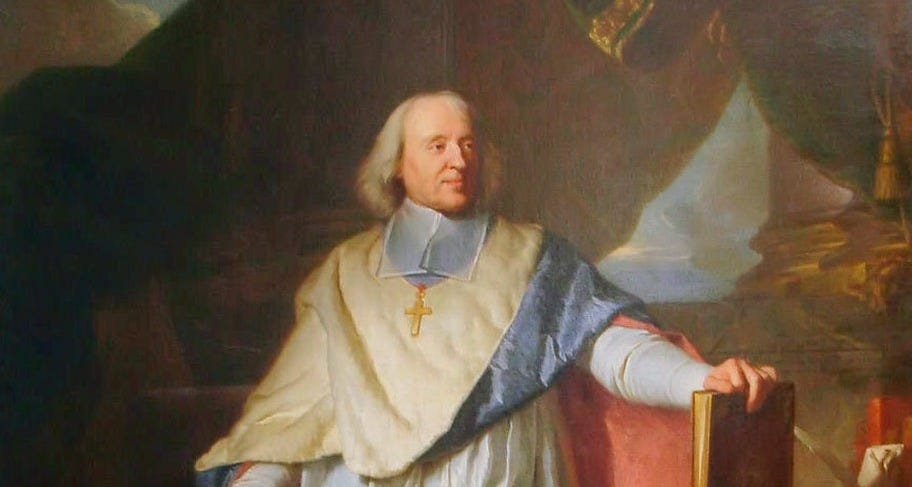
Fr Domenico Palmieri SJ directly refutes the ‘recognise and resist’ ecclesiology of the Gallicans.
Editor’s Notes
This is the second half of Fr Domenico Palmieri SJ’s Treatise on the Roman Pontiff, Thesis XXX. In this chapter, the Jesuit theologian refutes aspects of the Gallicanist theology of the Papacy.
As is clear from his treatment, this theology has much in common with the principles behind what is today called the “recognise and resist” movement. This movement holds (a) that a true Pope may teach error and even heresy, and promulgate universal disciplinary laws which are harmful to souls; and that in response, Catholics should (b) continue to recognise him as Pope, whilst (c) resisting his harmful teaching and universal laws. Fr Palmieri himself has been cited in support of this movement's ecclesiology.
In the first half, Fr Palmieri explained how the See and the “Seated” occupant may be distinguished – and how they may not be distinguished. He proceeds to explain how and why the rights of the See are indeed the rights of the Seated, and then considers how a vacancy of the Holy See affects the preceding points.
In this part, however, he takes direct aim at the Gallicans conception of the papacy, and explicitly rejects the idea of resisting the Roman Pontiff in the exercise of his teaching and governing authority.
Nor can his comments be limited to infallible ex cathedra definitions: although he does address this matter, his treatment refers to the immunity of the Roman See from all error. Referring to the Patristic texts from Pope Hormisdas and others, he asks:
“But if holy doctrine is always celebrated in that See, how can error at times creep in?”
This matter is also addressed in our long study Spotless and Unsullied:
He answers his own question by stating the Gallican concept of the Papacy as entailing “that the institution of Christ would be wholly perverted and rendered vain.” He also described a Papacy, as the Gallican hypothesis conceived it, as being “altogether inept and unworthy of God” – and contributing nothing to the Church.
As such, it is clear: Palmieri cannot be marshalled as an authority for the “recognise and resist” ecclesiology. In fact, he himself not only recognised an earlier form of it in his day: he also resisted it in the strongest terms.
You can read more about Fr Palmieri here.
Tractatus de Romano Pontifice cum Prolegomeno de Ecclesia
Fr Dominico Palmieri SJ
Editio Altera Aucta Et In Nonnullis Emendata
Prati, 1891, pp. 704–709
Available at Archive.org
THESIS XXX: Corollary
Recap of the Thesis Statement:
Every prerogative of the Roman See resides in the very person of the Roman Pontiff as in its subject; and therefore these prerogatives are most truly called personal, and the same prerogatives belong equally to each of Peter’s successors. Hence, although it is lawful in one respect to distinguish between the See and the Seated [inter sedem et sedentem], nevertheless such a distinction must be utterly rejected as false and absurd when it is directed to this end, namely, that the prerogatives and rights of the See should be different from the prerogatives and rights of those occupying it, and that the Roman See, or the whole series of the succession, should indeed enjoy the privilege of indefectibility or infallibility in faith, but not each individual successor of Peter separately.
Corollary: Therefore those men miserably deceive themselves who think that they can adhere to the Roman See and the Roman Church while resisting the Pontiff.
The infallibility of every individual Pope
IV. Now the second point must be proved, namely, that the individual Pontiffs are infallible.
Bossuet (Defensio, l. 10. c. 5.) teaches that although certain Pontiffs may not preach the true faith, but may err in it, nevertheless the faith of the Roman See remains invariable. For the defect of one Pontiff will either be repaired by the same Pontiff himself or by his successor. He therefore wishes the whole succession of the Roman Pontiffs to be considered as though together constituting the person of Peter, whose faith shall never totally fail. This faith can waver and at times fail in some particular Pontiff, just as, according to him, it failed in Peter when he denied Christ; but shortly afterwards it shall be restored, so that error cannot strike roots in this succession.
Thus the whole series is indefectible in faith, but not each one of the successors. Cardinal de Luzerne says:
“An infallible authority is one which can never err, even for one moment, in decisions of faith. Indefectibility of faith consists in this, that the faith cannot wholly perish; but if at some time it fails, it is promptly restored: so that if some Pope professes or teaches error, shortly afterwards the error may be corrected either by himself or by his successor.” (part 2. c. 2.)
But what sort of indefectibility is this? Is it properly infallibility? Those who claim the privilege of infallibility only for the universal Church or for a Council, as Bossuet does, must also teach that the indefectibility of the Roman See consists in this, that it indefectibly holds the faith which the Church teaches; but therefore not by teaching, but by learning: namely, that its infallibility is not active, but only passive, as Tournely says in the cited place. Certain men, however, seem to understand active indefectibility in such a way that, as we have just said, they concede infallibility to the See, but not to the one occupying it; they are perhaps not far from this interpretation (cf. Mourray, De Ecclesia, disp. 20. sect. 3. § 3.). For it must be recalled that distinctions of this sort arose from polemical controversy and were devised by all these men in order to meet the arguments of the Roman theologians, and therefore were adjusted according to necessity.
But in fact, the true doctrine entails much more…
The following comments are for WM+ members.
The WM Review is free for readers. This is because we believe these ideas must reach as many people as possible.
However, we also provide WM+ articles – additional material for those who choose to support this work financially.
This helps us continue producing serious Catholic research, while ensuring that the main body of material remains accessible for all.