

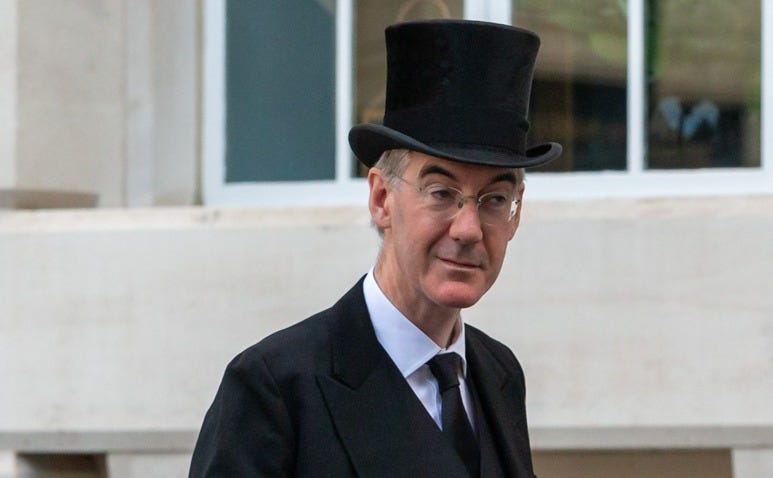
But is Sir Jacob Rees-Mogg the ‘Catholic hero’ for which many take him?
Introduction
“The way of peace they have not known: there is no fear of God before their eyes.”
— Ps. 13.3
Over the last few days, the UK mainstream media has been pointing towards imminent war with Russia.
On 21 September, Sky began its new series The Wargame, which features a “cabinet” of high-ranking former politicians from across the political parties, simulating a Russian attack on the UK.
At the same time, Sir Jacob Rees-Mogg – former Member of Parliament for the Conservative Party, and leader of the House of Commons – has been discussing the need for the people of the United Kingdom to “join the armed services”, to “do their duty”, and “to face circumstances in which people have to die… to save their country, as they did in the first and second world wars, and in many other wars before and since.”

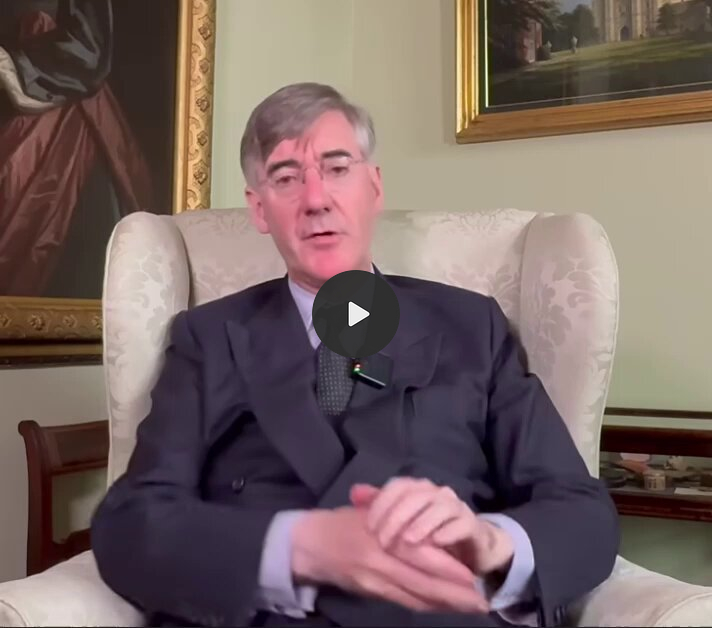
“That is something that makes a country survive,” he said. “If people are not willing to do their duty, then the country will be taken over by another country, ultimately, one way or another.”
Catholic commentator Connor Tomlinson noted the irony of such rhetoric in the face of the wave of migrants illegally entering the UK on small boats and super-dinghies, and being given accommodation at the taxpayers’ expense.


Other commenters posted Shrek memes, and speculating whether Rees-Mogg's own children would be drafted.


The same rhetoric has continued on his show Jacob Rees-Mogg’s State of the Nation, featured on the “conservative” television channel GB News. On the 21 September show, he gave a platform to former Labour advisor Paul Richards, who said:
“I think the British people would rise to greatness if they had to. We would have to lock a few people up, by the way: some of the pro-Russian voices, people who say there isn’t a threat, don’t fight for your country, don’t go to war for [Andrew] Burnham [our sixth prime minister in 10 years] – we’ll have to lock ‘em up.”
Rees-Mogg’s response to Richards was effectively to agree:
“Well, we suspended habeas corpus under the Napoleonic wars.”
The exchange was as follows:
Richards: Well, and under the Defence of the Realm Act.
Rees-Mogg: Indeed.
Richards: So, we would have to go to those measures. And we would have to look at things like conscription as well, to get the numbers up.

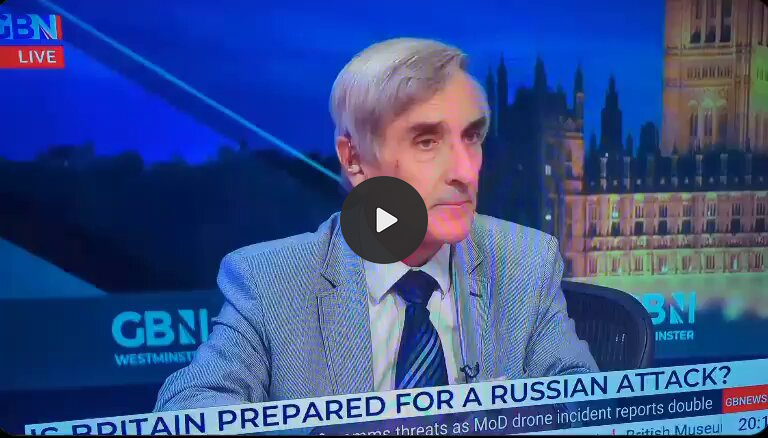
Richards was a founder of the radical and progressive Labour political organisation Progress. He is also the treasurer and a former national Chair for the Fabian Society.
It is also notable that this clip has been removed from the video of the show available on the GB News YouTube channel.1
Why should we care about Rees-Mogg at all?
Regarding Rees-Mogg: a television pundit, or even a politician, engaging such rhetoric would be of little interest to The WM Review and our readers, if it were not for the fact that Sir Jacob enjoys a reputation as a kind of “super Catholic” in British public life.
He is regularly criticised by the left-wing press for his “pro-life views”. He has also spoken out against same-sex marriage. He has been known to refer to Pope Pius IX in his speeches at the House of Commons, attends the Traditional Latin Mass. He has a cultivated persona as “The Honorable Member for the Eighteenth Century”, and has even spoken condescendingly about men changing their babies’ nappies (“diapers”, in the language of many of our readers).
In short, liberals consider him to be their worst nightmare. Because of this, some Catholics consider him to be a dream come true. However, “the enemy of my enemy is not necessarily my friend” – and in fact, when it comes to the Catholic faith and to moral issues, Rees-Mogg the apotheosis of superficiality and unseriousness.
While it is normally best to ignore such persons, such warmongering makes it necessary to explain why his “Catholic credentials” are a simply a veneer for the same liberalism that infects his fellow politicians. Other writers will be able to evaluate the necessity (or otherwise) of war with given nations; but whether the United Kingdom goes to war or not, Sir Jacob Rees-Mogg cannot be allowed to use a veneer of traditionalism in support of it.
Rees-Mogg and ‘the most Christian Prime minister in 50 years’
In 2016, Rees-Mogg described David Cameron as “the most Christian prime minister in 50 years.”
David Cameron was responsible for introducing “same-sex marriage” in 2013. Daniel Blackman summarised the matter:
“The UK’s coalition government, under Cameron, passed its same-sex marriage act in February 2013, by 400 votes to 175. ‘I believe we’ve made great steps … enabling those who love each other to get married whatever their sexuality,” Cameron said. Opponents of the act were branded bigots, homophobes, hate-filled, and ‘anti-love’.”
In 2012, Cameron delivered a speech at Melinda Gates’ London Summit on Family Planning, at which he advocated wider availability of contraception as a means of fighting poverty and “inequality.”
In 2008, he stated that he was in favour of the existing law that permitted the abortion of disabled babies up until birth. He also wrote to the UK’s Society for the Protection of Unborn Children (SPUC), stating that he considered “proposals for wider access to abortion as “practical and sensible.’”
As such, it is legitimate to ask whether Rees-Mogg’s comment says more about his own Christianity than Cameron’s.
Blackman recounts the context of this comment – which was an event at which I was also present:
“He was speaking at the London [Brompton] Oratory, South Kensington, to a gathering of young conservatives and Catholics in their 20s and 30s.
“When asked about his thoughts on Cameron’s same-sex marriage act, Rees-Mogg said: ‘It’s really hard for MPs because they get criticised for not standing by what they believe. Yet when David Cameron put forward his same-sex marriage plans he got criticised a lot, so it’s really hard, he really believed in it.’ […]
“‘I’m a Catholic, and I greatly value the Church’s sacrament of marriage. I voted against same-sex marriage, but I’m happy as long as the Catholic sacrament is left alone. The government is free to legislate and do as it pleases with secular legal marriage; however the legal arrangements are decided.’
“When challenged by members of the shocked audience, Rees-Mogg resorted to anecdotes about how happy he was to have a Catholic marriage, and repeated that the government had the job of legislating marriage. It was for the government to decide how marriage was arranged in secular, civil society.”
Blackman called it “a baffling and somewhat intense moment”, and explained why Catholics cannot accept the privatisation of “the Catholic sacrament” of marriage, or the idea that civil authorities are “free to legislate and do as it pleases with secular legal marriage”. On the contrary, marriage is a natural institution and Governments are obliged to respect the nature of things in their legislation.
At the same talk, Mogg opined that it was good that society had decided not to legislate for Christian morality, because this made it more meritorious for those who try to be virtuous. This is contrary both to common sense, and to the stated arguments in the various acts of the magisterium on the issue. The law has a normative force on the morality of society, and that which is permitted and forbidden necessarily has an effect on the conception of what is right and wrong.
Such is the teaching of the Popes to whom Rees-Mogg referred throughout his talk, as Blackman states:
“During his talk, Rees-Mogg quoted liberally from pre-Vatican II popes. Yet these same popes condemned the positions Rees-Mogg favoured in his talk.
“For example, Blessed Pope Pius IX, in his Syllabus of Errors, condemned the idea that ‘The State, as being the origin and source of all rights, is endowed with a certain right not circumscribed by any limits,’ and the error that ‘The Church ought to be separated from the State, and the State from the Church.’
“In an earlier interview, Rees-Mogg said: ‘My great hero is probably Pius IX, because of his traditional view of the state and the Church and his Syllabus of Errors was a clear view.’
“A fellow member of the audience suggested privately that Rees-Mogg was ‘a child of Vatican II, bereft of authentic Catholic formation because of these changes ushered in following the council.’ Whatever the case, it is hard to reconcile Rees-Mogg’s apparent familiarity with traditional Catholic teaching with his public comments.”
Blackman also reported other words from Rees-Mogg on the same issue:
“In another interview, Rees-Mogg was asked how same-sex marriage might impact Catholic school teachers, pupils and their families. He replied: ‘I think this is going to be a matter for the leadership of the Church. Are they willing to take a strong view on what they believe is right? Or are they going to go along with secularism?’”
It is difficult to know what this is supposed to mean, and whether Rees-Mogg – who started his career at J Rothschild Investment Management, and has an estimated net worth of £100 million – really understood the subject at hand, or what was at stake for the “Catholic school teachers, pupils and their families” mentioned.
Rees-Mogg and ‘the most naturally freedom-loving prime minister’
In November 2020, Rees-Mogg referred to then-Prime Minister Boris Johnson as “the most naturally freedom-loving prime minister we could think of having.”
What made this most ironic is that these comments were made during the COVID–19 debacle, in which Boris Johnson was responsible for the UK’s lockdowns (which he famously flouted – with the “Partygate” scandal being a factor in Johnson stepping down as Prime Minister and MP).
Rees-Mogg’s comments came a few days after the 31 October 2020 announcement that – after a period in a regional “tier” system, in which restrictions were based on the number of alleged cases – England would go back into lockdown for a month (subject to a vote by Parliament on 4 November).
(During this tier system, Rees-Mogg was accused of “hypocrisy” for “ignoring government guidance” by travelling from his home in a lower tier, in order to attend a Traditional Latin Mass in a higher tier. The guidance stated that “you should stay local and avoid travelling outside of your local area”. The reason for the charge of “hypocrisy” was that Rees-Mogg was himself a part of the Government that had imposed the restrictions.)
But Rees-Mogg was not just defending Johnson’s measures in November 2020: he himself voted for them in Parliament – in spite of the inclusion of yet more draconian restrictions against the Church, and significant fines imposed on those who violated them.
The restrictions for that lockdown included the following:
5. Weddings, civil partnerships, religious services and funerals
Funerals can be attended by a maximum of 30 people, and it is advised that only close friends and family attend. Linked ceremonial events such as stone settings and ash scatterings can also continue with up to 15 people in attendance. Anyone working is not included. Social distancing should be maintained between people who do not live together or share a support bubble.
Weddings, civil partnership ceremonies will not be permitted to take place except in exceptional circumstances.
Places of Worship will be closed, unless they are being used for:
Funerals
To broadcast acts of worship
Individual prayer
Formal childcare or where part of a school
Essential voluntary and public services, such as blood donation or food banks
Other exempted activities such as some support groups
These restrictions permitted churches to remain open for “private prayer”, so long as this did not “form part of communal worship”. Those organising communal worship faced fines of up to £10,000. Paul Smeaton reported at the time:
“This past weekend, the first weekend since the regulations were approved by politicians, police entered at least one Catholic church in England on the suspicion that a supposed transgression was taking place. […]
“A November 10 police report states that one organizer of a religious event in London is already being considered by the police for the maximum fine.”
At the time, Smeaton sent Rees-Mogg a request for comment, which contained the following:
On Wednesday November 4th 2020 you voted for a second lockdown which, among other appalling restrictions on the English people, suppressed public religious services. In doing so you formally co-operated in Parliament suppressing the Holy Sacrifice of the Mass for the first time since the Catholic Relief Act. You voted to impose fines on those who disobey these new laws. Already there have been reports of police entering Catholic churches to check whether “communal services” are being conducted.
You must know that St Thomas Becket was martyred for the principle of the liberty of the Catholic Church from civil interference.
You have claimed to admire Pope Pius IX, particularly for “his traditional view of the state and the Church” and the Syllabus of Errors. You must know then of the 44th condemned error, which reads: “The civil authority may interfere in matters relating to religion, morality and spiritual government.”
And further, you must also know that this principle is enshrined in English law by Magna Carta, which states that “the Church of England shall be free, and shall have all her whole Rights and Liberties inviolable.”
How then can you, a Catholic and an Englishman, vote for such a law? You should have voted against the bill on these grounds alone. What bargain or promise of future reconsideration of the restrictions could justify such an act?
You should have preferred to resign, or indeed to suffer anything, rather than embrace the ignominy of voting for that bill.
I urge you to consider that such a public betrayal of the Church and your co-religionists is a scandal that requires a similarly public act of repentance.
I would be grateful if you could reply to my email with answers to my questions by 5pm Thursday 12 November, after which we will publish our article.
Rees-Mogg did not reply. Smeaton’s article concluded with the following observation:
“These are without doubt strange and difficult times for us all. The greatest consolation any of us can have is recourse to the Mass and the sacraments. Thanks to Rees-Mogg and his colleagues, the government is now attempting to deny these to the faithful in England. So with friends such as him, who needs enemies?”
However, between the email being sent and the article being published, Rees-Mogg did deliver a short discourse in the House of Commons on 11 November 2020, on the traditional doctrine of the Church on the relations between ecclesiastical and civil authority. He was asked a straightforward question on the closing of places of worship by fellow Conservative MP Christian Wakeford:
“Throughout the pandemic, places of worship have helped to maintain social cohesion. They have mitigated the impact on the mental health of worshippers, and, more importantly, have been a sign of hope. Churches, Islamic centres and synagogues across Radcliffe, Whitefield and Prestwich have gone above and beyond to become covid-safe environments.
“Will my right hon. Friend, as a man of faith himself, join me in commending their efforts to protect the health and wellbeing of worshippers, and will he look to undertake an urgent review of places of worship so that they can continue to provide these most vital of services during these difficult times?”
To the visible bewilderment of Wakeford, Rees-Mogg responded with the following:
“The relationship between Church and state is one that sometimes proves rather difficult. Who can forget 29 December 1170, when Thomas à Becket was murdered in his own cathedral by the agents of the state sent by Henry II? The relationship between Church and state has not always been smooth. It was a great matter for discussion by medieval scholars, who concentrated on Luke 22:38: ‘there are two swords’.
“The question is which sword is superior – the spiritual sword or the temporal sword. The temporal authorities often think that the temporal sword is the superior sword. The ecclesiastical authorities were very happy to argue with that, and Pope Boniface VIII put it at its highest level in his 1302 papal bull ‘Unam Sanctam’, which claimed that all secular authorities were secondary to the spiritual authorities. We have seen this argument rage over the centuries, with greater powers taken by the state and then freedom of religion reasserting itself.
“My hon. Friend raises a point of fundamental importance, but the hope that we may all take – the reassurance that those of us who have faith may be certain of – is that the highest authority is unquestionably immortal, invisible and only wise, and even outside the control of the House of Commons.”

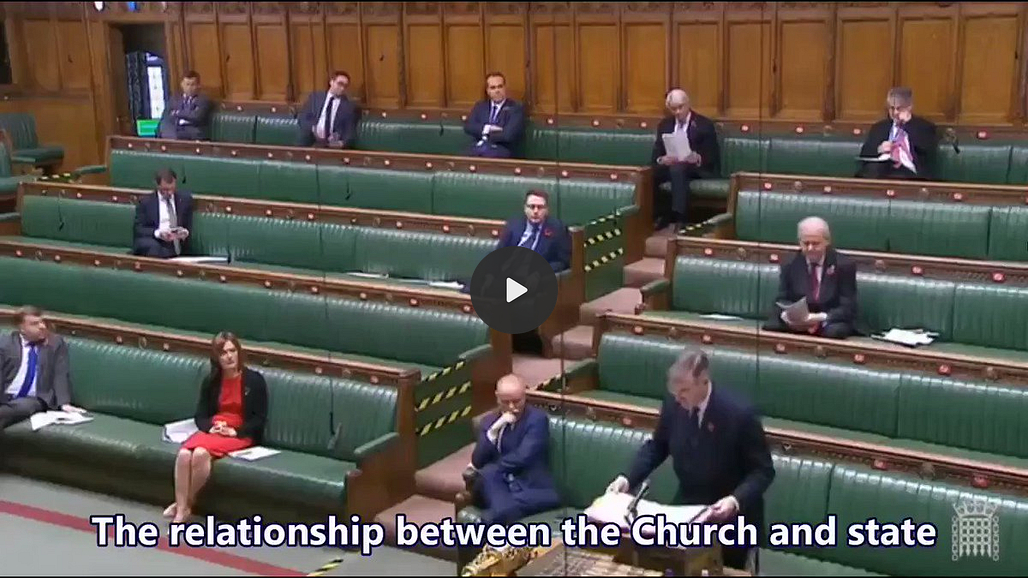
The speech was indeed bewildering, in that Rees-Mogg himself had played a role in violating what he was affirming, only a few days before. His general thrust seemed to be that God’s authority is so superior to man’s, that it does not really matter if man tramples over it.
Can. 1372 of the 1983 Code of Canon Law states:
The following are to be punished according to the provision of can. 1336 §§ 2-4:
1° those who hinder the freedom of the ministry or the exercise of ecclesiastical power, or the lawful use of sacred things or ecclesiastical goods, or who intimidate one who has exercised ecclesiastical power or ministry […]
Can. 2334 of the 1917 Code of Canon Law is clearer and stricter:
They are struck with an automatic excommunication specially reserved to the Apostolic See, who:
1.° Issue laws, mandates, or decrees contrary to the liberty or rights of the Church […]
Whichever Code one believes to be in force, both canons represent the mind of the Church.
Rees-Mogg and the COVID vaccinations
On the subject of COVID, Boris Johnson also presided over the rollout of the COVID “vaccines” during the same period. In December 2021, he declared that there would need to be a “national conversation” about mandatory vaccination in order to increase take-up nationally, and hinted that general COVID restrictions were still in place “just because a substantial proportion of the population still sadly has not got vaccinated.” However, Russia invaded Ukraine in February 2022, and the “national conversation” desired by the man Rees-Mogg “the most naturally freedom-loving prime minister” never took place.
In December 2020, Rees-Mogg was bragging in Parliament about how Brexit had enabled the UK to approve the COVID vaccinations more quickly than they would have done in the EU:
As regards Brexit and the vaccine, the UK should be really proud that our regulator got in first. We notice that the European regulator is a bit sniffy about it, wishes we had not done it, and that Germany and France and other European countries have not managed to do the same thing. We have, we are leaving – draw your own conclusions, Mr Speaker, as I am sure the British public will. We are now free of the dead hand of the European Union and will be even more free of it on 1 January. This is a huge British success that we should be proud of and pleased about.
In May 2024, he spoke negatively about what he called the “coercion” to take the vaccines at the time. However, he also stated that he considered the vaccine rollout to have been “the right decision” and that it “saved many lives” – despite acknowledging the lack of “long-term data” and that they “were not as efective as we first hoped.”
In the same video, he also condemned “conspiracy theories” and “conspiracy theorists” for because they are “negative, and it lowers trust in society.”
Rees-Mogg and the ‘pro-life movement’
Rees-Mogg has taken abuse over the years for a firm anti-abortion stance. According to UK parliamentary voting record site They Work For You, Rees-Mogg has “almost always” voted against increasing access to abortion.
(Intriguingly, the same site reports that he “consistently voted for [100%] mass surveillance of people’s communications and activities”.)
He has also been an outspoken supporter of the anti-abortion movement in the media. However, at times his stated reasoning has been so problematic as to undermine the anti-abortion position itself.
For example, in 2017 he was interviewed by Piers Morgan and Susanna Reid on Good Morning Britain, and challenged on his views. But while he was clear and immovable on this issue, his arguments were all couched in the teaching of the Catholic Church and religious faith.
At the time, Lisa Bourne at LifeSiteNews reported:
“Jacob Rees-Mogg said abortion was ‘morally indefensible’ and he was personally opposed to it even in cases of rape and incest. Rees-Mogg said as well that he supported the Catholic Church’s teaching on marriage.
“The Conservative Member of British Parliament identified himself as a Catholic in an interview with Piers Morgan and Susanna Reid on the Good Morning Britain television program and said repeatedly that he supports the teaching of the Church.
“‘I’m a Catholic and I take the teaching of the Catholic Church seriously,’ Rees-Mogg responded when asked if he supports same-sex “marriage.’ ‘Marriage is a sacrament and the decision of what is a sacrament lies with the Church and not with Parliament.’
“The hosts pressed Rees-Mogg to state unequivocally whether he supports ‘marriage’ between same-sex couples, to which he replied, ‘I support the teaching of the Catholic Church,’ and, ‘The teaching of the Catholic Church is completely clear.’”
He also introduced a distinction between issues that involve “something people are doing with themselves” (i.e., same-sex marriage) and “something that is done to the unborn child”. While there is indeed a distinction, it does not follow that all matters in the former category pertain only to private morality and can therefore be permitted by law.
At another point, he expressed his opposition to abortion in terms of his “personal opinion”:
“When posed the question of whether a woman raped by a family member should have the right to abort the baby, Rees-Mogg stated, ‘My personal opinion is that life begins at conception and abortion is morally indefensible.’”
We see here the same theme that appeared previously in the talk at the Oratory: an inability to distinguish between matters of faith and those of natural law. Even a non-Catholic nation is obliged to ensure that its laws are in keeping with the natural law: for a Catholic to cede that ground, and make out that his controversial views about the latter are based solely on his religion is to make a mockery of both faith and reason.
It ultimately leads to a kind of “fideism”, which is devoid of credibility when it comes to political issues, and is almost like treating opposition to grave moral evils with opposition to eating meat on Friday. The majority of non-Catholics will feel no obligation to pay any attention to Rees-Mogg’s private religious opinions.
Various pro-abortion and pro-LGBT outfits criticised Rees-Mogg for his interventions. But he was similarly criticised in sermons the following weekend, at at least two “Traditional Latin Mass” churches in London. Bourne also reported the following from Dr Joseph Shaw, the Chairman of the Latin Mass Society:
“Shaw said it was a serious mistake for Rees-Mogg to distinguish abortion and same-sex ‘marriage’ on the basis that gay ‘marriage’ is a private matter and abortion one of public justice. He also took issue with Rees-Mogg’s appeals to Church teaching as though these issues were a matter of ecclesiastical law or faith, as opposed to natural law.”
Rees-Mogg and congratulating same-sex parents
Despite his consistent voting record against LGBT issues, Rees-Mogg was extremely enthusiastic about Scottish Conservative leader Ruth Davidson – who was at that time “engaged” to her partner Jen Wilson – expecting a child.
Speaking to broadcaster Kay Burley – who herself got into trouble for breaking the COVID restrictions which she had championed – Rees-Mogg said of Davidson’s news:
“I meant to write to her, I haven’t yet done it. I think it’s wonderful news. It’s absolutely joyous news. And I love the statement that was reported. that she said she couldn’t keep it secret because she was so excited, she wanted to tell everybody. Which is exactly what I felt when all my children have been on their way, and there’s the period when you’re not allowed to say, under strict orders. And I’ve always found that very hard, and when Ruth Davidson said that, I thought I know exactly what you mean. I think it’s a wonderful, happy news and a new life always is.”
Burley asked him:
“Potentially goes a little against your religious beliefs?”
The following exchange ensued:
Rees-Mogg: “New life is always good news.”
Burley: “Potentially goes a little—”
Rees–Mogg: “No it doesn’t! No, no. You’re confusing things.
Burley: “Explain it to me.”
Rees-Mogg: “The Catholic Church is always in favour of new life. There is a new baby: this is wonderful news. A new soul; this is terrific. There’s no problem with that.
Burley: “So you’re—”
Rees-Mogg: “You’re going back to what happened to create that new life. That doesn’t matter: there is now a new life, and that is of overwhelming importance, and a matter of great joy.”
Without entering into the details of the issue, we can simply observe that the man whom Sir Edward Leigh called a “fellow ultramontane Catholic”, was speaking in such terms, and with such warm enthusiasm, about a child who would be raised by a same-sex couple, rather than with his natural parents or in the context of a natural marriage.
Conclusion
“‘It is all well enough to make war on abstract doctrines,’ some may say, ‘but in combating error, be it ever so evident, is it so proper to make an attack upon the persons of those who uphold it?’”
Such is the objection presented by Don Felix Sarda y Salvani, in his classic 1886 work El Liberalismo es Pecado (Liberalism is a Sin). This work was strongly commended by Fr Jerome Secheri OP, secretary of the Sacred Congregation of the Index in Rome. Here is the answer given by the author:
“We reply that very often it is, and not only proper, but at times even indispensable and meritorious before God and men. […]
“In order to combat and discredit false ideas, we must inspire contempt and horror in the hearts of the multitude for those who seek to seduce and debauch them. […]
“The authors and propagators of heretical doctrines are soldiers with poisoned weapons in their hands. Their arms are the book, the journal, the lecture, their personal influence. Is it sufficient to dodge their blows? Not at all; the first thing necessary is to demolish the combatant himself. When he is hors de combat [‘out of the fight’], he can do no more mischief.
“It is therefore perfectly proper not only to discredit any book, journal or discourse of the enemy, but it is also proper, in certain cases, even to discredit his person […]”
To that end, let us recall that in this essay, we have seen that Sir Jacob Rees-Mogg has:
Strongly praised David Cameron as “the most Christian Prime minister in 50 years”, despite him bringing in same-sex marriage
Denied the teaching of the nineteenth century Popes on the relations between the Church and State, despite presenting himself their admirer
Strongly praised Boris Johnson as “the most naturally freedom-loving prime minister we could think of having”, despite the Prime Minister locking down the country during COVID, whilst hypocritically flouting his own regulations, and raising the possibility of mandatory vaccination
Voted in favour of the suppression of the Holy Sacrifice of the Mass during the November 2020 lockdown, with draconian penalties for priests who disobeyed, and flouting his own Government’s “tier system”
Reduced serious moral issues of abortion and same-sex unions to the spheres of religion and his personal opinion
Presented the Church’s on the sanctity of life in a seriously confused way, such that he conveys approval for children being raised by same-sex couples.
Sir Jacob Rees-Mogg’s cultivated persona is one of respect for tradition, faith and decency. He is now employing this persona in order to prime British men and women to “do their duty”, in the face of the supposed threat of invasion of our nation – even while the UK Parliament reports that at least 205,000 migrants (or rather, as he suggested on the day of publication, potential Englishmen) have illegally entered UK by small boats in the period 2018 to June 2026.
This is the man who presently throwing his moral support, and prestige as a refined and traditional Catholic gentleman, behind the possibility of war with Russia, conscription, the deaths of British men and women, the suspension of habeas corpus, and the imprisonment of dissidents.
As should be clear, this moral support and prestige are an illusion.
“Turn away from evil and do good: seek after peace and pursue it.
“The eyes of the Lord are upon the just: and his ears unto their prayers. But the countenance of the Lord is against them that do evil things: to cut off the remembrance of them from the earth.”
— Ps. 33.15–17
Postscript
In 1939, Sister Lucia of Fatima said:
War or peace in the world depends on the practice of this devotion (the first Saturdays), together with the consecration to the Immaculate Heart of Mary; that is why I long so much for its propagation, and especially because it is the will of our Good God and our beloved Mother in Heaven.
The means given by Our Lady of Fatima to achieve this peace are very clear: on the part of the hierarchy, Russia must be consecrated to the Immaculate Heart by a Pope and the bishops in union with him. On the part of the laity, we are to carry out the First Saturday Devotions – that is, on the First Saturday of each month we do the following:
Go to confession
Receive Holy Communion
Say 5 decades of the Rosary
Spend 15 minutes meditation on the mysteries of the Rosary.
Each of these four acts must be carried out in a spirit of reparation for sins against the Immaculate Heart of Mary.
You can read about this here:

HELP KEEP THE WM REVIEW ONLINE WITH WM+!
As we expand The WM Review we would like to keep providing free articles for everyone.
Our work takes a lot of time and effort to produce. If you have benefitted from it please do consider supporting us financially.
A subscription gets you access to our exclusive WM+ material, and helps ensure that we can keep writing and sharing free material for all.
You can see what readers are saying over at our Testimonials page.
And you can visit The WM Review Shop for our ‘Lovely Mugs’ and more.
(We make our WM+ material freely available to clergy, priests and seminarians upon request. Please subscribe and reply to the email if this applies to you.)
Subscribe to WM+ now to make sure you always receive our material. Thank you!
Read Next:
Article about other aspects of Rees-Mogg’s religion: ‘Conservative’ Catholicism as the Most Dangerous Position (Part I) by Katharia from The Pursuit of Truth in La La Land
The enemies of the Church and the note of holiness – Cardinal Billot
Are Christians obliged to ‘bless Israel’? Points missed in Cruz/Carlson commentary
Follow on Twitter, YouTube and Telegram:
Twitter (The WM Review)
It was pointed out to me that Rees-Mogg’s program starts at 8pm GMT, and that the YouTube version of the show, which starts towards the end of the Russia discussion with Paul Richards, starts at 8.20pm – suggesting that 20 minutes had been cut.
The missing clip does not appear in the preceding video.
He's not a visible member of the Catholic Church.
He sounds like a near moron who refuses to see the contradictions he swims in and refuses to see that discussing Russian attacks and invasions the way he does is at this point irresponsible. Of course ignoring the history of Russia and much of the trad BS prop in favor of Putin is also a form of ignorance.