

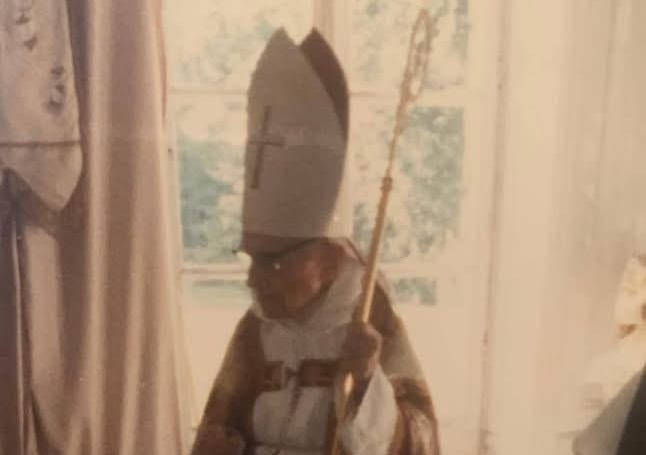
Shortly before his death in 1988, the French Dominican bishop Mgr Guérard des Lauriers reflected on the rumoured episcopal consecrations, which Archbishop Lefebvre conferred soon after.
Introduction
On 2 July 2026, the six bishops of the SSPX were declared to be in schism and excommunicated – along with all the ministers of the organisation, and any laymen who “formally adhere” to it. The meaning of this “formal adherence” is explained in a 1996 note to which yesterday’s documentation refers.
Later in the day, the Vatican released a process for those who wished to “reconcile” themselves, featuring such humiliations as suggesting that SSPX Third Order members should submit to the RCIA programme.
Much commentary has already been published on this matter.
However, in this article I shall provide a survey of pertinent texts delivered by Mgr Michel-Louis Guérard des Lauriers in the final years of his life. The French Dominican bishop was and remains a significant figure in post-Vatican II theological controversies. We publish this survey for its historical interest both in itself, and for its treatment of the matter of the excommunications – without endorsing the positions and opinions expressed within.
Joy over the excommunications?
Both before and after 1 July 2026, we have been told that these excommunications should not be the source of joy or triumphalism. The reason given for this is that such excommunications would be unjust and scandalous; and thus nothing to be glad about.
However, it often arises that an event or phenomenon that is evil under one aspect is good under another; and it can indeed be celebrated under the aspect of the latter. The Dominican moral theologians McHugh and Callan write:
237. Sinful joy is an act of the will by which one takes delight in sins already committed by oneself or by others. We must distinguish between sinful joy and joy about things that are sinful.
(a) Sinful joy rejoices over the iniquity contained in past acts, either because it loves that iniquity in itself, or because it loves it as the cause of some gain. Examples: An unjust and revengeful man rejoices when he thinks of the oppression he exercised against some helpless person who had incurred his wrath. A criminal recalls with joy the perjuries by which his helpers secured his escape from justice.
However, they continue:
(b) Joy about things that are sinful or consequent on sin rejoices, not that what was done was wicked, but over other circumstances that were good or indifferent. Examples: An employer admires in the conduct of a dishonest employee, not the injustice committed, but the shrewd manner in which the fraud was perpetrated. A bystander is very much amused to witness a fight, not because he likes discord, but because the acts and remarks of the fighters are comical. A man rejoices when he hears that a friend has committed suicide and made him his heir, if the joy is confined to the second part of the news.
Under some circumstances, the latter can be dangerous or even sinful. But on other occasions, it can be right, proper and even virtuous.
Rejoicing at the excommunications is manifestly an example of the latter. In order to explain the aspect under which these excommunications may legitimately give rise to joy, let us consider the words of the SSPX’s District Superiors, written in 1988 – who themselves clearly distinguish between grief for evil done and joy in good consequent upon this evil:
We are deeply grieved by the blindness of mind and the hardness of heart of the Roman authorities. […]
On the other hand, we have never wished to belong to that system which styles itself the “Conciliar Church,” and which defines itself by the Novus Ordo Missæ, by indifferentist ecumenism, and by the secularisation of the whole of society. Yes, we have no part — nullam partem habemus — with the pantheon of religions of Assisi; our own excommunication by a decree of your Eminence or of another dicastery would be only the irrefutable proof of this.
We would ask for nothing better than to be declared ex communione from the adulterous spirit which has blown through the Church for twenty-five years, excluded from the impious communion with unbelievers. […]
To be therefore publicly associated with the sanction which strikes the six Catholic bishops, defenders of the faith in its integrity and totality, would be for us a mark of honour and a sign of orthodoxy before the faithful. For these faithful indeed have a strict right to know that the priests to whom they turn do not belong to the communion of a counterfeit Church – evolving, Pentecostal, and syncretist.
It is in this context that we shall consider what Mgr Guérard des Lauriers wrote about what, at that stage, were rumours of impending consecrations by Archbishop Lefebvre.
Mgr Guérard des Lauriers: The 1986 article
The late Dominican bishop died in 1988, a few months before Archbishop Marcel Lefebvre’s episcopal consecrations the same year – as well as the SSPX’s consecration of Bishop Rangel in 1991.
The relationship between the two Frenchmen was, to put it mildly, strained – but it is interesting to see the hope that Mgr Guérard des Lauriers retained for Archbishop Lefebvre.
The former believed it necessary that bishops be consecrated – although not at any cost. In 1986, in an article titled To Consecrate Bishops?, Mgr Guérard des Lauriers discussed the rumours that Archbishop Lefebvre would imminently consecrate men to the episcopate without the permission of John Paul II. He considered it essential that such consecrations be carried out on the explicit basis that the Holy See was vacant (formaliter) – and that they not be carried out with the permission of John Paul II.
Regarding this point, Mgr Guérard des Lauriers even discussed the possibility that these consecrations might happen with the “ultra ultra secret” permission of John Paul II, without the faithful knowing it. It was for this reason that he also considered it essential that Archbishop Lefebvre be declared to have incurred a latae sententiae excommunication by the act of consecration: this would be the proof that there were no secret agreements. Some might consider this to be needless speculation – or even a “conspiracy theory” – especially with hindsight.
Nonetheless, Mgr Guérard des Lauriers presented his reasons for such a consideration in the 1986 article mentioned:
“[T]he fact is that Mgr L., suspended a divinis, continues nonetheless to ordain priests (1), to confirm, and even to “give” to certain of these priests the power to confirm (2). How then can it be that Mgr L., disobeying in the gravest matter him [W.] of whom Mgr L. affirms with pertinacity that he [W.] is the Authority [“bad Pope, but Pope”], how can it be that Mgr L. is not excommunicated?”
He explains that from the perspective of faith, this is ultimately because “W. is not the Authority”.1 However, he continues:
“[W]hat is evident in the Light of the most holy Faith remains densely obscure from the standpoint of Mgr L. and of W. They are agreed in affirming, in proclaiming, not only in words but in deeds: “W. is the Authority.” How then can it be that, without protest, “the said Authority” allows a Bishop suspended a divinis not only to exercise his powers, but to extrapolate them? That such a conjuncture, periodically repeated, should crystallise into a commonly accepted state of affairs – this leads ineluctably to regarding as very positively possible the hypothesis of an ultra-secret pact.
“This pact – here is what it would consist of, stated by W. addressing Mgr L.: ‘Continue to ordain and to confirm, as you see fit. You will not be troubled in any way. On one condition only, however – that of affirming and proclaiming that I am the Authority.’
“The greatest ‘service’ one can render to W., in his own light which is that of Satan, is to accredit him as the Authority. It is this ‘service,’ objectively ordered [and, by the Providence of God, derisively so] to the destruction of the Church, that Mgr Lefebvre accomplishes, and compels those who follow him to accomplish – unconsciously, I hope – but in any case obstinately. How, under these conditions, can one fail to suspect the insidious trap of Satan: ‘All this – a universal share in my Wojtylan church – all this, to thee, Marcel Lefebvre, I will give, if falling at [my feet] thou wilt prostrate thyself before me, W.’ (cf. Matt. IV, 9).
“I do not say that such a pact exists. I say that there are grounds to fear it. For, whilst saying IN WORDS: ‘There is nothing to be expected from Rome,’ Mgr L. continues to go to Rome – that is, IN ACT, to recognise W. as the Authority. Whether or not he is conscious of it – we repeat – Mgr L. renders, still now and always, to W. the ‘service’ [excellent service!] which the latter expects of him.”
He then applied this concern to the prospect of the consecrations:
“This being so, a threatening cloud hangs over the said episcopal consecrations. Supposing they take place, are they not destined to be the inexorably logical prolongation of the priestly ordinations? It will suffice, the pact becoming ultra ultra secret, to extend it to a new clause which will be the venom of slow death expertly injected into the entire work of Mgr L., and thereby into the traditional phalanx: ‘You may not only ordain, confirm, delegate: you may even consecrate Bishops. You will not be troubled in any way. On one condition only, namely: the Bishops consecrated by you [Mgr L.] shall recognise and proclaim, as you yourself do so well, that I, W., am the Authority.’
“It will therefore be fitting, should the said consecrations take place, not to rejoice prematurely.”
He continued:
One will have to examine whether the question of the ‘Roman mandate,’ normally required for every episcopal consecration, has been clearly posed and resolved – either by YES [in which case, quod Deus avertat, Mgr L. would be nothing more than a vassal of W., fully sharing in his capital schism], or by NO [in which case, Mgr L. being ipso facto, and even under the new ‘canon law,’ excommunicated latæ sententiæ, he would have to be declared excommunicated (as I myself was, together with Mgr THUC), by Mgr Ratzinger acting in the name of the ‘Authority’].
“One will therefore be able to rejoice with good reason at the Consecrations performed by Mgr L. only when the declaratory sentence of the excommunication incurred by him shall have been promulgated by ‘rome.’ It is this hypothesis that I suppose to have been realised. I considered it necessary to make this clear. For it would not be fitting for reasons of a doctrinal order to be alleged, even indirectly, with a view to appearing to justify conduct that would be consonant neither with truth nor with loyalty. Episcopal Consecrations performed according to the traditional rite, but ultra ultra secretly “una cum W.” – such Consecrations would be valid; but, foreign to sound doctrine, laden with sacrilege since injurious to the Testimony of the most holy Faith, they could be explained only by the cunning of Satan.”
It is intriguing that Mgr Guérard des Lauriers seems not to have countenanced the scenario that actually occurred: Archbishop Lefebvre consecrated the four men (a) without John Paul II’s mandate, and thus (b) with an excommunication, but whilst (c) openly maintaining a profession of union with the “pope”.
Perhaps he thought such a scenario as too absurd and implausible to consider – and that Archbishop Lefebvre could not possibly justify proceeding to an episcopal consecration without pontifical mandate without first concluding that John Paul II was not the Pope.
After much analysis of various factors, the bishop presents the following premises:
α’. IT IS NECESSARY to pursue the Missio, even in the Church in a state of privation.
β’. – NOW, it is impossible to pursue the Missio without Bishops.
He thus reaches the conclusion, in which he also refers to the possibility of Archbishop Lefebvre being excommunicated:
γ’. – THEREFORE, IT IS NECESSARY to consecrate Bishops.
This conclusion flows from the two premisses α’ and β’. It is necessarily binding, and its proof has not been refuted.
How is it that the faithful who claim to be attached to the Tradition generally refuse it in practice, even if, practising an [unconscious?] super-liberalism, they say they accept it ‘speculatively’? The true reason is that these faithful ‘of little Faith’ have need of security far more than of light. They therefore spontaneously prefer to cling to someone who is SEATED [and, humanly speaking at least, W. is seated very comfortably!], which leads them to consider neither the Truth nor the arguments that would prevent them from doing so. And the priests who, in exercising the Missio, feed these faithful, fear ‘losing’ them by affirming CLEARLY the whole Truth. Then these priests ‘diminish the truth’, or disguise it, or keep silent about it; and they are able to ‘keep’ … blind men who in fact hold above all else to remaining blinded. To what ends? God knows. God will judge; God already judges. That Mgr L. is preparing to consecrate Bishops – this is a most happy piece of news: Mgr L., by this act, will no longer be among those priests!
“One ought therefore to rejoice and give thanks – or at least prepare to do so. On condition, however, that, as has been explained [cf. 1], Mgr L. be declared by the ‘authority’ as being ipso facto excommunicated latæ sententiæ.”
Thus we see that, for Mgr Guérard des Lauriers, the excommunications of the modernists were not simply something about which to rejoice, but a positive sign of the legitimacy of Archbishop Lefebvre’s actions, and demonstrative of his separation from the modernists.
The 1987 interview
In 1987, Mgr Guérard des Lauriers was quite harsh on the matter – questioning whether one could have certainty that Archbishop Lefebvre was truly a member of the Church, and sharply delineating the conditions under which episcopal consecrations without pontifical mandate could be justified.
In a famous interview, he stated:
9. Sodalitium: What are your thoughts on the eventual consecration of Bishops on the part of Archbishop Lefebvre, who recognizes John Paul II as Pope, but regularly disobeys him?
Bishop des Lauriers: The eventual consecrations of Bishops on the part of Archbishop Lefebvre.
[I.] What is of primary concern in this event [that is, with regard to the state of the Church] is evidently the person of the ‘Consecrated’. Therefore, to specify [or examine] the conditions concerning the person of the Consecrator, it is necessary to start from those concerning the person of the ‘Consecrated’.
[II.] Now, the Bishop capable of perpetuating the MISSIO in the Church militant must satisfy the following conditions:
A Be validly consecrated, licitly, legally as much as is possible [see 7]. CERTAINLY, to be part of the Church. Now, in order that it could be affirmed with [moral] certainty that a faithful integrally professes the whole of the MISSIO, that this faithful has effectively the Faith and that is part of the Church militant, it is necessary, as we have demonstrated2:
B that this faithful sets as a principle that every member of the Church militant must carefully examine the question of the Pope until he has resolved it categorically;
C that this faithful affirms the vacancy at least ‘formaliter’ of the Apostolic See;
D that this faithful professes of having to submit himself to the Pope when Christ will give one to the Church.
[III.] Could a Bishop consecrated by Archbishop Lefebvre satisfy these conditions?
An affirmative response would not present a difficulty except for conditions B and C. Archbishop Lefebvre, affirming that Bishop Wojtyla is Pope and commanding his faithful not to examine the question, renders it IMPOSSIBLE to be able to affirm with CERTAINTY that he himself is part of the Church founded by Jesus Christ. One must certainly desire it, and one can suppose it; but it is impossible to be sure. As long as Archbishop Lefebvre continues to recognize and demands to recognize that W. is invested with supreme Authority, that same uncertainty would evidently weigh on a Bishop consecrated by Archbishop Lefebvre.
[IV.] The answer to question [9] is subject to the declaration that Archbishop Lefebvre will make [?] in the act of a possible consecration.
IF, on the occasion of a possible Consecration, Archbishop Lefebvre disavows his current position and affirms the vacancy (at least the formal one) of the Apostolic See, all conditions [II] will be fulfilled. We will then only have to rejoice. The MISSIO would be ensured by the work of Écône which would finally blossom, LOYALLY, into reality.
After all, it is precisely Archbishop Lefebvre, former Archbishop of Dakar and Tulle, who is in charge of completing this work; since Archbishop NGO DINH THUC died on December 13, 1984, and, at least as far as action is concerned, Archbishop de Castro Mayer only follows Archbishop Lefebvre. As for me, IF Archbishop Lefebvre FINALLY professes the sound doctrine that ALONE can justify his action, I want nothing more than to remain in the solitude from which I have not emerged except for the OBLATIO MUNDA.
IF, on the occasion of a possible Consecration, Archbishop Lefebvre DOES NOT EXPRESSLY AND PUBLICLY DECLARE the disavowal of his current position, even if outwardly he does not reaffirm that he recognizes W. as acting Vicar of Jesus Christ: then the duplicity3 which Archbishop Lefebvre systematically implements DEMANDS fear for the worst of compromises. Such ‘Consecrations’ would be ordered, satanically and masterfully, to better ensure the ‘ralliement’ (adhesion)4 of the ‘Traditional’ phalanx to the official church.
Once again, we see that Mgr Guérard des Lauriers did not seem to countenance the possibility that Archbishop Lefebvre would act contrary to the will of John Paul II and thus be excommunicated without first declaring him to lack authority.
Other questions in the interview
Earlier in the same interview, the bishop answers a question about his own “excommunication” by Cardinal Ratzinger:
7. Sodalitium: Excellency, in 1981 you were consecrated by Bishop Thuc. This Bishop was not always clear in his acts. Following this Consecration you were “excommunicated” by Cardinal Ratzinger. What are your thoughts on all this?
Mgr Guérard des Lauriers proceeds to explain the personal power received by Bishop Thuc, which he explains permitted him to consecrate bishops without Roman mandate,5 and various other aspects of the consecration. Regarding the excommunication itself, he replied:
“[IV.] ‘Cardinal’ Ratzinger notified me [through the Parisian nuncio, and not the General of the Dominicans] that I had incurred ‘latae sententiae’ excommunication. He encouraged me to ‘return’, assuring me of a warm welcome!
– I did not respond to this message, for the following reasons:
“‘Ex parte objecti’. The sentence is, in itself, deprived of any foundation: as we have previously exposed [II, III].
“‘Ex parte subjecti’: id est: Josephi Ratzinger, et ‘auctoritatis’. The only acts of ‘authority’ that may not be LACKING FOUNDATION are exclusively those ordered to the materialiter persistence of the hierarchy in the Church: only MATERIALITER, since [see 2a], the ‘authority’ has no power in the Church other than ‘materialiter’ and not ‘formaliter’. Thus, for example, the act with which the ‘authority’ would recognize the value and ecclesial scope of the Consecrations conferred by Archbishop Thuc: this act would be valid. While every act that is not expressly ordered to the permanence of the hierarchy [at least ‘materialiter’] is GROUNDLESS.
“We must take no account of something lacking foundation, which is in vain: this is the counsel of Saint John (II John, 10-11).
He ends the question by expressing his own feelings about the excommunication:
“– The message from “Cardinal” Ratzinger amused me and also cheered me up. Of all the Bishops who fully profess the Catholic Faith, I am the only one who is ‘excommunicated’ by W.’s ‘Rome’. As I am in no way in communion with that ‘Rome”’ I give thanks that it has, at least on one point, declared what the Truth is.”
(In the following question, he expresses his understanding of why episcopal consecrations without Roman mandate are necessary and legitimate. He also stated that he would neither have received the episcopate, nor passed it on to others, if Archbishop Lefebvre and the SSPX had ceased to name John Paul II in the canon of the Mass.)
The 1988 sermon
As Mgr Guérard des Lauriers approached death, he maintained the same views discussed above – the necessity of openly declaring the “formal vacancy” of the Holy See prior to any episcopal consecrations, and the necessity of an excommunication.
However, in his final sermon, he expressed these ideas in a slightly more hopeful way. On 3 January 1988, he stated his wish to rally behind Archbishop Lefebvre – if the conditions were right, of course – and stressed the importance of an excommunication, for the sake of making the lines clear.
“I believe I have already reminded you that when Saint Ignatius had just founded his order, there was in Spain another ecclesiastic, in the same conditions, who had equally consecrated to God generous designs. He had thought to do exactly the same thing as Saint Ignatius. In some way he found himself in competition. And when this person, whose name I no longer remember, learned that Saint Ignatius had this design, the latter had already begun to group the few companions who were to be the pillars of his company. This person then made the sacrifice, purely and simply of his project.
“‘Since Saint Ignatius does what I want to do; since it seems that there are all the sufficient assurances to believe that effectively, the will of God is on the side of Saint Ignatius to accomplish his work, I renounce it and I enter into silence’.
“And indeed, he renounced his work. He had, however, nourished this project; he had cherished it with love and solicitude, and taken all his dispositions to put it into action... he counted on realizing a grandiose design, he was attached to it by all the fibres of his being in view of its realization. And therefore to renounce such a project, is to renounce oneself. And well I believe that it is God who disposed this man to found the company at the same moment, at the same time as Saint Ignatius. Saint Ignatius in external action, and he in the sacrifice of himself and of all that he had most dear.
“And well you see, at bottom, the situation in which I find myself is the comparison that I propose to you. Archbishop Lefebvre has undertaken something – and you know that, at the beginning I helped him with all my power. He deviated on the points that we know, and of which I have just reminded you. But if Archbishop Lefebvre finally decided to consecrate – he said on Good Shepherd Sunday, but he has said so many times deadlines which, passed have seen nothing happen, that one can only wait… But if Archbishop Lefebvre decided to consecrate and to face excommunication for his consecrations – and well it is he, it is he evidently who, because he was a bishop, because he has an organisational talent that is top class, and because he has succeeded in many happy things in what has been accomplished – then it is well that I efface myself. I am quite ready, you see, to sacrifice myself and to renounce everything. I do not know what I would do.
“I have made a considerable sacrifice, you are not unaware of it, in leaving Etiolles to come to Raveau to try to found there a seminary of clean oblation. And it seems that the Good God forbids it to me, since he does not permit me even to keep the only disciple I had with me, to whom I no longer have the strength to give the courses to which he would be entitled. And therefore, the enterprise that I believed I should undertake – it seems that the Good God does not want it from me. And it is well, if he wants it by Archbishop Lefebvre – and if he shows it by the crucial sign, crucial...6 – that Archbishop Lefebvre finally decides to consecrate bishops; not to have them consecrated by Wojtyla but by him. If Archbishop Lefebvre does that, then it is well and with joy that I abandon all that I have done, all the sacrifices that I have made, so that the work of salvation continues through him.”
Within a few weeks, Mgr Guérard des Lauriers went to his reward.
The 1988 obituary
Finally, as an addition point of interest, Mgr Guérard des Lauriers’ disciple M. Adrien Loubier stated the following in his obituary for the late bishop (still before Jun 1988):
“The two churches now confronting each other must excommunicate one another, for they do not share the same faith. The Church for whom man is the road and whose pope is the pope of the rights of man, and the Church whose Jesus is the Way, the Truth, and the Life, and whose doctrine is that of the rights of God over the city and over souls; these two churches whose confrontation is concretized by the battle for Tradition, by the antagonism between the pure oblation ‘non una cum’ and the conciliar synaxis, and between the catechism of all time and the new catechisms – these two churches must exclude one another. The ambiguity must cease.
“And whether Mgr Lefebvre consecrates with the agreement of present-day Rome, thereby leading the whole of the resistance he has gathered behind him into a rallying to the bosom of the Conciliar Church; or whether he faces excommunication from present-day Rome and at last consents to address head-on the problems of the current crisis of authority – in either case we shall know where we stand. Either we shall have bishops like the others, Lustigers or Ratzingers in union with Wojtyla, whom we must reject for the same reasons – or else we shall have Catholic bishops, and the true Church will continue in the Cross, awaiting the hour when it shall please God to regenerate her.”
Loubier then states the following about the reading of the mandate:
“Let us not forget that the preliminary of the ceremony of the consecration of bishops is liturgically constituted by the reading of the Roman mandate. It is the beginning of the Pontifical. This prerequisite is obligatory, and if it is lacking, then, as Mgr Guérard des Lauriers did, it must be replaced by the exposition of the reasons for which one believed it necessary to proceed without it.”
Mgr Guérard des Lauriers’ “expositions” are extant, having been published in Sous la Bannière. We may translate some of them in due course.
In the SSPX’s 1988 consecrations, the answer to the ceremonial question about the Roman mandate was “Habemus” – we have it. This was widely criticised, because there was no such Roman mandate. What was read, instead, was a text similar to that described by Mgr Guérard des Lauriers, explaining why the consecrations were necessary.7 Similar criticisms were raised about the 2026 consecration, although this time, the answer was not “Habemus”, and the ceremony proceeded with an exposition read from a ceremonial scroll.8 Unsurprisingly, neither “exposition” professed the Holy See to be vacant.
By way of comparison, we can also note that Bishop Donald Sanborn recently explained that, for his own consecration by Bishop Robert McKenna, this “exposition” was delivered prior to the ceremony.9 Such “expositions” were also delivered at his consecrations of Bishops Joseph Selway and Germán Fliess.10
Conclusion
In this article, we have considered the ideas Mgr Guérard des Lauriers expressed on Archbishop Lefebvre’s conferring episcopal consecration without pontifical mandate. He believed that this was necessary, and held a positive view of a declaration of excommunication from the modernists, and explained the rationale for this view. He believed that these excommunications themselves were necessary – and said that his own excommunication by Cardinal Ratzinger “cheered [him] up”.
As a significant historical figure in the “traditionalist response” to Vatican II, the views which Mgr Guérard des Lauriers expressed are of interest for their own sake, whatever one thinks of them, or the “Thesis” which he propounded. There can be little doubt, however, that he would have disapproved of all three sets of SSPX episcopal consecrations.
While they took place against the will of John Paul II and Leo XIV, the men involved continued to insist that they were true Popes. As previously stated, Mgr Guérard des Lauriers does not seem to have entertained the idea that such a scenario could have occurred. The excommunications which he desired did follow, and they were indeed rejected – although not consistently on grounds which he would have accepted, and along with the continued profession of belief in the legitimacy of the papal claimants.
In short, the actual events are not precisely what Mgr Guérard des Lauriers hoped they would be, nor precisely what he feared and said would be condemnable. The excommunications of 1988 were not sufficient to drive the Society to reconsider its position on the post-conciliar claimants to the papacy. Although the harsher treatment of 2026 may have this effect, it seems unlikely at the present time.
HELP KEEP THE WM REVIEW ONLINE WITH WM+!
As we expand The WM Review we would like to keep providing free articles for everyone.
Our work takes a lot of time and effort to produce. If you have benefitted from it please do consider supporting us financially.
A subscription gets you access to our exclusive WM+ material, and helps ensure that we can keep writing and sharing free material for all.
You can see what readers are saying over at our Testimonials page.
And you can visit The WM Review Shop for our ‘Lovely Mugs’ and more.
(We make our WM+ material freely available to clergy, priests and seminarians upon request. Please subscribe and reply to the email if this applies to you.)
Subscribe to WM+ now to make sure you always receive our material. Thank you!
Read Next:


Follow on Twitter, YouTube and Telegram:
Twitter (The WM Review)
The answer to this question, in the Light of the most holy Faith, is evident. If W. does not apply the laws of the Church as he ought, even to Mgr L., the reason is that he himself acknowledges that he is not able to do so. The true reason is that W. is not the Authority. He apes being so, to the extent that this serves something entirely other than the good of the Church, and indeed serves the destruction of the Church.
“L’Eglise militant au temps de Mgr Wojtyla” (BOC No. 101, June 1985, pp. 12-24, in particular pp 18-19).
The last episode [to date!] of this satanic duplicity is the “hit of December 8, 1986”. Read in its entirety intra muros, in the Priories where it was necessary to convince hesitant Seminarians [and those resolved to leave Ecône] to renew their promises on December 8th, the “Declaration” of Archbishop Lefebvre [and de Castro Mayer] WAS NOT READ PUBLICLY in its entirety, at least in certain Priories. St. Nicholas Priory in particular: the main part, which disavows Vatican II and W. had been omitted. Thus the “hard” seminarians remained; and the faithful continued to be deceived.
And this even Archbishop Lefebvre persists not to see it – I explained it in the article cited in Footnote 6:
I examined this question in the article “Consecrate Bishops?” [Sous la Bannière. Supplement to No. 3. January-February 1986].
He writes:
Archbishop Thuc had therefore the power to consecrate Bishops WITHOUT PREVIOUSLY submitting the case to the Holy See, and therefore without the “Roman mandate”. Archbishop Thuc retained this SAME power when he was established as Archbishop of Huè by Pius XII. This is proved by the fact that it was Archbishop Thuc, and not the Apostolic Administrator, who selected and consecrated all the Bishops of Vietnam between 1940 and 1950 [Archbishop Thuc himself explained to me, and not without an insistent malice, the reason (hidden and true!). In this way the pensions and expenses of all these same Bishops in the event of retirement or illness become the burden incumbent to the faithful of Vietnam; while if these same Bishops had been consecrated by the Apostolic Administrator, they would have been the burden of “Rome”]. Whatever is made of this “amusing” [!] “end”, it remains that from the strict point of view of the formal cause, “Rome”, DE FACTO, under Pius XII, had confirmed Archbishop Thuc in all his powers and prerogatives of Legate. Archbishop Thuc was aware of having conserved them, and he revealed this orally to several people : “when they will find these documents after my death…….!” . But these Documents were not brought to light, and in an “updated” version, until very late [they went through multiple and dangerous vicissitudes], so it was not possible to make use of them, as would have been appropriate. It is therefore with the greatest good faith and even in all candor, that Archbishop Thuc proceeded to carry out: Consecrations and Ordinations. He rightly thought he had the canonical right to do so: as this right had not been taken away from him.
This word “crucial” was repeated four times by Archbishop Guérard, and evidently gives the key to this whole passage, as well moreover as the reasons for which we are favourable to the consecrations. These two Churches must excommunicate each other, because they do not have the same faith.
Do you have the Apostolic Mandate?
We have it!
Let it be read.
We have this Mandate from the Roman Church, always faithful to the Holy Tradition, which She has received from the Holy Apostles. This Holy Tradition is the Deposit of Faith which the Church orders us to faithfully transmit to all men for the salvation of their souls.
Since the Second Vatican Council until this day, the authorities of the Roman Church are animated by the spirit of modernism. They have acted contrary to the Holy Tradition, “they cannot bear sound doctrine, they turned their ears from the Truth and followed fables” as says St. Paul in his second Epistle to Timothy (4:3-5). This is why we reckon of no value all the penalties and all the censures inflicted by these authorities.
As for me, “I am offered up in sacrifice and the moment for my departure is arrived” (II Tim 4:6). I had the call of souls who ask for the Bread of Life, Who is Christ, to be broken for them. “I have pity upon the crowd” (Mk. 8:2). It is for me therefore a grave obligation to transmit the grace of my episcopacy to these dear priests here present, in order that in turn they may confer the grace of the priesthood on other numerous and holy clerics, instructed in the Holy Traditions of the Catholic Church
It is by this Mandate of the Holy Roman Catholic Church, semper fidelis (always faithful), then that we elect to the rank of Bishop in the Holy Roman Church the priests here present as auxiliaries of the Priestly Society of Saint Pius X:
Fr. Bernard Tissier de Mallerais
Fr. Richard Williamson
Fr. Alfonso de Galarreta
Fr. Bernard Fellay
[Habetis mandatum apostolicum?]
It is the Catholic and Roman Church, always faithful to the holy traditions received from the Apostles, who, in entirely exceptional circumstances, demands that we provide for the upholding of these holy traditions – that is, the deposit of faith – and that we take the means necessary to transmit them faithfully to all men for the salvation of their souls.
From the Second Vatican Council up to the present day, the authorities in the Church have been animated by a spirit that is contrary to that of the Faith, and have been acting against holy Tradition – “they will no longer endure sound doctrine, turning away their hearing from the truth, and turning towards fables,” as St. Paul says to Timothy in his second epistle (4:3-5). Therefore, before God, we consider it a sacred duty towards Holy Church and towards souls to proceed with the consecration of bishops who are entirely faithful to her holy Tradition and to her constant Magisterium.
Moreover, everywhere in the world, we hear souls beseeching us that, by the preaching of the Truth and the administration of the sacraments, the Bread of Life which is Christ might be given to them. That is why, out of compassion for this multitude, we have the most serious duty to transmit the grace of the episcopate to these dear priests, so that they themselves might confer the grace of the priesthood on many clerics formed according to the holy traditions of the Catholic Church. And we consider that every punishment and censure brought to bear against this step will have no validity.
Following this pressing demand of the always faithful Roman and Catholic Church, we choose these four priests here present as auxiliary bishops of the Priestly Society of St. Pius X, with the one and only purpose of serving the Holy Roman Church:
Father Pascal Schreiber, Rector of Sacred Heart Seminary in Zaitzkofen, Germany.
Father Michael Goldade, Rector of St. Thomas Aquinas Seminary in Dillwyn, USA.
Father Michel Poinsinet de Sivry, Superior of the Benelux District
Father Marc Hanappier, Professor of St. Thomas Aquinas Seminary in Dillwyn, USA.
Timestamped:
One such “exposition” was delivered in the sermon for Bishop Germán Fliess’ consecration (timestamped):
Interesting, as I myself (though unaware of these words of +des Lauriers) had recently written several articles making the same argument regarding the 2026 consecrations: That a secret permission by Prevost to consecrate could not be ruled out unless excommunications were declared to have been incurred.
What I did not foresee (and in sharp contradistinction to the 1988 Letter of District Superiors to Cardinal Gantin), was that the ralliement impulse would survive uninterrupted in the hearts of the SSPX leadership, despite the excommunications (as evinced in Fr. Pagliarani’s letter to Prevost after the Roman declaration).
Finally, it is also interesting that whereas +des Laurier had hoped that excommunications in +Lefebvre’s case might push him toward reconsidering the legitimacy of the recent papal claimants, as S. Wright observes, this does not seem likely in 2026. Quite the opposite, actually: The tenor of sadness in Pagliarani’s response to Prevost almost causes one to wonder if a slingshot effect in the opposite direction might not be the outcome (where remorse at the action reluctantly undertaken causes an intensification and acceleration of the ralliement impulse). Indeed, Cardinal Parolin says he is ready to resume talks, and there is nothing in Fr. Pagliarani’s response -unlike the response in 1988- indicating he is opposed.
I believe that the Spanish priest mentioned by Msgr. des Lauriers was Bl John of Avila, who was forming his own congregation of missionary priests, and when learning of the Jesuits, sent them all over to them.