

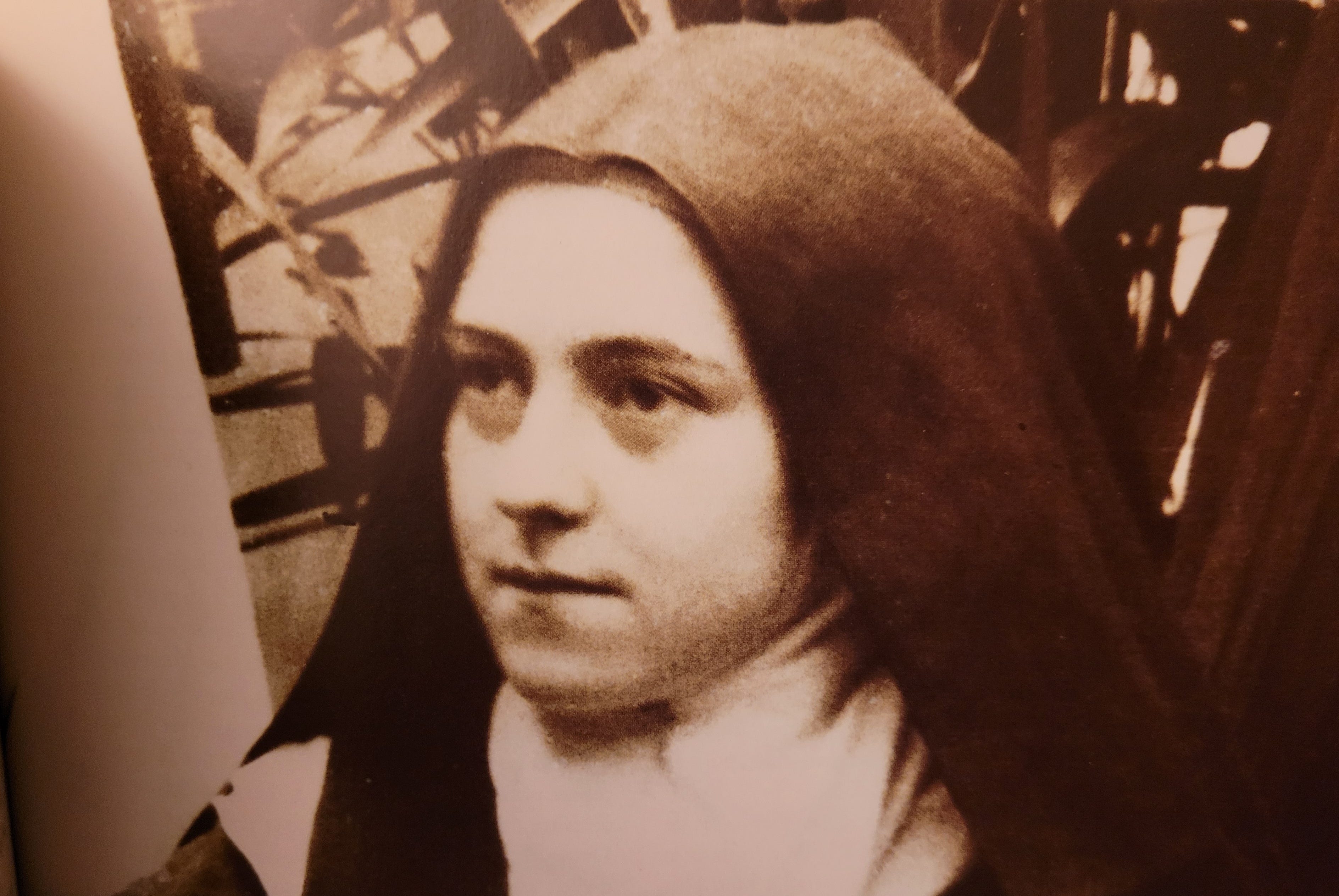
Better late than never... based on St Thérèse of Lisieux’s ‘Little Way’, here is The WM Review’s Little Lenten Effort for 2026.
‘Unless you shall do penance, you shall all likewise perish.’
(Mt. 13.3)
Lent is a time of penance – particularly fasting, but also combined with the other spiritual arms of prayer and almsgiving.
We have published several articles on this already, which are available in our Top 5 Lent Articles page:
However, many Catholics like to take up something positive in this period too.
To this end – a little late in the season – we are launching The WM Review’s Lenten Effort 2026.
St Thérèse of Lisieux
This Lenten Effort is inspired by St Thérèse of Lisieux.
St Thérèse needs no introduction, and you can read the papal praise of her here:
St Thérèse of Lisieux’s ‘Little Way’ – Dom Eugene Boylan explains
We have also published several other articles about this great and lovely Saint – including Mgr Alfred Baudrillart’s short essay on why “intellectuals” in particular need her insights:
St Thérèse of Lisieux and what ‘intellectuals’ need to learn from her (Mgr Baudrillart)
St Thérèse of Lisieux’s ‘Little Way’—nature, advantages and necessity (Mgr Laveille)
St Thérèse is perhaps best known for her “Little Way”, one aspect of which she describes in her own words as follows:
“But how shall I show my love, since love proves itself by deeds? Well! The little child will strew flowers... she will embrace the Divine Throne with their fragrance, she will sing Love’s Canticle in silvery tones. Yes, my Beloved, it is thus my short life shall be spent in Thy sight.
“The only way I have of proving my love is to strew flowers before Thee – that is to say, I will let no tiny sacrifice pass, no look, no word. I wish to profit by the smallest actions, and to do them for Love. I wish to suffer for Love’s sake, and for Love’s sake even to rejoice: thus shall I strew flowers. Not one shall I find without scattering its petals before Thee… and I will sing… I will sing always, even if my roses must be gathered from amidst thorns; and the longer and sharper the thorns, the sweeter shall be my song.
“But of what avail to thee, my Jesus, are my flowers and my songs? I know it well: this fragrant shower, these delicate petals of little price, these songs of love from a poor little heart like mine, will nevertheless be pleasing unto Thee. Trifles they are, but Thou wilt smile on them. The Church Triumphant, stooping towards her child, will gather up these scattered rose leaves, and, placing them in Thy Divine Hands, there to acquire an infinite value, will shower them on the Church Suffering to extinguish its flames, and on the Church Militant to obtain its victory.
“O my Jesus, I love Thee! I love my Mother, the Church; I bear in mind that ‘the least act of pure love is of more value to her than all other works together.’ [St John of the Cross]”1
You can see a very brief video explanation of this from one of the Sisters of St Thomas Aquinas, available here.

While “doing our daily actions for love of God” sounds very simple and easy, many of us struggle to start.
It’s really hard to do every small duty of our state in life specifically and intentionally for the love of God. We might try to aim at that, but then end up doing no action in this way at all.
That’s why our Lenten Effort this year is focused on starting this way of life.
If we can’t do every action for love of God, we can do one action... or two... and so on.
Here is the programme, based on the Treasure Sheets of the Eucharistic Crusade for children:
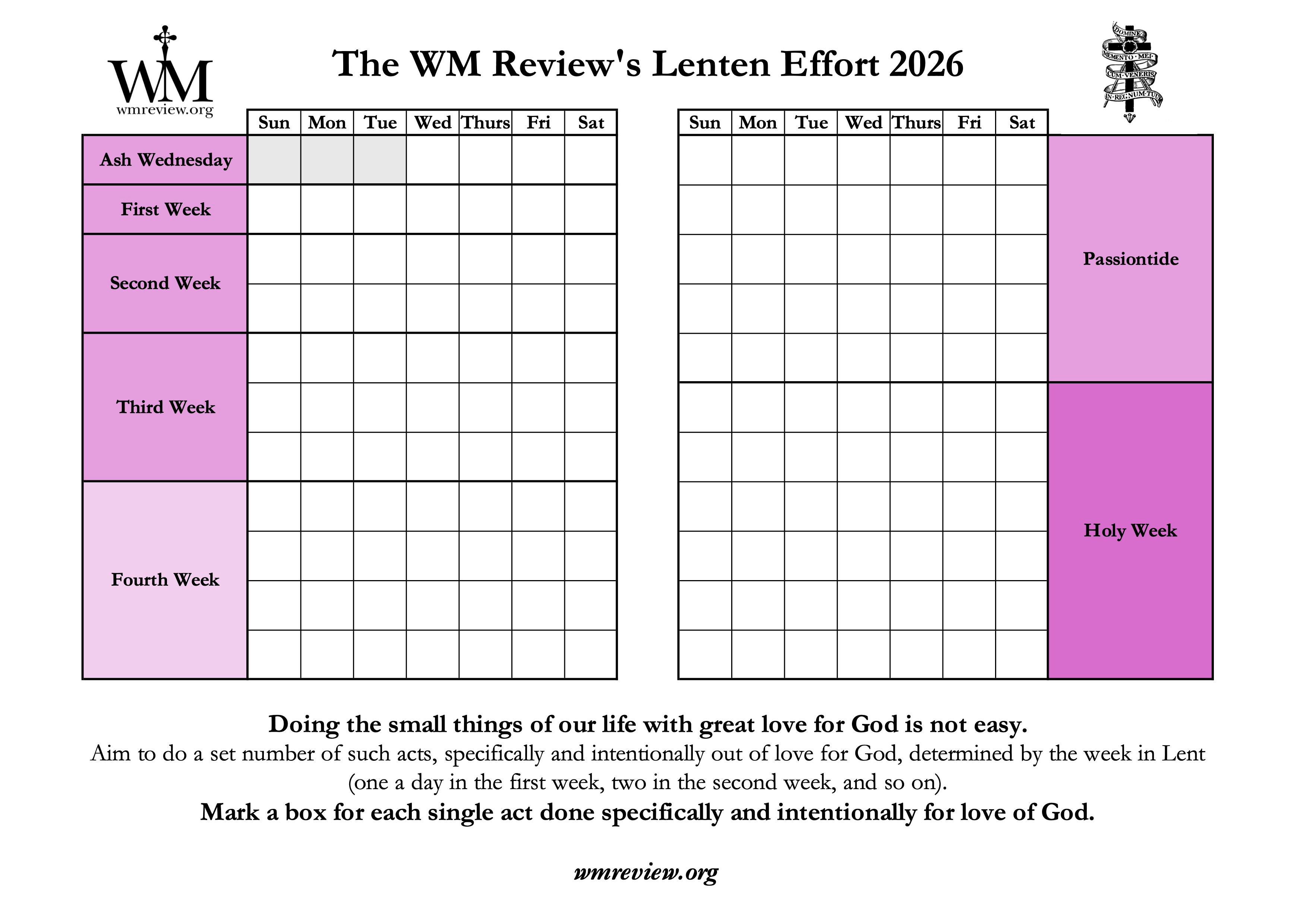
In the first week of Lent, we aim to do one of our ordinary actions per day specifically and intentionally for the love of God.
In the second week, we aim to do two such actions a day like this.
In the third week, three actions – and so on, until we are doing six of our daily duties like this in Holy Week.
Note: If you are joining this halfway through Lent, then it might be best to start with one such action a day, and ramp up at a sensible pace to the current week.

In doing these actions, we can make a little prayer like that given to the children of Fatima:
“O Jesus, it is for love of Thee, for the conversion of sinners, and in reparation for the sins committed against the Immaculate Heart of Mary.”
Or simply:
“Dear Jesus, I am doing this for Thee.”
We could make great and heroic sacrifices, if such arise or are possible, but the actions for this Little Lenten Effort need not be such: they can be just the ordinary and perhaps boring duties that make up our day.
St Thérèse said:
“You know well that Our Lord does not look so much at the greatness of our actions, nor even at their difficulty, as at the love with which we do them. What, then, have we to fear?”2
Of course, we should not feel limited to the set number of actions for the week in question (perhaps one could keep a tally, rather than crossing off the box). But the important thing is starting, counting and recording – not to feel good about ourselves, or out of what Francis called a “Pelagian current” when presented with a spiritual bouquet, but because this is recognised as an effective way of building good habits.
‘Spiritual Childhood’
St Thérèse herself wrote about how her saintly mother gave the children “sacrifice beads” for this very purpose:
“Having only good example before my eyes, I naturally wished to follow it, and I see with pleasure in my Mother’s letters that as I grew older I began to be a greater comfort. This is what she writes in 1876:
“‘Even Therese is anxious to make sacrifices. Marie has given her little sisters a string of beads on purpose to count their acts of self-denial. They have really spiritual, but very amusing, conversations together. Celine said the other day: ‘How can God be in such a tiny Host?’ Therese answered: ‘That is not strange, because God is Almighty!’ ‘And what does Almighty mean?’ ‘It means that He can do whatever He likes.’
“‘But it is more amusing still to see Therese put her hand in her pocket, time after time, to pull a bead along the string, whenever she makes a little sacrifice.’”3
Although there is an aspect of this which is “childish”, the whole point of “The Little Way” is itself “spiritual childhood” – as Pope Pius XI said at St Thérèse’s canonisation:
“We today conceive the hope of seeing spring up in the souls of Christ’s faithful a holy eagerness to acquire this evangelical childhood, which consists in feeling and acting under the empire of virtue as a child feels and acts in the natural order…
“If this way of spiritual childhood became general, who does not see how easily that reform of human society would take place which We set before us in the early days of our pontificate?”4
Final encouragement
Finally, we are also very pleased to share the following encouragement for this project from Fr Aedan Gilchrist RCI:
“In a world that is increasingly hostile to the interior life, it is essential that we make use of the small helps along the way that encourage and sustain us in the Christian life. Saint Ignatius, in his Spiritual Exercises, famously provides a method for keeping track of sins to overcome and virtues to cultivate.
“I am pleased to see WM Review offering this small but effective aid, following in the footsteps of the saints here, particularly in Saint Thérèse’s ‘Little Way’, by encouraging souls to offer small sacrifices throughout the day during this holy season of penance.
“Our first penance is to carry out our daily duties well and consistently. Our Lord told us that we must be ‘wise as serpents and innocent as doves.’ By this, He was not teaching us to be cunning, but to be wise and prudent in our lives, recognizing our weaknesses and taking the proper actions, enlightened by prayer and good counsel, to do all that will aid us. The spiritual life is not a sprint but a marathon, and we must take every means necessary to assist us on our pilgrimage toward our heavenly home.
“It brings me joy to encourage the faithful in their efforts, and I am glad to see WM Review doing the same.
“May God bless you all in this holy season of penance. Thank you to WM Review for encouraging the faithful with these practical suggestions and easy-to-follow methods.
– Father Gilchrist, RCI.
Fr Gilchrist himself is publishing daily meditations for Lent, available at his Thomistic Teaching YouTube channel.
There is of course more to “The Little Way” than the doing of small actions with great love. You can read about it here:
St Thérèse of Lisieux’s ‘Little Way’ – Dom Eugene Boylan explains
Good luck for Lent!
Repeating the above note: If you are joining this halfway through Lent, then it might be best to start with one such action a day, and ramp up at a sensible pace to the current week.
HELP KEEP THE WM REVIEW ONLINE WITH WM+!
As we expand The WM Review we would like to keep providing free articles for everyone.
Our work takes a lot of time and effort to produce. If you have benefitted from it please do consider supporting us financially.
A subscription gets you access to our exclusive WM+ material, and helps ensure that we can keep writing and sharing free material for all.
You can see what readers are saying over at our Testimonials page.
And you can visit The WM Review Shop for our ‘Lovely Mugs’ and more.
(We make our WM+ material freely available to clergy, priests and seminarians upon request. Please subscribe and reply to the email if this applies to you.)
Subscribe to WM+ now to make sure you always receive our material. Thank you!
Read Next:


On St Thérèse of Lisieux:
St Thérèse of Lisieux – Story of a Soul
Mgr Laveille – The Life of St Thérèse of Lisieux
Fr Petitot – St. Thérèse of Lisieux – A Spiritual Renascence
Follow on Twitter, YouTube and Telegram:
Twitter (The WM Review)
Story of a Soul, Chapter XI
Letter to her sister Céline, 20th October 1988
Story of a Soul, Chapter I
https://www.vatican.va/content/pius-xi/it/homilies/documents/hf_p-xi_hom_19250517_benedictus-deus.html, translation from Boylan.
You didn't mention this in the article but the Sister in the video clip mentions Dominic which I believe refers to St. Dominic Savio. I originally thought she was talking about St. Therese when I watched it.
Not to harp on once again about the inadequacies.of the conciliar/synodal church but I can't help call out its aversion to inspiring in its members the all-important and indispensable theological virtue of charity., love of God first, which alone can render all our other efforts pleasing to Him.
Their reformed sacraments seem designed to quench this virtue or make it more difficult to aquire when the faithful are encouraged to sacraligious practices in regards to due reverence to God and encouraging over-familuarity to all things holy, especially the novus order mass. This became the overriding reason for many (myself included) for their refusal to attend even whilst there was no alternative True Mass. Loss of faith begets cold-hesrtednes and vice versa, so important is the lex credendi lex orendi.