

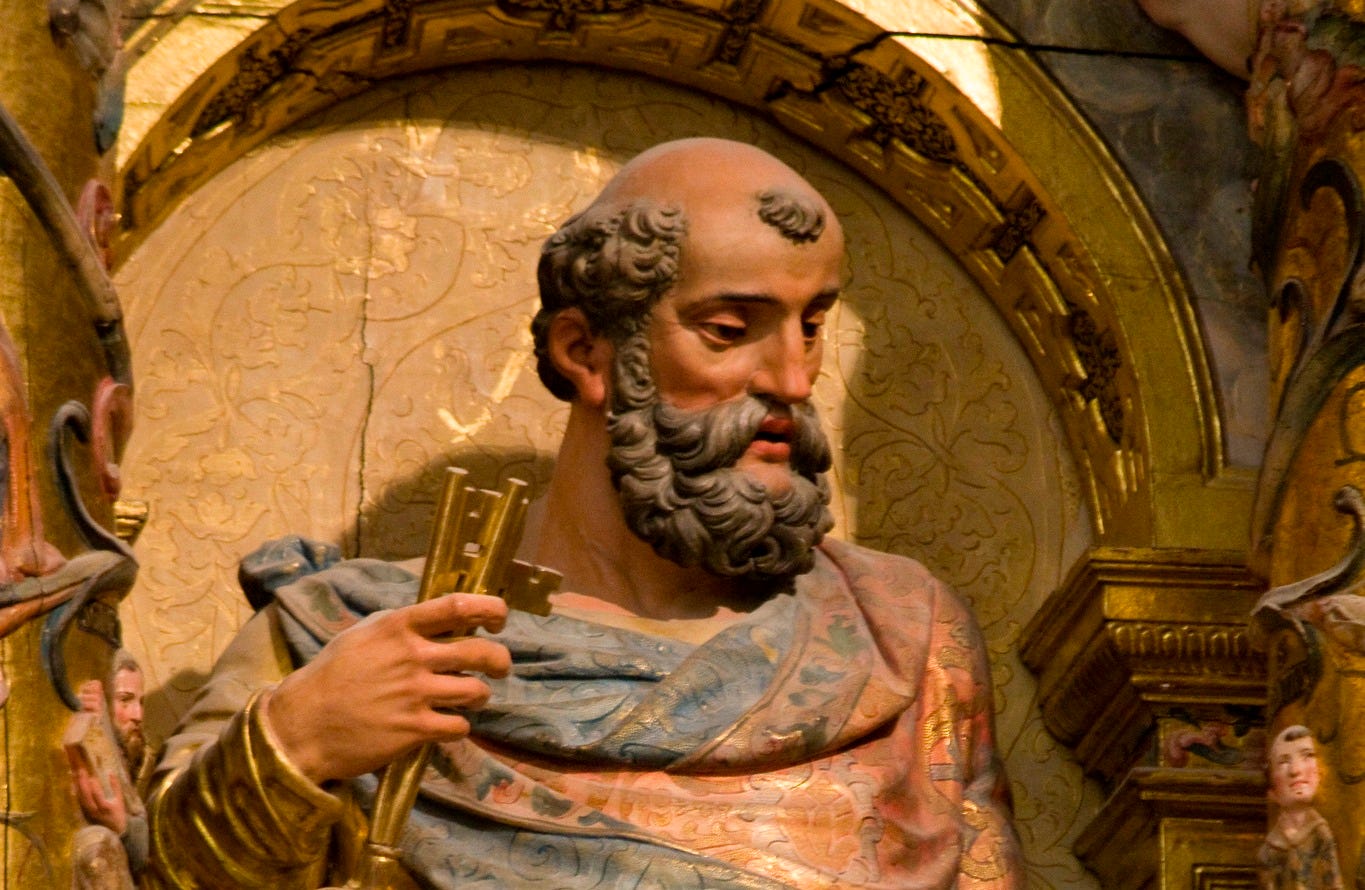
The assent of faith depends on the proposition and explanation of the Catholic Church.
Introduction
We recently published a short and informal article about Leo XIV’s comments about “communion between Christians and Muslims.”
In this article, I wrote the following in passing:
“Charity is the supernatural love of God as the highest good, and of all other men for his sake. But supernatural charity itself is dependent on supernatural faith – the acceptance of God’s revelation, as proposed by the Church. […]
“But Muslims do not accept God’s revelation: they reject it. Similarly, we could add, Protestants and Orthodox don’t accept God’s revelation as proposed by the Church. They base what they believe on their own private judgment of what Scripture teaches, or what tradition teaches. Basically, they don’t have the supernatural virtue of faith: they have private opinions about religion, even when many of these opinions are true.”
“This is why non-Catholics can’t be said to be in communion with the Church.”
I was asked to explain what I meant by saying “Orthodox don’t accept God’s revelation as proposed by the Church.”
Building on the private response I gave to this question, let us consider the topic a bit further here. But before doing so, I must point readers to the more technical and rigorous explanation of the matter by Fr Marín-Sola, from which the below is drawn:
The Church’s authority is indispensable for every act of divine faith
The great Thomists on the Church as a necessary condition for faith
Everything written below should be understood in the terms of Fr Marín-Sola’s explanation: any accidental departure from his explanation should be disregarded.
The necessity of the theological virtue of faith
The dogma extra ecclesiam nulla salus (outside the Church there is no salvation) is a controversial topic. Its exact meaning is a popular question, and often it is answered in a “popular” way. In Humani Generis, Pope Pius XII noted:
“Some reduce to a meaningless formula the necessity of belonging to the true Church in order to gain eternal salvation.”1
One reason for this is that the dogma cannot be understood apart from the nature and role of supernatural faith.
No one is saved without charity—that is, the love of God above all things, and of one’s neighbor for God’s sake. Implicit in this charity is contrition for one’s sins.
However, these terms do not refer to natural sentiments of philanthropy or remorse. They are supernatural realities; and in turn, they depend absolutely on the presence of supernatural faith.2 Holy Scripture is clear: “Without faith, it is impossible to please God.” (Heb. 11:6). While supernatural faith is insufficient for salvation on its own, supernatural charity and contrition are impossible without it. As such, it is absolutely necessary for salvation.
Pope Gregory XVI affirmed that this is itself a dogma of the Catholic faith:
You know how zealously Our predecessors taught that very article of faith which these dare to deny, namely the necessity of the Catholic faith and of unity for salvation.3
But what is this supernatural faith?
What is supernatural faith?
Faith is often understood as, in Martin Luther’s words, “a living, bold trust in God’s grace.”4 This definition—common even among misguided Catholics—is more akin to the theological virtue of hope. St. Paul, by contrast, distinguishes faith from hope, and defines the former as “the substance of things to be hoped for” (Heb. 11:1). In other words, it is not hope itself.
In the broad sense, faith means assenting to a proposition on the authority of another. When I assent to what someone tells me about their family, or I believe the doctor that this lump is nothing to worry about, I assent with human faith, or faith in the “broad sense”. It is based on the reliability or authority of the person revealing.
However, a merely natural faith is not sufficient: under Pope Bl. Innocent XI, Rome condemned the idea that faith “in the broad sense […] is sufficient for justification.”5
By contrast, the faith required for justification and salvation is supernatural—it is the “supernatural gift of God, which enables us to believe, without doubting, whatever God has revealed.”6 This supernatural faith is the virtue which enables us to give:
A certain assent to divinely revealed truths
Inspired and assisted by grace
Founded on God’s authority, rather than our own perception of the truth of the propositions or natural reason
As proposed and explained by the Church, either through definitions of popes or councils, or through the exercise of the ordinary and universal magisterium.
God’s authority, “The First Truth”, is the formal object of the assent of faith. It is a response to his revelation, and the motive is that God is the supreme good and truth who can neither deceive nor be deceived. The nature of such faith means that the assent is absolutely certain, and irrevocable. As Vatican I teaches:
“[T]he situation of those, who by the heavenly gift of faith have embraced the Catholic truth, is by no means the same as that of those who, led by human opinions, follow a false religion; for those who have accepted the faith under the guidance of the Church can never have any just cause for changing this faith or for calling it into question.”7
Further, the assent of faith is to everything which the Church proposes as revealed by God – explicitly to that which is explicitly proposed to us, and implicitly to everything else.
As the formal object of faith is God himself, one cannot pick and choose from what he has revealed and which is proposed by the Church: this “picking and choosing” is the root of the word heresy, and is destructive of the virtue of faith itself. This is why St Thomas writes:
“The species of any habit depends on the formal reason of the object, and if this is removed, the species of the habit cannot remain. Therefore, whoever does not adhere, as to an infallible and divine rule, to the doctrine of the Church, which proceeds from the First Truth as manifested in the Holy Scriptures, does not have the habit of faith. Instead, he holds by another means what pertains to faith, but in a manner other than by faith”.8
“In various conclusions of one science, there are different means by which they are proven, and one can be known without the other… but faith adheres to all the articles through one means, namely, through the First Truth proposed to us in the Scriptures according to the doctrine of the Church who has the right understanding of them. Therefore, anyone who rejects this means totally lacks faith.”9
The Church is necessary for supernatural faith
Divine revelation reaches individuals in two ways:
Indirectly (mediately), through the Church, which transmits divine truth via the magisterium.
Directly (immediately), as in the case of the Apostles, who received revelation straight from Christ.
Outside of such cases of direct private revelation, the Church’s proposition and explanation are a condition sine qua non for the virtue of faith for us (quoad nos – see Fr Marín-Sola’s explanation of this in the articles already cited).
Those who do not submit to the Magisterium of the Church cannot have supernatural faith, unless they receive a direct supernatural revelation from God – an extraordinary case, which is not to be presumed. Without the Church (whose credentials are established on independent grounds) or immediate revelation, there is no certainty that what is believed has been divinely revealed – only opinion, however sincere.10
This is the fundamental purpose of the Church: she is the authorised means, established by Christ, for proposing his revelation to the world in an authoritative and certain sense. There is a distinction here: her proposition and explanation are a necessary condition for the assent of faith, but not its formal reason. The formal reason remains the authority of God, and she is the means of achieving certainty that this or that point is indeed what God has revealed.
Fr W.G. Penny’s explanation
It is not sufficient to hold true opinions about the Christian religion, or to pick up the Bible and “believe” (viz., come to the opinion or natural certainty) that what it contains is true, or revealed.
Fr W.G. Penny, in his 1846 work The Exercise of Faith Impossible Except in the Catholic Church, recounted a work of fiction popular among Anglicans, in which a boy was cast on a desert island with his anti-Christian father, and grew up with religious instruction – or religious “prejudice”. In time, the father died and the boy was rescued, and came across a single page of Holy Scripture. “He read on,” Fr Penny tells us, “and was highly pleased with the account, and assented to what he read.”11
Fr Penny then asks:
“Now, can we possibly call this faith? Can we, by any stretch of meaning, say that faith ran result from the reading of a chance leaf which he found by accident in the road, and which he had no means of knowing that it was ever meant as a true relation, and not as an allegory, or even as a mere work of fiction? There is not a person in existence who would say that a mere piece of printed paper, found by accident, was an authority! However true its contents may be, yet something is needed for making it an authority – some voucher for its genuineness is wanted, otherwise no opinion that we may form upon its contents can be anything more than an opinion, in that it is not built on authority.”12
He continues:
“In order, then, that a printed paper may be an authority to us, there must be some second authority upon which we receive it – some one who is strictly and properly an authority, some one, that is, whom we are bound to listen to, and accept what we are told by him, and are held guilty if we do not – some one from whom we are bound to accept the whole message that he brings us; otherwise we are not bound to accept that particular part in which he says that the Bible is the word of God, and which, if we are not bound to accept it, is not an authority.
“To speak of the Bible, then, as being strictly the sole authority in matters of faith, is in reality to deny that it is an authority, for there can be no sole printed authority. [To assert that there is, would be to fall into the absurdity above mentioned, of supposing that a savage would be bound under penalty to obey a book which he met with accidentally, and without any one to vouch for it.]
“Without recognizing, therefore, the authority of the Church, which delivers the Scriptures to us, and vouches for their truth, they are themselves no authority. We should not be held to obey them, unless there were persons appointed to deliver them to us, whom we were bound to listen to. When a savage rejects the Scriptures, and sins in so doing, his real and immediate sin consists in the rejection of the living word of the missionary who offers them, and it is for this that he will be accountable; but, as I have said before, he would by no means be accountable for rejecting the volume, if he found it anywhere, untestified, and unvouched for.
“I hope from this it will be clear that the Holy Scriptures, though every sentence and every word of them is true, are yet not an authority to those who reject the authority upon which they come to us — that of the Church, for if there was no Church, the Scriptures would not be binding.”13
Working towards the act of faith
There are two ways of establishing the Church’s position in the act of faith. They are dealt with here:
We can have natural moral certainty through treating the Gospels as mere historical records, which show that the man Jesus did this or that action, taught this or that truth, was crucified and that his Apostles taught he rose from the dead and saw him, etc. Naturally speaking, the Gospels are no less reliable witnesses of what they relate than many other ancient texts, which recount events no one would question. It is begging the question to say that this could not be so, because they include miracles and so on.
The sufficient reason for these texts including such events – as well as the later events of the conversion of the Roman Empire, the spread of the Church, and so on – is that what the Gospels recount did indeed happen.
This is a claim which can be defended in more detail on another occasion – let’s just assume, for the sake of argument, that this is correct.
There is, then, no explanation for the facts than that Jesus of Nazareth is who he said he was: divine, and so on. The miracles he did testify to his claims, as does the fulfilment of very ancient prophecies which even his enemies (the Jews) admit are legitimate prophecies.
But at this stage, this assent is still a merely human faith. Our assent is based on our own private study and opinion.
The Gospel texts also tell us that Christ established an institution which he promised would be indefectible, i.e., remaining in existence and substantially unchanged until the end of time; with which Christ would remain until the end of the world; which would speak with his authority; and which would be the only place in which this authority would be found.
We then proceed to look for this institution, seeking to identify it by certain distinguishing marks of continuity with what we find in the texts. These marks are found only in the Catholic Church, as has been indirectly the topic of the interviews I’ve been doing with Stephen Kokx.
What are these marks? Vatican I, in the nineteenth century, taught specifically that the true Church is identified by four supernatural signs:
10. So that we could fulfill our duty of embracing the true faith and of persevering unwaveringly in it, God, through his only begotten Son, founded the Church, and he endowed his institution with clear notes to the end that she might be recognized by all as the guardian and teacher of the revealed word.
11. To the Catholic Church alone belong all those things, so many and so marvelous, which have been divinely ordained to make for the manifest credibility of the christian faith.
12. What is more, the Church herself by reason of her astonishing propagation, her outstanding holiness and her inexhaustible fertility in every kind of goodness, by her Catholic unity and her unconquerable stability, is a kind of great and perpetual motive of credibility and an incontrovertible evidence of her own divine mission.
13. So it comes about that, like a standard lifted up for the nations, she both invites to herself those who have not yet believed, and likewise assures her sons and daughters that the faith they profess rests on the firmest of foundations.14
These four qualities correspond to the four marks if the creed: one, holy, Catholic, apostolic, etc. These marks are obscure today, although not impossible to find, as has been the subject of the interviews already mentioned.
In addition to these marks, the Church herself is attested by miracles and by the prophecies that are fulfilled by her existence and history, etc.
Through this, and through other lines of consideration, we arrive at the conclusion, again a natural moral certainty, that the Church of the New Testament is the Roman Catholic Church.
Thus we have found the supernatural, infallibly certain means, the source of the divinely appointed condition, by which we know what God has revealed, and can assent to it as his revelation.
Only now we can make the act of faith in what has been revealed to us mediately/indirectly: we can say “I believe all this that God has revealed, because God has revealed it and the Church teaches it.”
Direct revelation
The possibility of direct revelation is important because it can explain how a man who has no access to the Church of Christ may nonetheless make a true and salvific act of supernatural faith.
For such a direct revelation, the proposition of the Church is not necessary for the person to make an act of faith – at least, not in the same way, nor for the points which have been directly revealed. However, for all other truths of revelation, the Church’s proposition remains as necessary as for everyone else who has not received a direct revelation.
Further, as stated, direct and private revelation is extraordinary and not to be presumed. There are many delusional madmen in the world, who are convinced they have received divine revelations, when they have not. But this does not undermine the fact that when God can reveal himself directly, and that when he does so, the recipient knows that it is indeed God revealing, and assents to what is revealed on his authority. Such person can make an absolutely certain act of supernatural faith on the basis of that direct revelation; the problem of madmen simply makes it hard for other people to know that another person has really received direct revelation.
This is why direct revelation is not the basis for the assent of faith for the human race in general. While immediate divine revelation remains possible, certain principles must be upheld:
The public and mediate revelation proposed by the Church enjoys an objective certainty; any supposed private or direct revelation which contradicts it is shown, per se, to be false.
Extraordinary claims require extraordinary proof. A person who claims private revelation must have solid, certain, and indubitable grounds; otherwise, the alleged revelation lacks the certainty necessary for faith.
Revelation is not a matter of personal experience. Feelings, intuitions, or subjective convictions - even strong ones - are not divine revelation and cannot constitute the object of supernatural faith.
Direct revelation points towards the Church. Saul, despite encountering Christ directly, was sent to the Church for instruction. Similarly, accounts of Christ appearing to Muslims immediately (e.g., Joseph Fadelle) point them toward the Church for the fullness of revelation to be given in the ordinary, mediate way. As such, one who assents to a true direct revelation shortly before death, dies subject to the Church and to the Roman Pontiff (whether the Holy See be legitimately occupied or temporarily vacant – as is presently the case).
This means that without either…
The Church’s teaching as the proximate rule of faith, or
An extraordinary private revelation directly from God
… a person’s belief in revealed truths – such as Christ’s divinity – is not, and cannot be, an act of supernatural faith. Instead, such “belief” remains a matter of personal opinion or private conviction, neither of which are sufficient for justification or salvation. It is not faith.
Applied to the Eastern Orthodox and others outside the Church
The Eastern Orthodox groups are usually treated as schismatics, in that they have separated themselves from the true Church of Christ. Sometimes we are even told that they are just schismatics and not heretics.
Let us remain focused on the assent of faith and see why this is not the case.
There are many good and interesting things which the Eastern Orthodox groups have retained from before the schism, and so is understandable that these groups are attractive to some Catholics. That said, we already have everything we need in the Catholic Church. For example: although an attraction towards certain parts of Orthodox mysticism is understandable, the first three of the five volumes of the Philokalia are made up of writings from Catholic saints.
But what is not in the Eastern Orthodox groups is supernatural faith.
The Eastern Orthodox do not even claim to have received direct revelation. Like us, they claim to have received indirect or mediate revelation. But their assent to revelation is not conditioned or determined by the proposition of Christ’s Church. It is based on either a) the authority of a body which separated itself from Christ’s Church, or b) their own human study or understanding of what was taught by the first set of ecumenical councils or in tradition.
Their proximate rule of faith is not the proposition and explanation of revelation by Christ’s Church, but something else: something not supernaturally certain, or supernatural at all.
They thus lack a necessary condition of the act of faith. For this reason, they can make only an act of human faith, which is not sufficient to attain supernatural charity, a state of grace or salvation.
The Orthodox face a further problem. They not only fail to assent to revelation as proposed by the Church with regards to the truths which they accept; they also reject certain revealed truths (e.g., the procession of the Holy Ghost from both the Father and the Son, the Primacy of St Peter and his successors, the Immaculate Conception, and so on). But as we have already seen, a man who rejects even one dogma rejects divine revelation itself, and so only holds what truths he retains as opinions or based on human faith.
“Hence it is evident that a heretic who obstinately disbelieves one article of faith, is not prepared to follow the teaching of the Church in all things; but if he is not obstinate, he is no longer in heresy but only in error. Therefore it is clear that such a heretic with regard to one article has no faith in the other articles, but only a kind of opinion in accordance with his own will.”15
Therefore, these men are heretics as well as schismatics; they do not have supernatural faith.16
But “without faith, it is impossible to please God”.
I have addressed these topics with regard to certain comments made by Leo XIV here:
To return to the article which prompted this response, the foregoing shows why there can be no communion without the external unity of faith.
Conclusion: Why is faith necessary for salvation?
To conclude, let us consider why that is, and why supernatural faith is necessary “to please God”, and why it is absolutely necessary for salvation.
The Athanasian Creed reinforces the necessity of supernatural Catholic faith for salvation:
“Whoever willeth to be saved, before all things it is necessary that he hold the Catholic faith, which faith, except every one do keep whole and undefiled, without doubt he shall perish eternally.”
We have already noted that faith is necessary for salvation because charity is necessary for salvation.
But we could consider the intrinsic reasons for this further. First, our supernatural destiny is to see God in the beatific vision; that is, to know and love God for all eternity. Knowledge and love correspond to our intellect and will; and these faculties must be elevated and ordered towards this utterly supernatural end. This is the role of supernatural faith and charity, which perfect our intellect and will respectively.
Second, it is through Christ’s mediation that we may attain this supernatural end. In order to benefit from this mediation, we must be united to or associated with Christ. This is why we speak of the Church as his mystical body: it is as members of the body that we are united to the head, and can benefit from his atoning and redemptive sacrifice on the Cross. But being united to Christ in the Church is not a matter of appearing in a parish register; it is a matter of being united to him by faith and charity. We must be living members of his body; that is, in a state of grace and with charity (and therefore faith) in our souls.
Third, charity is dependent on faith because we cannot love what we do not know, and faith is the means by which we attain certainty of the supernatural truths which God has revealed. Conversely, we cannot be said to love God if we refuse to believe what he has taught us. Both faith and charity represent the beginning of eternal life, here and now, and are utterly indispensable for attaining this supernatural end.
A failure to account for supernatural faith as the foundation for man’s union with God is at the heart leads to a naturalisation of the concept of faith itself – rendering supernatural faith unnecessary. It is a functional denial of the truth that “without faith it is impossible to please God” (Heb. 11:6), and a redefinition of faith from an assent of the intellect to the “living, bold trust in God’s grace” mentioned by Luther.
This is why so many modern writers talk freely of “faith” amongst non-Catholics. As an example, Cardinal Aveline – a frontrunner in the 2025 conclave – writes:
“… the attitude that believers, in the name of their faith…”17
[Quoting Christian de Chergé] “… by the sign of their respective faiths…”18
“… our respective fidelities to different faith standards…”19
“… Judaism, Christianity, and Islam, all seeking new formulations of their faiths…”20
This loose way of talking is impossible for one recognises the clear distinction between the natural and supernatural orders, particularly in relation to faith. As such, it is unsurprising that these ideas lead away from Catholic orthodoxy. The dogma of outside the Church there is no salvation becomes a “problem” to be explained away, so as to account for the “new reality” (which is not at all new) of religious pluralism. But even if it were a new reality, it would not justify a radical rethinking of the Church’s understanding of herself or of the nature of faith.
In short, the proposition and explanation of divine revelation by the Church is an essential condition, sine qua non, of the assent of faith “for us” (quoad nos). The redefinition of faith, without this condition, results in the redefinition (or functional denial) of the dogma – its reduction “to a meaningless formula” – and is the first step towards the complete dissolution of the Catholic religion.
It is, therefore, necessary to enter the Roman Catholic Church and submit to her threefold power of teaching, governing and sanctifying, in order to be saved. As Pope Boniface VIII infallibly taught:
“We declare, we proclaim, we define that it is absolutely necessary for salvation that every human creature be subject to the Roman Pontiff.”21
HELP KEEP THE WM REVIEW ONLINE WITH WM+!
As we expand The WM Review we would like to keep providing free articles for everyone.
Our work takes a lot of time and effort to produce. If you have benefitted from it please do consider supporting us financially.
A subscription gets you access to our exclusive WM+ material, and helps ensure that we can keep writing and sharing free material for all.
You can see what readers are saying over at our Testimonials page.
And you can visit The WM Review Shop for our ‘Lovely Mugs’ and more.
(We make our WM+ material freely available to clergy, priests and seminarians upon request. Please subscribe and reply to the email if this applies to you.)
Subscribe to WM+ now to make sure you always receive our material. Thank you!
Read Next:
The Church’s authority is indispensable for every act of divine faith
The great Thomists on the Church as a necessary condition for faith


Follow on Twitter, YouTube and Telegram:
Twitter (The WM Review)
Pope Pius XII, Encyclical Humani Generis, 1950, n. 27. https://www.vatican.va/content/pius-xii/en/encyclicals/documents/hf_p-xii_enc_12081950_humani-generis.html
The so-called “Letter to the Archbishop of Boston” (1949)—the status of which is outside this piece – affirms this necessity of supernatural faith. While it discusses the idea of some persons being united to the by implicit desire, it also affirms the following:
“But it must not be thought that any kind of desire of entering the Church suffices that one may be saved. It is necessary that the desire by which one is related to the Church be animated by perfect charity. Nor can an implicit desire produce its effect, unless a person has supernatural faith […]” (Emphasis added)
While many wish to focus on the idea of being united to the Church by virtue of a merely implicit desire, few have taken sufficient cognisance of the implications of this comment.
Pope Gregory XVI, Encyclical Summo Iugiter Studio, 1832, n. 5.
Denzinger Hunnermann n. 2123. Error n. 23, Condemned Propositions of the ‘Laxists’, Holy Office under Innocent XI.
Faith in the broad sense, which is based on thetestimony of creatures or on a similar reason, is sufficientfor justification. (Fides late dicta ex testimonio creaturarum similive motive ad iustificationem sufficit)
Penny Catechism q. 9.
Vatican I, Dei Filius. https://www.papalencyclicals.net/councils/ecum20.htm
ST, II-II, q. 5, a. 3.
ST, II-II, q. 5, a. 3, ad. 2.
Marín-Sola writes:
“The Church, according to Saint Thomas, becomes a true rule and a true reason for every act of our divine faith. This rule and reason do not pertain to our faith in its divine aspect, or in itself, but rather to divine faith insofar as it is ours [quoad nos]. They condition or modify the same First Truth or revealed deposit, not in themselves but in relation to us. This rule and reason are not about the formal object of faith but about its proposition and explanation. They are as necessary for every act of our divine faith as the proposition of the object by intelligence is necessary for the act of the will. A true act of the will cannot occur without this proposition, and it is reduced to a mere act of passion or sensitive appetite when this proposition is lacking. The proposing or proximate rule must belong to the same order as what is regulated. Anyone who acts against this rule of the Church’s definition, acts against divine faith – committing an act of heresy. Anyone who acts without this rule commits an act without divine faith – an act of mere science or human faith. Any explanation of the implicit or inclusive virtuality of the revealed deposit made against the Church’s definition is heretical. If made without the Church’s definition, it is purely scientific or human. If made by the Church’s definition, it is a divine explanation, a dogma of faith.”
Fr Marín-Sola, The Homogenous Evolution of Catholic Dogma. Chapter III, Section III.
W.G. Penny, The Exercise of Faith Impossible Except in the Catholic Church, p. 59. T. Richardson, London, 1846.
Penny, pp. 59-60.
Penny, pp. 61-2.
Vatican I, Dei Filius. https://www.papalencyclicals.net/councils/ecum20.htm
ST, II-II, q. 5, a. 3.
A delicate question related to this is as follows: in what way must the act of faith be related to the proposition of the Church? Theologians debate this, and there are difficult cases which could be considered. For example, a child who is baptised in a false sect before the age of reason is a member of the Catholic Church until he reaches such an age as to be construed as adhering to the sect (Bouscaren indicates that this is at the completion of the fourteenth year). At this point, he is presumed to be a non-Catholic, as he has neither of the external bonds of faith or communion.
But is it possible for such a one to retain the habit or virtue of faith, if perhaps he never commits a sin against faith? And if this is so, what does it mean for the claim that those in heretical sects do not have supernatural faith?
The Dominican moral theologians Frs McHugh and Callan also write:
931. The commandment of internal belief is brought before one for the first time, either of one’s whole life or for the first time after loss of faith, as follows:
(a) It is brought before a person for the first time in his life, when he first hears the truths of faith, or first realizes his duty of accepting them. Examples: A Catholic child who has just reached the age of reason and has been told in Sunday school that he must believe the Creed and other truths he has been taught; an adult Catholic who hears for the first time of transubstantiation, or of some other dogma just defined by the Church; a non-Catholic who has just perceived the truth of the Catholic Church.
(b) The commandment of internal belief is brought before one for the first time after loss of faith, as soon as the duty of returning to belief occurs to the mind.
932. Does this commandment require that, as soon as the obligation of faith dawns on one, one is obliged without an instant’s delay to make a formal and explicit act of faith?
(a) As regards children, on account of the imperfection of their understanding, it can easily happen that they do not perceive that the obligation binds them there and then, or that it binds under sin, and thus some time may elapse after the use of reason, or after knowledge of the command of faith, before the omission of the act of belief would become a sin. Practically every child of Catholic education complies with the command when, having learned the truths that must be known, he says devoutly the act of faith, either in his own words or according to the form given in the Catechism.
(b) As regards adults, while the entrance of converts into the Church admits of some delay for necessary preparation, the act of faith itself should not be postponed for an instant, once the necessity of making it is perceived as certain.
Fr Reginald Garrigou-Lagrange presents the objection and answers it as follows:
Certain theologians with nominal leanings are here involved. Hurtado and Castillo have said: “Many adults can be saved because of the mere possession of the virtue of infused faith without the need of making a personal act of faith.” The case is this. When baptism has been received in infancy, by one who grows beyond the awakening use of reason and soon dies without exercising the faith by any conscious act and without having committed a mortal sin, his salvation is secure. Nothing short of mortal sin can rob him of the baptismal grace. Nothing further can be deduced from the ruling of the councils.
First Reply. Granting the particular case with its accessory conclusion, there is nothing in it to undermine the following principle laid down by the Council of Trent in its exposition of justification. “The act of faith is requisite for all adults who were not placed in the state of grace before reaching the moral use of reason.”
Second Reply. In itself the antecedent is false, in virtue of the universal necessity for every man attaining to the use of reason to turn toward God as toward his last end. This is done by loving God above all else.” It implies voluntary conversion. Its mere omission deprives one of baptismal grace. [One’s first responsible act is, therefore, either a mortal sin or an act of virtue. ]
Let one do his duty and what follows? A degree of interior enlightenment is accorded by God, which advances the soul into supernatural conversion over which faith presides directively. This is how it happens that no adult can be saved without exercising the infused habit of faith, if it is in him.
By an adult should be understood one whose maturity is in reason, not necessarily in years. If a baptized subject turns out to be demented or an idiot, his salvation remains secure, the same as for an infant.
The Salmanticenses are in agreement with us, as may be seen from what we here condense of our commentary on the Ia Ilae, Question 89, Article 6. With Aquinas one must hold that, of those who come to the use of moral reason, God bestows upon one and all, supernatural aids that are at least remotely sufficient for believing. Yet if the recipient declines to use them, if he neglects them, by holding off and not doing what lies within the range of his personal effort, he sins mortally. One who, on the contrary, does not resist these initial advances on God’s part, but profits by this offering of grace according to his ability, is bound to receive an increase of enlightenment and further help that will mature in the act of faith which is requisite to complete conversion.
Objection one. Faith is not the same thing as the first grace. That official denunciation was leveled against Quesnell (cf. Denz. 1377). Indeed, many supernatural acts precede the act of infused faith, properly so called. Their purpose is to stimulate a pious credulousness in one’s affection. Sometimes these experiences lead to salvation, because of their sufficiency. They are really faith begun, lodged in one’s desire implicitly, and inclining one properly, before there has been any clear, express preachment of faith in the form of a proposition.
Reply. We borrow our answer from the Carmelites of Salamanca (De Gratia, n. 71). Such alleged supernatural acts, going before the assent of faith, may be sterile and linked with dissent, or an indisposition that shackles the assent of faith. In that case they do not suffice for salvation. If they are not sterile and the act of faith follows upon them, they still suffice only part way. The act of faith regulates supernatural conversion but not properly without fitting into a superior act of charity or God-love. All that precedes the act of faith terminates by merely making it possible for the soul to enter into God as revealer. It does not accomplish the inherence thus prepared for. Let one do what he can and God will not fail to give his grace. It is an easy matter for God to manifest the prime credibles, for they are ingrained in religious traditions which have streamed forth in many varieties from primitive revelation.
It is not surprising, therefore, that theologians hold commonly to the need on the part of all adults to exercise personal effort in producing deliberately the proper and formal assent of theological faith, under penalty of missing salvation. Thomists support the doctrine unanimously, together with Suarez, Valentia, De Lugo, and theologians as a class. The Salmanticenses record that some go so far as to condemn the contrary doctrine as heretical, erroneous, or temerarious. In face of such widespread staunchness the opposing view smacks too much of falsity to be defended as probable.
The Theological Virtues, pp. 206–8
He also writes:
2. Certain Catholics remain invincibly ignorant of particular dogmas and entertain doubts about them without committing a formal sin. In the premises, their condition is owing to insufficient instruction. But it is commonly held that those who live habitually among Christians can never be totally ignorant of what God has revealed. Everybody knows at least the two prime credibles: “God is” and “God rewards.”
The upshot of these data is taught commonly by theologians, namely: “Infused faith is not lost without the guilt of a grievous formal sin committed against the faith itself, contracted by withdrawing previous assent to one or more dogmas, actually revealed by God and embodied in the teachings of the Church.” Faith is not lost by any or every mortal sin that offends against charity or hope—nor by the denial of a particular dogma through ignorance, even when vincible—nor by courting occasions that might wind up in heresy eventually, but not right away— reading forbidden books, for instance, without proper authorization or preparation and thereby drifting toward forms of rationalism. Not every mortal sin wrecks faith, even though its malice is flung against faith. This can happen if a mortal sin is perpetrated against the public confession of faith, without breaking with the faith interiorly; or if interiorly, there is a rupture in the virtue of faith, ensuing from a side issue that is only indirectly voluntary. An objective loss of infused faith is brought about only by a persistent unwillingness to accord intellectual assent to a dogma that has been sufficiently proposed for belief.
The Council of Trent is invoked by theologians as a body in support of this decision, thanks to a blanketing canon dealing directly with justification. It runs thus: The state of grace, called “justification, is lost”—and this truth must be unwaveringly “asserted”—“not only through complete infidelity that abandons faith itself, but by any mortal sin whatever, even when faith is not lost.”
Corollary. A practical conclusion is inevitably forced upon us by this common stand. A Catholic child, in virtue of its baptism duly administered, when brought up among unbelievers and heretics, does not part with infused faith by the mere fact that he professes an infidel or heretical sect through ignorance, whether his ignorance is invincible or vincible and voluntary.
Objection I. It is a common opinion that there exist people who are invincibly and involuntarily ignorant of everything going by the name of revealed religion. But a baptized child could be living among such infidels without ever hearing a word about revelation. The case shows the possibility of one of the faithful living among infidels in the state of complete invincible ignorance touching all revealed truths. Coninck seems to say: The circumstances show more than a possibility. It could be a probability.
Reply. Probable or only possible, the rare occurence would not weaken our thesis. The baptized child, reared in irresponsible ignorance of all revelation, would not for that reason be deprived of the infused habit of faith. His deficiency would not consist in the absence of God’s infused gift, but in his not being aware of the possession or knowing how to use it. He would not exercise himself in the performance of an act of faith. But special reasons dissuade us from admitting that the hypothesis is probable. The habit of faith, infused through baptism into the child in question, connotes with a certain propriety the accompaniment of a right to particular actual graces that would stir him to believe at least the prime credibles: “God is” and “God rewards.” The only requisite disposition would be the attainment of the full use of reason. At this instant of growth mortal sin would be possible, but not necessarily through infidelity. The mastering sinful attraction might operate through sensuality or in some other way. A like contingency would not rob the child of God’s infused gift—faith—which he would continue to preserve until and if, later on, he would indulge in a mortal sin formally against faith itself; one which would have to be a sin of positive disbelief.
Objection II. What a wonderful thing, that any infused virtue should last for a long time without being exercised at all!
Reply. It happens even among the faithful when subjects are demented. Besides, habit is one thing and act another. Act is an accessory, not a constituent; least of all when the habit is infused. It is by divine mercy that infused faith is preserved within us, just so long as there is not committed the formal mortal sin of disbelief—just so long as the soul does not knowingly withhold its assent from any dogma sufficiently proposed, or entertain a deliberate doubt about such a doctrine with full consent to the doubt.
There is prophetic and Gospel support for this position in the words: “The bruised reed he shall not break: and smoking flax he shall not extinguish” (Is. 42:3; Mt. 12:20). The Council of Trent explains: “Thanks to his grace, God does not abandon those who have been once justified, unless they abandon him first” (Denz. 804). Although the wording of this truth expressly touches the state and loss of sanctifying grace by any sin, nevertheless, it covers also the condition of the faithful who, though in the state of mortal sin, refrain meanwhile from casting the faith aside. Partial abandonment is reciprocal between God and the sinner, midway, so to speak, between union and complete desertion. It is involved in the law of proportion. God’s mercy is still in operation and continues until God himself is deliberately and completely shut out as revealer. This can be only through a sin of positive disbelief, an outright repudiation of believing faith as a whole. Formal faith is an indivisible unit. When, in the absence of charity, faith is formless or lifeless, God’s mercy remains operative, as sap in the root of a tree that has been struck by lightning, but not utterly destroyed, nor deprived of the power to grow forth new branches. (438–441)
It must be noted, however, that Fr Garrigou-Lagrange does not discuss here what he teaches elsewhere, namely the same doctrine of the necessity of the promulgation and explanation of the Church for the act of faith:
In a heretic who pertinaciously withholds his belief in any one article known to be of faith, infused faith no longer remains, whether unformed by charity or lifeless. It does not matter what other articles he chooses to believe in. […]
Proof from the Analysis of Properties. Once a formal object or formal motive is removed or changed, the habit and act that were specified by it cease. But when a heretic willfully refuses to believe any one truth after it has been sufficiently propounded as of faith, he thereupon rescinds his assent to the formal object quo, which affects faith as a whole, both with regard to its habit and its acts. Therefore, granting that a heretic disbelieves any one article of faith, by so doing he forfeits the infused faith which is necessary to make him a Christian believer of any and all other articles to which he continues wedded.
Aquinas furnishes the thought which proves the major: “The species of any human habit whatever depends on the formal factor in its object. Remove that factor and the species is no longer the same.” This principle is of tremendous import because of the light it casts on the whole teaching of theology concerning the virtues, whether acquired or infused, together with the gifts of the Holy Ghost. All virtues, whether belonging to natural culture or infused, are distinguished by their formal object.
The minor premise has its soundness from Prime Truth revealing. The discernment of what it reveals is safeguarded in the Scriptures, which are divinely inspired, and the doctrine of the Church, assisted by the Holy Ghost in her infallible guardianship and declaration of what the deposit of faith contains. The containment thus circumscribed by Scripture and tradition involves: (1) the formal motive of faith, which is God’s authority certifying what he communicated as the author of grace; (2) the material content of Scripture and tradition as the object quod or sum total of all that is to be believed—wherefore its designation as a body of truths divinely deposited; (3) a condition for transmission sine qua non, namely, the infallible proposal of revealed truth by the Church that has been empowered to function proximately as the expository norm of faith and lineal successor to the prophets who, in pre-Christian times, were divinely commissioned messengers for those to whom they spoke.
The second and third requirements for faith indicated here have themselves been revealed for what they are. Scripture and tradition have been divinely authenticated as embodying the deposit of faith. And the Church is kept infallible to maintain the custody and official declaration of what is in the deposit.
From this it follows that breaking with the Church over anything that it declares to be binding in faith is not merely impugning the condition sine qua non of true faith, it also compromises the intellectual assent to the formal motive of faith. Rather, it rejects the authority of God in revealing the infallibility of the Church, which proceeds from Prime Truth as its origin and originator. There is no getting around or away from St. Thomas’ clear conclusion; in his own words it runs: “Whoever, thinking otherwise, does not cling to the doctrine of the Church as the infallible and divine rule proceeding from Prime Truth, manifested in the Sacred Writings, is devoid of the habit of faith.” (332, 334–4)
Thus, while it may be possible for someone to retain the habit of faith outside the Church, at least for a time, this would be exceptional. It is also difficult to explain how this could last for a long time without reference to the Catholic Church, given the “condition sine qua non” which we have discussed (although attempts have been made). It is also difficult to explain for every individual case whether an act of faith is or is not sufficiently related to the proposition and explanation of the Catholic Church.
“… l’attitude que des croyants, au nom de leur foi …”
Jean-Marc Aveline, ‘Évolution des problématiques en théologie des religions’, in Recherches de Science Religieuse, 2006/4 Tome 94, pp. 496-522.
“… par le signe de leurs fois respectives…”
Aveline, 2006
“… nos fidélités respectives à des normes de foi différentes…”
Jean-Marc Aveline, ‘Les enjeux actuels des relations entre juifs et chrétiens,’ Études 2010/10 Tome 413, p 355-366. Available here.
“… le judaïsme, le christianisme et l’islam, en quête de nouvelles formulations de leurs fois…”
Aveline 2010.
Pope Boniface VIII, Bull Unam Sanctam, 1302. https://www.papalencyclicals.net/bon08/b8unam.htm
Hi Stephen,
Contrary to what you think, liturgy is not “the northstar of theology.” It is an expression of the theology of the Church. The theology comes first.
Changes to the Roman liturgy followed changes in theology that had already been infallibly condemned by the Church. They aren’t merely liturgical abuses but expressions of a religion the tenants of which have been condemned by the Catholic Church.
Such false doctrines don’t come from the Church nor could they have come from men who were visible members in her. These men have chosen their own way that is not hers and in doing so rejected and separated themselves from her.
A singular focus on the liturgy ignores far more important theological issues that are at the root of the present crisis of faith.
I suggest that you listen to Louie Verrecchio’s podcast series on the crisis in the Church as it provides a good introduction to the crisis and how what we see in reality fits in with what the Catholic Church teaches about herself. I’ve republished it on my substack with permission. Start with season 2 “Vatican II revisited.”
So what is your understanding of it? And you are sure it's nowhere or ever been prayed, that Pope's can't be heretical?