
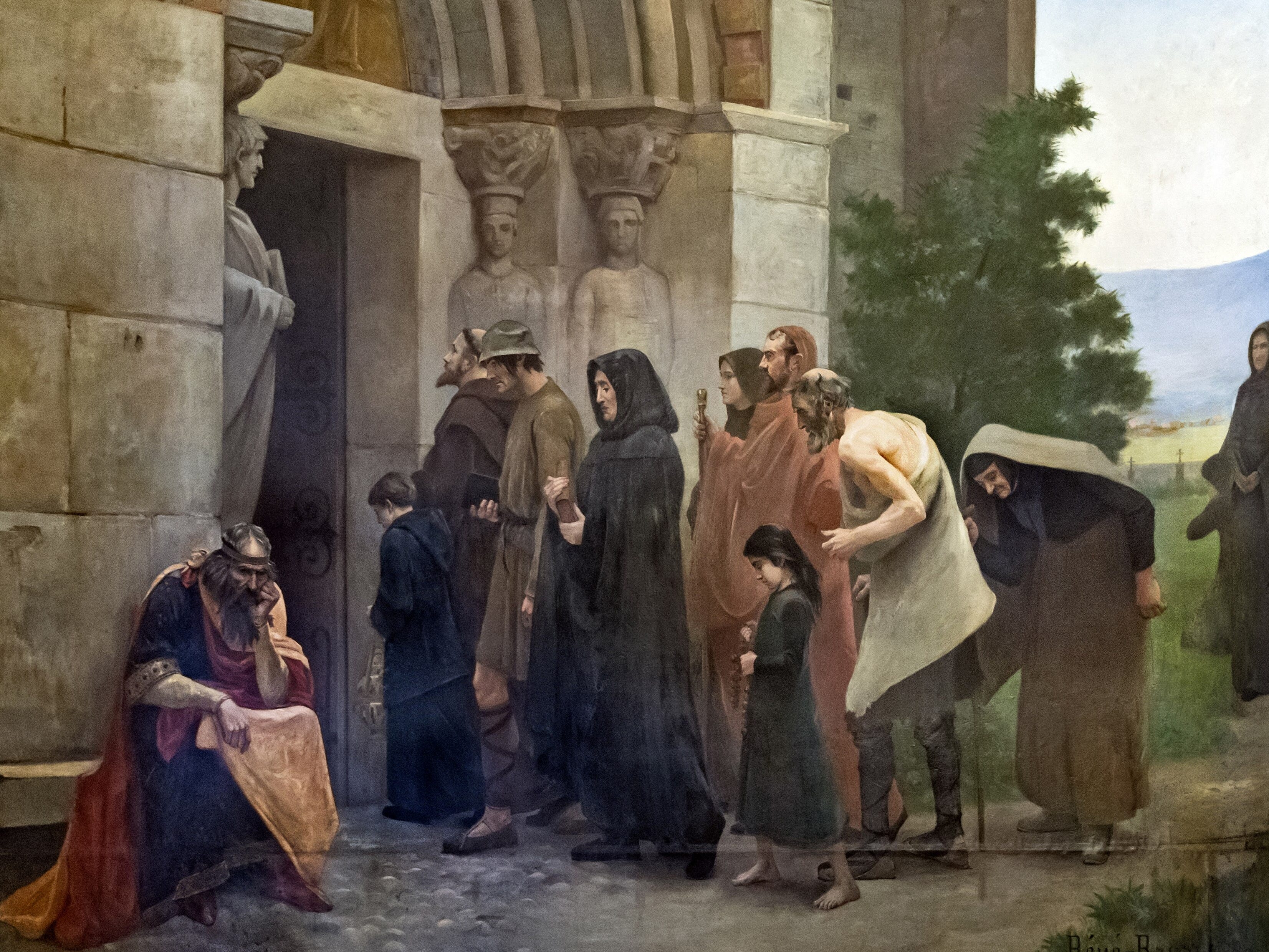
Imagine a world where wicked leaders make a confession like this.
Editor’s Notes
This is Part III of a trilogy of extracts taken from The History of St Dominic, Founder of the Friars Preachers (1891) by the English author Augusta Theodosia Drane – also known as Mother Francis Raphael. You can see more about Drane in Part I.
This trilogy – which recounts the conflict between the Church and Count Raymond VI of Toulose – is intended to illustrate what a society becomes when imbued with Christian principles, and in which Christ is King.
As mentioned, the doctrine in question may be summarised as follows:
Our Lord Jesus Christ is not only the King of individuals who choose the accept Him; He is King over the whole of Creation, including nations and states. Civil authority is not only obliged to work for the common good of civic society, namely peace and the common good of the nation; it is also obliged to recognize Our Lord Jesus Christ, His Divinity and His Kingship, to offer Him appropriate homage and public worship, and to govern in accordance with the Gospel.
In the previous parts, we saw that Raymond VI had been permitting various forms of lawlessness in his lands, as well as tolerating the encroachments of the Cathars and Albigensians. We saw that his excommunication led him to “string things along” with the Church, in order to avoid a declaration deposing him and relieving his subjects of their allegiance to him – and how this “temporizing” did not last very long, due to the murder of the Papal Legate Bl. Peter de Castelnau.
In response to the murder of the his ambassador, Pope Innocent III called for a crusade against the Albigensians and Count Raymond. In alarm, Raymond went to Rome and sought reconciliation with the Pope.
The chief interest of this extract for our purposes is the list of crimes for which the Church required Raymond to make reparation. In addition to his involvement with the murder, they included:
Paying bands of thugs to terrorise and rob the citizenry
Failing to observe “The Truce of God”, and using war and violence in violation of the Church’s strict rules (see Part I)
“Oppressive tolls” on his subjects
Ejecting bishops from their sees
Ill-treatment of clergy and religious
Seizing churches for his own purposes
Favouring heretics and breaking his oaths to expel them from his lands.
Given the state of our current world, we can consider again the questions posed in the first part. While men such as Senator Ted Cruz wish to characterise the Kingship of Christ as un-American, would we prefer to live in a world in which civil rulers are held to account for the crimes mentioned (some of which may seem familiar), or in which they can commit them with impunity?
Regrettably, however, Raymond VI was ultimately incorrigible. He did not diligently deal with heresy in his dominions, and was thus declared to have violated his oath again. He was again excommunicated, and Toulouse was placed under interdict. Defeated by Simon de Montfort, he was exiled to England – until he eventually returned in 1217 and defeated de Montfort himself. He died under excommunication in 1222.
The Kingship of Christ does not result in a utopia, and there will always be those who refuse to live according to its demands. Nonetheless, the case of Raymond VI “proves the rule”, showing what such a world considered to be acceptable and unacceptable – and the extent to which civil rulers were held to account by the Church and the Vicar of Our Lord Jesus Christ.
“Men must look for the peace of Christ in the Kingdom of Christ.”
Pope Pius XI, Quas Primas
From
The History of St. Dominic, Founder of the Friars Preachers
Augusta Theodosia Drane
Longmans, Green and Company, London, 1891. pp. 70–72
Why the Kingship of Christ is the best set-up for society: War and Tyrants
The martyrdom of Bl. Pierre de Castelnau – what the reaction shows us about the Kingship of Christ
The Crusade
The death of Peter de Castelnau took place in the February of 1208, and its effect, as we have seen, was to put an end to all hopes of temporizing.
The crime of the Count of Toulouse was declared to be one which freed his subjects from their allegiance until such time as he should have made due reparation: and a new commission of bishops and abbots was appointed to preach the Crusade, and undertake the ecclesiastical government of the country.
At its head was placed the Cardinal Legate, James Galba, commonly known as the Cardinal Milon, who lost no time in seeking an interview with Philip Augustus, King of France, and urging him to lead his forces in person against the Albigenses.
The King excused himself on the plea that his own territories were endangered by the hostile attitude both of the Emperor and the King of England; nevertheless he gave permission to all his vassals and subjects to take the Cross, engaging that both he and his son would do the same as soon as the safety of the kingdom was secured.
Raymund Submits
Active preparations were accordingly set on foot, and Raymund, fairly alarmed, himself had recourse to the King for counsel and protection. But Philip gave him clearly to understand that his only course lay in unconditional submission to the Holy See.
The Count therefore repaired to Rome for the purpose of protesting his innocence of the murder of the Legate, and obtaining for himself the best terms in his power. He was not unfavourably received, though as it happened, an embassy of bishops from the Narbonnese provinces had preceded him to Rome to make known to the Pope the miserable state to which the country had been reduced by the heretics and their supporters, and to implore his interference.
As regarded the Albigenses, it was felt that no further indulgence was possible, but the Pope showed himself willing to admit the Count to reconciliation with the Church on certain conditions. He was required, after making ample reparation for his crimes, to deliver up seven strong places in his dominions to persons appointed by the Holy See, as a security for the fulfilment of his promises; and to submit in every respect to the orders of the Legate.
These conditions he solemnly swore to observe, and returning to France, he repaired to St. Gilles,1 where the Legate, in company with three archbishops and nineteen bishops were to meet and receive him to absolution.
His confession
The proceedings which followed are singularly characteristic of the age, and make us clearly understand the grounds on which Count Raymund stood charged as a public criminal.
On the 18th of June, 1208, an altar was prepared outside the western door of the Church of St. Gilles, whither, in sight of an immense multitude, the Count was conducted; and standing there barefoot, and with shoulders bare to the waist, he swore on the Blessed Sacrament and holy relics, henceforth to show himself a true son of Holy Church, and to obey the Legate in all things that should be commanded him.
This oath, which was in substance a public confession of his crimes, ran as follows:
“I, Raymund, Count of Toulouse, do hereby swear to obey the Pope and his Legate, in all the articles for which I have been excommunicated, namely, that I have refused to make peace; that I have not kept my oaths to expel the heretics, but have always favoured them, and incurred suspicion of heresy; that I have kept in my pay bands of Routiers; that I have given public offices to the Jews; that I have turned churches into fortresses; that I have driven the Bishop of Carpentras from his see, have imprisoned the Bishop of Vaison, and ill-treated his clergy and religious; that I am suspected of the murder of Peter de Castelnau of happy memory; that I have broken the holy Truce, and disturbed the public peace on Sundays, and during the time of Lent; that I have denied free passage by land and water through my dominions to travellers, and have forced them out of the beaten track2; that I have imposed oppressive tolls on my subjects; that I have done violence to churches and monasteries, and have troubled the peace of elections.
“On all these articles I now swear obedience; and I moreover promise to enter into no alliance with the heretics, but to bring them to justice; and if I violate these present oaths, I consent that my seven strong castles shall all be forfeited; that an interdict be pronounced on my dominions; and that all my vassals be released from their oaths of fealty and allegiance to me.”
Sixteen of the Count’s chief vassals stood by his side as he gave these pledges, which they likewise bound themselves to observe, adding some others on their own account.
They promised, as became true knights, to guard the public roads, and not to ally themselves with brigands; whilst, should the Count prove faithless to his engagements, they swore to lend him no support, but to remain loyal to their oaths as became true sons of Holy Church.
His Penance
After these formalities the Cardinal Legate threw a stole over the Count’s neck, and taking the ends of it in his hands, led him into the church, striking him with a rod on his bare shoulders as they proceeded up to the high altar, where he was absolved from all the censures he had incurred.
The crowds that had gathered in the church to witness the ceremony were so great that Raymund, in returning, had to make his way through the crypt, and in so doing, was obliged to pass by the tomb of his murdered victim, Peter de Castelnau.
A few days later Cardinal Milon concluded peace between the Count and a number of barons, with whom he had persisted in waging war, and established a tribunal for the just arbitration of their differences; and finally both Raymund and his fast ally, the Count de Foix, swore on the holy Gospels to aid and protect the forces of the Crusaders, as long as they should remain in their territories.
From: The History of St Dominic, Founder of the Friars Preachers
Why the Kingship of Christ is the best set-up for society: War and Tyrants
The martyrdom of Bl. Pierre de Castelnau – what the reaction shows us about the Kingship of Christ
HELP KEEP THE WM REVIEW ONLINE WITH WM+!
As we expand The WM Review we would like to keep providing free articles for everyone.
Our work takes a lot of time and effort to produce. If you have benefitted from it please do consider supporting us financially.
A subscription gets you access to our exclusive WM+ material, and helps ensure that we can keep writing and sharing free material for all.
You can see what readers are saying over at our Testimonials page.
And you can visit The WM Review Shop for our ‘Lovely Mugs’ and more.
(We make our WM+ material freely available to clergy, priests and seminarians upon request. Please subscribe and reply to the email if this applies to you.)
Subscribe to WM+ now to make sure you always receive our material. Thank you!
Read Next:

Follow on Twitter, YouTube and Telegram:
Twitter (The WM Review)
St. Gilles was the real capital of his hereditary dominions, and gave its name to the family of the Counts of Toulouse.
This was an offence of which the lawless tyrants of these times frequently stand charged; and to understand its heinousness we must bear in mind that the protection of unoffending travellers was one of the duties demanded by the laws of chivalry from every belted knight; and that the object aimed at was to force them into dangerous paths where they could be more conveniently pillaged.
Agree, but when the clergy in Rome are heretics who are in league with the traitors in government, who is going to invoke the essential Kingship of Christ when those heretics don't believe in that principle?