
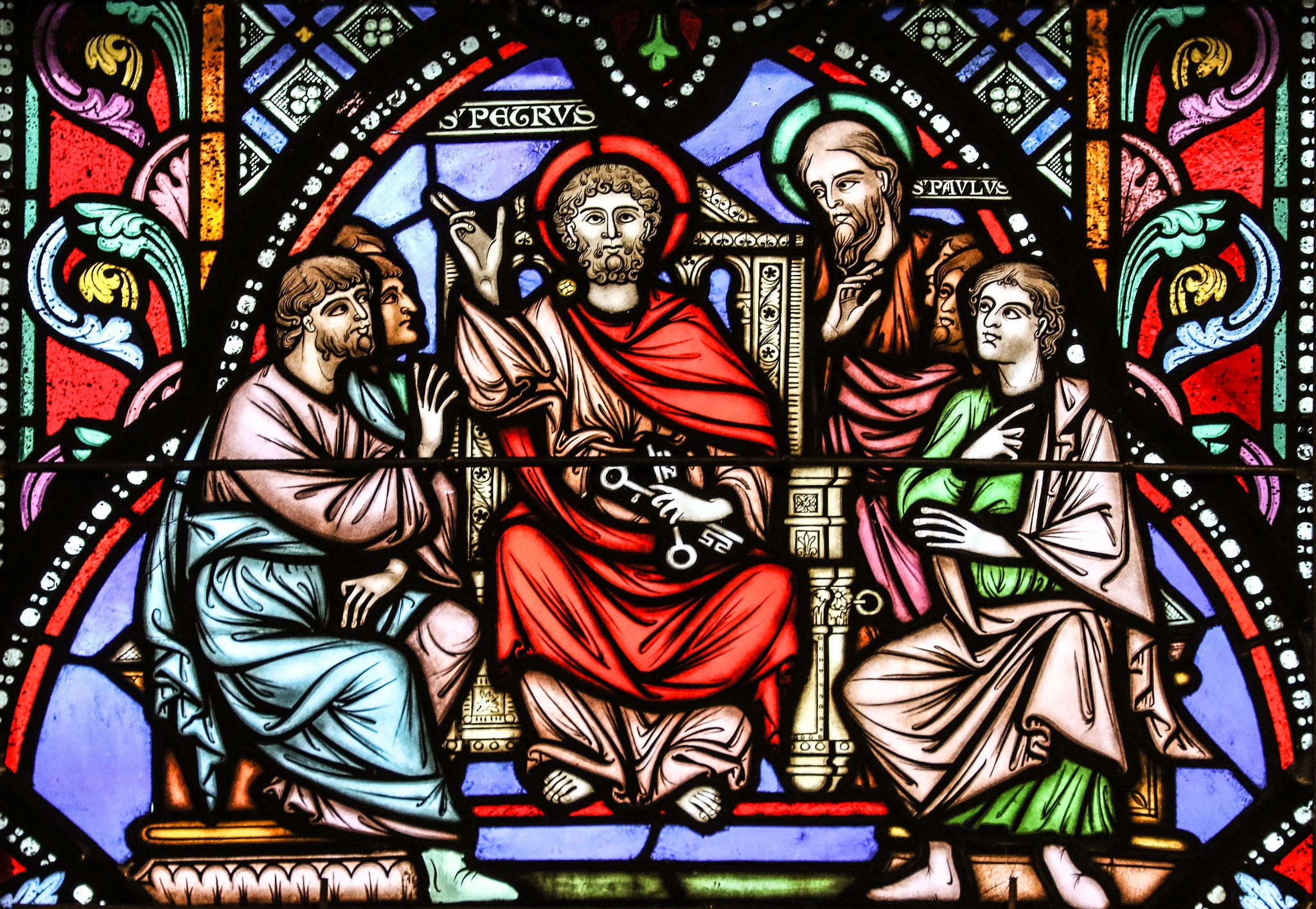
Professor of Dogmatic Theology Fr Raphael Cercia SJ answers objections about the continuity of papal succession.
Editor’s Notes
The following text is taken from Fr Raphael Cercia SJ’s Treatise on the Church of Christ.
We are sharing it because of the interesting comments he makes towards the end regarding a vacancy of the Holy See and the effect this has on the idea of the continuity of apostolic succession. The rest is shared to give a full picture of the context.
The first part, however, deals with the argument from prescription as a means of establishing the primacy of the Roman Pontiff over the whole Church. It would be easy for the implications of this argument to be misunderstood in our present situation. The argument from prescription conclusively establishes the primacy under all circumstances, but can result in begging the question when applied to the legitimacy of particular claimants under certain circumstances. We have previously addressed this matter in the article below:
About the Author
Fr Cercia was a dogmatic theologian and controversialist. He was born in Naples on 2 April 1814, and entered the Society of Jesus at age 14. He later taught rhetoric at Sorrento, Sacred Scripture and Theology and Naples, and became a Professor of Dogmatic theology at the Roman College in 1857. He died in Naples on 2 June 1886.
Here are some of his principal works:
Dogma
Tractatus… de Ecclesia Christi, Naples, 1848;
Tractatus… de Romano pontifice, Naples, 1850;
Tractatus… apparatum complectens ad doctrinam de gratia Christi, Naples, 1853;
De sanctissimæ Trinitatis mysterio tractatus dogmatico-scholasticus, Naples, 1880;
Others
In Epistolam B. Pauli apostoli ad Romanos commentarius analyticus, Naples, 1853;
Manuale cattolico compreso in conferenze religiose [Catholic Manual Comprised of Religious Conferences], Naples, 1855;
La parola della Bibbia ed i veri credenti [The Word of the Bible and True Believers], Naples, 1862;
Del purgatorio e dei suffragi [On Purgatory and Suffrages], Naples, 1864;
Il mondo vecchio et il mondo nuovo [The Old World and the New World], Naples, 1871–1873;
Empietà e stoltezze del secolo XIX [Impieties and Follies of the Nineteenth Century], Naples, 1876;
La Chiesa e i suoi diretti [The Church and Her Rights], Naples, 1876;
Aneddoti di religione dedicati ai moderni neoteorici [Religious Anecdotes Dedicated to the Modern Neo-Theorists], Naples, 1876;
Oimè! chi si salva? [Alas! Who Is Saved?], Naples, 1878;
Gli Evangelici e le loro botteghe [The Evangelicals and Their Shops], Naples, 1880;
Il specchio del protestantismo [The Mirror of Protestantism], Naples, 1882;
C’è l’inferno? [Is There a Hell?], Naples, 1882;
Il libro del perchè in fatto della religione [The Book of “Why” in Matters of Religion], Naples, 1885;
La confessione sacramentale [Sacramental Confession], Naples, 1886.
He also contributed to Civiltà cattolica, Bibliothèque de la Compagnie de Jésus, and Nomenclator.
S.D.Wr.
From
De Ecclesia Vera Christi et de Romano Pontifice
Raphaele Cercia, SJ
Volumen I, Tractatum Complectens de Ecclesia Christi, Editio Tertia
Danis, Neapoli, MDCCCLVIII. pp. 344–352.
Translated by The WM Review, with some headings and line breaks added for ease of reading.
LECTIO IV: The foundation is laid for demonstrating the notes which flourish in the Roman Church.
If, as was observed a little above, all the notes are conspicuous and stand out in the presence of the apostolic hierarchy, we shall not be acting beside the point if we begin the question concerning the Roman Church, by establishing it from the genuine and adequate apostolic succession itself. And so it must be called to mind that three things are required for a true hierarchy, and a true succession, to be said to exist in any society.
In the first place, it is necessary that there flourish in that same [society] a true succession of the centre of unity, that is, a legitimate series of successors of St. Peter.
Secondly, that there flourish in its bishops a true succession of the Apostles.
Finally, that these successors themselves be found in perpetual adhesion to the centre of unity itself.
Accordingly, we must accurately vindicate the Roman Church, by which name, as we have pointed out, we understand all Christian societies which communicate with the Roman Church.
Argument from prescription for the Papacy
And first, as regards the succession of the centre of unity, this verification involves both ius [right] and factum [fact]: that is, that it be known who can be considered true successors of Peter; [as a matter of] fact, that they have truly flourished perpetually in the Roman Church.
As to the first point, there is no need for us to labour here on this matter, since it should be held that the Roman Pontiffs succeed Peter in the Roman episcopate and in his primacy by divine right. For this will be treated ex professo in the treatise on the Roman Pontiff, whence this quasi-lemma [a kind of presupposition in a syllogism] may be transferred to us for the present matter.
And certainly, unless succession in Peter’s primacy belonged to the Roman bishop, it could not be explained how from the earliest times of the Church until now, whether among the Latin or the Greek Fathers, all unanimously and without dissent recognised the primacy of the Roman Pontiffs; how, with no one objecting, the bishop of bishops and judge of bishops was perpetually held [to reside in Rome]; how it never entered anyone’s mind, not even the Patriarch of Antioch, to claim for himself the right to the dignity of the primacy; how, finally, neither bishops who dissented from the Roman Pontiff, nor the heretics – if more recent exceptions are raised – have ever called a matter of this kind into doubt.
Furthermore, it is established from ecclesiastical documents that the Roman see was always used as the cathedra [chair] of St. Peter, and that the primacy was always retained over all the other churches of the world; that the Roman bishops ever settled controversies of faith as supreme judges; that they exercised the primacy over bishops of Africa, Asia, and all other provinces; that by their own authority they always convoked and ratified ecumenical councils; and that they perpetually possessed and exercised the right of appeals, etc. But all these things could not have taken place without the primacy itself residing in them, and indeed by divine right, with such universality, harmony of minds, and perpetuity. Therefore, etc.
But let these things be said in passing concerning the right itself of the primacy of the Roman Pontiffs. As to the fact – namely, that there has never been lacking in the Roman Church the series of successors of St. Peter exercising his primacy – this is evident both a priori and a posteriori, from the things we have already determined concerning the Roman Church. For if the primacy is once judged to have been assigned to the Roman Church, nothing else is needed than that there be attributed to it a full and never interrupted possession of that succession. Indeed this succession is not like the successions of particular churches, which are divisible and defectible: but from the mind of Christ it is itself indivisible and indefectible, just as the unity of the Church is such, on account of which this kind of succession was instituted. Therefore that Church which possesses the beginning of the succession, and the first transmission, cannot have it interrupted; since to that same [Church] has been bequeathed something which can neither be lost, nor can ever be lacking.
A posteriori, the matter becomes known:
From ecclesiastical histories, in which are recorded the names, homeland, age, legitimate election, deeds, etc. of the various Roman Pontiffs succeeding one another without interruption.
From the remaining ecclesiastical monuments – from sacred diptychs, catalogues, musical works, painted icons or the most ancient [images], and even from the sepulchres of the Pontiffs themselves – [one arrives] at the existence of St. Peter.
From the testimony of the sacred writers: thus Tertullian (de praescr. cap. XXXII) and Irenaeus (lib. III adv. haer. cap. III), then Eusebius (in hist. et chron.), Epiphanius (haer. LXX), Optatus of Milevis (lib. II contr. Parmenian.), Augustine (epist. CLXV) diligently record the succession of the Roman bishops down to their respective times. The remaining Pontiffs are similarly enumerated by later Fathers.
It is evident from the very things we touched upon a little earlier when the matter of the primacy by right was being treated. For there is no age in history in which there does not everywhere appear a certain kind of presence, and of real presence of the Roman Pontiff, as de Maistre calls it – whether when the Roman bishops condemned errors and heresies, whether when they settled controversies which had arisen everywhere among the nations, whether when they disciplined bishops scattered far and wide both in the East and in the West by threats or deposition, whether when they presided through their legates or in person at synods of ecumenical [councils], up to the Council of Trent – assuredly there was never lacking in the Roman Church one who enjoyed the primacy of Peter.
Therefore the perpetual and never interrupted succession of Roman Pontiffs admits of no sane doubt. On the other hand, no one has ever dared to be uncertain about their legitimate institution and ordination [to the See]; but the whole Church has recognised them as the legitimate successors of St. Peter, and has perpetually rendered to them full obedience. Therefore, etc.
Finally, the whole matter has been so thoroughly established that it can scarcely be called into doubt by any of the adversaries, whether as regards the material part of the succession or as regards the formal. Indeed, they themselves are wont to marvel at such a succession, by which it comes about that the Apostolic See, through nineteen centuries, amid so many religious and political vicissitudes, continues to endure and stands firm in full vigour.
The succession of the Church is proved from the Roman succession
If these things hold regarding the succession of the supreme pontificate in the Roman Church, it follows from the principles established above that the entire apostolic succession likewise flourishes in that same Church. For we have said that this [apostolic succession] is inseparable from the succession of the centre of unity, from which its formal constitution derives. Whence there either exists nowhere any succession of bishops, which is absurd, or it must be found in that Church in which the succession of the centre is found.
Furthermore, if we consult the fact, there is no particular church among those which communicate with the Roman Church that cannot exhibit its own series of bishops, whose lineage is traced back without interruption all the way to the Apostles; or at least whose succession has not been supplied or repaired through adhesion to the centre of unity. We have said that these things suffice for possessing a true apostolic succession. Therefore, etc.
Hence from these things it is clear that there exists in the Roman Church adhesion to the centre of unity; and moreover it is evident that, from this same [centre] in the Roman Church, it may be judged who exactly pertains to the centre of unity of the Roman Pontiff. Finally, it is certain that the Roman Church has never tolerated, or at least considered them as bishops who did not adhere to the Roman Pontiff in faith and communion. Therefore, etc.
Objections
These things are indeed so clear as to present the highest degree of evidence. Nevertheless, opponents raise:
Inextricable difficulties concerning the succession of the Roman Pontiffs from its very beginning.
For they disagree as to who was the first successor of Peter – whether Linus, as Irenaeus has it (lib. III adv. haeres. c. III), or Clement, as Tertullian teaches (de praescript. c. XXXII). Likewise concerning Cletus and Anacletus, whom some distinguish, while others in fact identify them. “The opinions vary,” says Schelestrate himself (antiquit. eccles. diss. II cap. I), “concerning Clement and the other three first Pontiffs who succeeded Peter.
“For some place Clement in the second position; others place him third, following the more ancient catalogue; others, following St. Jerome, place him fourth from St. Peter. Equally great is the disagreement among the ancients concerning the other three Pontiffs who sat after Peter. For Optatus of Milevis (lib. II), enumerating the succession of the first four pontiffs, places Peter first, to whom, he says, Linus succeeded; Clement succeeded Linus; Anacletus succeeded Clement, etc. St. Augustine holds exactly the same (epist. CLXV)…”
… for Linus succeeded Peter, Clement succeeded Linus, Anacletus succeeded Clement. But St. Irenaeus (lib. III cap. III) differs, for he enumerates the order in this way: Peter, Linus, Anacletus, Evaristus. Therefore, etc.
Resp. I deny the assumption. As proved by distinguishing the antecedent. That the succession of the Roman Pontiffs among the ancients presents difficulties which touch upon the perpetual succession itself of them; I deny; which touch upon some of its individuals [within the succession] and accidentals; I concede.
The ancients, although they may seem to disagree somewhat concerning the order or person of certain individuals, nevertheless plainly and unanimously attest that the Roman episcopate had the primacy of St. Peter attached to it, and that the Roman bishops were his successors. Secondly, they agree in this, that from the death of Peter down to their own times the series of the Roman Pontiffs was never interrupted. And certainly, as we saw above, they drew their argument from that very succession of the principal cathedra to establish the truth of the Church. They raised this against heretics of every kind, provoking them to exhibit the lines of their own bishops.
Both things therefore – both that Peter made the Roman bishops his successors, and that they were not interrupted – had to be a well-known fact, public and acknowledged by all. Otherwise heretics could have objected and turned the accusation made against them back upon [the Catholics]; of which indeed no trace exists in the historical record.
Since this is how things stand, who can doubt either matter or both together? It is therefore in itself inescapable, and only the labour of criticism remains, to show those who can reconcile the ancients with one another, or from what causes they may have fallen into disagreement, and finally what most tested series of all can be had.
Now indeed, lest we pass over this matter entirely in silence: first of all, Tertullian, who places Clement second after Peter, and Irenaeus, who places him fourth, can be most readily reconciled if we say that Irenaeus spoke of Linus and Anacletus as the immediate successors of Peter, but Tertullian [spoke] of Clement as a mediate successor of St. Peter. As to what pertains to Cletus and Anacletus – either it must be said that they were one and the same, but endowed with a double name, one of which was the apocope [shortened form] of the other, as often occurs in antiquity, and can even happen among us – or it happened that those who made these distinctions were in fact ignorant of this, and that whether they had named [him] now Cletus, now Anacletus, they treated two persons as one, which certainly does not alter the objective series of the succession. Or, what seems more probable, it must be affirmed that Cletus and Anacletus were two individuals with scarcely different names. And in this case, some have judged that those were the names of the same person, and two successors of Peter who, since each held his office for an equal duration, were conflated into one through error.
Finally, as to the fact that some place Clement in the third position, others in the fourth: Bellarmine (lib. II de rom. Pont. cap. X) holds that there were two Anacleti – one who was the predecessor of Clement, and who is identical with Cletus; the other a successor who heard only the name Anacletus. But there is no need to resort to these conjectures. Let us simply say that the Fathers recited from memory one or another series, and that by a lapse of the same [memory] they placed one before the other. And this could the more easily have occurred because they could see that this was a matter of indifference, and could probably [see] that no doubt could arise about the uninterrupted succession of the Roman Pontiffs from this.
Objection II. In the series of subsequent Roman Pontiffs there occur doubtful Popes, intruders, simoniacs, etc. Therefore nothing certain about the integrity of that chain can be affirmed.
Resp. In the objection, it is either supposed that the institution of such Pontiffs was either legitimate, or not. If the legitimate, it does not matter that they conducted themselves wickedly, or that they did everything through simony, etc. For as we noted above, the sanctity of the succession does not depend on the deeds of individuals, and as St. Leo says (serm. III de Nat. ips. III cap. IV) “The dignity of Peter does not fail in an unworthy heir”.
But if the discussion is about those whose institution was null on account of the vice of intrusion, or simony, or for some other reason, or [was] doubtful, such a time time must be considered as one of the see being vacant and not yet provided for. So that meanwhile the uproar and protests may subside, and whatever consensus there may be regarding that Pontiff – whether by admitting or tolerating him – already every wound is understood to be healed by the consent of the Church itself.
Objection III. Yet in the series, there occur not so much doubtful pontiffs, but rather frequent interruptions, on account of the see being vacant for a long time. Therefore, etc.
Resp. I distinguish the antecedent. Frequent interruptions occur which have the true character of an interruption of the series: I deny; which were a simpler, shorter or longer vacancy of the Roman see: I concede.
For Christ promised the perpetuity of the succession in such a way as to show that He would efficaciously prevent all things that could indeed truly interrupt the series of the succession — but not, upon inspecting everything, that which would merely delay the institution of a successor.1 Therefore nothing can be concluded in itself from a vacancy of the see, however long, until it be proved that that vacancy had the characteristics of a true interruption.
Indeed, in every political society, the series of kings or rulers is not thought to be interrupted for as long as only external impediments prevent the king or leader from being elected; and in the meantime, the society itself is in a state of electing, and strives to elect, and recognises itself to be without a king or leader, and [to be] maimed and deformed.
By equal reasoning, therefore, if the Church had at some time departed from the state of electing a Pontiff, and had considered this matter to be harmful or useless to itself, and had not meanwhile been able to elect a Pontiff, we would have the characteristics of a true interruption.2 But in fact, the opposite has always occurred. For in the interim, the pontifical power was in the disposition of its causes, that is, in the power of the electors, so that it could be conferred upon an individual by the determination of electing [him].
From all this, it appears how much less relevant to the matter is the epoch of the Great Western Schism, and how greatly the adversaries seem to allude [to it]. First, indeed, if Urban VI was not the Roman Pontiff, his election being invalid, then no doubt Clement VII’s (elevation), established by the voice of all the Cardinals except one, was valid. But he was not accepted as Pope by all, as there was doubt about the valid election of Urban VI. Further, at this present time it is now nearly universally acknowledged that Urban VI was the legitimate successor of Peter.
Finally, even if no Pontiff had existed in that age, this case should be reckoned among the cases of a see extrinsically impeded – as being vacant through an accidental cause.
HELP KEEP THE WM REVIEW ONLINE WITH WM+!
As we expand The WM Review we would like to keep providing free articles for everyone.
Our work takes a lot of time and effort to produce. If you have benefitted from it please do consider supporting us financially.
A subscription gets you access to our exclusive WM+ material, and helps ensure that we can keep writing and sharing free material for all.
You can see what readers are saying over at our Testimonials page.
And you can visit The WM Review Shop for our ‘Lovely Mugs’ and more.
(We make our WM+ material freely available to clergy, priests and seminarians upon request. Please subscribe and reply to the email if this applies to you.)
Subscribe to WM+ now to make sure you always receive our material. Thank you!
Read Next:


Follow us elsewhere:
Twitter (The WM Review)
This phrase has been recast for readability. Here is the Latin:
“Non sic Christus spopondit perpetuitatem successionis, ut inspectis omnibus, ostenderet velle se arcere efficaciter illa omnia quae possent non quidem vere interrumpere seriem successionis, sed retardare dumtaxat institutionem successoris.”
Here is a more literal reading:
“For Christ did not promise the perpetuity of the succession in such a way that, upon inspecting everything, He wished to show that He would efficaciously prevent all things that could indeed not truly interrupt the series of succession, but only delay the institution of a successor.”
The current situation is not a departure from the state of electing; it is one in which many incorrectly think that a true successor has been elected. That these two states are distinct is obvious to anyone who looks at the matter without an ideological intention.
Those who have recently begun advocating for an imperfect general council to elect a Pope would not escape from the problem raised by Fr Cercia’s objection here, or be able to level it against those who disagree with their programme, given that several decades have elapsed since they believe that the vacancy began; as such they are obliged to make the same distinction in response.
My understanding is that it was called by Constantine. But what makes it an ecumenical council was the approval of the pope. I suppose you could say that in a sense he convoked it because of that, but that's not really the ordinary sense of the word convoked.
Regarding the point of footnote 2, it is nevertheless a harrowing point for us traditional Catholics which highlights the dangers of becoming comfortable with the status quo.
For the distinction raised in the footnote applies to those Catholics who in good faith are found to be mistaken as to the true nature of the crisis. It does not do much for those Catholics who have come to the conclusion that the See is Vacant as far as I can tell.
The point being, the longer we as traditional Catholics eshew the duty the Church has to elect for herself a head, or at least eschew the discussions that would clarify what the obligation is and how to fulfill it in today's crisis, the closer we get to a true interruption in the succession which though impossible is still not the direction we want to trend towards.