

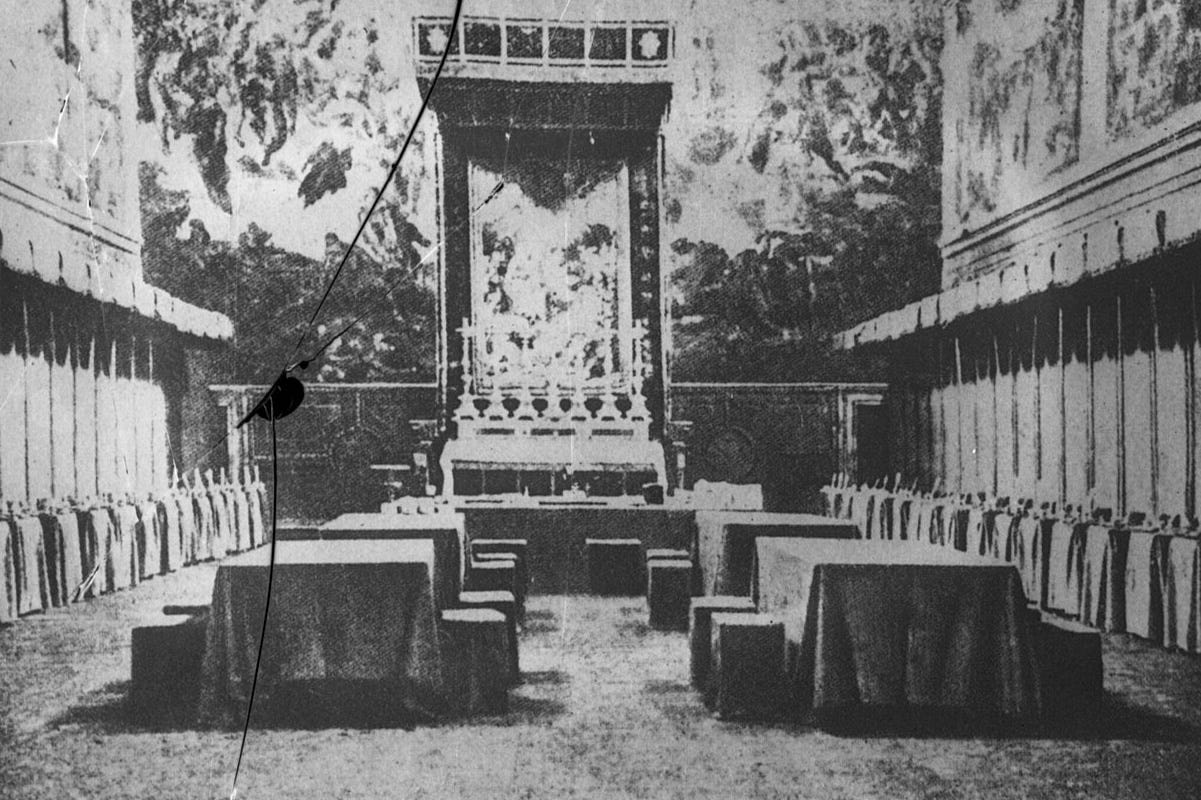
It is often asserted that, if the chair of St. Peter were vacant for a significant period of time, it would become impossible to elect a new pope. Here’s why this is false.
Introduction
It is often asserted that, if the chair of St. Peter were vacant for a significant period of time, it would become impossible to elect a new pope because there would be no cardinals left to carry out an election.
It is then argued that because the Church cannot fail to have the means to elect a new pope, it is impossible that there should be an extended vacancy.
However, this argument only has merit if the Church’s capacity to elect a new pontiff is dependent on the existence of the College of Cardinals. When we examine the history of the Church, we see that this is certainly not the case.
In fact, for more than half of the Church’s history, papal elections were not carried out by a college of cardinals.
For the first thousand years elections were carried out by the clergy of Rome and the bishops of the neighboring sees. During this period elections took various forms, and sometimes also involved the participation of the Roman laity, and even secular rulers such as Roman Emperors, and, later, Holy Roman Emperors.
In fact, we can posit three bodies of potential electors:
The College of Cardinals
The clergy of Rome
The bishops of the universal Church
The College of Cardinals
To seek the origins of the College of Cardinals we must go back to the earliest centuries of the history of the Church. The Cardinal Bishops were originally the bishops of the dioceses immediately neighboring Rome. The Cardinal Priests were those attached to certain important churches within the diocese of Rome, and the Cardinal Deacons were the deacons who administered the seven ecclesiastical regions of the city of Rome. Over the centuries each of these roles developed to meet the changing needs of the Church, and the body of cardinals grew in honor and prominence.
In 1059 a constitution of Pope Nicholas I decreed that after the death of a pope the Cardinal Bishops were to meet and select a number of the worthiest candidates. Afterwards, the other cardinals would join them and together they would elect a candidate from those selected, and, finally, the assent of the rest of the clergy and laity of Rome would be sought.
In 1139, the Second Lateran Council restricted the election to the cardinals, and in 1179 the Third Lateran Council introduced the requirement of a 2/3 majority. In 1274, the Second Council of Lyons introduced the rule that the cardinals meet together with no outside influences, thus establishing the institution of the papal conclave. The provisions established by these three councils have been the basis of papal elections ever since.
The clergy of Rome
However, should it ever be impossible, for whatever reason, for a college of cardinals to carry out a papal election, the right to election would revert to the Roman clergy. The reasons for this were expressed simply and straightforwardly by St. Robert Bellarmine:
First, because the right of election was transferred from all the neighboring bishops and the Roman clergy to the Cardinals, who are a certain part of the bishops and clergy of the Roman Church; therefore, when the Cardinals are lacking, the right of election ought to return to all the bishops and clergy of the Roman Church.
Second, because this is a most ancient custom (as we showed above from Cyprian), that the neighboring bishops, in the presence of the clergy, should elect both the Bishop of Rome and others also.1
A council of bishops
There is, however, a third possibility. The authority of Christ is exercised in the Church by the Roman Pontiff and by the other bishops who, in succession to the apostles, form with him the Apostolic College. The pope is the head of the visible Church. As a perfect society, the Church must have the power to select her head and, should an extraordinary vacancy occur, the power devolves to the other successors of the apostles, who have the right and power to meet and fill the vacancy.
St. Robert Bellarmine explains:
Without a doubt, the primary authority of election in that case pertains to a Council of Bishops; since, when the Pontiff dies, there is no higher authority in the Church than that of a general Council: and if the Pontiff were not the Bishop of Rome, or any other particular place, but only the general Pastor of the whole Church, it would pertain to the Bishops either to elect his successor, or to designate the electors.
St. Robert explains that while the college of bishops may be the primary authority, election by the clergy of Rome should be preferred since “after the Pontificate of the world was joined to the bishopric of the City, the immediate authority of electing in that case would have to be permitted by the bishops of the whole world to the neighboring bishops, and to the clerics of the Roman Church,” and this for the two reasons already given above.
However, the bishops of the whole world should meet, exceptionally:
… in a case where it is doubtful who should be the legitimate electors. For this doubt ought to be resolved by a general Council, as was done in the Council of Constance.
Thus is it is clear that, even should no cardinals remain, the Catholic Church always retains the ability to choose a new pope.
HELP KEEP THE WM REVIEW ONLINE WITH WM+!
As we expand The WM Review we would like to keep providing free articles for everyone.
Our work takes a lot of time and effort to produce. If you have benefitted from it please do consider supporting us financially.
A subscription gets you access to our exclusive WM+ material, and helps ensure that we can keep writing and sharing free material for all.
You can see what readers are saying over at our Testimonials page.
(We make our WM+ material freely available to clergy, priests and seminarians upon request. Please subscribe and reply to the email if this applies to you.)
Subscribe to WM+ now to make sure you always receive our material. Thank you!
Read Next:

The WM Review archive on Papal Elections
Papal elections without the cardinals? – St Robert Bellarmine
Papal elections without the cardinals? – Journet & Cajetan
What is the Church like during a period of sede vacante? Journet & Cajetan tell us
Papal elections without the cardinals? – Gaspar Hurtado SJ
Papal elections without the cardinals? – Cardinal Billot
Papal elections without the cardinals? – Francisco de Victoria OP
The Church could elect a pope even after a long vacancy: here’s how – M.J. McCusker
Fake conclave, true pope? – S.D. Wright
2 weeks or 60 years: Which fits Franzelin’s account of sede vacante?
Follow on Twitter, YouTube and Telegram:
St Robert Bellarmine, De Controversiis, De clericis, Book I, Chapter 10, translated by Mr James Larrabee.