

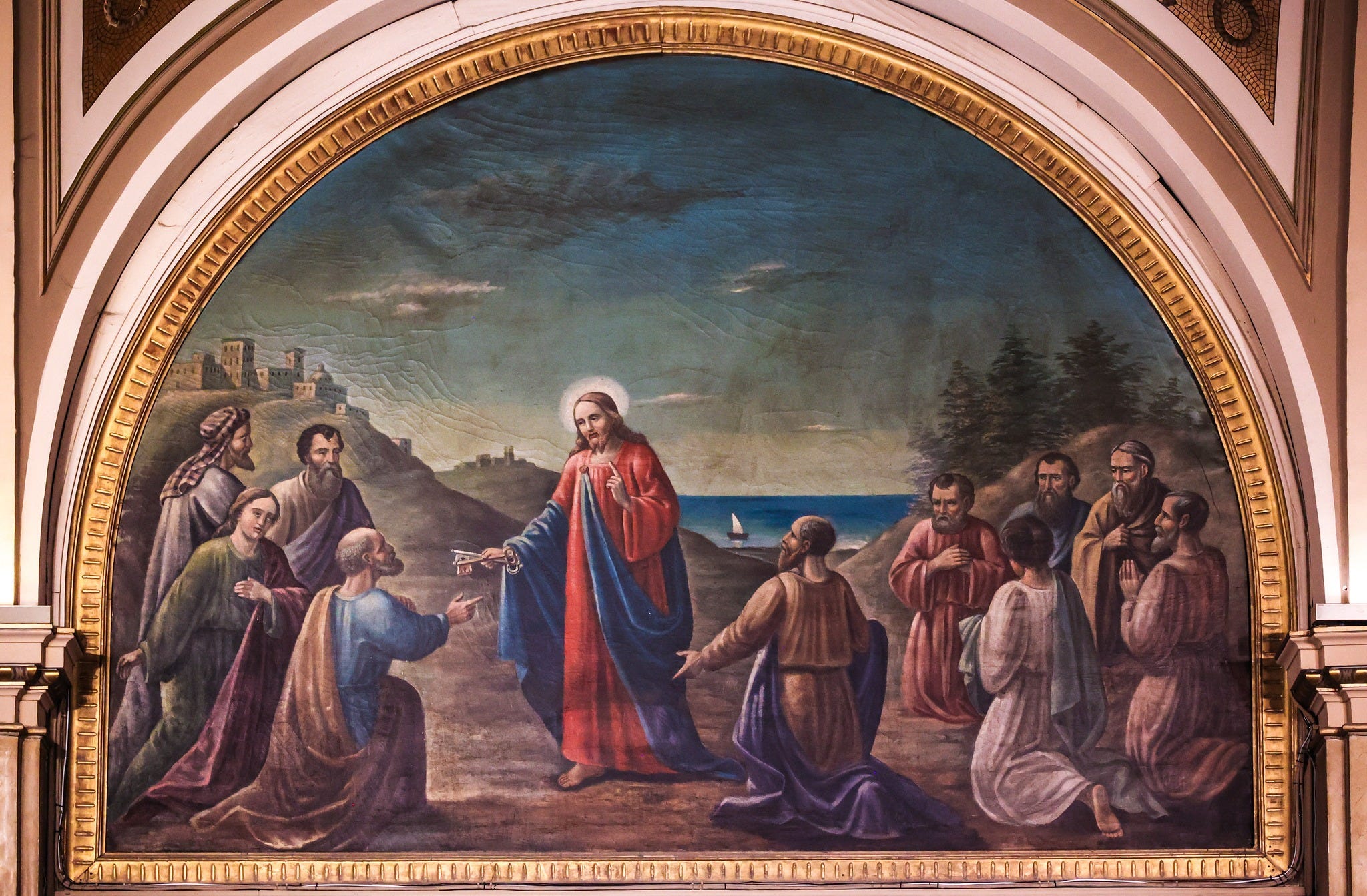
Indefectibility has become a popular topic – and it’s more important than ever to understand the doctrine correctly.
Editors’ Notes
The following article by Peregrinus presents the teaching of the magisterium on the Church’s indefectibility, and considers the implications of this teaching in our day.
The topic of indefectibility is at the front of mind at present, for both “sedevecantists” and for “sedeplenists”, and several articles or videos have been published on the topic in recent months. It is more important than ever that we have a correct understanding of the doctrine.
In addition to our own response to Fr Thomas Crean OP on the subject (Spotless and Unsullied), which has also been the subject of several videos with Stephen Kokx of Integrity Magazine, Alexander Poe also recently released a video exposition which we can recommend:
You can see S.D. Wright’s long article on the subject here:
‘The Elephant in the Room’: The Indefectibility of the Apostolic See
By Peregrinus
There is an ancient doctrine taught by many Popes and Doctors of the Church throughout her history; a doctrine always denied vehemently by heretics, because it is the effective and ever standing condemnation of their deviation from the Faith. It is also the foundation of that unshakeable confidence which prompted the great Doctor and Father of the Church, St. Augustine, to say:
“You are not to be looked upon as holding the true Catholic faith if you do not teach that the faith of Rome is to be held”1.
The doctrine to which I refer is one that many “sedeplenist” (viz., those who claim that the Holy See has continued to be legitimately occupied since Vatican II) Traditional Catholics have never encountered, or which has never been explained to them by the priests in the chapels that they frequent. In sedeplenist circles, this doctrine is conspicuous by its absence; it is very uncomfortable to hear it mentioned, because it perplexes them and makes them doubt their convictions.
Even the late Abp. Lefebvre was disturbed by its implications, which he seems to have understood well:
“It seems inconceivable that a successor of Peter could fail in some way to transmit the Truth which he must transmit, for he cannot – without as it were disappearing from the papal line – not transmit what the popes have always transmitted.”2
It is the elephant in the room, and however much you ignore it, it does not go away.
The doctrine to which I refer is that of the indefectibility of the See of Rome, and causally connected to it, the indefectibility of the Church in faith and morals.
Indefectibility means an inability to fail, to be corrupted or cease to exist. It is the constant and undisputed testimony of the Ordinary and Universal Magisterium throughout the ages that the See of St. Peter has always remained and will always remain free of any defect in the faith; that this See of Truth will never become the see of heretical pestilence3; that the Holy Roman Church, Mother and Teacher of all the churches, will never contradict, dilute or renounce the faith by teaching heresy.
This protection is the foundation of what is described to be “the perfect and perpetual immunity of the Church from error and heresy”.4 In fact, out of all the sees, “only to one particular Church is indefectibility assured, viz. to the See of Rome”,5 guaranteed by no other than the Church’s Divine Founder, Our Lord Jesus Christ.6
In other words, the Catholic Church is indefectible because the Roman See is indefectible.
Some Quotes from the Magisterium
Pope Saint Lucius I, Epist. I ad Episcopos Hispaniae et Galliae:
“The Roman Apostolic Church is the mother of all Churches and has never been shown to have wandered from the path of Apostolic tradition, nor being deformed, succumbed to heretical novelties according to the promise of the Lord himself, saying, ‘I have prayed for thee, etc.’”7
Pope Saint Gelasius I, Epistle to the Emperor Anastasius:
“This is what the Apostolic See guards against with all her strength because the glorious confession of the Apostle is the root of the world, so that she is polluted by no crack of depravity and altogether no contagion. For if such a thing would ever occur (which may God forbid and we trust cannot be), why would we make bold to resist any error?”8
Pope Pelagius II, Quod ad Dilectionem:
“Consider, most dear ones, that the Truth could not have lied, nor will the faith of Peter be able to be shaken or changed forever. For although the devil desired to sift all the disciples, the Lord testifies that He Himself asked for Peter alone and wished the others to be confirmed by him; and to him also, in consideration of a greater love which he showed the Lord before the rest, was committed the care of feeding the sheep; and to him also He handed over the keys of the kingdom of heaven, and upon him He promised to build his Church, and He testified that the gates of hell would not prevail against it.”9
Pope St. Agatho, Letter to the Sixth Ecumenical Council:
“[F]or [Peter] received from the Redeemer of all himself, by three commendations, the duty of feeding the spiritual sheep of the Church; under whose protecting shield, this Apostolic Church of his has never turned away from the path of truth in any direction of error...
“... by the grace of Almighty God, has never erred from the path of the Apostolic tradition, nor has she been depraved by yielding to heretical innovations, but from the beginning she has received the Christian faith from her founders, the princes of the Apostles of Christ, and remains undefiled unto the end...
“... the evangelical and apostolic uprightness of the orthodox faith, which has been established upon the firm rock of this Church of blessed Peter, the Prince of the Apostles, which by his grace and guardianship remains free from all error...”10
Pope St. Leo IX, Epistle to Peter of Antioch:
“Without a doubt, it was for he alone whom the Lord and Savior asserted that he prayed that his faith would not fail, saying, ‘I have prayed for thee, etc.’ Such a venerable and efficacious prayer obtained that to this point the faith of Peter has not failed, nor can it be believed that it is ever going to fail in his throne.”11
Pope St. Leo IX, In Terra Pax Hominibus:
“By the See of the Chief of the Apostles, namely by the Roman Church, through the same Peter, as well as through his successors, have not the comments of all the heretics been disapproved, rejected, and overcome, and the hearts of the brethren in the faith of Peter — which so far neither has failed, nor up to the end will fail — been strengthened?”12
Pope Innocent III, Sermon II (On the Consecration of the Supreme Pontiff):
“If I were not made firm in the faith, how could I strengthen others in the faith? That is what is recognized as pertaining especially to my office, as the Lord witnesses: ‘I have prayed for thee, Peter, that thy faith not fail; and thou being once converted, confirm thy brethren.’ He prayed and He brought it to pass, since He was heard in all things out of reverence for Him. And therefore the faith of the Apostolic See has never failed in any disturbance, but has always remained whole and unimpaired in order that the privilege of Peter should persist unshaken.”13
Pope Innocent III, Apostolicae Sedis Primatus:
“The Lord confesses at the time of the Passion that he prayed for him: ‘I have prayed for you, Peter, that your faith may not fail: and when you have turned again, strengthen your brethren,’ by this manifestly indicating that his successors would never at any time deviate from the Catholic faith, but rather, they would recall others and also strengthen the hesitant...”14
Council of Florence, Session 13:
“... the most illustrious profession of the Roman Church about the truth of the faith, which has always been pure from all stain of error...”15
First Vatican Council, Pastor Aeternus:
“So the fathers of the fourth Council of Constantinople, following the footsteps of their predecessors, published this solemn profession of faith: ‘The first condition of salvation is to maintain the rule of the true faith. And since that saying of our lord Jesus Christ, You are Peter, and upon this rock I will build my Church, cannot fail of its effect, the words spoken are confirmed by their consequences. For in the Apostolic See the Catholic religion has always been preserved unblemished, and sacred doctrine been held in honor. Since it is our earnest desire to be in no way separated from this faith and doctrine, we hope that we may deserve to remain in that one communion which the Apostolic See preaches, for in it is the whole and true strength of the christian religion.’
“... It was for this reason that the bishops of the whole world, sometimes individually, sometimes gathered in synods, according to the long established custom of the Churches and the pattern of ancient usage referred to this Apostolic See those dangers especially which arose in matters concerning the faith. This was to ensure that any damage suffered by the faith should be repaired in that place above all where the faith can know no failing...
“Indeed, their apostolic teaching was embraced by all the venerable fathers and reverenced and followed by all the holy orthodox doctors, for they knew very well that this See of St. Peter always remains unblemished by any error, in accordance with the divine promise of our Lord and Savior to the prince of his disciples: “I have prayed for you that your faith may not fail; and when you have turned again, strengthen your brethren.”16
Pope Leo XIII, Satis Cognitum:
“The meaning of this divine utterance is, that, notwithstanding the wiles and intrigues which they bring to bear against the Church, it can never be that the church committed to the care of Peter shall succumb or in any wise fail... And since all Christians must be closely united in the communion of one immutable faith, Christ the Lord, in virtue of His prayers, obtained for Peter that in the fulfilment of his office he should never fall away from the faith.”17
Implications of This Doctrine
Some Catholic theologians deny that the Pope, even as a private person, can ever defect from the faith, while others admit the possibility of a Pope defecting as a private person or private theologian.
However, all Catholic theologians either deny that the Pope as Head of the Church can teach the Universal Church heresy, or, with Gregory of Valencia and Torquemada, say that he could attempt to do such a thing but it would be in vain because by that attempt he would show that he had “lost his authority through manifest heresy” and the Church “would immediately recognize that he is no longer really the pope.”18
When confronted with this doctrine, some sedeplenist apologists will deny that the manifest errors of the Conciliar pretenders rise to the level of heresy, but this is easily refuted because of the not infrequent brazenness of the said pretenders in recognizing the opposition between their ideas, and the traditional teaching of the Church.
Others will try to deflect by claiming that these men are unaware of the contradiction between their statements and the Faith – but should we not expect someone who was first a Bishop, Cardinal and then supposed Pope to know the basic doctrines of the Faith?
Finally, there are those who will even try to deny that the pretenders’ heresies are public or notorious. But when every excuse is defeated, what will they do?
Differing Interpretations
They will tackle the elephant in the room. What else can they do? What can they say?
They are left only with the choice of accepting the dogma and its inevitable conclusion (which they dread, because they have been conditioned to dread it as the worst thing imaginable), or of changing the interpretation of the dogma.
At this step those who love the truth will stop and reflect, maybe a long time, and will not object any more. Some will accept the conclusion that is made manifest to their intellects. And some will be stuck somewhere in the middle, in the domain of doubt and fear, wanting to accept the dogma, but not the conclusion that inevitably proceeds from its application – because it is frightful to them, as an earthquake shaking the very foundations of their position, and asking them with every tremor:
Do you love the truth, even when it is difficult to bear? Do you love the truth enough to lose friends, to be scorned, attacked, defamed, accused, denied communion, ejected out of churches for its sake? Do you love the truth so as to shun all the subtleties of errors invented by those who would not accept it? Do you love the See of the blessed Peter so, that you will not permit its greatest glory to be denied, or an impostor to be glorified in its place? Do you love your Holy Mother Church so, that you will defend her honor when she is accused of infidelity, or when a harlot comes forward wanting to supplant her?
Others, however, will immediately seek to change the interpretation, so that it would fit the conclusion that they desire. They will say: Every time that the Popes and Doctors teach that the faith of the Apostolic See is indefectible, what they mean is that it is infallible when defining doctrine or condemning errors.
In other words, they will make the indefectibility of the Apostolic See the same thing as Papal Infallibility. The former can be correctly described as the passive protection of the See against error in faith, which is always in effect (proclaimed by Our Lord with the words “I have prayed for thee, that thy faith fail not...”), and the latter as the active protection of the Pope against error in faith, when the Pope wields it (proclaimed by Our Lord in that same sentence: “...and thou, being once converted, confirm thy brethren.”).
On the other hand, if we apply their interpretation to the present crisis, the quote from Pastor Aeternus would then mean something like this:
“This See of St. Peter always remains unblemished by any error, unless you count all of those grave errors and heresies it teaches the Universal Church without engaging infallibility.”
The meaning of Satis Cognitum would be:
“That in the fulfilment of his office he should never fall away from the faith, even if in the fulfilment of that office he teaches the Church all kinds of abominable errors and heresies, so long as they do not involve an infallible definition.”
And when this interpretation is applied to the whole Church, the words from Quas Primas would mean that the Church has
“… perfect and perpetual immunity from error and heresy, but absolutely no immunity from those errors and heresies that the Pope (or an ecumenical council under the Pope) teaches the Church without using definitions.”
A False Path
With apologists such as these, how easy it is for the Modernists! They can change the faith as much as they want into whatever they want, both in preaching and in catechisms, they can institute marriage ceremonies for unnatural perversion (they have already started with the so far “informal” blessings), they can introduce women “priests” and “bishops”, and as long as they do not define anything, that society will supposedly still be the Church and they will supposedly still be popes.
However, that would ultimately make the See of St. Peter, outside the strict limits of infallible definitions, no different than the seat of any heretical sect; far from being safe and confident in giving due filial obedience to its teaching, Catholics would always have to be on guard lest they be infected with some heterodox contagion proceeding from it. But never has any Catholic been advised to be guarded towards the teachings of the Holy Roman Church, or to sift through them for heresy. What an impious thought!
Some apologists will even go so far as to say that the only time the Pope actually teaches the Church is when he infallibly defines or condemns something, and that in every other case he is teaching merely as a private theologian, and so they will ironically find themselves affirming precisely the error of which they falsely accuse sedevacantists – that every teaching of the Papal Magisterium is infallible.
Consequences Following
However, what some of these sedeplenists have actually done is to neutralize the dogma in their minds. They have relegated it to the status of a synonym of Papal Infallibility, filed it away in a drawer of the mind, and forgotten about it.
But “if wishes were horses, beggars would ride”: treating something as if it does not exist will not change the truth of things. Thus, their every word in condemnation of the Modernist heresies found in the official teaching of the supposed Roman Pontiff will raise the question to which they will not have an answer, as will their every action done to preserve the Faith in opposition to the authority and Magisterium of the supposed Roman Pontiff (e.g. professions of faith, episcopal consecrations, and so on).
It pains me to say that if they are consistent in their thinking, what some of them end up believing in and confessing is not just a defected Roman Pontiff, but a defected Church (another impossibility contrary to dogma) – a Church:
Which professes and officially teaches all kinds of pernicious errors and heresies to its faithful,
Which by its laws permits sacrilege and deviations from the moral law,
Whose official liturgy diminishes the faith of its faithful and the reverence due to God.
In short, it would be a Church which in no way resembles Christ’s Immaculate and Chaste Bride (“not having spot or wrinkle”19), of whom the Roman Catechism teaches “This one Church, seeing it is governed by the Holy Ghost, cannot err in delivering the discipline of faith and morals”.20
The True Path
The solution, the way to recover true faith in the Church, as we profess in the Creed, is not to run away from the infallible doctrines of the indefectibility of the Apostolic See and of the Church, but to hold them firmly in our minds and in our hearts, where they will give us strength to know “that Jesus Christ, hanging on the Cross, opened up to His Church the fountain of those divine gifts, which prevent her from ever teaching false doctrine”21; and that despite all the assaults against her of both ancient and recent heretics, “never at any time were they able by any artifice or exertion to make this [Apostolic] See tolerate even a single one of their errors”.22
Do this, my dear sedeplenist friends and brothers in Christ, and (I speak from personal experience) the truth will set you free.
My recapitulation and conclusion are these words of Pope Pius XII:
“Mother Church, Catholic, Roman, she who has remained faithful to the constitution received from her Divine Founder, and who even today stands firmly on the solid rock on which He willed to found her, possesses in the primacy of Peter and of his legitimate successors, the assurance, guaranteed by Divine promises, of maintaining and transmitting whole and inviolate, through centuries and tens of centuries, even to the end of time, the whole body of truth and grace contained in the redemptive mission of Christ.”23
HELP KEEP THE WM REVIEW ONLINE WITH WM+!
As we expand The WM Review we would like to keep providing free articles for everyone.
Our work takes a lot of time and effort to produce. If you have benefitted from it please do consider supporting us financially.
A subscription gets you access to our exclusive WM+ material, and helps ensure that we can keep writing and sharing free material for all.
You can see what readers are saying over at our Testimonials page.
And you can visit The WM Review Shop for our ‘Lovely Mugs’ and more.
(We make our WM+ material freely available to clergy, priests and seminarians upon request. Please subscribe and reply to the email if this applies to you.)
Subscribe to WM+ now to make sure you always receive our material. Thank you!
Read Next:


Follow on Twitter, YouTube and Telegram:
Twitter (The WM Review)
Sermo cxx., n. 13
Homily of Abp. Lefebvre in Ecône, September 18, 1977
Bishop Bossuet of Meaux:
“If this Roman See could fall and be no longer the See of truth but of error and pestilence, then the Catholic Church herself would not have the bond of a society and would be schismatic and scattered - which in fact is impossible.”
(Quoted by Bishop Gasser in the Relatio of Vatican I)
Pope Pius XI, Quas primas
Joyce, The Church, 1908, in the Catholic Encyclopedia
Luke 22:31-32, Matthew 16:18
Quoted by St. Robert Bellarmine, On the Roman Pontiff, vol. 2: Books III-V [De Controversiis], p. 157
Idem, p. 161
Denzinger, 246
On the Roman Pontiff, vol. 2, p. 158
Denzinger, 351
Denzinger, 43rd edition, 775
Ephesians 5:27
Part I, Ch. X, Q. XVI
Pope Pius XII, Mystici Corporis
Pope Pius IX, Nostis et Nobiscum
Pope Pius XII, Allocution to the Consistory, June 2, 1944; translation from The Catholic Mind, vol. 42 [July, 1944], pp. 389-391

Thank you to Mr. Wright for editing and publishing the article.
I would describe the Indefectibility of the Roman See as a suit of armor and shield that the Pope always wears, and Infallibility as the sword that he takes out of its scabbard, when necessary, and wields to lead the Church Militant in spiritual combat, to confirm his brethren and to condemn error.
Our Sedeplenist brothers should reflect especially on that quote from Pope Pius XII at the end of the article. If they try to apply it to the Conciliar-Synodal Church, they will necessarily conclude that it does not "maintain and transmit whole and inviolate, through centuries and tens of centuries, even to the end of time, the whole body of truth and grace", which means that it does not have "the assurance, guaranteed by Divine promises" of doing this. This means that it is not the Catholic Church but a counterfeit, and that the head of this counterfeit Church, the leader of the Revolution against the True Church, is not the head of the Catholic Church.
This scholarly yet genuinely pastoral approach to the age-old Catholic teaching on the indefectibility of the Roman See being intimately connected with the indefectibility of the Church brought for me a clarity in this unprecedented crisis that I have long sought but did not know. Indeed, the truth does set you free. By acknowledging the hesitations and fears of those Catholics seeking to be as authentic as possible about tackling this elephant in the room, this article lays out what is not promised in the statement the truth will set you free. Nowhere is it promised that coming to know the truth will make you feel good; nowhere is it promised that coming to know the truth will not jarring. But the truth is still there, it is still the reality of the situation, acknowledged by the individual or not.
The statements connected with the Society of St. Pius X's consecration of four priests as bishops without papal mandate are what jarred my thought process to dive deeper into the indefectibility of the Church. I began to find it perplexing that the SSPX leadership could speak so forcefully and even correctly of the True Church founded by our Lord Jesus Christ and a conciliar church, a modernist church, AND, at the same time, plead for permission to proceed from those who are promulgating heresies from the conciliar church, the modernist church. As well-intentioned as they may be in trying to continuing navigating as authentic Catholics in the context of decades of confusion, it hit me (perhaps a jolt from the Holy Ghost) that there cannot exist the two churches -- the True Church and the conciliar church -- in one entity. Or to put it more plainly, the man generally acknowledged as occupying the Seat of St. Peter cannot be head of both the True Church and the head of the conciliar church at the same time. In short, the step the SSPX does not yet seem willing to take is to admit its seeming acts of disobedience are to protect the flock from the Pope. And that is the thing that is so scary. Yet think of the possibilities if the SSPX ever comes, officially, to embrace the truth of the indefectibility of the See of St. Peter.