

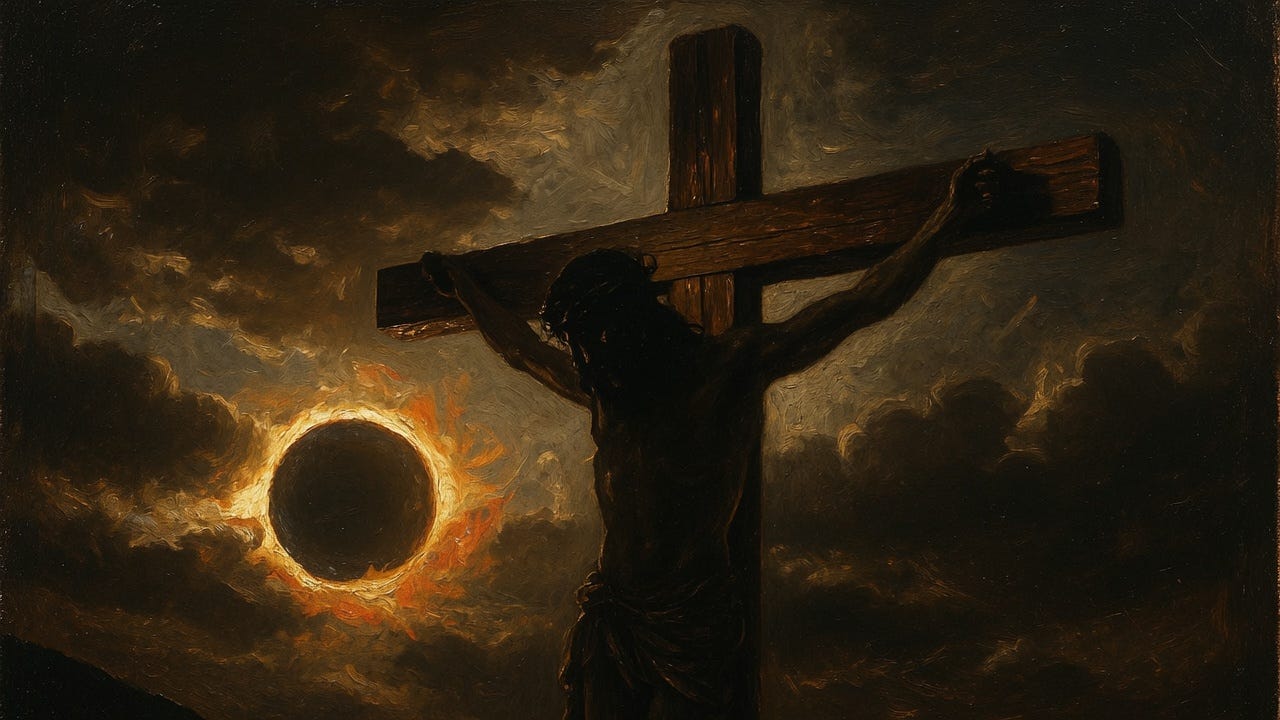
Following on from his article comparing the crisis in the Church with the Passion of Christ, Peregrinus now compares it with the eclipse that took place while Our Lord was on the Cross.
The Passion and the Eclipse
By Peregrinus
In an earlier article, Peregrinus wrote about the parallels between the Passion of Our Lord Jesus Christ and the Passion of His Mystical Body, which is the Holy, Catholic, and Apostolic Roman Church.
Today, he writes about another mystical connection between the two.
The Testimony of Holy Scripture
Erat autem fere hora sexta, et tenebræ factæ sunt in universam terram usque ad horam nonam. Et obscuratus est sol, et velum templi scissum est medium.
And it was almost the sixth hour; and there was darkness over all the earth until the ninth hour. And the sun was darkened, and the veil of the temple was rent in the midst. (Luke 23:44,45)
The Latin verses are from the Vulgate Bible, St. Jerome’s faithful translation from Greek and Hebrew manuscripts. For centuries, the Vulgate was the only version of Scripture used in the Western Church, and it was the basis for vernacular translations until the mid-twentieth century. The Douay-Rheims Bible was translated directly from the Vulgate.
The verses describe what happened as Our Lord Jesus Christ commended His spirit into the hands of His Eternal Father. Let us focus on the beginning of the second verse, describing the sun, and the word “darkened.”
St. Luke is the only Evangelist to mention the sun. In the Vulgate the word given is obscuratus, which can mean darkened, concealed, or hidden. However, in astronomy, one of the ways of saying “the sun was eclipsed” is exactly obscuratus est sol, a phrase popular in authors from the Middle Ages because of the influence of that form in the Vulgate.
In the Greek texts, the phrase is (toû hēlíou) eklipóntos, which comes from the verb ekleípō, with various meanings (e.g. to faint, to fail, or to depart). When used in astronomy it means to be eclipsed, and it is the origin of the word ékleipsis - eclipse. This is why the modern NAB translation, which is translated from the Greek rather than from the Vulgate, translates this part as (darkness came...) because of an eclipse of the sun.
Further Testimony
Is there, then, any other mention of a total solar eclipse occurring during the Crucifixion?
Indeed there is, in the apocryphal Gospel of Nicodemus. This “Gospel” was not included in the Bible, because it was not certain that it was divinely inspired – but it was very popular during the Middle Ages, and the Catholic Encyclopedia says that it is “of orthodox composition and free from Gnostic taint”.1 It is precisely from this text that we learned the names of St. Longinus (the Roman centurion who pierced the side of Jesus) and of St. Dismas (the Good Thief).
The Gospel of Nicodemus has Pilate asking the Jews if they saw the darkness, and they answer: “There has been an eclipse of the sun in the usual way”2, which means precisely that it was not in the usual way – solar eclipses last only about 7.5 minutes, not 3 hours – because they did not want to admit to him that something extraordinary happened.
In her visions, Anne Catherine Emmerich also describes the unnatural eclipse, and the great anxiety it caused among both men and beasts, with the Pharisees insisting to Pilate that it was a completely natural event.3
A Mystical Allegory
Why is all this important, and how is it connected to the Passion of the Church?
Since the Mystical Passion of the Church parallels the Passion of Christ, I do not think we could find a parallel that describes the state of the Church today as precisely as that phenomenon of an extended total solar eclipse – which we have good cause to believe was present at the Crucifixion.
Let us imagine a man who did not know what a total solar eclipse is, experiencing one for the first time. When he went out of the house and saw it in the sky, he would think that he was looking at one body, the Sun, which had for some reason gone dark, and only an outer ring could be seen. The Earth would be covered in darkness.
If, for the sake of our consideration, such an eclipse continued for years, he would simply think that that is how the Sun had come to look. His children, born after the eclipse started, would not even know that a different Sun existed.
Well, the Catholic Church is, fittingly, the Sun, since she illuminates the world with sanctity of life and heavenly doctrine. The dark Moon obscuring the Sun is the Modernist sect (those who publicly confess the Modernist heresies, and especially the intruders who occupy the churches and usurp the positions of authority), which has placed itself in the position of the Sun4, obscuring it (“Et obscuratus est sol”) so that the observer can see but a tiny fragment of its rays (the true doctrine and Mass now found in few places). The Earth covered in darkness represents the world which lost its moral compass and sank into the worst sins and faithlessness, now that the Church is occupied by Modernists, and her visibility and guiding light is diminished.
Just as the observer thinks that what he is seeing is the Sun having gone dark, people think that they are seeing the Catholic Church changing her doctrine and rites, and ceasing to shine with the holiness and purity that they (even non-Catholics) had previously observed in her. Those born after the change do not even know of a different church than that dark entity with a shiny edge they grew up seeing.
But to a few, it is given to see that the Church is not that entity; that what they see is just an appearance. It is in fact two bodies that they see: one, bright, which is the Church, the body being eclipsed; the other, dark, the Modernist sect, the body eclipsing the former.
The unnaturally long duration of the eclipse at the Crucifixion is another parallel, since it was over 24 times longer than the longest natural eclipse; the current vacancy of the Apostolic See, depending on which year is taken as the start, has been from 22 to over 24 times longer than the longest “normal” vacancy (2.76 years, in the late 13th century).
Further Explanation
To the common observer, the appearance is that of one body, composed of…
(a) Catholics, deceived into thinking that the Conciliar Church represents the Catholic Church (which is not surprising, because materially it seems to be the same body with the same name and succession of pastors), and also
(b) all kinds of Modernist heretics,
… with each category confessing a multitude of opposing doctrines.
This mirage of one body is the Conciliar Church – those who recognise the Conciliar pretenders as popes and submit to them. It is no wonder, then, that the Conciliar Church is not united in faith, since it is not in fact one body.
On the other hand, Traditional Catholics are that shining remnant of the Sun visible at the edge, marginalised and small, but still showing the beauty and holiness of the True Church in her rites and her doctrine, so that even so obscured, she is always attracting new converts. One of the distinguishing features of Traditional Catholics is precisely this refusal to submit to the darkness of the Modernists, and even though some verbally recognise the usurpers, none truly submit to them. The eyes of Traditional Catholics are not veiled by that darkness and by ignorance of the Faith (unlike those who are still Catholic but trapped in the N.O.), they are not mixed up in the chaos of the Conciliar Babylon (“Go out from her, my people...”5). They are the ones who obey what God commands through His Apostle:
Bear not the yoke with unbelievers. For what participation hath justice with injustice? Or what fellowship hath light with darkness? And what concord hath Christ with Belial? Or what part hath the faithful with the unbeliever? And what agreement hath the temple of God with idols? For you are the temple of the living God; as God saith:
I will dwell in them, and walk among them; and I will be their God, and they shall be my people. Wherefore, Go out from among them, and be ye separate, saith the Lord, and touch not the unclean thing: And I will receive you; and I will be a Father to you; and you shall be my sons and daughters, saith the Lord Almighty. (2 Cor. 6:14-18)
Reflection
This Crisis has lasted a long time. The sea is relentless, the little ship is now filled with water, and the storm is raging all around us. We can do nothing to stop it; we are powerless. Our Lord seems asleep.
Let us pray that He may soon rebuke the wind and calm the waves, but let us not be of little faith: He is in control. All will marvel when He miraculously intervenes to end these times of darkness, just as they marveled at the See of Galilee.6 To quote Mr. John Lane, “this crisis is a crisis of faith”; as such, a renewal of faith is the answer.
Note
The analogy of the eclipse was adopted because it seems to be the best phenomenon to describe the state of the Church, and because it seems to show another parallel between the Passion of Christ and the Passion of His Mystical Body.
Not counting the visions of Anne Catherine Emmerich (which are neither approved nor condemned by the Church), this article is not intended to promote any supernatural messages or books containing such, and especially not those condemned by the Church.
We know that there is a multiplication of various false messages in modern times. If such are found to mention the same phenomenon, that does not mean that the analogy presented in this article is false (or that those messages are true), because even in false supernatural messages there are often elements of truth to make them more believable.
HELP KEEP THE WM REVIEW ONLINE WITH WM+!
As we expand The WM Review we would like to keep providing free articles for everyone.
Our work takes a lot of time and effort to produce. If you have benefitted from it please do consider supporting us financially.
A subscription gets you access to our exclusive WM+ material, and helps ensure that we can keep writing and sharing free material for all.
You can see what readers are saying over at our Testimonials page.
And you can visit The WM Review Shop for our ‘Lovely Mugs’ and more.
(We make our WM+ material freely available to clergy, priests and seminarians upon request. Please subscribe and reply to the email if this applies to you.)
Subscribe to WM+ now to make sure you always receive our material. Thank you!
Read Next:


Follow on Twitter, YouTube and Telegram:
Twitter (The WM Review)
Chapter 11, paragraph 2
The Dolorous Passion of Our Lord Jesus Christ, chapters 43-44
From the Prayer to St. Michael: “In the Holy Place itself, where has been set up the See of the most blessed Peter and the Chair of Truth for the light of the world, they have raised the throne of their abominable impiety, with the iniquitous design that when the Pastor has been struck, the sheep may be scattered.”
Revelation 18:4
Matthew 8:23-27, Mark 4:35-41, Luke 8:22-25
My thanks to Mr. Wright for editing and publishing the article.
I remember those words by Mr. Lane: "renewed faith is the answer", or something similar to this phrase, but I don't remember the exact place where he says this. If someone can remind me, it would be much appreciated.
Just as the Apostles were powerless before the storm and the raging sea, we are indeed powerless to provide a solution to this Crisis. They begged Our Lord to intervene, and we must do the same, because only Our Lord can end it, but we can find an explanation for the Crisis, which the WM Review is in fact doing very well, and we can find an answer to the Crisis, which, as Mr. Lane said, is faith - to believe all that the Church teaches, even if there are mysteries in this Crisis that we cannot explain right now. This Faith we must not contradict or change in any way, whether by accepting the Modernist errors, or by adopting novel errors to avoid coming to terms with some unpleasant conclusions or to justify what we would like the situation to be, instead of what the reality is, as some trads have unfortunately done (both in the sedeplenist and sedevacantist camps). We don't need to "reinvent" the Faith, we only need to keep it.
Some commentaries see the actual darkness from the sixth to the ninth hour as a manifestion of the spiritual darkness of those who cried, ‘Crucify Him' - a complete dearth of faith. This considered, the Novus Ordo ignorantly or willfully cries out the same as they prefer the Concilliar ‘V2 "mercy" Ecumenism/human respect’ rather than Our Lord Jesus Christ - Sun of Justice. It is down to seeking or refusing the True Faith.