
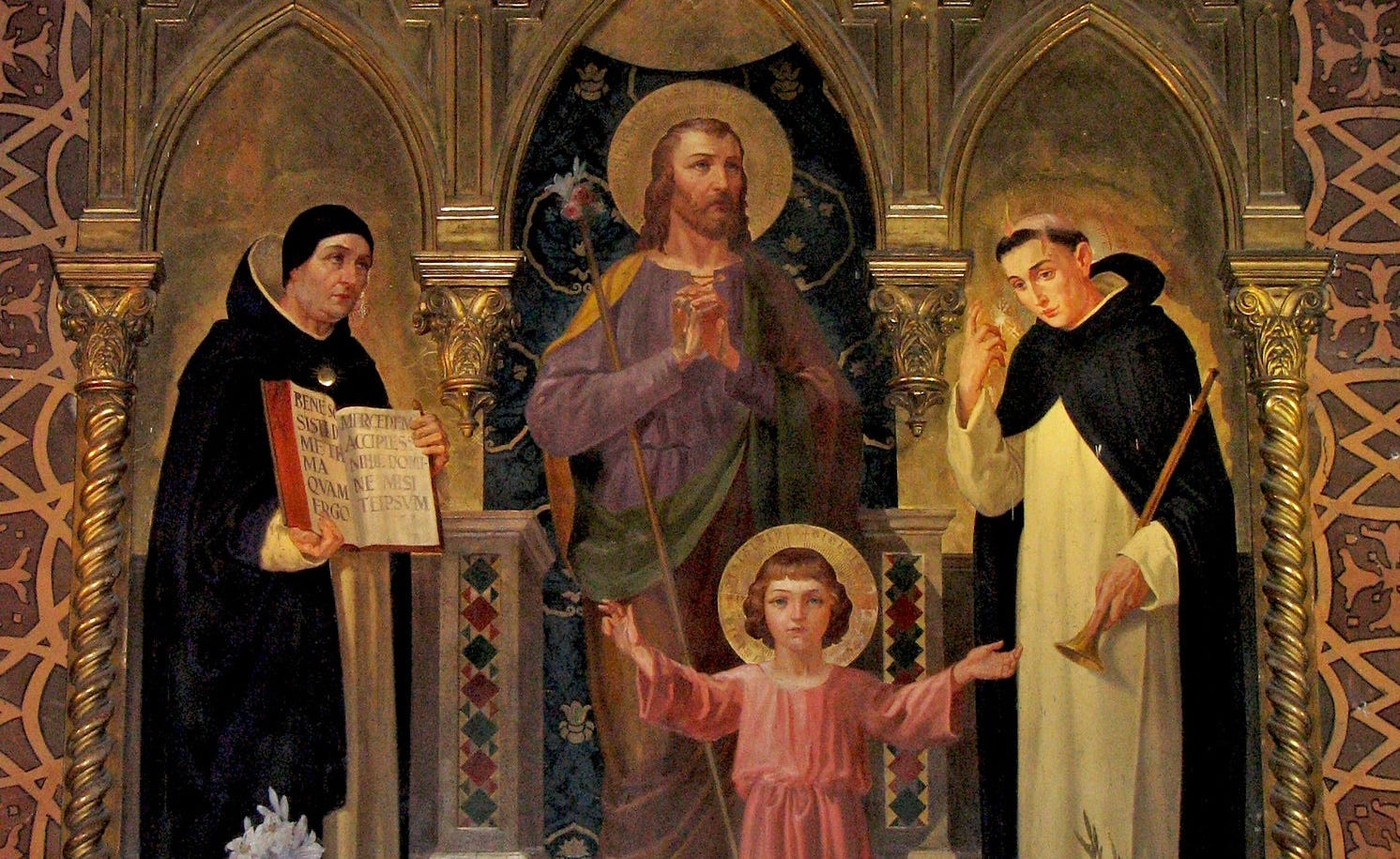
What was the nature of St Joseph’s holiness – and what role did his relation to Our Lady play in it?
Editors’ Notes
In 1847, Pope Pius IX instituted a feast to celebrate St Joseph as the protector and patron of the Church. This was observed in Eastertide; Pope St Pius X later fixed it on the Wednesday between the Second and Third Sundays of Easter. Pope Pius XII later replaced it with the feast of St Joseph the Worker (1st May).
Earlier in the year, on the Feast of St Joseph on March 19, we published a 1987 sermon Mgr Guérard des Lauriers. That sermon was on the relationship between St Joseph and the Church.
In honour of the day on which the Eastertide feast historically fell, we are publishing another text from the same bishop on St Joseph.
This is the first part of a longer text, published in the July–August 1986 edition of Sous la bannière. We have separated the text into two parts to be published separately.
In this first part, Mgr Guérard des Lauriers focuses on why St Joseph is “Saint Par Excellence”, grounding his exposition on the teaching of Pope Leo XIII and the saint’s relation Our Lady, and communication of goods entailed in marriage. Given that the feast of March 19th is more focused on St Joseph as the spouse of the Blessed Virgin, and this feast is more focused on St Joseph as the protector of the Church, we could have more fittingly published the two texts the other way around.
The footnotes themselves are lengthy: at 1,700, they are longer than the text itself (1,500 words). They contain a lot of interesting material that explain in detail some of points he makes in the text.
Mgr Guérard des Lauriers was a very significant figure in post-Vatican II theological controversies. For more on his life and legacy, see HERE.
St Joseph: Saint Par Excellence
Mgr Guérard des Lauriers OP
Part I of St Joseph: Saint Par Excellence, Saint of Silence
In Sous la Bannière, n. 6, July–August, 1986
Text separated into two parts by The WM Review for ease of reading. Headings and some line breaks added for the same reason.
We believe that our translation of this text is covered by fair use; if there is an existing copyright holder who would like us to remove it, they can reach us in the comments to this article.
The unfolding of truth
The unfolding of the Truth is a fruit that the SPIRIT ripens within the Church. And in reality, this unfolding is what gives structure to the flow of time. The Word was made flesh,1 and this was “the fullness of time”2 – the fullness, that is, of Truth manifesting itself in time. Since then, for each of the Truths revealed from the very beginning, there has been a “time of fullness” marking its definitive assimilation by the divinely taught Church militant.
In this sense, there was in the Church a time of the most Holy TRINITY, a time of the INCARNATE WORD, a time of the REDEMPTION and of the SACRAMENT truly containing the CHRIST IMMOLATED, RISEN, GLORIFIED. Each of these Realities was, let us say it again, known and lived from the very origin; but it was in the fullness of its own time that each began to command the attention of Christendom.
Now, in the Church militant, it is the fullness of time for Joseph, the hidden Saint.3 He showed himself at Fatima; through the “humble Brother André,” he worked very many miracles at “Saint Joseph’s of Mount Royal” in Canada. And since he took no part on earth in the Passion of Jesus, is it not fitting that he should stand, with Him and with Mary, at the bedside of the Church in her agony? Let us come to know his presence better, discerning in the silence that prepared the hour of Saint Joseph the providentially fitting sign of his eminent holiness.
A Saint is a [human] creature who, through the patient exercise of the virtues grounded in grace, has first made it possible, and then conformable to the divine Wisdom, that God should fill him with His own Holiness. Here there are two things to consider, for it is fitting, at least “quoad nos,” to distinguish them.4 On the one hand, the degree of holiness: the “thrice Holy” God is “more or less” participated5; and this “more or less,” ex se, already pertains to quality. On the other hand, the modality, or type, or quality – if not of Holiness itself, at least of the path that leads to it and of the finition in which it flowers. The Saints are each themselves, irreducibly... virginally6; yet all are holy, substantially, with the same Holiness.
What, in the case of Saint Joseph, is the degree of holiness, and what its quality? To contemplate these, let us decipher, in the words and in the facts, what the revealed message is.
Saint Joseph, Saint Par Excellence
Jesus, Mary, and Joseph form that Family which is holy. Jesus is the Holy One of God,7 Holy because He is God. Mary is invested with the grace whose very substance is God Himself, because She is immaculate.8 What, then, of Saint Joseph?
Leo XIII gave precious teaching on this point. Having recalled that “dignity, grace, holiness, and glory have their fulfilment [profectæ] in Joseph, by virtue of the twofold relation he bears: to Mary, whose husband he is, and to Jesus, whose father he is putatively,”9 the Pope goes on:
“It is certain that the dignity of Mother of God is so exalted that nothing surpassing it could have been created. But since the bond of marriage has joined Joseph to the blessed Virgin, there is no doubt that Joseph himself drew near, as no one else has done more [UT NEMO MAGIS], to that supereminent dignity by which the Mother of God towers over all created natures. For marriage is in effect a society, the closest of all bonds, carrying with it by its very nature the communication [or sharing] of goods between the two spouses.
“Now, concerning this point, if God gave Joseph to the Virgin as her husband, it is certain [profecto] that He gave her not merely a companion of life, a witness of her virginity, and a guardian of her honour, but also, through the conjugal bond itself, a participant in her supereminent dignity.”10
Three Data Points
From this magisterial teaching, then, three certain data points emerge, each presupposing and specifying those that precede it.
a. The fulfilment, the state of completion, with respect to holiness [and to dignity, grace, and glory] comes to Saint Joseph from the relation he bears to Mary and to Jesus.
b. The nature of the relation Joseph bears to Mary has two valences, one human, the other theological, whose unity is at once analogical and ontological.11
The relation between Joseph and Mary is the matrimonial bond: that is the human valence. Now this bond, so intimate, involves as its primary content12 the communication of goods. And Leo XIII dares to affirm that this communication, inherent in the nature of marriage, extended from Mary to Joseph to include even the most excellent good Mary possessed – namely, being Mother of God. Such is the theological valence, in Mary and in Joseph, of their conjugal relation.
That there is analogy between the two valences – an objective analogy, in reality – is easy to see. The communication of human nature could not have been more perfectly realised than in the act whereby that nature is assumed by and in the Word who created it. And since this communication was originally and purely to take place in marriage, it was fitting that the supreme realisation of this communication should subsist in such an excellent marriage. Finally, since the communication proper to marriage flows, between the spouses, from the communication of nature itself, the same excellence had to belong unitedly and analogically both to the [physical] communication of [human] nature and to the theological communication between the [persons] of the spouses. If, per impossibile, the very act of Mary at the Incarnation had not been shared by Joseph in some way, it would have been the very essence of marriage as divinely instituted that suffered violation. Joseph is not merely a companion of life for Mary; he “participates in the supereminent dignity of his Spouse.” This is what the Vicar of Jesus Christ affirms with a discrete but inexorable rigour.
With this comes a second precision. We know that the fulfilment of holiness comes to Joseph from the relation he bears to Mary [and to Jesus].^(a) We must further understand that, in the relation Joseph bears to her, Mary does not figure merely as the Immaculate Virgin radiating the Uncreated in the transparency of her virtues; she figures expressly in that prerogative “so exalted that nothing surpassing it could have been created.” The fulfilment of holiness comes to Saint Joseph from the fact that he is constituted a participat [“Deus Josephum dedit... participem...”] in “the supereminent dignity” proper to his Spouse: that of being Mother of God – that is, being wholly relative to the Word of God incarnating Himself in her.13
The ‘maximal’ holiness
c. The relation Saint Joseph bears to the Blessed Virgin is, with respect to the entire created order and in its theological valence, maximal.
This is [already] implicitly affirmed by the analogy just discussed. The bond of marriage, Leo XIII recalls, is indeed “the closest of all”; and the communication that by nature results from it extends, between Mary and Joseph, to the theological order itself – and more than that, to the supereminent dignity of Mother of God. In Leo XIII’s view, the very essence of the matrimonial bond serves as a paradigm for unveiling the nature of the Communication–participation by which Mary imparts to Joseph her own privilege: being Mother of God. This Communication, made to Saint Joseph, therefore surpasses any that can be made to other persons, just as the bond of marriage surpasses, by its essence, every other bond [humanum dico].
What is thus explained and justified in the latter part of the cited text is first stated categorically: UT NEMO MAGIS. “It is beyond doubt that Joseph drew near, as no one else has done more, to that supereminent dignity by which the Mother of God towers over all created natures.”
Such is the third precision, adding to the first two. The fulfilment of holiness comes about in Saint Joseph: a) from the conjugal relation he bears to Mary; b) from the fact that this relation involves, for Saint Joseph, participating in the supereminent dignity constituted by the divine Maternity; c) from the fact that this sharing is maximal – that no one has realised it to a greater degree: UT NEMO MAGIS.14
From these considerations it follows, evidently, that Saint Joseph is a Saint par excellence. UT NEMO MAGIS – in such wise that no one can be holier than he, save Jesus and Mary.
The realisation of Holiness is grounded, for every person, in conformity to the crucified Love; this is the sign that the fulfilment of holiness comes through relation to Him who, “lifted up,” draws each of His members into Himself,15 into His own Glory.16 It is therefore, so to speak, the “intensity” of this relation that formally measures holiness. Now, this relation of the human creature to the Word in whom she is created is ABSOLUTELY maximal in Mary, at the instant when the Word incarnates Himself in Her,17 given that “nothing surpassing it could have been created.” And Saint Joseph, compared with every other human, shares maximally in this ABSOLUTELY maximal relation. It follows, then, that Saint Joseph is the holiest of all human beings, in sub-ordination to Jesus the Holy One of God18 and to his Spouse, Holy Mary, Mother of God.19
Base text translated with AI and thoroughly checked by The WM Review.
We believe that our translation of this text is covered by fair use; if there is an existing copyright holder who would like us to remove it, they can reach us in the comments to this article.
HELP KEEP THE WM REVIEW ONLINE WITH WM+!
As we expand The WM Review we would like to keep providing free articles for everyone.
Our work takes a lot of time and effort to produce. If you have benefitted from it please do consider supporting us financially.
A subscription gets you access to our exclusive WM+ material, and helps ensure that we can keep writing and sharing free material for all.
You can see what readers are saying over at our Testimonials page.
And you can visit The WM Review Shop for our ‘Lovely Mugs’ and more.
(We make our WM+ material freely available to clergy, priests and seminarians upon request. Please subscribe and reply to the email if this applies to you.)
Subscribe to WM+ now to make sure you always receive our material. Thank you!
Read Next:


Follow on Twitter, YouTube and Telegram:
Twitter (The WM Review)
“Et Verbum caro factum est” (Jn 1:14).
“At ubi venit plenitudo temporis, misit Deus filium suum factum ex muliere factum sub lege” (Gal 4:4).
Saint Joseph obtained only very late a public and universal cult.
The first trace of this cult encountered in the East is no earlier than the ninth century. In the West, his name appears in certain martyrologies of the tenth century.
The private cult paid to the holy Patriarch by Saints and by high-placed personages in the Church gradually led to public cult. Among the former, one must mention Saint Bernard, Saint Gertrude, Saint Bridget of Sweden, Saint Vincent Ferrer, and Saint Teresa of Ávila. It was above all the chancellor Jean Gerson who laboured to advance the cult of Saint Joseph, particularly at the Council of Constance.
Before him, Saint Bernardine of Siena and the Franciscans had prepared the ground through their efforts. Sixtus IV [1471–1484] was the first to approve devotion to Saint Joseph and to introduce his office. Clement XI [1700–1721] raised the rank of his rite. In the fifteenth and sixteenth centuries, several religious orders celebrated the feast of the Foster Father of Jesus – the Dominicans in particular; and Father Isidore de Isolano published in 1522 the Summa of the Gifts of Saint Joseph, a foundational work and the source of everything written since on the holy Patriarch.
Finally, Gregory XV in 1621 made the feast of Saint Joseph a feast of precept; Benedict XIV inserted his name in the Litanies of the Saints; and Pius IX established him, on 8 December 1870, as Patron of the Universal Church. [Father Lataste, a Dominican, offered his life to obtain this grace accorded by Pius IX.]
John XXIII inserted the name of Saint Joseph into the “Communicantes.” The two lists [“Communicantes” and “Nobis quoque peccatoribus”], or “Diptychs,” lie in the margin of the Canon. A Pope who truly is such may make a modification to them. And we hold, until certain proof to the contrary, that John XXIII was truly Pope. His Encyclicals, however, show well enough that he was not inspired by the Holy Ghost in each of the acts he performed; but the mention of Saint Joseph is a thing good ex se. In other words: from an Authority that enjoys the Sessio, even though it offers no full guarantee regarding the MISSIO, one may accept the [disciplinary] “ordinations” that the said Authority has the power to promulgate, on the condition that these “ordinations” conform to the demands of Truth.
“In my Father’s house there are many dwelling places; had it been otherwise, would I have told you that I go to prepare a place for you?” (Jn 14:2). Multiplicity being excluded, repetition requires ordination. Ordination may be taken either from the reference of each element of the order to the principle of the order, which grounds the degree; or from the mutual reference of the elements to one another, which manifests the quality.
Jesus rebukes the coveting of the first places in the “kingdom” (Mt 20:21) of “glory” (Mk 10:37). He thereby confirms the existence of a hierarchy among the places.
“None was found like him in keeping the law of the Lord” (Ecclus 44:20). The author of Ecclesiasticus is here praising Abraham. Now the Church applies this text to every Bishop Confessor [Gradual of the Mass “Salus autem”], thereby signifying that while all canonised bishops are saints, each is so in his own way.
“A man possessed by an unclean spirit cried out: ‘What have we to do with thee, Jesus of Nazareth? Art thou come to destroy us? I know who thou art: the Holy One of God...’“ (Mk 1:23–24). – “[Peter, answering in the name of the twelve:] We believe and know that thou art the Holy One of God” (Jn 6:69). – Hostile demons, no less than chosen disciples, pay homage to the Holiness moreover prophesied by the Angel: “The child to be born shall be holy” (Lk 1:35).
The word “immaculate” designates – negatively, with regard to the sinful race from which Mary issued without the stain of sin – the prerogative proper to “She who is in the most Holy Trinity,” first by this title in the entire created order. This prerogative, and this primordiality, consist in the fact that Mary is maximally pure – as pure as a creature as such can be. Mary is like an absolute transparency wholly relative to the Word in whom She is created (Jn 1:3).
It follows that the “participation of the Divine Nature” [“consors divinæ naturæ” (2 Pet 1:4)] is not modalised in Mary by any condition arising from created nature; rather, created nature subsists in her as an absolute transparency ordered to this participation. Mary is “full of grace” (Lk 1:28); She possesses in Herself the fullness of grace – that is, the investiture of the Divine Nature – in such wise that there is nothing of this Nature not present in Mary, according to the ineffable measure that the divine Wisdom alone assigns in conformity with the very essence of the creature.
Grace springs forth in Mary as it does in the Divine Nature Itself. Mary is a source within THE Source, as She is Mediatrix within the Mediator. It is in this sense that the celebrated assertion of Saint Paul must be understood: “unus mediator” (1 Tim 2:5). Pius IX, in defining the Immaculate Conception, affirmed that the grace of Mary surpasses that of all creatures taken together.
This striking characteristic, seen from below [that is, from the created], is however only a manuductio to the ineffable mystery that can only be glimpsed from the Uncreated. It is in Verbo that Mary is “consors divinæ naturæ,” because She is “She who is in the Most Holy Trinity” [Revealed by Mary Herself on Saturday, 12 April 1947, in Rome (Saint Paul of the Three Fountains); revelation approved by the Vicariate of Rome]. Mary is “an order apart,” grafted into and subsisting in the Uncreated Order.
“Hinc omnis ejus [Josephi] dignitas, gratia, sanctitas, gloria profectæ” [Leo XIII, “Quamquam pluries,” 15.08.1889; DS 3260].
“Certe Matris Dei tam in excelso dignitas est ut nihil fieri majus queat. Sed tamen, quia intercessit Josepho cum Virgine beatissima maritale vinculum, ad illam præstantissimam dignitatem, qua naturis creatis omnibus longissime Dei para antecellit, non est dubium, quin acceserit ipse ut nemo magis. Est enim conjugium societas necessitudoque omnium maxima, quæ natura sua adjunctam habet bonorum unius cum altero communicationem. Quocirca, si sponsum Virgini Deus Josephum dedit, dedit profecto non modo vitæ socium, virginitatis testem, tutorem honestatis, sed etiam excelsæ dignitatis ejus ipso conjugali fœdere participem” [Ibid].
Then – but only then – Leo XIII briefly situates the relation of Joseph to Jesus; but this he does exclusively from a moral point of view.
That is to say, the analogy does not concern merely the concepts by which the different aspects of reality are respectively apprehended. The analogy is, objectively, a state of reality itself.
Procreation is the act by which the spouses place human nature in a state of communication – human nature being the most fundamental of the goods they share [“And God created man in his image... He created them male and female” (Gen 1:27; 5:2)]. Considered in its full amplitude and depth, the communication of goods is therefore in fact what is primordial in the conjugal bond.
It follows that, in the final analysis, “dignity, grace, holiness, and glory have their fulfilment in Saint Joseph” by virtue of the relation Saint Joseph bears to the Incarnate Word – a relation that constitutes the “paternity of Saint Joseph.” Leo XIII thus affirms the existence of this paternity, understood in a metaphysical and theological sense. We shall return to this question at a later date.
This affirmation obviously raises the question: how can other creatures “participate in” the divine Maternity, which is proper to Mary?
The answer lies in the Gospel and in analogy. “Whoever does the will of God, that one is my brother and my sister and my mother” (Mk 3:35). Such is the answer Jesus Himself gives to the message relayed to Him: “Behold, thy mother and thy brethren are outside seeking thee” (Mk 3:32).
One can be a “mother” to Jesus by willing oneself wholly relative to Him and by serving as an instrument of Life for souls. Mary does not do only this; She did first for the Head what She does thereafter for the members: She is “the Mother” par excellence. The Gospel thus clearly shows the analogical amplitude of maternity, in the concreteness of an “aggregative choice.”
Mary is chosen to be THE Mother of the Word incarnating Himself in Her. Yet this divine Choice is not exclusive. Others can be “mother” to Jesus. Every member of the Mystical Body can and even must be so – at once like Mary, in Mary, and differently from Mary. It is in this perspective that the UT NEMO MAGIS of Leo XIII must be situated. Saint Joseph shares in the “divine maternity” – and not only in a direct and primordial way with respect to the Head Himself.
All members of the Mystical Body share in the maternity with respect to Jesus. Mary is The Mother, absolutely speaking. Now, as to this sharing, Saint Joseph is one with Mary rather than with us. The degree – UT NEMO MAGIS – is here convertible with the quality. This quality of participation in the relation Mary bears to the Word incarnating Himself in Her is, let us repeat, the very mystery designated in fact [if not, alas, in intention!] by the expression: “paternity of Saint Joseph.”
“And I, when I am lifted up from the earth, will draw all things to myself. He said this to indicate the manner of death he was to die” (Jn 12:32–33).
“When he had said these things, Jesus lifted up his eyes to heaven and said: ‘Father, the hour has come; glorify thy Son, that thy Son may glorify thee’“ (Jn 17:1). – “And now, Father, glorify thou me in thy own presence with the glory which I had with thee before the world was made” (Jn 17:5).
Cf. fn. 8.
Cf. fn. 7.
Cf. fn. 4.
I am so pleased to read this article by Msgr, Des Lauriers on St. Joseph; and just as delighted to find the link to the other articles on the same subject, especially those of Fr. Bover S.J. A great Marian theologian.
Very good post. St. Joseph is not finished yet by any means. I found footnote #3 interesting. I think there is a reason our Saint is not in the Canon of the Mass. perhaps he does not need to be.