
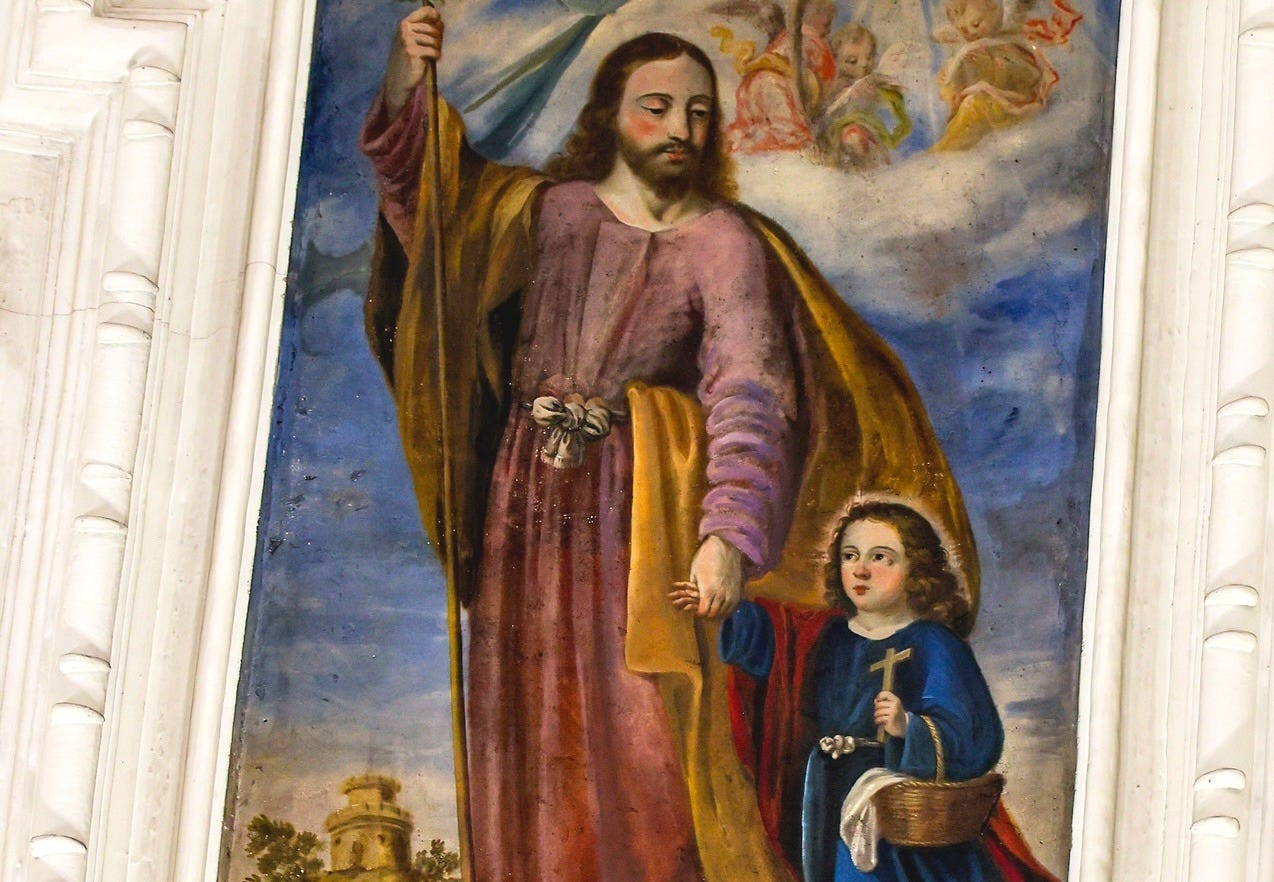
What are the parallels between the Holy Family and the Church, and between St Joseph and the Pope?
Editors’ Notes
In 1987 – for the last feast of St Joseph before his death – Mgr Guérard des Lauriers preached the following sermon on St Joseph and the Church.
The sermon is very French – by which we mean that two key points of reflection are based around words which do not translated easily into English.
These two words are “patron” and “education” – both of which are types of “false friends”, in that the same word exists in English, whilst carrying different meanings or connotations.
In French, “patron” is an inelegant way of referring to one’s boss, chief or manager. Mgr Guérard des Lauriers refers to these meanings in consider St Joseph’s title as “Patron of the Universal Church.”
Similarly, “education” in French encompasses a wider set of ideas than simple academic teaching. It refers, rather, to upbringing or how one is raised. It is essential to keep this in mind when the bishop discusses the “education” of Our Lord Jesus Christ.
Mgr Guérard des Lauriers was a very significant figure in post-Vatican II theological controversies. For more on his life and legacy, see HERE.
The Feast of St Joseph
Sermon pronounced on 19 March 1987
Mgr Guérard des Lauriers
In Sous la Bannière, n. 12, juillet-août, 1987
Headings and some line breaks added for ease of reading.
We believe that our translation of this text is covered by fair use; if there is an existing copyright holder who would like us to remove it, they can reach us in the comments to this article.
St Joseph and the Church
The feast of Saint Joseph is very dear to us here. He is the steward; he is the one who is constituted by the good God the administrator of all His goods, and firstly of the Church, which represents on earth the good par excellence, insofar as, being the true Church, she is faithful to her mission which is to guard the Deposit and the pure Oblation.
We therefore celebrate together Saint Joseph. It is with joy that I come among you to celebrate Mass in his honour, to ask his protection, and that he confirm us in the difficult resolutions which we must maintain.
It is moreover difficult to situate Saint Joseph in relation to the Church. I have already shared with you this question which always dwells within me and which I have not resolved. You know that the suppression of the feast of Saint Joseph on the third Sunday and the third Wednesday after Easter entailed as a repercussion that, today, according to the current rite, you must also celebrate Saint Joseph as being the patron of the universal Church. We shall speak again of these things. Although it was Pius XII who made this transformation, I believe that on this occasion he was not exactly well inspired.
He allowed the solemnity of the Wednesday of the third week after Easter to be supplanted by the feast of Saint Joseph the Worker; so that the title of Patron of the Universal Church, which was celebrated the third week after Easter, was transferred back to today’s feast.
We can, in any case, retain this question, because it belongs to all the feasts of Saint Joseph: what role does he have exactly in relation to the Church? We sense well that “Protector” is not sufficient; all the saints protect the Church; that “Patron” is a word which has pejorative nuances [in French, patron can mean “boss”, “chief” or “manager”]; and it is difficult to situate him. I have not yet resolved this question, but with a view to arriving at an answer I propose to you that we consider the successive phases through which the Church has passed.
How the Church is structured
The Church, what is it? It is exactly this: the Head of the Church, the Incarnate Word, plus at least one member.
Now it was indeed so, from the moment when the Word was conceived in the womb of Mary. And at that moment, Saint Joseph was present, since the Conception by the Blessed Virgin was for him the occasion of the silence which we have celebrated elsewhere. He therefore attended this birth, he was a witness of the Conception; and, at the moment when Jesus is conceived, there are therefore, with Him – with the Incarnate Word – and Mary and Saint Joseph, the latter acquiescing to the mystery and honouring it firstly by his heroic silence. And there is the Church constituted; she is already there, more than in germ; she is there in substance. What comes after – the apostles, and then we in the course of time – is aggregated, so to speak, to this initial cell. And we grasp there a very important law for the constitution and for the development of the Church. Everything, in the Church, rests upon choices which express and manifest predestination. Now these choices are of the aggregative type, and not of the segregative type.
I call a segregative choice that which consists in rejecting what one does not choose. Thus a housewife who is making a tart takes a basket of apples and rejects the rotten ones. It is a choice of the segregative type: one retains what is good, one does not concern oneself with the rest. In the Church it is not so. True, it is first Israel which is chosen, but the prevarication of Israel entailed that others also are chosen.
And for the situation of the Pope in relation to the episcopate, this remark is also of very, very great import; one must not conceive the priority of the vicar of Christ as starting from the other bishops. The Bishop of Rome is indeed “primum inter pares.” But, in reality, his “primacy” comes from on High. It is Jesus who constitutes the Pope as being His vicar, having therefore plenary jurisdiction over the whole Church; and, in addition, the Pope aggregates to himself, to govern such a diocese, such a person who will be the bishop of that diocese. One understands very well thereby that, in one and the same diocese, there are two true bishops: firstly the Pope, and secondly the bishop aggregated to the Pope, the one whom the Pope aggregates to himself precisely to govern that diocese.
The Holy Family and the Church
Therefore everything in the Church rests upon an aggregative choice. In the history of the Church, it is likewise so; the original ecclesial cell is Jesus, Mary, Joseph; and this cell developed, it blossomed. Obviously structures of the social and juridical order were grafted onto this initial cell, which is of the familial type; but it is the same law of development which is conserved intrinsically in the Church. There is here a remark of great import. We contemplate the order of divine things. The things of God rest upon principles which, absolutely, remain immutable, although the conditions of their application are indefinitely varied according to circumstances.
So this cell is constituted. Then we know the history of Saint Joseph. One can say that it is the Church, the Church pérégrinante, or the Church in a state of adventure: the flight into Egypt, the return, etc. Who is the head of this Church? If we consider the visible aspect of things, the head of the Holy Family is Saint Joseph; it is always to him that the Angel speaks.
“Fear not to take unto thee Mary thy wife”
“Take the child and his mother”
“Those who sought to harm his life are dead.”
It is always to Saint Joseph that the heavenly discourse is addressed.
If therefore we look at things from the visible point of view, it is Saint Joseph who is the patron [“chief”]. He is the head of the Church. In the same manner as the vicar of Jesus Christ is currently, or ought to be, the head of the Church militant, so Saint Joseph was the head of the Holy Family, which was the sole cell of the initial Church. Obviously you will say to me that the head is Christ. Yes. And yet, if we look today – I insist – at things from the visible point of view, from what is seen outwardly, the head was not Jesus, it was Joseph. See, in the Gospel which we read for the feasts of the Blessed Virgin and of Saint Joseph, when Jesus returns to Nazareth after the incident of the Temple, where Jesus is found among the doctors, it is well said to us: erat subditus – He was subject to them. Therefore the Church – that of Bethlehem, that of the flight into Egypt, or that of Nazareth – until such time as Jesus left His home to proceed to the foundation of the Church as we currently understand it, until that time, Jesus was subject – erat subditus – and the patron was Saint Joseph. And we can give to the word “patron” its two meanings: the patron was the one who was the head; it was also the craftsman, the carpenter, who was teaching Jesus himself the trade which Jesus exercised.
And if we push things a little further, we see clearly that there are, in this cell of Nazareth, the essential components of the whole Church, of the whole mission. What does Jesus say to the apostles: “Go, teach, baptise, educate, etc.” Well then, who taught Jesus? It was Mary and Joseph. Jesus was not baptised by them; but, nevertheless, the circumcision and the initiation of Jesus to the law was indeed done by Mary and Joseph. Every year, the Gospel notes, they went up to the Temple, and on the occasion of one of these ascents, the twelfth, precisely Jesus remained at the Temple. This signifies well that teaching and education had their role.
Jesus, it is true, did not receive them as coming from outside in relation to Himself; He discovered in Himself what He carried, on the occasion of the teaching which was given to Him by Mary and by Joseph. His infused knowledge obviously surpassed all the teaching which could come to Him from without. But nevertheless He willed that, at the very least, Mary and Joseph should be the occasion of discovering Himself what He carried in Himself; and therefore they did indeed teach Him. Jesus received this teaching. And, paradoxically, we can consider that in this original Church, the one who was the head and moreover the visible vicar of Jesus Christ was Saint Joseph; the one who exercised the mission par excellence of educating, teaching, and watching over the initiation of Jesus to the rites of the ancient law was Mary; and the faithful, it was Jesus: Erat subditus; we also, by right, must be subject to the Church – when it is the true Church, of course.
Thus we have a very great comfort, in these times so troubled and so difficult, so chaotic for us, in contemplating the original cell of the Church where all is in order. It is, so to speak, according to a learned word which you will understand, the paradigm of the Church. The paradigm, that is to say, the model in itself – the model brought to its point of perfection. Well then, this paradigm is therefore the Holy Family, and we have there all the elements of the Church.
The upbringing of Our Lord
If we wish to push further in relation to the psychology of the Incarnate Word, one can say that Jesus was educated [brought up] – that is true. What is education? It is a thing difficult to analyse. However, one senses it when one speaks of persons poorly brought up, poorly raised; of fathers or children who have not received a good upbringing, who are uncouth. We know well also that the external social level does not have a direct relation with upbringing. We find people of a modest social condition who are raised perfectly that is to say that, spontaneously, they adjust the most familiar behaviours to the delicacy of the heart and of the sentiments. Whilst it is well known that there are people who are supposedly very highly placed, and who conduct themselves like boors and churls.
Now education (educere, to bring forth from), to bring forth from this man in potency a man who is accomplished, this task of education, it is Mary who accomplished it, for Jesus... a mystery. Let us take one more step. To raise the child is to prepare him for life: Of what above all did Jesus have need in order to accomplish His mission? He had need of a renunciation which escapes us. Already several times we have said it together: the normal state for Jesus was that of the Transfiguration. Now precisely He chose to remain in a diminished state, to be deprived of this right which belonged to Him. Who taught Him this?
It was Mary. She had humanity as we do. Infinitely more pure, and therefore the hearth of a great radiance. But after all, she did not have to possess the resplendence which belongs to the Incarnate Word. She therefore taught Jesus by her habitual comportment and her maternal tact.
It is very difficult to find the right words, so much does one fear to bruise the mystery from some angle. Jesus would perhaps have had the inclination to manifest Himself always in a glorious manner; and this is indeed what the devil proposes to Him in the desert, at the time of the temptation: to let play, so to speak, His divine omnipotence – and Jesus must refuse. He refuses because He wills it, of course! But no doubt also because precisely He was brought up by Mary. The habitus whose spontaneous play reacts correctly at the moment of temptation, Jesus willed to have it primordially through Mary, from Mary who educated Him. To say everything in a word: see that the Blessed Virgin instructed Jesus, she raised Jesus, in the spontaneous sense of the renunciation which prepared Him for the sacrifice of the Cross. And it is the most substantial element of education that Jesus received from Mary.
But this is not nothing. The directors of seminaries, those responsible for religious institutes, know very well the differences between a young man, a child, who certainly has a vocation, but has lived in a pagan, hostile milieu – and a young man who has lived in a Christian family. The latter has spontaneously the reflexes which make him choose what is most reserved. He has a sort of acquired discretion, which is the foundation-stone of infused discretion, which comes from on high. And this makes a very great difference for those who have the task of subsequently educating clerics and consecrated persons. It is a very great difference to deal with a person who has already undergone the impregnation of a Christian milieu, or with someone who, despite his good will, belongs to a hostile milieu. It is a commonplace experience, so to speak. Jesus was God. Of course, that carries everything. But nevertheless He willed to be educated by Mary, and to receive from this familiarity with a creature the infused renunciation which He carried in Himself; He willed to receive it in an acquired manner, by modelling Himself, so to speak, upon the virtue and the comportment of His most holy Mother.
Thus we see in the Holy Family, this original cell of Church, we see clearly that there was education in the strongest sense of the word, in the most profound sense. Jesus was educated; He was the child; He was the member of the Church that we have to be; He let Himself be educated by Mary, that is to say, He willed that His design to pass through the Cross should be seconded in His own Person, in His Humanity, by the education which He received from Mary. And Joseph was there. The patron, he presided, he sanctioned everything, he approved, and he made possible this intimate exchange between Mary and Jesus. If he had not been there to provide for the daily needs, to organise the household, etc. – all contingencies which Jesus and Mary willed to undergo – if Saint Joseph had not been there, the thing would have been impossible. Therefore he is not a sort of fifth wheel. No, he is an essential part of this original cell of Church which, I repeat, was constituted as soon as Jesus was conceived, and conceived by Mary, and conceived in the presence of Joseph and at the price of the silence of Joseph.
The Church then developed, sometimes going back on herself; but, as we were saying just now, she always conserved the same economy. The succession of generations, the development across the planet, the aggregation of the different parts to be evangelised – all of this already existed when the Church was constituted. And we can conceive that the Church of Pentecost is at bottom nothing other than the Church of Nazareth, but blossomed and extended; extended to other persons, to other principles of social order. But the fundamental principles remain, the essential of the primordial choice remains: Jesus, Mary, Joseph – that suffices to make the Church. We are not superfluous, because Jesus loves us and has chosen us, by an aggregative choice which crowns the primitive choice, and which respects the primordiality of that choice – a choice which will always remain first, whatever the greatness of those who come after.
The question of St John the Baptist
Yes, the primordial, primitive, choice fell upon Mary and upon Joseph – whence the greatness of Saint Joseph. Whence also the helpful illumination of a mysterious word. Mystery is always illuminated by questions. Jesus said in the Gospel: “Among the children of men, none is greater than Saint John the Baptist.” And Saint Joseph? Is Saint Joseph greater than Saint John the Baptist or not? Another question connected with those we are posing. An embarrassing question, and I shall not propose to you an ex cathedra answer, given that I do not have authority to settle it.
However, one can say this: Saint Joseph, according to what we have just seen, situates himself, so to speak, as the precursor of the popes, the precursor of the vicars of Jesus Christ; in a sense he is the first vicar of Jesus Christ; but his privilege was to have had a sort of plenary power of jurisdiction, not only over the Church, but over Christ Himself, the founder of the Church. Jesus willed that it should be so. And, in this sense, Saint Joseph on the one hand is lesser than Saint John the Baptist because Saint John the Baptist is precursor of Christ, whereas Saint Joseph is so only of the visible head of the Church. But, in return, Saint Joseph has, over Christ directly, a jurisdiction which Saint John the Baptist did not have.
Thus one can draw up the very beautiful diptych which is the comparison between Saint Joseph and Saint John the Baptist; they are, each, the greatest, but from a certain point of view.
Conclusions for the state of the Church today
There then, my dear brethren, is what we can say, what discourse one can make concerning Saint Joseph. You see at present this Church militant of which we are part, of which we glory in being part since our baptism. We are agreed in knowing what the situation is, and that we no longer have the head, nor the means of having one; we can no longer direct our gaze towards someone who would be our support. One must “make do” with solitude. But we have nevertheless, and in the absence of the “church” of Rome which is presently faltering and in waiting, we have the Church of Nazareth. Let us turn towards her. This Church of Nazareth exists in Heaven, and the threefoldness, the trilogy Jesus, Mary, Joseph, is not abolished by the foundation of the Church. On the contrary, it is living, ever living and subsisting in the Church. We do not therefore depart from the Church founded in Rome by looking towards something which is not only the past, but which is the perpetual present, namely Jesus, Mary, Joseph, the Church, the original Church and the Church of all time, because she remains the foundation, the living foundation of the Church as she is constituted now and until the end of this time.
Let us therefore pray together to Saint Joseph; and let us ask him that he hasten the dénouement, by his very silence, and by the silence which he imposes upon us. The silence which he imposes upon us in the sense that the most difficult questions which arise for us remain without answers. For after all, by whom, how can the crisis be resolved? It becomes ever more apparent that it can only be by the direct intervention of Heaven. The solution, the only one possible through the normal canonical ways, proves day by day more impossible and impracticable.
Now the intervention of Heaven requires the entirety of the choice. One cannot expect that God will come to the aid of those who do not confess the truth in all its exigency and to the very end. Saint Joseph, by his silence, went to the very end of the crucifying truth which was imposed upon him. Let us imitate him; let us enter into his psychology. We must therefore, in the absence of the “church” of Rome which no longer offers the figure of Christ, in the absence of the vicar of Jesus Christ who would precisely reflect the authority and the power of Christ, in their absence, we must turn our gaze towards the Church of Nazareth, of which Saint Joseph was the head in a certain fashion. And of course, if we complete this human perspective (that the Church is visible) by the other perspective (that the Church descends from Heaven), we must say that the head of the Holy Family was Jesus. But Mary and Joseph are part of this Family only by relationality to Jesus. This is certainly the deepest aspect of the mystery.
But that which we evoke today, secondary though it be in relation to the essential aspect, is not negligible. It is an important datum, since we graft ourselves into this perspective, since we are indeed part of the visible Church militant, which is a visible society. And this visibility bears primordially upon apostolicity, which presently causes such great difficulty. It is, at bottom, the stumbling block for Mgr Lefebvre; because he has not grasped that visibility is not a note. The note is apostolicity; so that, as long as there remains the possibility for the Church to recover herself and to proceed to the assembly of a conclave, apostolicity remains in potency. Apostolicity would be severed if we said that the see is vacant and that it can remain so indefinitely. That is impossible; since the Church is apostolic, and she must remain so.
Let us therefore remain in expectation of what God will do, and to console us in this expectation, to strengthen our faith, let us turn our gaze at once towards the past, to be instructed in the nature of things, and towards the present, because Jesus, Mary, and Joseph, in heaven, live and watch eternally. Amen.
Base text translated with AI and thoroughly checked by The WM Review.
We believe that our translation of this text is covered by fair use; if there is an existing copyright holder who would like us to remove it, they can reach us in the comments to this article.
HELP KEEP THE WM REVIEW ONLINE WITH WM+!
As we expand The WM Review we would like to keep providing free articles for everyone.
Our work takes a lot of time and effort to produce. If you have benefitted from it please do consider supporting us financially.
A subscription gets you access to our exclusive WM+ material, and helps ensure that we can keep writing and sharing free material for all.
You can see what readers are saying over at our Testimonials page.
And you can visit The WM Review Shop for our ‘Lovely Mugs’ and more.
(We make our WM+ material freely available to clergy, priests and seminarians upon request. Please subscribe and reply to the email if this applies to you.)
Subscribe to WM+ now to make sure you always receive our material. Thank you!
Read Next:


Follow on Twitter, YouTube and Telegram:
Twitter (The WM Review)
Concerning St. Joseph and St. John the Baptist, Msgr de Lauriers wrote:
' Jesus said in the Gospel: “Among the children of men, none is greater than Saint John the Baptist.” '
Perhaps He was speaking of those then living in the world at that time, not of those who had since departed.
As for how Our Lord willed to be brought up and taught by Joseph and Mary, it may be that He willed that the potentiality He embodied within Himself according to His Divinity was to be 'confirmed' or 'enabled', so to speak, by interactions with His parents.
This was very interesting. Gave me new angles not before considered.