
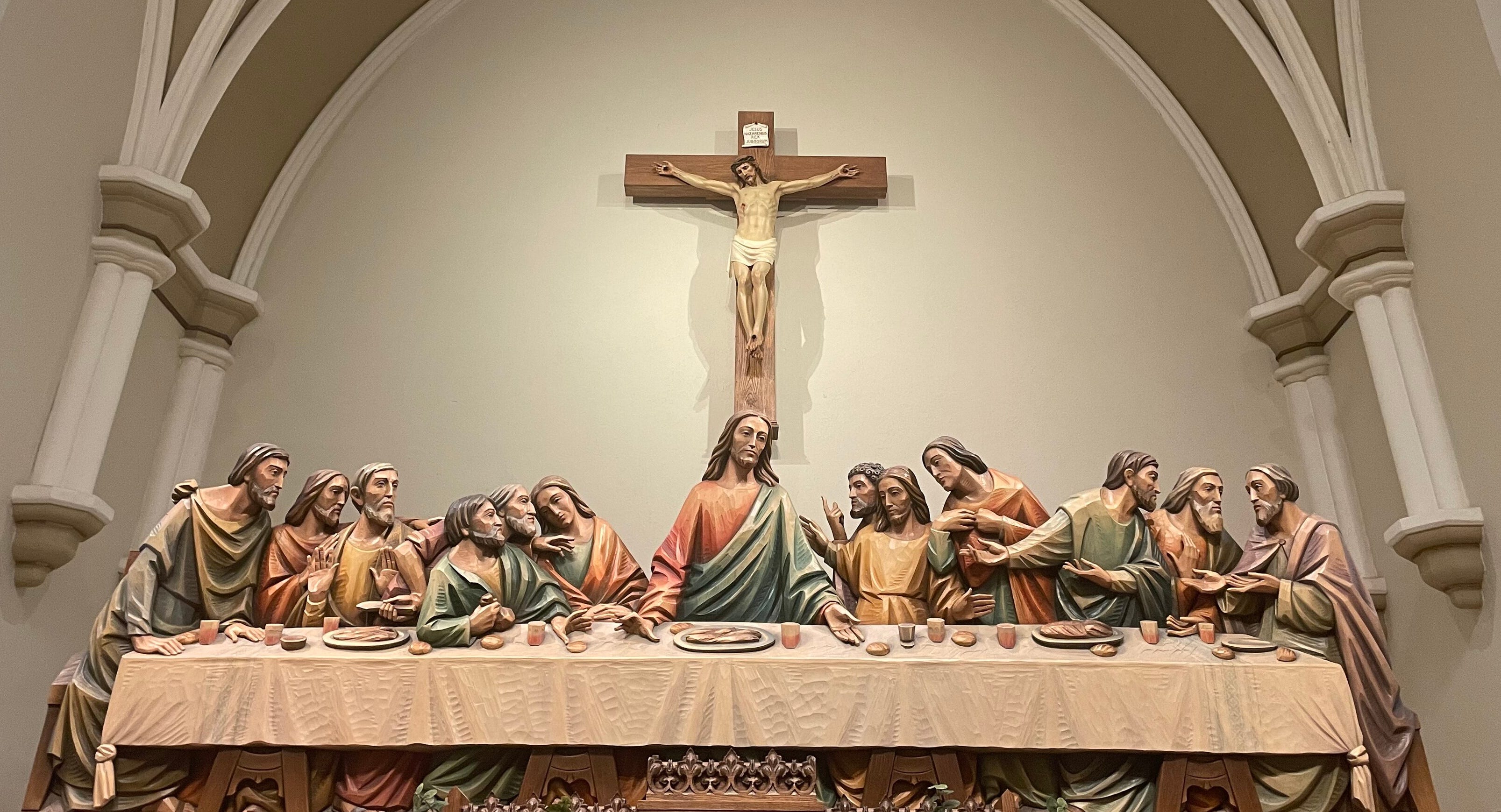
One and the same Sacrifice, in a bloody and unbloody manner – not separated by a night, but united in it.
Editor’s Notes
We conclude here our translation of Fr Gabriel Daniel SJ’s treatment of the practice of the Quartodecimans – a group which fell out of the Church following the Council of Nicaea. (For more information about the Quartodecimans, and Fr Daniel, see Part I.)
This treatment was originally published by Fr Daniel as a companion piece to his translation of Fray Luis de León’s “system” for calculating the dates of Holy Week, and harmonising the four Gospels with each other and with the Roman liturgy.
In this part, we reproduce Fr Daniel’s Sixth to Eight Propositions:
Sixth Proposition: The Council of Nicæa did not have in view preventing the day of Our Lord’s Passion from coinciding with the Jewish Passover.
Seventh Proposition: It merely sought to ensure that the Church’s Easter did not depend on the Jewish Passover, their calculations, or their cycles – assuming they had any.
Eighth Proposition: Some scholars have misunderstood the Greek texts of Eusebius and Socrates regarding the Quartodecimans, and have corrupted those of Sozomen and Nicephorus by attempting to correct them according to their own biases. Evidence for this last proposition will be scattered throughout various parts of this work.
What emerges from the final part of the study is a reality which has been staring us in the face, but to which few have adverted. We tend to think of Our Lord holding the Last Supper the day before he suffered; this is what the Roman Canon says, and – and by our reckoning of days – so he did. But by the Jewish reckoning of days, the institution of the Blessed Eucharist – taking place after nightfall – was on the same day as the Crucifixion, as Our Lord and the Apostles would have understood it.
This way of looking at the two events may provide further food for thought and reflection in relation to the Catholic doctrine that the Sacrifice of Calvary and the Sacrifice of the Mass are one and the same, as the Roman Catechism teaches:
“We therefore confess that the Sacrifice of the Mass is and ought to be considered one and the same Sacrifice as that of the cross, for the victim is one and the same, namely, Christ our Lord, who offered Himself, once only, a bloody Sacrifice on the altar of the cross. The bloody and unbloody victim are not two, but one victim only, whose Sacrifice is daily renewed in the Eucharist, in obedience to the command of our Lord: Do this for a commemoration of me.
“The priest is also one and the same, Christ the Lord; for the ministers who offer Sacrifice, consecrate the holy mysteries, not in their own person, but in that of Christ, as the words of consecration itself show, for the priest does not say: This is the body of Christ, but, This is my body; and thus, acting in the Person of Christ the Lord, he changes the substance of the bread and wine into the true substance of His body and blood.”
Without entering into controversies over the Pian reform of Holy Week, we can see that there is indeed a certain sense in the Mass of Maundy Thursday being celebrated in the evening, and there being no sacrifice on Good Friday (which would have been a “second” sacrifice on the same day, according to this way of reckoning).
While an extended essay on a very early group of heretics may seem like a strange choice for Holy Week reading, it is directly related to the Church’s celebration of the Passion and Resurrection of Christ – and, if Fr Daniel is correct, it not only makes sense of some apparent discrepancies in the Gospels, but also sheds further light on how the Resurrection fulfils the Mosaic Law, as we shall see in due course.
This is an important text – but it is long and theological, rather than devotional. For a more devotional piece about Good Friday, see the below:

Note on the text
The text contains a number of marginal notes, which I have omitted.
Fr Daniel’s argument is that confusion has arisen through the use of terms for various feasts. In French, he uses Pâques to denote the Passover, Easter and the Quartodeciman observation of the Passion on the 14th day of the Jewish month of Nissan. As such, the author’s own usage can be quite confusing itself. In order to bring more clarity, I have used Passover to denote the Jewish festival, Easter to denote the celebration of the Resurrection, and Pascha to indicate either the period of the Triduum or earlier uses in which the meaning was less clear.
The Discipline of the Quartodecimans for the Celebration of Pascha
Fr Gabriel Daniel SJ
Articles VIII-X
Taken from Recueil de divers ouvrages philosophiques, théologiques, historiques, Apologetiques et de Critique, Vol. III, MDCCXXIV, pp 473-508
The real timeline of the Last Supper and the Crucifixion (Fray Luis de León)
How an ancient controversy unlocks the Gospels’ Holy Week timeline (Fr Gabriel Daniel SJ)
How the Quartodecimans celebrated ‘Pascha’ (Fr Gabriel Daniel SJ)
How the early Easter disputes are misunderstood by historians (Fr Gabriel Daniel SJ)
The Last Supper and the Crucifixion were on the same day – by Jewish reckoning (Fr Gabriel Daniel SJ)
Article VIII
Fifth Proposition: The Council of Nicaea did not aim to prevent what we now call the Feast of Easter from falling on the day of the Jewish Passover.
My reasons are:
That this is not seen in Eusebius, Socrates, nor in what we have of the Council of Nicaea.
That the Quartodecimans, on whose account the Paschal decree was made in the Council, never celebrated what we call the Easter feast on the day the Jews celebrated theirs. This I have proven irrefutably in the second article of this dissertation.
Finally, in the letter that Constantine wrote to the Churches about the Council’s decree, where he says that everyone agreed to celebrate the Paschal feast at the same time and not to base it on Jewish customs, Constantine, I say, does not speak of the feast of the Resurrection but of the Passion [Good Friday], as seen from the two passages of that letter I have quoted and repeat here.
“First of all,” he says, “it seemed to everyone unworthy to follow the custom of the Jews in the celebration of this most holy feast... it is appropriate to follow the way we have followed from the day the Passion of the Savior was first celebrated, until now.”
“Moreover,” he adds, “one must reflect that it is against all reason not to agree on a matter of such importance, and in the celebration of so great a feast. Our Savior has left us but one feast, which is the day of our Redemption, that is, of His most holy Passion. He wanted there to be only one Catholic Church, whose members, though dispersed in various places, should be animated by the same spirit.”
Thus, if the Council of Nicaea intended to prevent some Christian feasts from being solemnized on the day the Jews celebrated their Passover, it was not what we now call the feast of Easter, but what we call the Passion [Good Friday].
But I further say that the Council did not intend to prohibit either. That is my sixth proposition.
Article IX
Proofs of the Sixth Proposition
I take the proofs for this proposition from the ordinary practices of the Catholic Churches since the Council of Nicaea, after they received the decree. First, when the full moon of the equinox fell on Thursday, the Passion was always celebrated on Friday, to observe the feast of the Resurrection on Sunday. But to celebrate the Passion on Friday in this case is to celebrate it on the fifteenth of the moon, which is the day the Jews hold their Passover feast. Therefore, the Church’s practice shows that the Council of Nicaea did not intend to prevent Christians from celebrating the feast of the Passion [Good Friday] on the day of the Jewish Passover.
Likewise, when the fourteenth of the moon fell on Saturday, 21st March, the feast of the Resurrection was observed the next day; that is, the fifteenth of the moon and therefore the day of the Jewish Passover. Therefore, the Church does not believe that celebrating our Pascha on the day of the Jewish feast is acting against the decree of Nicaea.
It is true that the Jews at the time of the Council of Nicaea, both before and after the Council of Nicæa, sometimes mistakenly celebrated their Passover before the equinox: Eusebius, Socrates, Sozomen, Saint Epiphanius, and the testimony of various Councils leave no doubt about this; but it is also true that they sometimes celebrated this feast after the equinox, and in this case, the Christians could coincide with them, either for the day of the Passion or the day of the Resurrection. But it was never the point, nor ever believed in Rome or in Egypt, that by following the two rules for celebrating Easter, they were acting against the intention of the Council of Nicaea when the days fell in such a manner.
It is according to this principle and custom that Saint Epiphanius says, disputing against the Audians, that the Catholic Church celebrates the feast of Easter on the Sunday following the fourteenth of the moon, whether that fourteenth falls on Monday, Tuesday, Wednesday, Thursday, Friday, or Saturday as long as it is not before the equinox. But, as I just said, if it fell on Thursday, we would celebrate the Passion when the Jews celebrate their Passover feast, that is, the fifteenth of the moon; if it falls on Saturday, the Easter feast will be celebrated among us on the same day they celebrate theirs, as long as they celebrate their Passover after the equinox.
ARTICLE X
Seventh Proposition: All that the Council sought to regulate among Christians in relation to the Jews is that the Christian Pascha be completely independent of their Passover, and that the former do not take into account the time when the latter celebrate it, their calculations, or their cycles, assuming that they had any.
This is all that Constantine said and meant in his letter to the Churches, in which he speaks in this manner:
“It is something unworthy,” he says, “to follow the custom of the Jews in the celebration of this most holy feast. It is contrary to all reason to give them a place to boast that without their help and direction we do not know how to celebrate this feast, etc.”
This is all, I say, that the Council intended to prescribe to the churches concerning the Jews.
But its main intention was to ensure uniformity in everything. Therefore, it ordered that the Resurrection be celebrated only on Sunday, while the Quartodecimans sometimes celebrated it on one day, and sometimes on another, depending on the day their Pascha or the fourteenth of the moon fell. Additionally, it ordered that it not be celebrated before the equinox and, finally, that the Paschal fast not end before the night of Resurrection Sunday – for concerning the hour of ending the fast, the practice since the Council of Nicaea has varied according to the various churches.
Article XI
The causes and consequences of the false prejudices that have existed until now on this matter
I believe that the causes can be reduced to the little care that has been taken until now to clarify this point of ecclesiastical history, and to the ambiguous manner in which the ancients expressed themselves when dealing with this topic.
Since the Council of Nicaea, the error of the Quartodecimans did not cause much noise in the church, and the schism of those who continued it was not very widespread. Many centuries after that great Council, some vestiges were still seen, especially in Scotland, as narrated by the Venerable Bede; but they reached an agreement, and the group of those who remained obstinate dissipated. Thus, nothing compelled the wise to pay extraordinary attention to the subject of these ancient disputes.
But the main origin of the false prejudices we have reached until now has been the ambiguity of the name Pascha, which the historians who have spoken about the Quartodecimans have used without explaining, given that in their time it was understood in the sense given to it.
The name Pascha feast meant to the first Christians what we now call the day of the Passion [Good Friday]; I believe I have provided undeniable evidence in this regard. Just as the Christians sacrificed the mystical Lamb in the sacred mysteries on the night between Holy Saturday and Resurrection Sunday, and even held a feast that had some similarity to the Jewish Passover, they also gave the name Pascha to this solemnity. And since then, the name Pascha had different meanings: the Quartodecimans gave it only to the day of the Passion, and the others to Resurrection Sunday; or rather, these latter, without ceasing to use it for the day of the Passion, understood and also gave it to the day of the Resurrection – for Tertullian, among others, sometimes took it with one meaning and sometimes with another. The author of the Chronicle of Alexandria speaks of certain people (undoubtedly the Quartodecimans) “who were scandalized that the Church gave the name Pascha to the holy day of the Resurrection.”
“They are ignorant,” he adds, “of the meaning of this word. What in Greek is called diabasis, exbasis, hyperbasis, passage, exit, is called Phase or Passover [Pesach] in Hebrew. The Church, therefore, calls with the name Pascha not only the death of Our Lord but also his return to life, for the death and Resurrection have been, for humanity, a passage, a liberation, an exit, etc.”
We have seen from the passages of Saint Augustine and Saint Ambrose that the name Pascha was given to the period of the three days in which Our Lord was crucified, remained in the tomb, and rose again. Saint Epiphanius even applies it to the entire Holy Week. But as the Council of Nicaea spoke about the Quartodecimans, it took that word as the day of the Passion, as I have proven by the letter from Constantine to the churches about the decisions of the Council – although there was always some relation to the feast of the Resurrection on which it depended.
Finally, as the customs of the Quartodecimans were abolished almost everywhere, the name Pascha became in a very short time almost exclusively for the day of the Resurrection, and for several centuries now it has only been given to that day. This ancient usage, therefore, is what caused the error of many scholars, who, when reading in the historians of the early centuries that the Quartodecimans celebrated Pascha on the fourteenth of the moon, believed that on that day they celebrated the feast of the Resurrection, although they actually celebrated the Passion [Good Friday].
What also caused the misunderstanding and led to the belief that the Quartodecimans celebrated the feast on the day of the Resurrection on the fourteenth of the moon, is that Eusebius, speaking of the custom of the Quartodecimans, opposed to them the decree of the Councils that met during the time of Pope Victor, which ordered that the feast of the Resurrection be celebrated only on Sunday; however, this decree was not made because the Quartodecimans celebrated this feast on the fourteenth, but because they celebrated their Passover on the fourteenth regardless of what day of the week it fell, and therefore celebrated the Resurrection three days later; thus that fourteenth, which they took as their only rule, was the cause that they often celebrated the feast of the Resurrection on a day other than Sunday. That is the reason for the decree that ordered the Resurrection to be celebrated only on Sunday, as I have explained before.
Conclusion
What can be concluded from the tradition of the Quartodecimans in favor of the system of the Spanish theologian [Fray Luis de León] and against other systems.
I assume, after having clearly proven it, that the tradition of the Quartodecimans was a true tradition, meaning that they followed for Pascha the practice of Saint John and Saint Philip.
This tradition implies or encompasses three things: first, that Our Lord celebrated the Passover of the Law, which is why the Quartodecimans were so attached to this observance; second, that they celebrated the Passover feast on the fourteenth of the moon; third, that this Passover feast was the feast of the Passion of Our Lord.
The first article destroys the System of R.P. Lami of the Oratory, who claims that Our Lord did not celebrate the Passover of the Law the year of his death.
That same article, as well as the second, clearly implies that Our Lord was slain on the fourteenth of the moon, since the Asians celebrated the feast of the Passion on that day.
By the same principle, it seems clear that they held the Paschal feast on the night that began on the fourteenth before celebrating the feast of Pascha, that is, the Passion [Good Friday]; and since they did so only because their tradition had taught them that Our Lord did the same according to the Law, it follows that Our Lord held the Passover feast on the first night of the fourteenth, and that the Jews did the same according to the Law. This is the proposition of the Spanish doctor [Fray Luis].
Now, can there be any doubt that this was the practice of the Quartodecimans? Does not the name itself indicate it? If they had held the Paschal feast only on the night following the fourteenth of the moon, and celebrated the Paschal feast – that is, the Passion [Good Friday] – on the fifteenth, they would have been called quintodecimans, and not quartodecimans. They would have celebrated it on the fifteenth of the moon and not the fourteenth.
Is not the manner in which Bishop Polycarp expresses himself on this point decisive? He says that he and his confreres, the bishops of Asia, and their holy predecessors celebrated the Paschal feast when the Jews purged their houses of leaven: “They celebrate Pascha when the Jews threw the leaven out of their houses.” But they did not throw the leaven out of their houses on the fifteenth of the moon, as their houses had to be completely purged at the beginning of that day according to the Law – that is, from the first night of the fifteenth when the Passover feast and the seven days of Unleavened Bread began; they took care of this on the fourteenth of the moon. Therefore, on the fourteenth of the moon, the Quartodecimans celebrated the Passion of Jesus Christ, which had been preceded the night before by the Paschal feast and the celebration of the sacred mysteries.
Finally, the idea has always been held in the Catholic Church, founded on the testimony of the ancients, that the Council of Nicaea intended not only that Christians should not follow either the custom or the calendar of the Jews regarding the Passover feast, but also that they should never coincide with them on that date; but this cannot be understood to mean that Christians never celebrated the feast of the Resurrection or the Passion on the same day that the Jews celebrated their Passover feast. For the Jews celebrate this feast on the fifteenth of the moon according to the law: “On the fourteenth day of the first month shall be the Lord’s Passover. On the fifteenth day of this month shall be a feast” (Num. 28:16). And assuming they celebrate it after the equinox (as they do and did at times in the early centuries of the Church), it is impossible for Christians not to coincide with them, since when the fourteenth of the moon falls on Thursday, we celebrate the feast of the Passion the following Friday – and thus, on the day of the Jewish Passover feast. When the fourteenth is on Saturday, we celebrate the feast of the Resurrection the following day – and thus, on the day of the Jewish Passover feast, as I said before.
What, then, could have been the meaning and intention attributed to the Council? It is that Christians were not t0 celebrate the Christian Pascha at the same time that the Jews celebrated the Passover of the Law; that on the same night that the Jews ate the Passover Lamb, the Christians were not to immolate nor eat the Mystical Lamb or celebrate the holy Mysteries of the Christian Pascha. But assuming that the Jews ate the Passover Lamb on the second night of the fourteenth – that is, at the beginning of the fifteenth – the Christians of Nicaea could and did in fact coincide with them in the circumstances I have indicated. On the contrary, assuming that the Jews ate the Lamb on the first night of the fourteenth, Christians could never coincide with them, because according to the Council, the fourteenth had to have passed in order to celebrate the mystery of the Resurrection. To reconcile the Council’s decree with the practice of the Church, it must be concluded that the Council believed that, according to the Law, the Jews ate the Passover Lamb at the beginning of the fourteenth or on the first night of that day, and not at the end or on the second night.
I leave it to the wise to decide on the solidity of my conjectures and reasoning, as well as on the solidity of the Spanish theologian’s System.
Read Next:
The real timeline of the Last Supper and the Crucifixion (Fray Luis de León)
How an ancient controversy unlocks the Gospels’ Holy Week timeline (Fr Gabriel Daniel SJ)
How the Quartodecimans celebrated ‘Pascha’ (Fr Gabriel Daniel SJ)
How the early Easter disputes are misunderstood by historians (Fr Gabriel Daniel SJ)
The Last Supper and the Crucifixion were on the same day – by Jewish reckoning (Fr Gabriel Daniel SJ)


HELP KEEP THE WM REVIEW ONLINE WITH WM+!
As we expand The WM Review we would like to keep providing free articles for everyone.
Our work takes a lot of time and effort to produce. If you have benefitted from it please do consider supporting us financially.
A subscription gets you access to our exclusive WM+ material, and helps ensure that we can keep writing and sharing free material for all.
You can see what readers are saying over at our Testimonials page.
And you can visit The WM Review Shop for our ‘Lovely Mugs’ and more.
(We make our WM+ material freely available to clergy, priests and seminarians upon request. Please subscribe and reply to the email if this applies to you.)
Subscribe to WM+ now to make sure you always receive our material. Thank you!
Follow on Twitter, YouTube and Telegram:
Twitter (The WM Review)
Based text of translation made with the assistance of AI and each line scrutinised and checked against the French text.
The Jews are wrong! Jesus during on the cross and the last supper were not on the same day!