
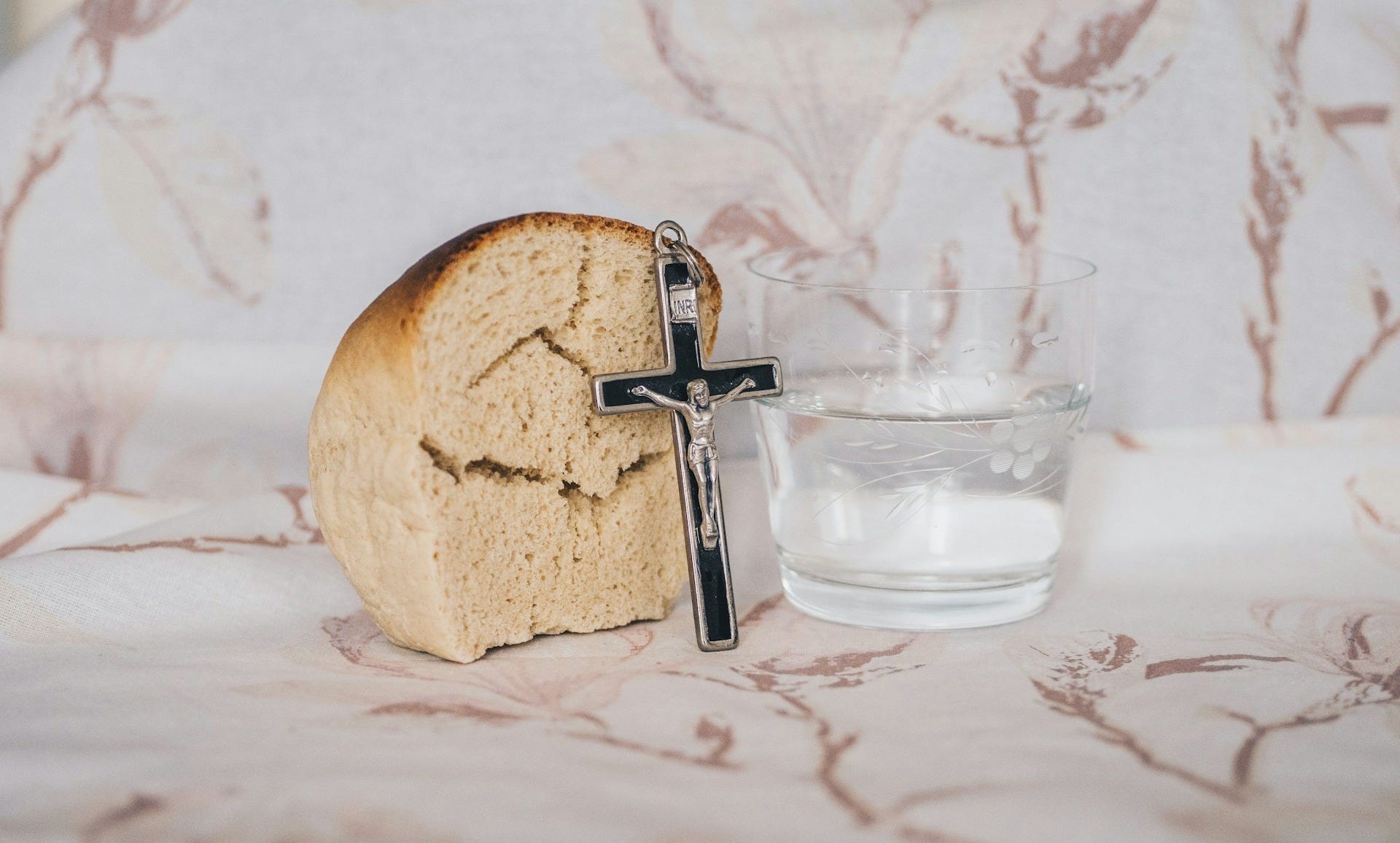
The rule of fasting and abstinence that Catholic should follow is a controverted question. Fr Ricossa explains why the law of the 1917 Code is still in force.
Editors’ Notes
The following are translations of Fr Francesco Ricossa IMBC’s two articles on the current law of fasting, made with the permission of the Mater Boni Consilii Institute and their outstanding Sodalitium magazine.
In the first article, Fr Ricossa discusses the importance of fasting and abstinence, and sets out the universal law of the Church as it stood prior to Vatican II, and as enshrined in the Code of Canon Law (1917).
In the second article, he responds directly to an objection which he mentions in the first. In particular, he engages with an article by Fr Hervé Belmont, which states that dispensations based on a 1949 decree of the Holy Office (which allowed bishops to dispense from all but four days of fasting) remain in force, in the dioceses or nations in which they were made.
Fr Ricossa points out that dispensations do not change that the law itself remains that of the 1917 Code. He then argues:
“The episcopal sees being currently formally vacant, these dispensations are no longer granted.”
He also provides some circumstantial evidence which he uses to argue for the non-applicability of these dispensations, even prior to Vatican II.
The conclusion that he draws from this is that the current obligations are those found in the universal provisions of the Code, taking account of subsequent changes of the law (as opposed to permissions for dispensations).
However, he also adds that the law should be applied with common sense, taking account of the grounds for dispensations from the law, as well as the social fact that the law has not been observed in its fulness since 1941.
Although Fr Ricossa emphasises the non-renewal of the dispensations, it does not seem entirely clear that these dispensations needed to be renewed. Abbé Hervé Belmont mentions that a particular French diocesan publication mentioned the mitigated provisions each year until 1966:
“In fact, in the Semaine religieuse de Bordeaux these provisions are found repeated each year until February 1966, the date on which the decisions of Vatican II were to [not] come into force.”
However, it is not clear that these were renewals or simply reminders of dispensations that remained in force.
The state of affairs following 1949
We have previously argued that the crisis in the Church, as well as decrees such as that of 1949 (as well as 1936 and 1941) make it difficult to see who is bound to fast, and when, thus creating a an objective doubt of law, in which case the law cannot bind under pain of sin.
Fr Ricossa’s articles basically disagree with this line of argument, although his conclusion – the application of pastoral sense, and a recognition of the force of custom working to the contrary – appears basically similar.
Further, the circumstances – the Second World War and its aftermath – that gave rise to the very broad dispensatory powers in the 1949 decree certainly no longer apply.
But whatever one makes of this question, it is certain that fasting is central to Lent, and a crucial part of the Christian life. Fasting is a precept of the natural law, and it is not going to be fulfilled by four days (let alone two) for most Catholics. Fr Henry James Coleridge SJ wrote:
“Catholic theologians tell us that the obligation of fasting rests upon the natural law, in so far as the mortification of the passions, which is the fruit of fasting, is in general necessary for salvation in our present condition.
“The time, manner, and degree of fasting are matters which it belongs to the Church to determine. Thus, if the Church had not fixed the times and modes of this holy exercise, we should still be obliged to practise mortification of this kind, in order to gain the ends for which it is the natural and appointed means.”


Similarly, it is clear that fasting – and not just mortification in general – is central to Lent. One can open the Missal to any day of Lent, and one will find references to fasting: the liturgy – the great teacher of the faithful (cf. Pope Pius XI, Quas Primas, n. 21) presumes that everyone is observing a communal fast. Other mortifications and sacrifices, made out of supernatural love for God, are meritorious and worthy. They can and should be taken up as additional to the Lenten fast, and they can be legitimate substitutes for those who cannot fast, and may even be more meritorious in themselves – but they are not simply interchangeable with fasting.
Similarly, dispensations from ecclesiastical law do not carry the implication that the natural law precept is similarly dispensed, or that it is fulfilled by the radically reduced ecclesiastical obligations. If one believes that these ecclesiastical obligations have been rendered doubtful or non-binding, one is still obliged to fast and mortify oneself to the degree necessary – as Fr Coleridge essentially says above.
In considering the degree necessary, Fr Belmont points to the law in the 1917 Code:
“[O]ne must not forget that the law in full force is that of canon law, with (according to the dioceses) the transfer of Lenten abstinence from Saturday to Wednesday. Even if, because of the dispensations legitimately (and very widely) granted, the law is only partially of strict application, it remains a precious indication of the spirit and the wish of the holy Church of Jesus Christ.”
It is this universal law that Fr Ricossa explains below.
Note on English law
Fr Belmont’s comment above – which mentions the transfer of Lenten abstinence from Saturday to Wednesday – brings us to another point for English readers.
One is, of course, free to abstain from meat for the whole of Lent, a peculiar indult of 1911 dispensed Catholics in England from the obligation of abstaining from meat for two days in a row. As a result of this, and in keeping with the Church’s wish to retain at least two days of abstinence in Lent, Catholics in England were obliged to abstain from meat on Wednesdays and Fridays, rather than Fridays and Saturdays. Fr Henry Davis SJ wrote in 1945:
“The Wednesdays in Lent are enumerated because in England there is an indult to substitute the Wednesdays for the Saturdays. The Saturdays of the Ember weeks are not days of abstinence—outside Lent—in virtue of an Apostolic letter which dispensed from the abstinence on any day that immediately precedes or follows a Friday or another day of abstinence.” [Jan 27. 1911: AAS, 1911, p 58.]
Foreigners in England were permitted to observe the universal law on this matter (i.e., eat meat on Wednesdays and abstain from it on Saturdays), provided that this caused no scandal to English Catholics:
“Strangers coming into England from other countries are bound to abstain on either the Wednesdays and Fridays, or on the Fridays and Saturdays of Lent, but scandal must be avoided if the latter alternative is adopted, the reason being that the substance of the precept is that there should be two abstinence days in each week in Lent.” [SCC, Feb 9, 1924.]
For the particulars of what is permitted on days of fasting and abstinence (as opposed to when these days occur), see Fr Henry Davis SJ here:

The WM Review would like to thank Fr Ricossa, the IMBC and Sodalitium for permission to translate and publish these articles.
S.D.Wr.
Note on the Fast
Fr Francesco Ricossa IMBC
Extracts from Sodalitium (French Edition) n. 27, March 1992, with subsequent additions.
“We deem it unnecessary to show the importance and advantages of fasting. The sacred Scriptures, both of the Old and New Testament, are filled with the praises of this holy practice.”
Dom Prosper Guéranger, Abbot of Solesmes1
Unfortunately today, the Abbot of Solesmes would change his opinion; fasting has almost totally disappeared from the spiritual life of Christians, despite the praises given it by the Old Testament:
“Prayer is good with fasting and alms more than to lay up treasures of gold.” (Tobit 12.8)
“And she wore haircloth upon her loins, and fasted all the days of her life, except the sabbaths, and new moons, and the feasts of the house of Israel.” (Judith 8.6)
“Now, therefore, saith the Lord. Be converted to me with all your heart, in fasting, and in weeping, and mourning.” (Joel 2.12)
“And when she had laid away her royal apparel, she put on garments suitable for weeping and mourning: instead of divers precious ointments, she covered her head with ashes and dung, and she humbled her body with fasts.” (Esther 14.2)
“So when they had all done this together, and had craved mercy of the Lord with weeping and fasting, lying prostrate on the ground for three days continually, Judas exhorted them to make themselves ready.” (2 Maccabees 13.12.)
And the New Testament:
“And when you fast, be not as the hypocrites, sad. For they disfigure their faces, that they may appear unto men to fast. Amen I say to you, they have received their reward.
“But thou, when thou fastest anoint thy head, and wash thy face; that thou appear not to men to fast, but to thy Father who is in secret: and thy Father who seeth in secret, will repay thee.” (Matthew 6.16-18)
“And as they were ministering to the Lord and fasting, the Holy Ghost said to them: Separate me Saul and Barnabas, for the work whereunto I have taken them.
“Then they fasting and praying and imposing their hands upon them, sent them away. (Acts 13.2-3)
“But in all things let us exhibit ourselves as the ministers of God, in much patience, in tribulation, in necessities, in distresses, in stripes, in prisons, in seditions, in labours, in watchings, in fastings […]” (2 Cor. 6.4-5)
“In journeying often, […] in labour and painfulness, in much watchings, in hunger and thirst, in fastings often, in cold and nakedness […]” (2 Cor. 11.27)
Naturally speaking, fasting consists in taking neither food nor drink. In the Church there exist two forms of fasting: the ecclesiastical fast and the eucharistic fast. It is ecclesiastical fasting that concerns us here.
Why ecclesiastical fasting
To do penance is a divine commandment. If we do not do penance, we shall all perish (cf. Luke XIII, 5).
The Church, applying this commandment, has always prescribed days of fasting. Taking example from Moses, Elijah and Our Lord Jesus Christ who fasted forty days, she instituted Lent. According to St Jerome,2 St Leo the Great,3 St Cyril of Alexandria4 and St Isidore,5 the apostles themselves had already established the quadragesimal [Lenten/forty-day] fast.
The fast of the Ember Days, at the beginning of each season, is also very ancient in the Roman Church; as is the fast of the vigils of feasts.
The badge of our warfare
Referring to the quadragesimal fast, Pope Benedict XIV wrote:
“The observance of Lent is the very badge of the Christian warfare. By it we prove ourselves not to be enemies of the cross of Christ. By it we avert the scourges of divine justice. By it we gain strength against the princes of darkness, for it shields us with heavenly help.
“Should mankind grow remiss in their observance of Lent, it would be a detriment to God’s glory, a disgrace to the Catholic religion, and a danger to Christian souls.
“Neither can it be doubted that such negligence would become the source of misery to the world, of public calamity, and of private woe.”
Enc. Non Ambigimus May 30, 1741.
The prophecy has unfortunately been realised.
The current discipline
In the current situation, it is “in ashes and sackcloth” that we should do penance. But at least, let us observe the law of the Church concerning abstinence from meat and fasting. It is already very softened and mitigated compared to the rigor of the past.
But what precisely is the law of the Church on this matter?
Given the lack of validity of [Paul VI’s] J.B. Montini’s 1966 Constitution Poenitemini – by which he, who did not have Pontifical Authority, reduced the law of fasting to only two obligatory days – one must refer to the preceding law. This is found in the Code of Canon Law, at Canons 1250-1254, modified by two decrees of the Sacred Congregation of Rites6 and of the Congregation of the Council.7
Taking these modifications into account, we recall for you the current law for the faithful of the Latin rite (that is to say not belonging to the Eastern Churches), a law which we take from the Catechism of Christian doctrine published by order of the Sovereign Pontiff Saint Pius X, edited by the Libreria Editrice Vaticana in 1959.
The law of fasting obliges all the faithful, aged between 21 years and 60 years, who are not otherwise excused or dispensed.8 The law of abstinence from meat obliges from the age of 7 years.
Fasting consists in taking a single meal per day, but two small collations – which theologians limit to 60g [about 2oz] in the morning and 250g [about 8-9oz] in the evening9 – are tolerated.
The days of penance are the following:
I - Of abstinence from meat [without fasting].
All Fridays except those on which falls a feast of obligation.
II - Of abstinence and fasting.
Ash Wednesday
Each Friday and Saturday of Lent
The Wednesdays, Fridays and Saturdays of the Ember Days, or of the four seasons, that is to say:
Spring, in the first week of Lent
Summer, in the week of Pentecost
Autumn, in the third week of September
Winter, in the third week of Advent.
The Vigils of:
Christmas (December 24)
Pentecost
The Immaculate Conception (December 7)
o d) All Saints (October 31).
III - Of fasting alone
All other ferial days of Lent (that is to say, all the other days of the week during Lent: we never fast on Sundays)
A dispensation from Pius XII
During the war, beginning in 1941, many indults limited the law of the Church that we have just explained. People fasted by force since there was nothing to eat...
But on January 28, 1949, the decree Cum Adversa, of the Sacred Congregation of the Council, partially restored the observance of the law, limiting the faculties of dispensation previously granted to Ordinaries. One was therefore to observe anew abstinence on all Fridays, and abstinence with fasting on Ash Wednesday, Good Friday and the vigils of the Assumption (subsequently replaced by that of the Immaculate Conception) and of Christmas.
It would however be an error to consider this decree of 1949 as being the law in force. By this decree, Pius XII only maintained the faculty of dispensation for all the prescribed days except four. But as this faculty of dispensation has not been renewed, due to the absence in actu of Authority, no one, strictly speaking, can avail themselves of it today.
Nevertheless…
Given the intention expressed by Pius XII in the decree of 1949
Given that in normal times the Ordinaries could have dispensed from the law and reduced the obligation to only four days per year
Given finally that this law [Canon 1252] has not in fact been observed since 1941 – for which reason one could eventually invoke, against the observance of the law, a custom of more than forty years (cf. Canons 25-30);
… one can be particularly generous in accepting grounds for exemption from fasting and abstinence for the days when, beginning in 1949, it was customary to dispense from them.
Exhortation
To affirm however, without giving other precisions, that the ecclesiastical law of abstinence and fasting currently prescribes only four days of penance is – objectively – an error.
We therefore invite all the faithful to follow these norms of the Church and, more generally to carry their own Cross in following Jesus, mortifying vices and concupiscence in order to conquer the rampant sensualism that prevents the soul from rising toward God.
What is – currently – the law of ecclesiastical fasting?
Fr Francesco Ricossa IMBC
Sodalitium (French Edition) n. 54, December 2002
In issue no. 27 of March 1992 (pp. 58-60), Sodalitium published a brief article on eucharistic fasting and on ecclesiastical fasting, in order to explain to the faithful – who share in holding the thesis of the formal vacancy of the See dating, at least, from December 7, 1965 – what is currently the law of the Church.
It has been objected to us on several occasions…
That the law to which we refer, on the ecclesiastical fast and on abstinence from meat (Canon 1252 of the code of canon law promulgated by Pope Benedict XV on September 15, 1917), is outdated, since it was corrected by subsequent pontifical documents
That the Mater Boni Consilii Institute would therefore be imposing a law that no longer exists in the Church, and would thus demonstrate disobedience toward the Church herself on the one hand, and lack of pastoral spirit on the other, by placing upon souls an impossible burden to bear – or, in any case, one that has not actually been not prescribed.
We have always responded personally to these objections, which certain friends raised with us personally.
An excellent article…
A mutual friend recently10 presented us with his objections based on an article devoted to the commandments of the Church; an article whose author is our confrere Father Hervé Belmont.11 At the time, the article had escaped me, but now that I have read it, I can assure the reader that it is worth disseminating given the usual clarity of exposition and typical sureness of doctrine of its author.
I permit myself however to offer an important clarification precisely concerning the discipline of fasting.
… which deserves an important clarification
The author writes:
“[A]ccording to the decrees of the Sacred Congregation of the Council [January 28, 1949, July 25, 1957 and December 1, 1959], the days for which fasting has remained strictly obligatory are:
December 7 and 24,
Ash Wednesday and
Good Friday.
“One may, if one wishes, replace December 24 with December 23” (cited work, p. 7).
Therefore, according to Father Belmont, the current law on fasting [given that – I recall – Paul VI was not formally Pope] would prescribe only four days of penance.
On the contrary, the IMBC, basing itself on Canon 1252, maintains that the current law of fasting obliges on Ash Wednesday and Good Friday, but also:
All weekdays of Lent with the exception of Sundays
The Wednesdays, Fridays and Saturdays of the four ember days
The four Vigils of Pentecost, All Saints, the Immaculate Conception and Christmas.
Quite a difference!
Who is right?
Everything depends on the content of the three decrees to which Father Belmont refers – without, however, citing them.
The decree of 3rd December 1959 (not 1st December, as cited) – issued under John XXIII – simply extends a privilege, previously granted to France (decree of 27th August 1957), to all the faithful. This privilege was to anticipate the fast of Christmas Eve on 23rd December (whereas it was normally fixed on 24th December).12
For its part, the decree of 25th July 1957 limits itself to transferring the obligation of fasting and abstinence prescribed for the Vigil of the Assumption of Mary (August 14) to the Vigil of the Immaculate Conception (December 7).13
But if the decrees of 1959 and 1957 – on which Fr Belmont bases himself – provide no support for his position, there remains his reference to that of January 28, 1949.
The decree of January 28, 1949
It is to this decree that I had referred in the Sodalitium article (no. 27, pp. 58-60) cited above.
Since many readers do not recall it, or do not trust me, I publish it here in its entirety (bold type added by the editors):
Decree of the S.C. of the Council relating to fasting and abstinence.
Since the difficult circumstances which, in 1941, led to granting the dispensation from the law of abstinence and fasting have almost everywhere improved somewhat, to prepare for the approaching Holy Year and in conformity with the wishes expressed by many Ordinaries, it seems opportune that the observance of said law be restored at least in part.
For this reason, Our Most Holy Father Pope Pius XII has deigned to decide that from the first day of the coming Lent, until further notice, for all the faithful of the Latin rite, even belonging to Religious Orders or Religious Congregations, the faculty granted to Ordinaries to dispense from abstinence and fasting be limited in the following manner:
a) abstinence must be observed on all Fridays of the year
b) abstinence and fasting must be observed on Ash Wednesday and Good Friday, on the Vigils of the feasts of the Assumption and of Christmas: moreover, for all these days of fasting and abstinence, the use of eggs and dairy products is authorized everywhere in the small meals of morning and evening.
The Ordinaries who will make use of this new mitigation of fasting and abstinence will not fail to exhort the faithful, especially the secular clergy, religious men and women, to be willing, in these very difficult times, to add exercises of Christian perfection and works of charity, particularly toward the poor and those who suffer, and to pray according to the intentions of the Sovereign Pontiff.
Rome, January 28, 1949.
Francesco Cardinal Marmaggi, F. Roberti, secretary.14
… brief commentary
From the text of the decree that I have just reproduced it follows that the law of abstinence and of fasting, put into force by Canon 1252, was neither changed nor abolished by the subsequent decree of 1949. The only real changes – the only ones, among others, noted in footnotes in my 1965 edition of the Code dating from Paul VI – concern the transfer of the obligation from the vigil of the Assumption to that of the Immaculate Conception (S.C. of the Council, decree July 25, 1957) and the extension of the law of fasting and abstinence of Lent until Holy Saturday midnight.15
This second provision is decisive for the interpretation of the 1949 decree. If Fr Belmont’s interpretation were correct, the 1955 decree would be absurd: for why extend the abstinence and fasting of Lent to midnight of Holy Saturday16 if since 1949 – according to Father Belmont – there is no longer abstinence and fasting on that day at all, but only on Good Friday?
On the contrary: it makes sense that, with the reform of Holy Week shifting the time of the Easter Vigil to the night, the Congregation of Rites extended the Lenten fast until night as well.
Consequently the law established by Canon 1252 of the Code of Canon Law remained substantially unchanged until the Constitution Poenitemini of 1966 by Paul VI. Fr Belmont, following (like us) the Thesis of the formally vacant See, ought therefore to conclude that the law of the Church in force is that of Canon 1252 (apart from the two changes indicated), Paul VI’s Constitution itself being null.
But doesn’t the 1949 decree leave only 4 days of fasting in effect?
No. As Sodalitium has already explained, the 1949 decree only limited the power, granted to Ordinaries (diocesan Bishops or the like), to dispense from observance of the law. It excluded from their power that of dispensing for those four days. The episcopal sees being currently formally vacant, these dispensations are no longer granted.
Applying the law… with good sense
Such is the law, without the shadow of a doubt.
This does not mean that said law should not, nowadays, be applied with good sense, and with pastoral sense. This means that the reasons commonly adopted by moralists to release the faithful from application of the law must be evaluated with great benignity, taking into account:
a) That in normal times the Ordinaries could have dispensed from the law and reduced the obligation to only four days per year;
b) That this law, in fact, has not been observed since 1941, for which reason one could eventually invoke – against the observance of the law – a custom of more than forty years (cf. Canons 25-30).
To affirm however, without giving other precisions, that the ecclesiastical law of abstinence and fasting currently prescribes only four days of penance is – objectively – an error.
HELP KEEP THE WM REVIEW ONLINE WITH WM+!
As we expand The WM Review we would like to keep providing free articles for everyone.
Our work takes a lot of time and effort to produce. If you have benefitted from it please do consider supporting us financially.
A subscription gets you access to our exclusive WM+ material, and helps ensure that we can keep writing and sharing free material for all.
You can see what readers are saying over at our Testimonials page.
And you can visit The WM Review Shop for our ‘Lovely Mugs’ and more.
(We make our WM+ material freely available to clergy, priests and seminarians upon request. Please subscribe and reply to the email if this applies to you.)
Subscribe to WM+ now to make sure you always receive our material. Thank you!
Read Next:
Why do we have to fast? (Fr Henry James Coleridge SJ)
How fasting helps the soul—and the modern world (Fr Henry James Coleridge SJ)
Did the Church intend to abolish fasting—or modify it? Newman Explains
What does the law of fast and abstinence actually require? (Fr Henry Davis SJ)
Follow on Twitter, YouTube and Telegram:
Twitter (The WM Review)
Dom Prosper Guéranger, The Liturgical Year, Lent. Ed. of 1878 pp. 11 and 12
Ep. XXVII ad Marcellam
Sermons II, V, IX de Quadragesima
Homil. Paschal.
De eccles. officiis 1, VI c. XIX
September 16, 1955
July 25, 1957
From the anniversary day of 21 years until 59 years completed (Inceptum sexagesimum, beginning of the 60th year).
It is permitted to take the small collation of 250g [8-9oz] at noon and the full meal in the evening.
This article was published in Issue 53 (December 2001) of Sodalitium’s Italian edition.
Notre-Dame de la Sainte-Espérance, no. 28, September 1988. [Editors’ Note: I believe that this is the article: https://www.quicumque.com/documents/leglise-catholique/quelques-lois-ecclesiastiques/]
Cf. La Documentation catholique, no. 1318, 12/20/1959, col. 1566
Cf. La Documentation Catholique, no. 1257, August 4, 1957, col. 1020.
Cf. La Documentation Catholique, no. 1038, March 13, 1949, col. 325
Sacred Congregation of Rites, general decree, November 16, 1955, no. 10.
Translator’s note: viz. midnight between Saturday and Sunday.
We don't eat meat on Wednesdays, Fridays, and Saturdays outside of Lent. So during Lent we only eat meat on Sundays. This was the custom in the old Catholic peasant world in Hungary. And somehow it survived.
Thanks to Fr. Ricossa for clearly laying out the laws of fasting and abstinence according to the 1917 Code of Canon Law. There are "Trads" who claim it's "lamentable" that the disciplines have been gradually relaxed over the centuries, and the Pio-Benedictine Code of Canon Law promulgated in 1917 is the "final straw" for them. These "Trads" find the laws in that Code "too lax" and, instead, insist that the way to be "truly Traditional Catholics" is to practice *more* rigorous fasting.
We should return to the medieval practices, or even those of the ancient Church, because the laws of 1917 aren't restrictive enough; they bemoan being "put to shame" by our Eastern "brethren" (they would include the schismatics as well) not only eating a fully vegetarian diet, but also not even making use of oil or wine except on Sundays. But last year I had listened to a Lenten sermon by a sedevacantist priest on the subject of fasting, and his perspective is that it is "doubly meritorious" to zealously follow the laws of Holy Mother Church rather than to Pharisaically do more than is required in a spirit of pride and gain no merit at all.
I appreciate you sharing Fr. Ricossa's writing on the subject! May God bless you with many graces during this Lenten season!