

The pope is bound to publicly profess the Catholic rule of faith just as every other Catholic is. If he does not, he is neither Catholic nor the pope.
Introduction
The Pope, the Bishop of Rome, is the visible head of the Catholic Church. By virtue of his office, he exercises supreme authority over the Church.
The pope possesses the fullness of the threefold power of teaching, sanctifying, and governing, which Christ committed to His Church. This power and authority are granted to him by God alone.
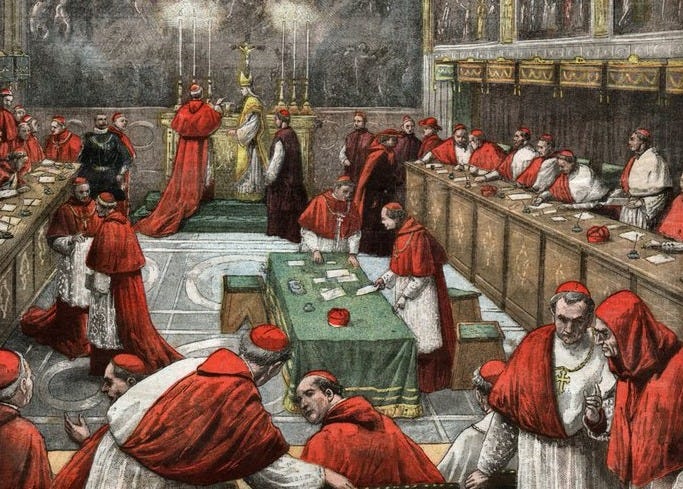
When a pope dies, his successor is chosen by human agency, but this election must be accordance with the order established by God. The papal office is not open to everyone.
This article examines the essential characteristics that must be possessed by the one who is to be validly elected as pope.
Who is eligible for election to the papacy?
Theologian Rev. Sylvester Berry writes:
Any person of the male sex having the use of reason can be elected Supreme Pontiff, provided he be a member of the Church and not excluded from office by ecclesiastical law.1
He explains further that:
The very nature of the office makes it necessary that the Supreme Pontiff be a member of the Church and have the use of reason; the will of Christ demands that he be of the male sex.
These conditions for election are of divine law and can never be altered. However:
Other conditions may be required by the Church, since the pope, having full authority in the government of the Church, may establish laws that would render a papal election null and void unless the prescribed conditions be fulfilled.2
The same doctrine is found in the commentary of canonists Wernz and Vidal, who specify that the following are the conditions required for a valid election:
All those who are not impeded by divine law or by an invalidating ecclesiastical law are validly eligible. Wherefore, a male who enjoys use of reason sufficient to accept election and exercise jurisdiction, and who is a true member of the Church can be validly elected, even though he be only a layman. Excluded as incapable of valid election, however, are all women, children who have not yet arrived at the age of discretion, those afflicted with habitual insanity, heretics and schismatics.3
In the article, we will not consider the conditions required by ecclesiastical law, as they are variable, and under certain circumstances may no longer bind. Instead, we will focus on the three conditions which are required by divine law, and which may never be altered.
A successful candidate in a papal election must be:
Male
In possession of the use of reason
A member of the Catholic Church
If one or more of these characteristics is lacking, the election will be invalid.
1: Male
The pope is the Bishop of Rome. Therefore, the successful candidate must be a bishop, or, if he is not a bishop at the time of his election, he must intend to be consecrated as a bishop after his election.
The sacrament of Holy Orders can only be conferred on members of the male sex. Therefore, only a man can be elected as pope. Berry writes:
It is absolutely necessary that the Roman Pontiff be of the male sex, for to such only has Christ committed the government of His Church and the power of Orders… A layman can be validly elected to the office… but the power of Orders would come only through the sacrament of Orders, which he would be obliged to receive, since Christ evidently intended that His Church be governed by bishops.4
A candidate for election to the papacy must be of the male sex.
Therefore, the attempted election of a person of the female sex will be invalid.
Furthermore, if a man who is not a bishop were elected, he must intend to be consecrated a bishop. In the absence of this intention, he could not (and thus would not) validly accept the election.
2: In possession of the use of reason
The pope exercises the power of governance over the members of the Church. Those who govern others must do so in accordance with reason. Therefore, the one who exercises such power must possess the use of reason. As Berry writes:
[The pope] must have use of reason because the primacy consists essentially in the exercise of jurisdiction and this in itself is an act of reason. Consequently a person who is permanently insane, or a person who has not yet reached the age of discretion, cannot be validly elected to the Supreme Pontificate.[5]
A candidate for election to the papacy must possess the use of reason.
Therefore, the attempted election of a child below the age of reason, or a man who was permanently insane, would be invalid.
3: A member of the Church
The Pope is the Visible Head of the Catholic Church, the Mystical Body of Christ. Therefore, it is absolutely necessary that he be a member of that body:
He must be a member of the Church since no one can be the head of any society unless he be a member of that society.5
The Catholic Church can be defined as:
The society of men who, by their profession of the same faith, and by their partaking of the same sacraments, make up, under the rule of apostolic pastors and their head, the kingdom of Christ on earth.6
There are therefore three conditions for membership of this society:
The body or external and visible society of the Church is held to come together only with those members who converge into one assembly through a) the external profession of the same faith; b) the recognition of the same authority or governance; c) the communion in the same sacraments.7
In his encyclical letter Mystici Corporis Christi, “On the Mystical Body of Christ”, Pope Pius XII summarized this doctrine as follows:
Actually, only those are to be included as members of the Church who have been baptized and profess the true faith, and who have not been so unfortunate as to separate themselves from the unity of the Body, or been excluded by legitimate authority for grave faults committed.8
Those who are not members are: (i) the unbaptised (infidels); (ii) those who do not profess the true faith (heretics); (iii) those separated from the unity of the body (schismatics); (iv) those who totally abandon the Christian faith (apostates); and (v) those separated from the Church by sentence of perfect excommunication.9
A candidate for election to the papacy must be a member of the Church.
Therefore, the attempted election of a non-member would be invalid.
Let us briefly consider each type of non-member, for greater clarity. In keeping with the purpose of this article, we will not deal with the question of excommunication, which is a matter of ecclesiastical law, but rather examine the necessity of baptism, public profession, and lawful obedience in a candidate for papal election.
(i) Baptism
Baptism is the rite by which a man becomes a member of the Church:
The Church is a visible society. But in every visible society (especially religious) there is customarily some external rite (taken at least in a broad sense) to manifest one’s admission and entrance into that society. Therefore it was necessary that Christ also, when he instituted his visible religious society, should establish some external rite, to make clear one’s entrance into his society.10
It is by baptism that a man comes to be able to partake of the other sacraments, and share in sacramental communion with the rest of the Church. As Pope Pius XII taught:
Through the waters of Baptism those who are born into this world dead in sin are not only born again and made members of the Church but being stamped with a spiritual seal they become able and fit to receive the other sacraments.11
If a man is not baptized, he is not a member of the Church, nor does he share in the communion of the same sacraments with other members of the Church.
A candidate for election to the papacy must be baptized.
Therefore, the attempted election of a non-baptized man as pope will be invalid.
A more detailed treatment of the relationship between baptism and membership of the Church can be found here.
(ii) Public profession of the Catholic faith
By profession of the Catholic faith, the second criterion for membership of the Catholic Church, is meant:
External profession of the true faith, which is had by submission to the teaching authority of the Church.12
This external profession of faith is absolutely essential for membership of the Church, because without it, the Church would lose the unity of faith which is one of her permanent characteristics.
Monsignor Gerard Van Noort explains further:
The unity of faith which Christ decreed without qualification consists in this, that everyone accepts the doctrines presented for belief by the Church’s teaching office. In fact, our Lord requires nothing other than the acceptance by all of the preaching of the apostolic college, a body which is to continue forever; or, what amounts to the same thing, of the pronouncements of the Church’s teaching office, which He Himself set up as the rule of faith. And the essential unity of faith definitely requires that everyone hold each and every doctrine clearly and distinctly presented for belief by the Church’s teaching office; and that everyone hold these truths explicitly or at least implicitly, i.e., by acknowledging the authority of the Church which teaches them.13
A heretic is someone who, after being baptized, obstinately denies or doubts one of the truths that must be believed by divine and Catholic faith.14
A heretic does not accept the rule of faith proposed by the magisterium of the Church, but instead adopts another rule in its place, whether that of the teachers of another religion, or his own erroneous judgement.
Those who externally profess a rule of faith other than that proposed by the magisterium of the Church are public heretics. Public heretics do not belong to the body of the Church. This is because:
[T]he unity of the profession of faith, which is dependent on the visible authority of the living magisterium, is the essential property by which Christ wanted His Church to be adorned forever… But notorious heretics are those who by their own admission do not follow the rule of the ecclesiastical magisterium. Therefore they have an obstacle that prevents them from being included in the Church, and even though they are signed with the baptismal character, they either have never been part of its visible body, or have ceased to be such from the time they publicly became heterodox after their baptism.15
A candidate for election to the papacy must externally profess the Catholic faith.
Therefore, the attempted election of a public heretic will be invalid.
A more detailed treatment of the relationship between public heresy and membership of the Church can be found here.
(iii) Public schism
As seen above, members of the Catholic Church share in “the recognition of the same authority or governance.”16 This is because the “necessity of unity of government” follows from “the existence of the Church as a visible organized society.”17
As a heretic separates himself from the Church by refusing submission to the teaching authority of the Church, so does the schismatic by his refusal of submission to the governing authority of the Church or by his rejection of the bond of charity (or communion) amongst her members.
Schismatics, says St. Thomas Aquinas, “are those who refuse to submit to the Sovereign Pontiff, and to hold communion with those members of the Church who acknowledge his supremacy.”18
Theologian Sylvester Hunter S.J. writes:
The sin of schism specially so called is committed by one who, being baptized, by a public and formal act renounces subjection to the governors of the Church; also by one who formally and publicly takes part in any public religious worship which is set up in rivalry of that of the Church. It is not an act of schism to refuse obedience to a law or precept of the Supreme Pontiff, or other ecclesiastical Superior, provided this refusal does not amount to a disclaimer of all subjection to him.19
It is also not schismatic to refuse submission to a doubtful superior. Canonists Wernz and Vidal state:
They cannot be numbered among the schismatics, who refuse to obey the Roman Pontiff because they consider his person to be suspect or doubtfully elected on account of rumors in circulation.20
And the theologian De Lugo writes:
Neither is someone schismatic for denying his subjection to the Pontiff on the grounds that he has solidly founded doubts concerning the legitimacy of his election or his power.21
Public schismatics are not members of the Church:
They are not members because by their own action they sever themselves from the unity of Catholic communion.22
And, as with heresy:
[I]t makes no difference whether a person who breaks the bonds of Catholic communion does so in good faith, or in bad; in either case he ceases to be a member of the Church. The innocence or guilt of the parties involved is purely an internal matter, purely a matter of conscience; it has no direct bearing on the question of one of the external and social bonds requisite for membership.23
Therefore, the attempted election of a public schismatic will be invalid.
A more detailed treatment of the relationship between public schism and membership of the Church can be found here.
Conclusion
It is of divine law that to be elected to the Roman Pontificate a person must be:
A member of the male sex
Possessing the use of reason
A member of the Catholic Church
Consequently, the attempted election of the following individuals will certainly be invalid:
A member of the female sex
A boy below the age of reason
A man who is permanently insane
A man who is not baptized
A man who is a public heretic
A man who is a public schismatic.
HELP KEEP THE WM REVIEW ONLINE WITH WM+!
As we expand The WM Review we would like to keep providing free articles for everyone.
Our work takes a lot of time and effort to produce. If you have benefitted from it please do consider supporting us financially.
A subscription gets you access to our exclusive WM+ material, and helps ensure that we can keep writing and sharing free material for all.
You can see what readers are saying over at our Testimonials page.
(We make our WM+ material freely available to clergy, priests and seminarians upon request. Please subscribe and reply to the email if this applies to you.)
Subscribe to WM+ now to make sure you always receive our material. Thank you!
Read Next:

Follow on Twitter, YouTube and Telegram:
Rev. E. Sylvester Berry, The Church of Christ: An Apologetic and Dogmatic Treatise, (Mount St. Mary’s, 1955), p227.
Berry, Church of Christ, p228.
Wernz-Vidal, Ius Canonicum, vol II, no. 415.
Berry, Church of Christ, p227-28.
Berry, Church of Christ, p227.
Mgr G. Van Noort, Dogmatic Theology Volume II: Christ’s Church, (6th edition, 1957, trans. Castelot & Murphy), p xxvi.
Aemil Dorsch, De Ecclesia Christi, P. II, Sec. II, Art. II. Translated by an associate of the author.
Pope Pius XII, Mystici Corporis Christi, No. 22.
There is a lesser form of excommunication which does not sever the wrongdoer from membership of the Church.
Francisco A P. Sola S.J ‘Treatise II: On the Sacraments of Christian Initiation or On Baptism and Confirmation,’ Sacrae Theologiae Summa IVA, (originally published 1956; translated by Kenneth Baker, S.J., 2015), p128.
Pope Pius XII, Mystici Corporis Christi, No.18.
Berry, Church of Christ, p126.
Van Noort, Dogmatic Theology Volume II: Christ’s Church, pp 127-28.
Joachim Salaverri S.J., Sacrae Theologiae Summa IB, (1956; translated by Kenneth Baker S.J., 2015), p422
Louis Cardinal Billot, De Ecclesia, Question 7: The Members of the Church, (extracts translated by Fr Julian Larrabee).
Aemil Dorsch, De Ecclesia Christi, P. II, Sec. II, Art. II.
Rev. Sylvester Joseph Hunter S.J., Outlines of Dogmatic Theology, (London, 1896), No. 224.
St. Thomas Aquinas, ST II.II q.39 a.1.
Hunter, Outlines, No. 216.
Wernz and Vidal, Ius Canonicum, vol VII, no. 398.
De Lugo, Disp. De Virt. Fid. Div disp xxv, sect iii, nn. 35-8.
Van Noort, Christ’s Church, p244.
Van Noort, Christ’s Church, p244.