
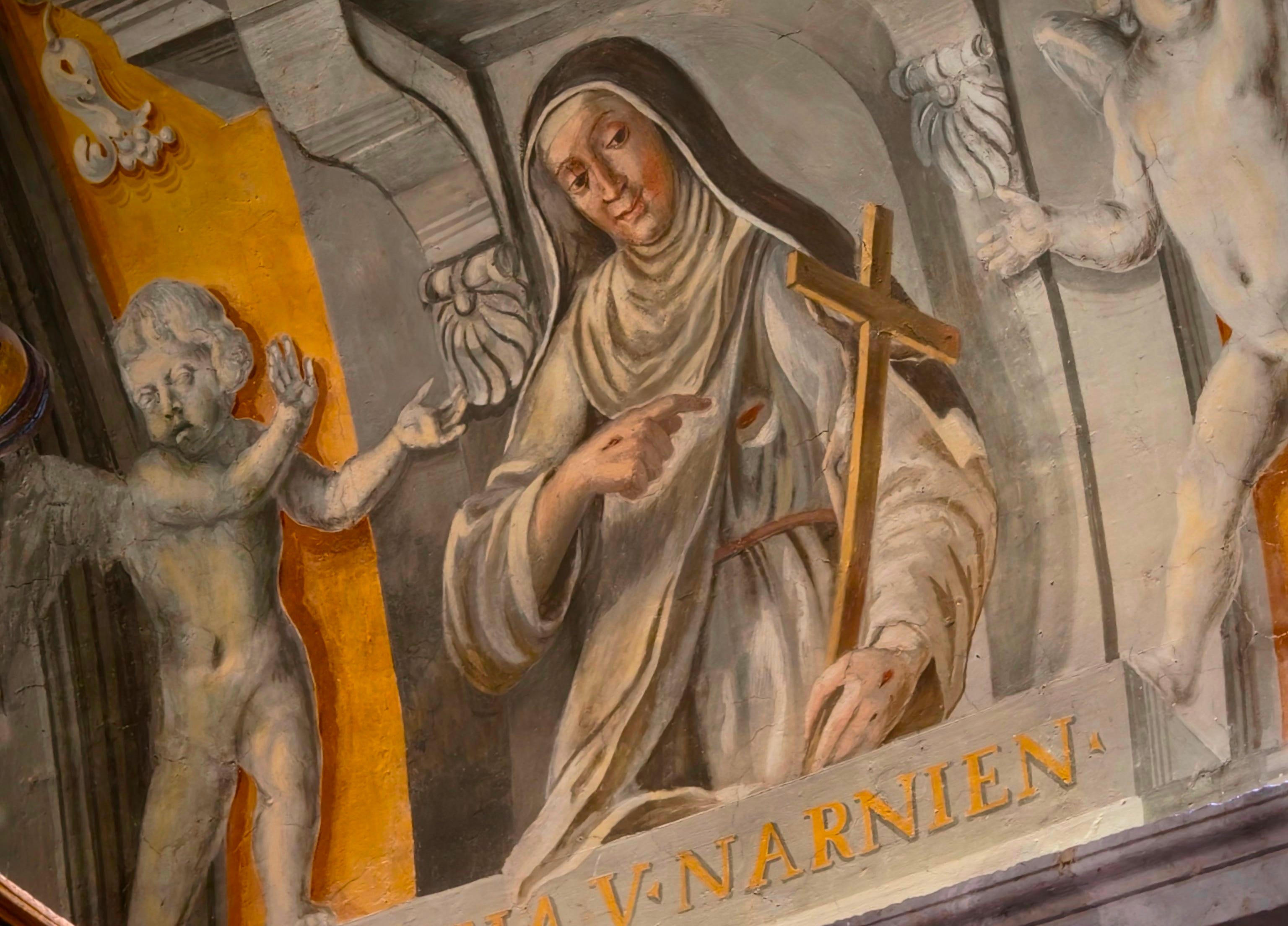
Here’s the remarkable life of the Dominican tertiary with whom C.S. Lewis’ beloved character Lucy shares a name.
Editor’s Notes
Following recent interest and amusement online, about the existence of a “Bl. Lucy of Narnia” in the liturgical calendar of the Dominican Order, we are publishing the account of her life found in Short Lives of the Dominican Saints.


This book was written by a Dominican sister based in England at the turn of the century. The account given is the true explanation of how there came to be a “Bl. Lucy of Narnia” in the Dominican liturgical books, and there do not seem to be any compelling links between this holy sister and the character of Lucy Pevensie, in C.S. Lewis’ Chronicles of Narnia.
However, this need not stop us imagining what might have been…
(The above “account” has been updated since it was initially published as a note on Substack.)
In this article, however, we will stick with the true account.
Bl. Lucy of Narnia, Pray for us!
Blessed Lucy of Narni, Virgin
(A.D. 1476–1544)
From
Short Lives of the Dominican Saints
by
A Sister of the Congregation of St. Catherine of Siena (Stone)
Ed. Very Rev. Father Proctor
Kegan Paul, Trench, Trübner & Co. London, 1901.
Her infancy
Blessed Lucy was born at Narni, in Umbria, on the 13th of November, A.D. 1476, of the noble family of the Broccolelli. When she was quite a little child, one of her uncles brought some toys and pious objects from Rome as presents to his nephews and nieces. Lucy immediately made choice of a rosary and a little statue of the Infant Jesus as her share of the gifts; and this “Christarello,” as she called it, became the cherished object of her devotion.
Going one day, when she was seven years old, to visit another uncle, in whose house she remembered to have seen a room, on the ceiling of which was a painting representing the holy angels, she wanted to behold the picture once more. She was unwilling to have any companion who might disturb her devotions, and yet the staircase which led to the room was too steep and difficult for her to climb alone. She therefore had recourse, as usual, to the Infant Jesus, and found herself miraculously transported to the apartment in question.
Whilst praying there, she was favoured with a heavenly vision of our Divine Lord, accompanied by His Blessed Mother, Saint Dominic, Saint Catharine of Siena, and a glorious troop of angels and of saints. Jesus then espoused her to Himself, placing a precious ring upon her finger; and Saint Dominic and Saint Catharine took her under their special protection, the former bestowing upon her the scapular of his Order, which she continued to wear under her secular attire until she was able to assume it in public. Many other heavenly favours, together with the gift of prophecy, were granted to her during her childhood; and she was thrice miraculously restored to health by Saint Catharine of Siena and Saint Peter, Martyr.
Marriage to Count Pietro
As she grew older, her family sought to give her in marriage, but Lucy firmly and courageously resisted; until at length our Blessed Lady revealed to her that it was the will of God that she should accept the hand of a certain Count Pietro, and that her married life was to be an imitation of the holiness and purity of the house of Nazareth.
Though she now had the management of a large household, which is said to have been as devout and well-ordered as a religious community, Blessed Lucy relaxed nothing of her customary exercises of prayer and practised heroic penance, daily receiving the discipline at the hands of one of her maids. Prompted by a spirit of humility, she would clothe herself in coarse and shabby clothes, and during several hours every day take part with her servants in the domestic work of the house, after which she resumed the rich attire which befitted her rank.
After about four years of married life, Blessed Lucy resolved, in obedience to the express command of Heaven, to leave her husband and carry out her early desires of consecrating herself entirely to her Heavenly Spouse.
Taking the habit of the Third Order
She retired for a time to her mother’s house, where the Prior of the Dominican Convent of Narni gave her the habit of the Third Order in the presence of witnesses, and a week later received her to profession. She then proceeded to Rome, where her uncles procured her admission into a Monastery dedicated to Saint Catharine of Siena, in which she spent nearly a year.
After this, she was sent to found a Convent of the Order at Viterbo; and three years later, when she had attained the age of twenty-three, at the earnest request of Duke Hercules d’Este, the Pope commanded her to repair to Ferrara and establish a Convent in that city, of which she was appointed perpetual Prioress.
During this time she had much to suffer from the Count, her husband; but she at length succeeded in inducing him to take the habit of Saint Francis, in which he lived and died holily.
Miracles and favours
Amongst many other miraculous visions and favours, Blessed Lucy was visibly marked with the sacred stigmata. She was held in universal esteem for her sanctity and miracles, and for her spirit of prophecy. But our Lord loved His faithful Spouse too well to leave her without a large share in His own chalice of suffering.
Accordingly, after the death of her patron, the Duke of Ferrara, some members of the Community, whom she had had occasion to reprove for their evil lives, conspired against her, and by their calumnies, which were believed by the Superiors of the Order and by the Sovereign Pontiff himself, procured her deposition from office. She was made to take the lowest place, deprived of any voice in the affairs of the Convent she had founded, forbidden to go out of the house or to speak with seculars, or even with her confessor, in whose place another confessor was assigned her who was prejudiced against her.
For the remaining thirty-eight years of her life Blessed Lucy thus remained beneath the shadow of the Cross, often afflicted also in body by serious illness, in which she received no assistance from the Community, who had allowed themselves to be strangely blinded to her true character. But our Lord sent His Saints to visit and console her from heaven, and on one occasion miraculously transported Blessed Catharine of Raconigi, who was then still living, from her home in Savoy to spend the night in the cell of Blessed Lucy, whom she had ardently desired to see.
The end came at last on the 15th of November, A.D. 1544. Having received the Last Sacraments, and with the joyful cry on her lips, “Away, away to heaven!” she happily departed to her Spouse, whilst angelic melodies floated in the air around. Then the eyes of her Sisters were opened, and they buried her with great honour.
Many miracles followed her death, and she was beatified by Benedict XIII.
Prayer
O God, who didst wonderfully adorn the Blessed Lucy with the marks of the Passion of Thy Son, and with the gifts of virginity and patience, and didst enable her to elude the blandishments of the world, and to overcome its persecutions; grant that by her intercession and example we may neither be overcome by the allurements of the world nor sink under any of its adversities. Through the same Christ our Lord. Amen.
HELP KEEP THE WM REVIEW ONLINE WITH WM+!
As we expand The WM Review we would like to keep providing free articles for everyone.
Our work takes a lot of time and effort to produce. If you have benefitted from it please do consider supporting us financially.
A subscription gets you access to our exclusive WM+ material, and helps ensure that we can keep writing and sharing free material for all.
You can see what readers are saying over at our Testimonials page.
And you can visit The WM Review Shop for our ‘Lovely Mugs’ and more.
(We make our WM+ material freely available to clergy, priests and seminarians upon request. Please subscribe and reply to the email if this applies to you.)
Subscribe to WM+ now to make sure you always receive our material. Thank you!
Read Next:
This article has been prompted by recent discussion of “Blessed Lucy of Narnia” – and more can be found about the real and the imaginary Lucys below:
Follow on Twitter, YouTube and Telegram:
Twitter (The WM Review)