
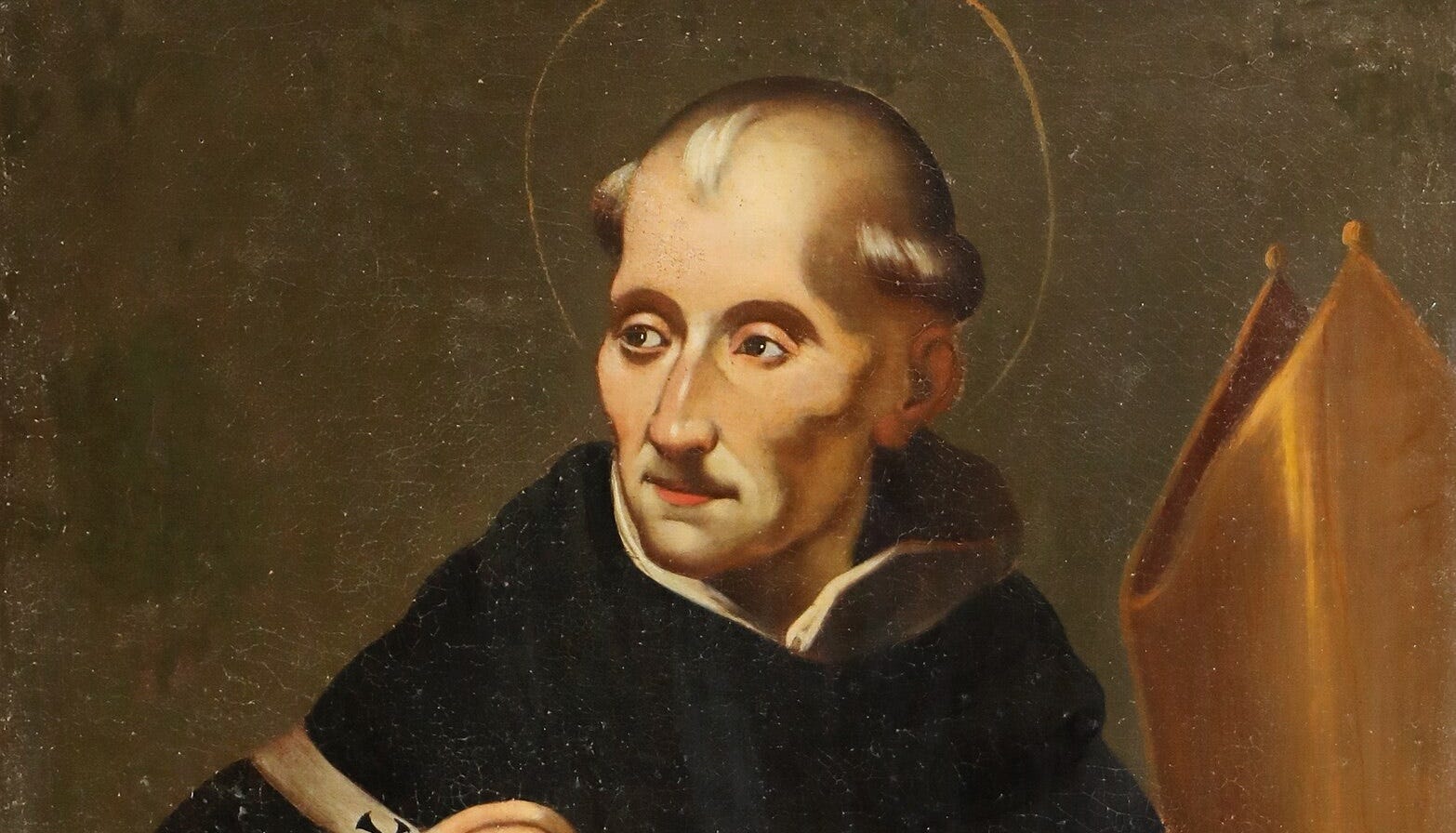
The sainted bishop of Florence expressed the same conclusion as St Robert Bellarmine: that a Pope who falls into heresy cuts himself off from the Church and the office of the papacy.
Editor’s Notes
St Antoninus of Florence OP
St Antoninus was born in 1389, and died in 1459. He joined the Dominican Order at the age of about 16, and made his novitiate with Fra Angelico. During the Great Western Schism, he was an adherent of the “Roman” claimant (Gregory XII), who is commonly considered to have been the true Pope. He assisted as a theologian at the Council of Florence, and was later compelled by Pope Eugene IV to accept episcopal consecration and the See of Florence. The Catholic Encyclopedia also claims that Pope Eugene IV called St Antoninus to assist him at his deathbed. He was consulted by subsequent Popes on other matters of importance, and was canonised by Adrian IV in 1523.
Dom Prosper Guéranger tells us the following about the Saint:
“Heaven blessed that illustrious City with temporal prosperity on account of its saintly Archbishop. Cosmas of Medici was frequently heard to say, that Florence owed more to Antoninus than to any other man. The holy prelate was also celebrated for his great learning. He defended the Papacy against the calumnies of certain seditious Bishops in the Council of Basle: and, at the General Council of Florence, he eloquently asserted the truth of the Catholic Faith, which was assailed by the abettors of the Greek Schism. How beautiful is our holy Mother the Church, that produces such children as Antoninus, and has them in readiness to uphold what is true, and withstand what is false!”
His principal work was Summa Theologica Moralis, which dealt with moral theology, and was an important text in the fifteenth and sixteenth centuries, and it is difficult to find copies of it in modern script, without the abbreviations and unusual markings common in scholastic texts of that time.
However, with the help of Mark Escobar, we have located the section relevant to “The Pope Question”, transcribed it and its surrounding context, and have made it available in Latin and English for readers.
In this section, St Antoninus teaches that if a “Pope” is “found” departing from the faith, or “caught” falling into heresy – indicating an external act, rather than a merely internal sin – he is “ipso facto deposed.”
Naturally, he also explains why this is the case.
Resistance
After dealing with the problem of a “heretical pope”, St Antoninus turns to the question of a wicked pope, which he distinguishes from the former. He explains why these two cases should be distinguished – and also specifies the type of wickedness that he has in mind.
As such, his calls for “resistance” have no relevance to our current situation – and the same applies also to what Bellarmine says on the matter, citing the following sections of both Turrecremata and Cajetan:
Could a Pope destroy the Church? John de Torquemada answers
How an evil pope could ‘destroy the Church’—Cajetan’s objections
How to defeat a destroyer pope – Cajetan and prayer
Final nail in the Bellarmine ‘resistance quote’ coffin? Cajetan’s context
‘Resisting the pope?’—Bellarmine on doubtful and tyrannical popes
In discussing Bellarmine’s text, some (such as the late Fr Anthony Cekada) placed a certain emphasis on who was permitted to resist an evil Pope (i.e., kings and prelates, and not individual Catholics).1 However, this seems debatable: it is more straightforward to insist that St Robert Bellarmine and the others were speaking about a certain set of evils that could be resisted (as Fr Cekada did indeed recognise) – in which heretical teaching and harmful universal laws did not feature.2
Final Note
Following the text, we are also reproducing another short extract from St Antoninus on a related topic, cited by Don Francesco Ricossa IMBC and translated by the seminarians of Most Holy Trinity Seminary. Although the extract is discussing the state of affairs after a Pope has died, it has obvious implications for a Pope losing office due to heresy, schism, apostasy, permanent insanity or resignation – or for when a man elected does not accept the office in the first place.
Whether the Pope can be Deposed for any Crime
St Antoninus of Florence
From Summae Sacrae Theolgiae, Iuris Pontificii, et Caesarei, Pars Tertia.
Titulus Vigesimussecundus – De Statu Summorum Pontificem
Cap. V, De Maxima Potestate Papæ, pp. 393-4
Venetiis, Apud Bernardum Iuntam et Socios, MDLXXI. Available (at the right page) at Google Books. (Latin transcript available here)
§3: Can the Pope be deposed?
The question is asked, whether the pope can be deposed for any notorious crime whatsoever.
It seems that he can. For it is said, Distinction 40:
“If the pope should fall into such faults, no mortal may presume to reprove him, since he who is to judge all men is himself to be judged by none, unless he be found deviating from the faith.”
Therefore, it seems that he may be deposed, at least for heresy.
Indeed, the gloss on the said chapter says that for any other notorious crime – such as adultery, simony, and the like – if he were incorrigible and gave scandal to the Church, he could be deposed.
On the contrary is what Anacletus says, Distinction 79:
“The Lord reserved to himself the election of the supreme pontiffs, although he granted their election to good priests and spiritual peoples.”
And in 9, Question 3, it is said:
“No one shall judge the First See.”
For neither by the emperor, nor by all the clergy, nor by kings, nor by the people, shall the judge – that is, the pope – be judged. Upon which the gloss says that a council cannot judge the pope, as in Extra, De electione,3 chapter Significasti; and this is so unless he should submit himself to the judgment of certain persons, as in Cause 2, Question 7, Nos.
Likewise, Pope Symmachus says in IX, q.3:
“God willed that the causes of other men should be settled by men, but he has without question reserved the presider of this see to his own judgement; he willed that the successors of blessed Peter should owe their innocence to heaven alone, and should have their conscience enclosed within the scrutiny of the most subtle examiner.”
It must be said, according to Augustine of Ancona, in the place cited above, that the pope is not to be deposed for any crime, however notorious, because such deposition or accusation would redound to the harm of the whole Church. For if accusations against him were to be heard, the Church would remain headless.
And this is so, except for the sin of heresy – though even in this case, if he were willing to correct and amend himself, he ought not to be deposed, as Hugo notes in the twenty-first distinction. And therefore the bishops gathered in council did not depose Marcellinus, who had confessed heresy and idolatry, because he was prepared to be corrected and to revoke his sententia, which indeed he did.
Why a heretic pope loses office ipso facto
But for heresy itself he is fittingly deposed ipso facto, because the pope is chosen as the head of the whole Church, according to that saying of Ephesians 1:
“Himself, Christ, he gave as head over all the Church, which is his body.”
Now the pope represents the person of Christ. Hence Christ also called Peter Cephas, that is, head; and the office of the head is to infuse life into all the members. But the principle of spiritual life is faith, for, as the Apostle says, “Without faith it is impossible to please God.”
If therefore the pope is found to have deviated from the faith, he is himself dead to spiritual life, and consequently cannot infuse life into others. Hence, just as a dead man is not a man, so a pope caught in heresy is not pope, because he is deposed ipso facto.
The same is said by Peter Paludanus, in the place cited above, namely, that the pope, so long as he is pope, cannot be deposed for any crime whatsoever – whether by a council, or by the whole Church, or by the whole world. This is not only because he is superior and has no man above him who can judge him, but also because this is for God, who has reserved to himself the judgment of the Roman prelate, so long as he is prelate, as in Cause 9, Question 3, Aliorum.
But when he lapses into heresy, then by that very fact he is cut off from the Church and ceases to be head; and then he is deposed de facto, not de iure, because “he who does not believe is already judged” (de iure); but this is before any judgment, since by the very fact that he is a heretic, he is cut off from the Church. Now the head cut off from the body cannot, while it remains severed, be the head of the body from which it has been cut off. Whence the pope, by this very fact, ceases to be the head of the body of the Church. And thus a heretic cannot be, nor remain, pope, because the keys of the Church cannot be possessed outside of the Church. But by other sins, the pope is a sick head, which does not on that account cease to be head – nor can he therefore be judged by the members.
An objection: expanding this conclusion to a wicked pope
Peter moreover says that the gloss upon the chapter Si papa, cited above, which says that for any other notorious crime, if the pope be incorrigible, he may be deposed and judged, is false. And he gives the reason for this: the gloss says that, since the pope is incorrigible, he is said to be heretical through contumacy; and since he is contumacious, he is consequently an unbeliever and a heretic.
But it must be said, according to Peter, that when heresy is said to be contumacious, heresy is taken in a broad sense – just as simony also is sometimes called heresy, because of a certain likeness. But when it is said that the pope can be deposed or is deposed on account of heresy, it is taken there in its proper and strict sense – that is, through a fixed error concerning matters of faith. Therefore, not for any other sins, however incorrigible he may be, can he be deposed.
The same is said by Augustine of Ancona, upon that gloss. He adds, however, that the said gloss can be preserved – namely, that when it is said that a man can be deposed on account of the incorrigibility of some vice, it must be understood when he is so incorrigible that the sin which he commits, even though it be mortal, he believes and asserts not to be a sin. For then indeed he would be truly and properly a heretic, and so he can be deposed – but not merely because he does not cease from the act of sin.
How to respond to a wicked Pope
What then is to be done when the pope is so wicked that by his conduct he destroys the Church of God? Peter Paludanus says that there is a twofold remedy.
The first is after the example of Paul, who withstood Peter to his face at Antioch, because he was leading the Gentiles astray, inclining them, as it were, to Judaise, through an excessive condescension towards the converted Jews, lest he should scandalise them, as is found in Galatians 2 and in 2, q. 7. Thus the pope, according to Paul, is not to be obeyed in evil matters, but resisted by honest reproof.
Hence, if the pope wished to give the whole treasure of the Church to his relatives, or to destroy the Church of Saint Peter, or to give to his relatives the patrimony of Peter, or to do anything of this kind which is not lawful, it ought not to be permitted, but he should be resisted – though without recourse to deposition.
The second remedy is after the example of blessed Hilary, who prevailed against Pope Leo by prayer. This Leo was, I believe, the one who by another name is called Pope Liberius, who favoured the Arian heretics. Therefore, for such an incorrigible pope the whole Church ought to pray that God may either correct him or remove him from the world. Nor would God ever so despise his Church that he would not hear her. And a council ought to be convened against him, if he himself were unwilling to convene it, so that by it he might be admonished, or that God might be implored to apply a remedy by resisting the evils which he wished to do, lest the Church should be endangered. Another example of this remedy is found in the case of Pope Anastasius, who, favouring heretics, was struck down by divine judgment, as is read in Cause 19, Anastasius.
Likewise note, according to Augustine of Ancona, that whilst the pope is pope, and a general council cannot be assembled except by his authority (as is clear in distinction 17 throughout), nevertheless because a pope on account of the crime of heresy is not pope, in such a case his authority is not therefore required; the authority of the college of cardinals and of other bishops and doctors would suffice.
He also says that if it is notorious that a pope has died in heresy, and during his life in the Church taught or fostered a perverse doctrine, and did not amend himself, even after his death he may be accused and condemned, as is argued in Cause 24, Question 3, chapter Si vera.
Base text translated with the aid of AI, with each line scrutinised by a human person.
The Power of the Pope during an Interregnum
St Antoninus of Florence
Translated by seminarians of Most Holy Trinity Seminary (fair use)
From Summae Sacrae Theolgiae, Iuris Pontificii, et Caesarei, Pars Tertia.
Titulus Vigesimussecundus – De Statu Summorum Pontificem
Cap. V, De Maxima Potestate Papæ, pp. 376-7.
Venetiis, Apud Bernardum Iuntam et Socios, MDLXXI. Available (at the right page) at Google Books.
§ 3. Whether the power of the Pope remains in the College of Cardinals after the death of the Pope?
Augustine of Ancona responds in the third Question of the aforesaid book: After his death the power of the Pope remains in the College of Cardinals in two ways. First with respect to the root, for the College is compared to the Pope as the root to the tree or the branch. But just as the power of the tree or the branch, by which it blossoms and produces fruit, remains in the root even after the tree itself or its branch are destroyed, so the papal power remains in the Church or the College after the death of the Pope. It remains in the College as in the proximate root and in the church of the prelates and other faithful as in the remote root. Secondly, such power remains in the Church and in the College with respect to that which is material in the papacy, since after the death of the Pope the College is able, through election, to determine a person to the papacy, that it be such or such a one. Wherefore just as the root produces the tree through which it produces the flowers and fruit, so also the College makes a Pope who has jurisdiction and administration in the Church. Hence, if by the name of papacy we understand the election and determination of the person (which is the material thing in the papacy, as has been said before) then such power remains in the College after the death of the Pope. But if by the name of papal power we understand his authority and jurisdiction (which is the formal thing), then such power never dies, because it always remains in Christ, who rising again from the dead, dieth now no more.
Wherefore St. Augustine, commenting on the words “all power is given to me in heaven and in earth ... and behold I am with you all days, even to the consummation of the world” (Mat. 28), says that the Apostles, to whom Christ spoke, were not going to remain until the consummation of the world, but He spoke to them in the person of all those that would succeed them, as to a single body of the Church. If, however, by the name of papal power we understand the actual administration, which is the material and formal thing in the papacy, then it is true that this actual administration dies with the death of the Pope, since the actual administration of the papal power does not remain in the College after the death of the Pope (except to the extent that it was entrusted to them by a decree of the predecessor), nor does it remain, in this manner, in Christ, because, according to the common law, Christ has not exercised such power, after His resurrection, except through the mediation of the Pope; for although He Himself is the door, He has nevertheless constituted Peter and his successors as the His porters, by whose mediation the door of access to Him is opened and closed.
The power of the Church therefore with regard to jurisdiction (which is, as it were, the formal thing in the papacy) does not die with the death of the Pope but persists in Christ. Nor does it die with regard to the election and determination of the person, (which is like the material element), but it persists in the College of Cardinals; it dies, however, with respect to its actual administration and jurisdiction, because after the death of the Pope, the Church is vacant and is deprived of the administration of such power. Nor is that conclusion hindered by saying that the priesthood of Christ will endure forever, just as Christ, and that therefore, after the death of the Pope, his power remains, because this is true with regard to what is formal in the priesthood. For just as all priests, as regards the power of consecration, are but one priest, Christ, inasmuch as all consecrate in the person of Christ); so all Popes are but one Pope, Christ, because all Popes receive jurisdiction and the power of ruling immediately from God; and yet the actual administration of the said power dies with the death of this or that Pope.
HELP KEEP THE WM REVIEW ONLINE WITH WM+!
As we expand The WM Review we would like to keep providing free articles for everyone.
Our work takes a lot of time and effort to produce. If you have benefitted from it please do consider supporting us financially.
A subscription gets you access to our exclusive WM+ material, and helps ensure that we can keep writing and sharing free material for all.
You can see what readers are saying over at our Testimonials page.
And you can visit The WM Review Shop for our ‘Lovely Mugs’ and more.
(We make our WM+ material freely available to clergy, priests and seminarians upon request. Please subscribe and reply to the email if this applies to you.)
Subscribe to WM+ now to make sure you always receive our material. Thank you!
Read Next:


Lovely Mugs
Extended Vacancy Mug
Ipso Facto Mug
The Fifth Opinion Mug
Follow on Twitter, YouTube and Telegram:
Twitter (The WM Review)
Fr Anthon Cekada, The Bellarmine “Resistance Quote: Another Traditionalist Myth”, 2004. p. 1. Available here.
It is intriguing that Fr Bernard Lucien did not recognise this in Cahiers de Cassiciacum III-IV, writing:
What precisely does St. Robert Bellarmine mean by the expressions “attacking souls” or “striving to destroy the Church”?
This remains entirely undefined. If we adopt the strong interpretation of the text—which is the hypothesis we are now entertaining—then we must exclude from those expressions all cases in which the pope would be acting heretically (cf. above). But this filtering is not indicated in the text.
There is therefore no criterion by which to determine what St. Robert included or excluded with these expressions.
On the contrary, Bellarmine provided specific references to Turrecremata and Cajetan, which provide sufficient clarity – and indeed, did not include heresy.
I believe it is treated as a hypothetical case, if a pope were to become a heretic or a heretic were elected pope.
The reality, however, was clearly defined when the Fathers of the First Vatican Council concluded that no Pope had ever been a heretic – not Liberius, Honorius I, John XII, John XXII, nor any other name that is brought up in association with the accusation of “papal heresy.” Nor had any pope failed to maintain Apostolic Tradition in doctrine, worship, sacramental rites, discipline or anything essential to the Catholic faith & practice. NEVER HAPPENED AND NEVER WILL. The Holy Spirit also prevents heretics from being elected pope (like the Freemason Rampolla in 1903), and a true pope can’t even teach, promote or approve anything injurious to faith or morals or perfect worship, and not just when teaching ex cathedra.. This is the Tradition of the Church.
“…this See of Saint Peter always remains unblemished by any error, according to the divine promise of our Lord & Savior to the prince of his disciples: ‘I have prayed for you that your faith may not fail….’” – Vatican I, Pastor Aeternus, 4.
novusordowatch.org/2022/04/felix-cappello-heretical-pope-impossible;
novusordowatch.org/2015/04/heretical-popes-first-vatican-council
https://novusordowatch.org/2025/01/pope-pius12-on-perpetual-orthodoxy-of-papacy
All this gives greater credence to the reality that a validly elected pope was threatened into invalid abdication in 1958.
BTW, it's "Summa Theologica Moralis."
It cannot be repeated often enough that all the classical theologians who discussed the question (as in the present case) only considered the possibility of a pope falling into personal heresy.
The inference is that a pope going further still, and attempting to bind the universal Church to heresy through magisterial acts (eg., encyclicals) was a scenario so radically opposed to the raison d’etre of the papacy as to require no comment.
This fact is continuously lost sight of in the R&R championing of Cajetan/JST (as though these latter would have accepted such a thing as possible).