

This aspect of French Republicanism is very weird, and definitely worthy of criticism.
2026 was the summer of laïcité for me and my family.
Item I: The Fort of Brittany
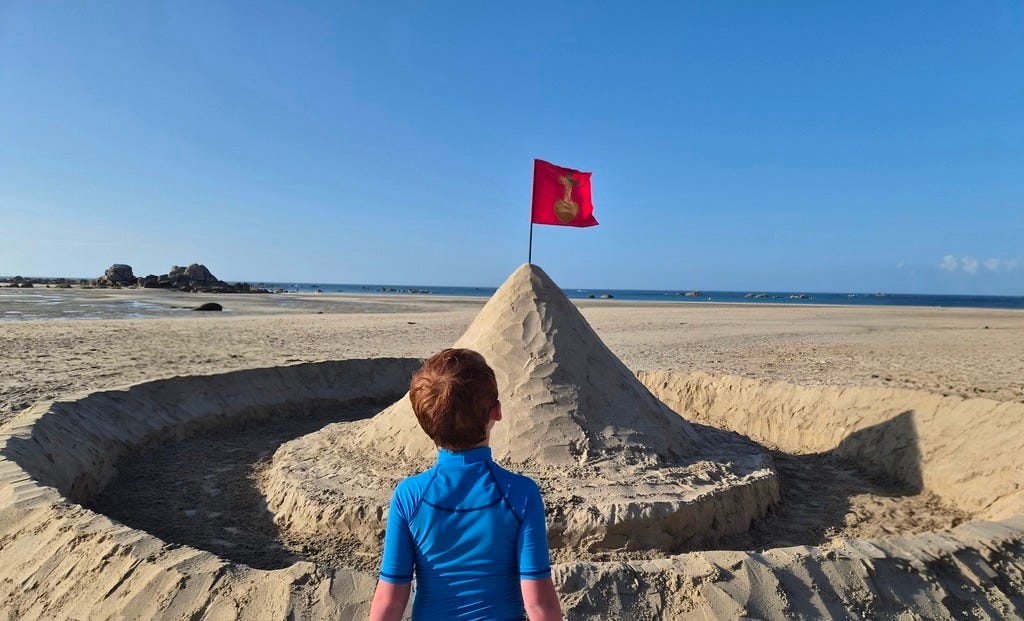
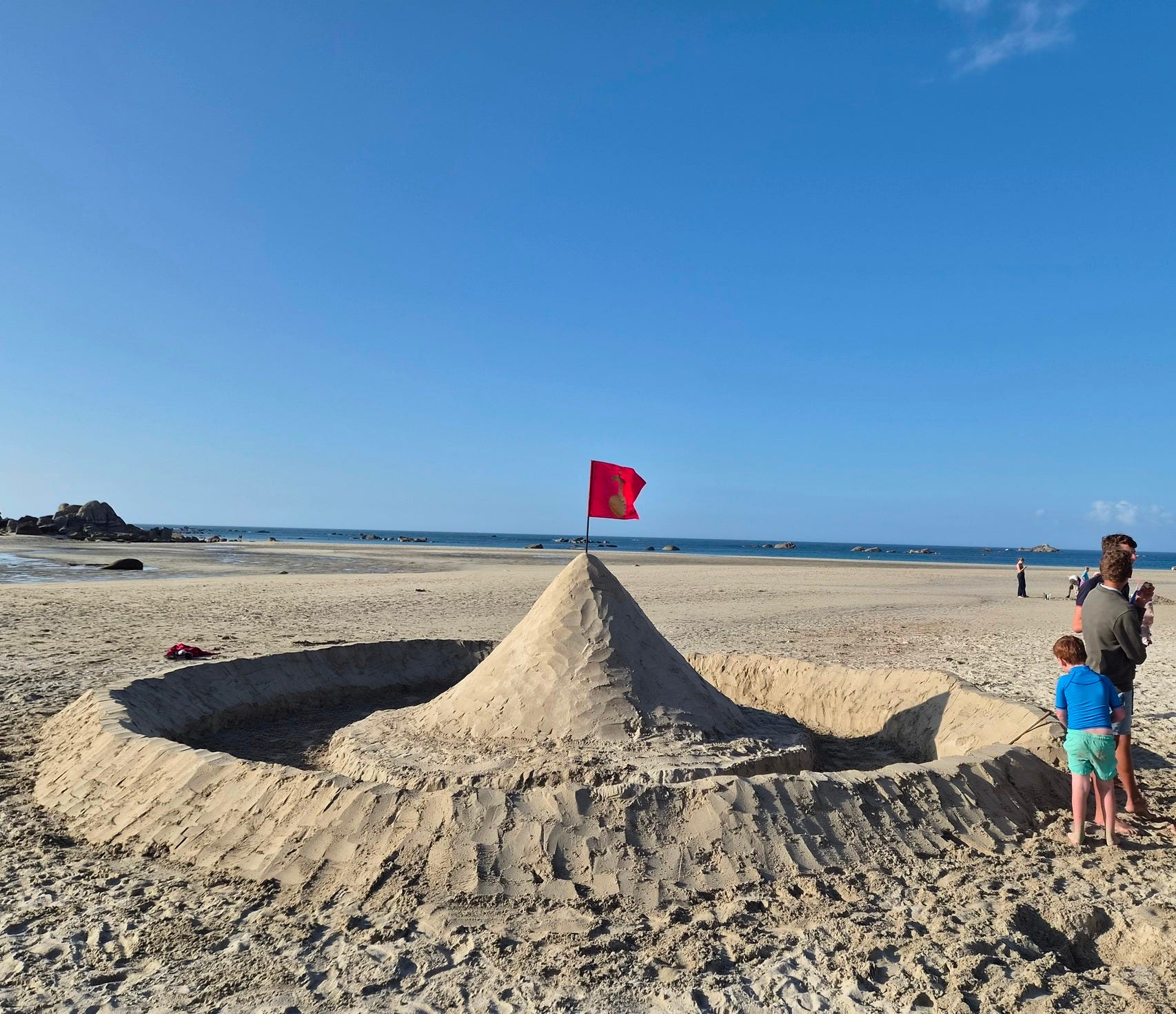
During our summer vacation, we found ourselves on the beach in Brittany, France, where about a dozen of my nieces and nephews were building a massive pyramid fort with a moat.

The pictures won’t do it justice, but it was the biggest beach construction I’ve ever seen.
This is the kind of thing this family of French kids do for fun, and between the big labour force they had, and the garden spades they were using, they made something really impressive.
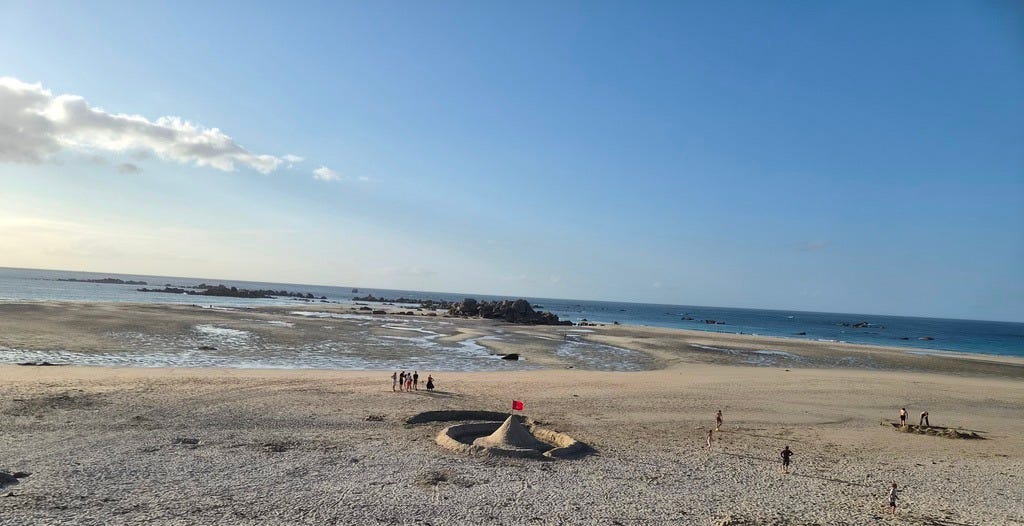
At the top of the pyramid, as you will have seen, they had planted a red and gold flag of the Sacred Heart – also the sign of the Vendean resistance to the French Revolution several centuries ago
Most people who wandered by stood and admired it, and some congratulated them on their work.
However…
One older couple came over. They weren’t happy. They objected to the kids having a “religious symbol” in a public place. They angrily said it was contrary to “laïcité”.
One of my nephews responded, “It’s the symbol of the Vendée”. The argument continued, until the couple walked towards the path away from the beach. The woman stayed there for a while, talking to people angrily about the construction. Then she made a phone call about it.
Not having good enough conversational French to get into an argument with a member of the public, and conscious of being a visitor, I decided to loiter near the rocks and see if she was calling the police or not. She ranted for a little while – before wandering off. No police arrived.
But this wasn’t my first brush with laïcité of the vacation.
Item II: The Funeral Home
Aside from visiting family, this summer vacation also included the funeral of my wife’s late aunt. (Please pray for the repose of her soul.)
She was a much loved figure, and lost her fight with cancer just before we left. We hadn’t seen her since Christmas, and had been led to think she’d hang on a bit longer.
After her death, the family commissioned the town pompes funèbres (funeral home and undertakers) that they’d used for several other loved ones.
For every other death in recent years, these chaps provided a good service. The bodies of the deceased have been laid out in a spacious enough room, and we’ve been able to go and keep vigil and pray the Rosary with them in the lead-up to the funeral. The undertakers even join in with the prayers at the graveside (something you wouldn’t see in England).
But this time, we were told that they wouldn’t be able to provide the standing crucifix that they had installed for the previous family members.
Why? “Par souci de laïcité” – because of concern for this quasi-sacred notion of laïcité.
Just to labour the point: They wouldn’t provide the same standing crucifix they’d always provided before, to be put in a private room to which the family had the key, and no members of the public would have seen it. “Because of concern for laïcité.”
Item III : The Speedos
The third summer incident was recounted to me by a friend and colleague, who also spent the summer in France.
He took his little girl to the swimming pool, and was wearing a pair of swimming shorts – upon which were emblazoned the name and logo of the swimming brand, Speedo.
In spite of this, a member of staff informed him that he wasn’t allowed to wear those shorts in the swimming pool.
The reason? Well, the reason stated was that it was because they were a bit “puffy” and were “street clothes” – even though they were made by Speedo.
My friend was directed to a vending machine, where he was able to purchase a pair of lycra-style swimming shorts. Not wanting to disappoint his little girl, he complied. When in Rome, do as the Romans do.
He was also told that he was not allowed to wear a shirt specifically designed for swimming – for the same reason.
He found himself back at the pool later in the vacation: in spite of the humiliation of having to wear such grotesque shorts, the children cannot be disappointed. But it was on this second occasion that the humiliation was consummated: a Frenchman informed him that he had a hole in the seat of his swimming shorts.
What does any of this have to do with laïcité? And what is laïcité anyway?
What is laïcité?
Laïcité is a word which doesn’t have a direct translation in English. It is a principle of the French constitution which sums up the ideas of secularism, and the separation of Church and state. It appears in the first article of the French Constitution. But – as the examples above show – it is nothing like what Americans would think of by those terms.
Americans and other western nations generally hold that the civil authority should not establish any one religion as the official state religion, should protect “freedom of religion”, and avoid involving itself in the administration or life of any religion.
However, laïcité goes further than that. It enjoys an enormous and quasi-sacred character, being bound up with the French Revolution, the “guerre scolaire” (a long conflict over the role of the state and the Church in education), the 1905 “Law of Separation”, and – for many – French identity itself. Frankly, it is surprising that the word is not engraved on municipal buildings underneath Liberté, Égalité and Fraternité.
It enshrines a default separation between religion and civil life as the rule: events like processions and so on are permitted at times, but the general idea is that religion is a private matter, and so remains in the private sphere; and that the public sphere should be kept free from any one religious group. This inevitably means that it should be kept free from all religious groups.
Similarly, the principle tends towards the idea that individuals are to avoid emphasising their own religious differences in public.
The pedigree of this idea is the French Revolution. After a period of bloody persecution of the Church, laïcité came to be a kind of compromise position. But the real meaning of this doctrine is that civil society must be “protected” against the Catholic Church – which is to say, it must be “protected” against God.
The Church has condemned the idea on many occasions. It is a violation of the First Commandment, which enjoins the worship of the true God, according to the way in which he has revealed he is to be worshipped. Each individual is bound to obey this commandment, and this is so whether he is on his own, or with his family, or organised as civil society. This is why the Popes referred to the growth of laïcité as a principle – both in France and elsewhere – as a “deliramentum”, or as “legal apostasy”. The doctrine of Christ’s “Social Kingship” is diametrically opposed to it too.
The Church’s teaching on these matters is explained here:
In 1925, the French Cardinals and Archbishops released a Declaration which expressed this openly and clearly:
“The laws of laïcité are unjust, first of all, because they are contrary to the formal rights of God. They proceed from atheism and lead to it in the individual, familial, social, political, national, and international order. They presuppose the total disregard of Our Lord Jesus Christ and of His Gospel. They tend to substitute for the true God mere idols (liberty, solidarity, humanity, science, etc.); to de-Christianise all lives and all institutions.”
Only after this fundamental injustice do they state the temporal problems caused by this ideology:
“They are unjust, moreover, because they are contrary to our temporal and spiritual interests. Let them be examined: there is not one among them that does not strike us at once in our earthly goods and in our supernatural goods.”
They list the following:
The education laws
The law of separation
The law of divorce
The laïcisation of hospitals.
By contrast, as Pope Pius XI wrote in Quas Primas, the proper relationship between Church and State – one in which the State recognises the true religion, and offers corporate worship to God – is one which brings both spiritual and temporal blessings.
“He is the author of happiness and true prosperity for every man and for every nation. ‘For a nation is happy when its citizens are happy. What else is a nation but a number of men living in concord?’ If, therefore, the rulers of nations wish to preserve their authority, to promote and increase the prosperity of their countries, they will not neglect the public duty of reverence and obedience to the rule of Christ.”
This is a non-negotiable part of the Catholic faith, enshrined in the First Commandment, and sadly denied by the Second Vatican Council’s Dignitatis Humanae.
Laïcité and Islam
As is clear, laïcité is fundamentally an aggressive concept. However, over time, it has become particularly directed at Muslims.
Certain measures – such as the public-space bans on the hijab, the abaya and the “burkini” – have been “paid for” with laïcité – resulting in corresponding bans on Christian symbols and basic modesty as well.
These bans – and the principle of laïcité – have been supported even by the “Far Right”, in the form of Marine Le Pen’s Rassemblement National (formerly Front Nationale). This party’s support for laïcité is why a certain number of Catholics are less than enthusiastic about Jean-Michel’s daughter.
Here we can illustrate the point, with the incident described above in Item III (The Speedos).
Some say that French laws about swimwear at swimming pools date from the early twentieth century, and they are ostensibly about hygiene, dirt, and the wearing of street clothes in the pool. For similar grounds, several local authorities in France have banned the “burkini” – a full-body swimsuit commonly used by Muslims, out of concern for modesty.
The same hygiene rules against streetwear in pools are cited for this – but so are the “concerns for laïcité.” Back in 2016 – shortly after a terrorist attack, and the murder of Fr Jacques Hamel – newspapers reported that a woman on a beach in Nice was ordered by police to remove her “burkini”. Another woman was also fined for wearing leggings, a tunic and a headscarf on a bean in Cannes. This was followed by several bans – one of which stated that accessing beaches and swimming locations were prohibited…
“[T]o any person not wearing appropriate attire, respectful of good morals and laïcité, respecting the hygiene and safety rules for swimming adapted to the public maritime domain.”
What did the French “right wing” have to say about this?
It is often said that the terms “right wing” and “left wing” are essentially liberal, in that they refer historically to the two wings of the post-revolutionary epoch. Nowhere is this clearer than in France – even though the cordon sanitaire serves to exclude the the “far right” from getting in. (As shown by the Catholic favourite François Fillon giving his support to Emmanuel Macron in 2017, as a means of avoiding the Front National from winning.)
At the time of the ban, Marine Le Pen referred to the “burkini” as a “fundamentalist uniform”, and called it an “absolutely extraordinary regression”, and stated that “Nobody can say that it is an act of freedom for women.”
“We want to live in a laïc political system,” she said. “If people have a problem with that, it’s their problem.”
While she claimed that her opposition was a reaction to “the rise of Fundamentalist Islam in France”, rather than to Catholics or Jews – and that the ban did not extend to the garb of clerics or religious – she nonetheless condemned those who wish to “dress differently”.
Naturally, we have no sympathy for Islam qua Islam; but we do have sympathy for Muslims (and anyone else) qua people who want to dress modestly – even if some might consider the “burkini” to be unnecessary or excessive.
The conclusion is clear: concern for modesty in swimwear is forbidden, being understood as disrespectful to “good morals” and the untouchable value of laïcité – even according to the “great right hope”, Marine Le Pen.
Conclusion: Leo XIV’s comments in France
In light of all this, we can see that – despite not being a true Pope, or even a Catholic – Leo XIV raised a point well worth discussing when he visited France in September 2026. French laïcité is completely out of hand, and is fundamentally and aggressively anti-Catholic in nature.
He said:
“A Christian engaged in public service and is guided by the light of his or her conscience illumined by faith, cannot be considered a proselytizer or a threat to the unity of the nation. Indeed, authentic secularity [laïcité] does not exclude religion but is capable of valuing it as an educational resource.
“That is precisely why Catholic schools have a rightful place in the educational landscape of a country like France. This is part of a broader issue essential to any dialogue, in schools and in society as a whole: learning to know and love ourselves, in order to be able to encounter others with respect and openness.
“An authentic secularity, then, consists not in excluding religion from the public sphere or from education, but in striving to ensure that the State and religious institutions maintain dialogue and join forces in the service of the common good, that the world may have life. […]
“Mr President, ladies and gentlemen, I would like once again to thank you for this meeting. Indeed, to echo the words spoken by Your Excellency to the Bishops of France in 2018, it serves to show how ‘a Church that claims to be uninterested in temporal matters would not be fulfilling her vocation; and that a President of the Republic who claims to be uninterested in the Church and in Catholics would be failing in his duty.’ Be assured of my fervent prayers for your great nation.”
But while Leo XIV appears to critique this notion of laïcité, and even the separation of Church and State, what exactly are we looking at here? What is an “authentic laïcité”, in this context, and who is Leo XIV to tell the French Republic what it is?
These questions – and the supposed “precedents” found in the teaching of Popes Leo XIII and Pius XII – will be the subject of another article.
HELP KEEP THE WM REVIEW ONLINE WITH WM+!
As we expand The WM Review we would like to keep providing free articles for everyone.
Our work takes a lot of time and effort to produce. If you have benefitted from it please do consider supporting us financially.
A subscription gets you access to our exclusive WM+ material, and helps ensure that we can keep writing and sharing free material for all.
You can see what readers are saying over at our Testimonials page.
And you can visit The WM Review Shop for our ‘Lovely Mugs’ and more.
(We make our WM+ material freely available to clergy, priests and seminarians upon request. Please subscribe and reply to the email if this applies to you.)
Subscribe to WM+ now to make sure you always receive our material. Thank you!
Read Next:


Follow on Twitter, YouTube and Telegram:
Twitter (The WM Review)