

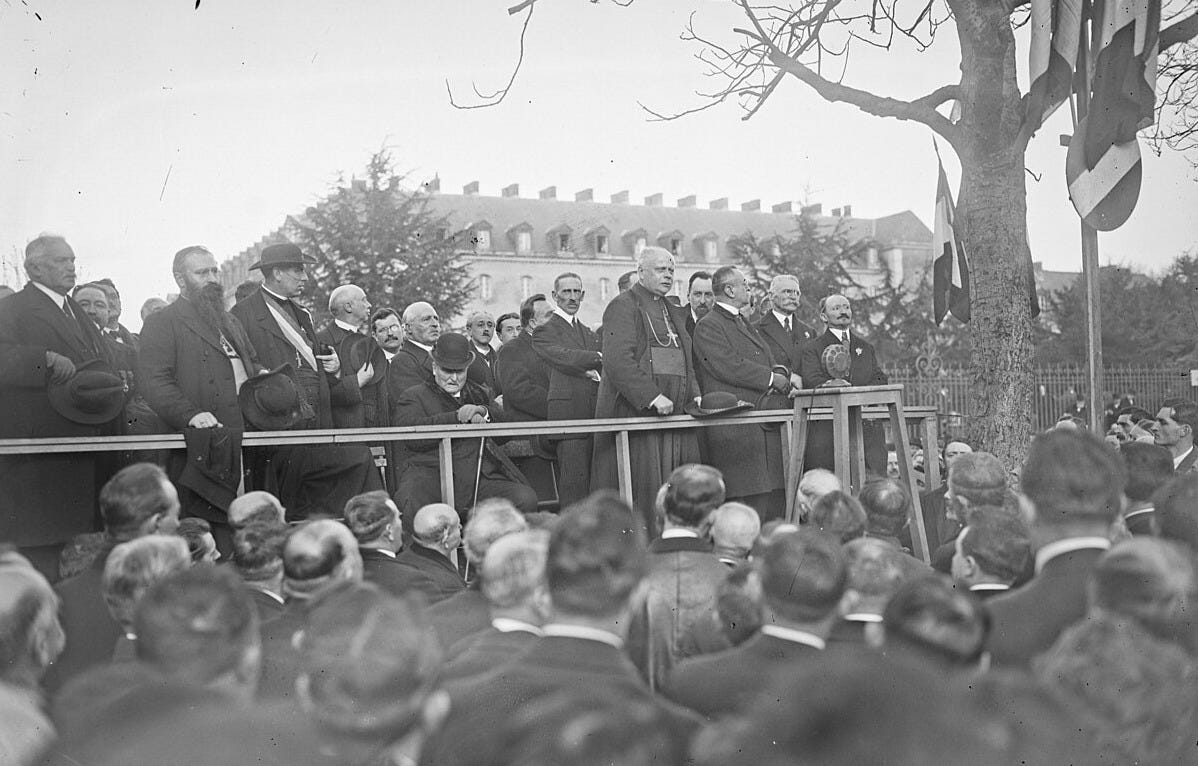
Over a century ago, the French hierarchy protested the ‘so-called laws of laïcité’ and set out a programme to combat them.
Editor’s Notes
On 10 March 1925, the Assembly of Cardinals and Archbishops of France – the precursor to the French Bishops’ Conference – published a “Déclaration” against “the so-called laws of laïcité”. This is a translation of that Déclaration – which not only condemns the “so-called laws” and the concept of laïcité – but also sets out a concrete programme of action.
The word laïcité does not have a direct translation into English – perhaps because our language is too pure to have a word for such a perverse concept, and we have never really had to find a single word to describe it. It is a principle of the French constitution, which sums up the ideas of secularism and the separation of Church and state.
It is an aggressive concept, as it is fundamentally about the “freedom” of the public sphere from the influence of the Catholic Church – as the Déclaration below explains. Today, such laws are often invoked in order to prevent certain public expressions of the Islamic religion – including modesty at the beach or swimming pools (!) – but they continue to serve as obstructions to the Church, and a block against the civil authority discharging its duties to God and the true religion.
We recently reviewed the new book from Stabat Mater Press – a new translation of Fr Théotime de Saint-Just’s classic work, The Social Kingship of Christ According to Cardinal Pie – to which I wrote a foreword. This Déclaration is included in French in an appendix to this new book.
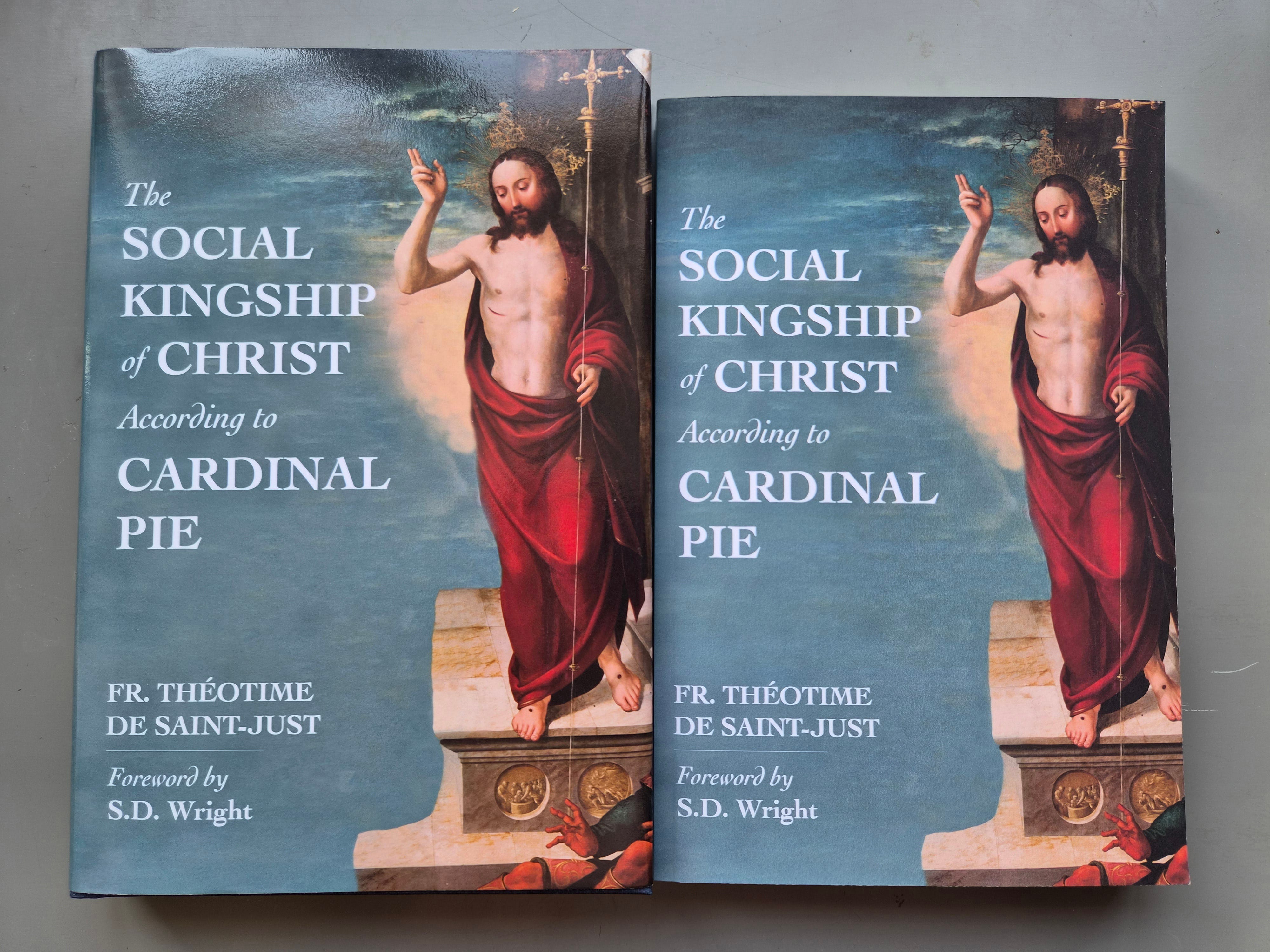
Here is what Fr Théotime had to say about it:
“Since [the First World War], the question of the social kingship has made immense progress. It has penetrated the depths of our people, and hundreds of thousands of French signatures are asking the Pope to establish a liturgical feast celebrating the social kingship of the Sacred Heart throughout the universe.
“From a doctrinal point of view, the issue reached its climax in the Declaration of the Cardinals and Archbishops of France on the So-Called Laws of Secularism.
“This splendid declaration, a true charter of liberation, a luminous counterpart to the obscure and sacrilegious Declaration of the Rights of Man, is, since the [First] Vatican Council, the most important spiritual event of our time. In our opinion, it is the last doctrinal step before the supreme condemnation of secularism and the solemn proclamation of the dogma of the social kingship of Jesus Christ by a General Council.”
The Déclaration is a striking document, with many instructive points for our own time. For example: it says that it is “very desirable” that “publicists and lecturers” be “formed and prepared seriously”, and that “in particular they study the treatises on the Faith, on the Church, and on the State.”
Some simple works on these topics could include:
Faith: Laying the Foundation: A Handbook of Catholic Apologetics and Fundamental Theology
The Church: The Church of Christ: An Apologetic and Dogmatic Treatise (Fr E. Sylvester Berry)
The State: Sociology: A Class Manual In The Philosophy Of Human Society (Mgr Paul J. Glenn)
And of course:
The Social Kingship of Christ According to Cardinal Pie – Fr. Théotime de Saint‑Just O.M.C.
More advanced works could include:
Faith:
On Divine Revelation: The Teaching of the Catholic Faith (Fr Réginald Garrigou-Lagrange)
The Church: Sacrae Theologiae Summa IB: On the Church of Christ • On Holy Scripture (Fr Joachim Salaverri SJ, Fr Michaele Nicolau SJ)
The State: The Framework of a Christian State (Fr Edward Cahill SJ)
The Déclaration also states that, over the last several decades, we have become habituated to the idea that it is acceptable to vote for a candidate who represents the “lesser evil”. The habituation has, in some cases, turned acceptability into duty.
“In the mind of these serious men,” the prelates say, “the theory of the lesser evil, pushed beyond all bounds, has brought us defeats and misfortunes ever more irreparable, which we could have averted, at least in part, by a firmer attitude.” By contrast, the Cardinals and Archbishops of France openly recognise the legitimacy of Catholics, as a voting bloc, being instructed to refuse to vote for candidates who might seem to be a lesser evil unless they are truly “adversaries of laïcism”.
The Déclaration also shows the centrality of the doctrine of Christ’s “Social Kingship”, presented in the encyclical Quas Primas by Pope Pius XI only a few months after this document.
Fr Théotime adds, speaking of both the Déclaration and his own book:
“French Catholics who have admired and appreciated this incomparable document [the Déclaration] now know their duty. The doctrinal pages we present to them will help them to understand it even better and to fulfill it without fail.”
Readers who wish to read “the doctrinal pages” of Fr Théotime’s book on Cardinal Pie’s writings may find it here:
The Social Kingship of Christ According to Cardinal Pie – Fr. Théotime de Saint‑Just O.M.C.
(NB: I do not receive any commission or benefits from sales of the book.)
S.D.Wr.
Declaration of the Assembly of Cardinals and Archbishops of France
On the so-called laws of laïcité
and on the measures to ne taken to combat them
I. The injustice of the laws of laïcité
1. The laws of laïcité are unjust, first of all, because they are contrary to the formal rights of God. They proceed from atheism and lead to it in the individual, familial, social, political, national, and international order. They presuppose the total disregard of Our Lord Jesus Christ and of His Gospel. They tend to substitute for the true God mere idols (liberty, solidarity, humanity, science, etc.); to de-Christianise all lives and all institutions. Those who inaugurated their reign, those who have strengthened, extended, and imposed it, have had no other purpose. By this very fact, they are the work of impiety, which is the expression of the most culpable of injustices, just as the Catholic religion is the expression of the highest justice.
2. They are unjust, moreover, because they are contrary to our temporal and spiritual interests. Let them be examined: there is not one among them that does not strike us at once in our earthly goods and in our supernatural goods.
The education laws take from parents the liberty that belongs to them, and obliges them to pay two taxes: one for official instruction, the other for Christian instruction; at the same time, it deceives the intelligence of children, perverts their will, and distorts their conscience.
The law of separation despoils us of the properties that were necessary to us and places a thousand obstacles in the way of our priestly ministry, not to mention that it entails the official, public, and scandalous rupture of society with the Church, with religion, and with God.
The law of divorce separates spouses, gives rise to sensational legal proceedings that humiliate and degrade families, divides and saddens the child, renders marriages partially or entirely sterile, and moreover it juridically authorises adultery.
The laïcisation of hospitals deprives the sick of that devoted and disinterested care which religion alone inspires, of the supernatural consolations that would soften their sufferings, and exposes them to dying without the sacraments.
One could develop these considerations endlessly, adding to them and showing that laïcism, in all spheres, is fatal to the private and public good.
From this it follows that the laws of laïcité are not laws. They have of law only the name, a usurped name; they are but corruptions of law, acts of violence rather than laws, as St. Thomas says: “They are acts of violence rather than laws.” (Ia IIae, q. 96, art. 4). Even if they harmed us only in the temporal order, in themselves they would not oblige us in conscience:
“Such laws (namely, laws contrary to the human good) do not bind in the court of conscience.” (ibid).
But since the laws of laïcité attack the rights of God; since they strike us in our spiritual interests; since, having ruined the essential principles on which society rests, they are the enemies of the true religion which commands us to recognise and to adore, in every domain, God and His Christ, to adhere to their teaching, to submit to their commandments, and to save our souls at all costs – it is not permitted to us to obey them; we have the right and the duty to combat them and to demand their abrogation by every honest means.
“Laws can be unjust by being contrary to the divine good, as tyrannical laws inducing to idolatry or to anything else that is against the divine law: and such laws it is in no way permitted to observe, because as it is said, Acts 5, ‘It is necessary to obey God rather than men.’” (Ibid.)
II. Measures to Be Taken to Combat the Laws of Laïcité
Two approaches. The first would consist in not confronting the secular legislators head-on; in trying to appease them and to obtain from them that, after having applied their laws in a spirit of moderation, they should end by letting them fall into disuse. It is possible that with certain men invested with power who are less ill-disposed, this method might have some chance of success. Cases could be cited in history where it has succeeded. Moreover, it would have the advantage of not exasperating adversaries and of not provoking on their part measures all the more formidable for being inspired by a more irritated sentiment. However, this approach presents several grave disadvantages.
1. It leaves the laws standing. Supposing that one ministry or several ministries should use them only with benevolence, or cease to use them against Catholics, it will depend upon a new government to draw them out of oblivion and to restore their vigour and their efficacy. This danger is not imaginary, for in our time power passes continually from a relatively tolerant party to an extreme party. It is enough that the first should have shown itself somewhat conciliatory for the second, by reaction, to show no consideration whatsoever towards us.
For years we have witnessed this ebb and flow of religious persecution which, at bottom, has always grown worse. It habituates minds, even those sincerely Catholic, to regard the laws of laïcité as just, as compatible with religion; it favours those men who, perpetually oscillating between laïcism and Catholicism, are ready for every concession in order to win votes on the right and on the left, to enter a ministry, and who, attempting only to attenuate some effects of laïcism, leave its principle intact, and in practice sacrifice Catholicism to it almost entirely. It will be said that an attitude of conciliation has won us some particular favours. Small advantages when one considers the immense current of error that invades souls and carries them to apostasy! Small advantages that chain us and prevent us from reacting against our adversaries!
2. The most harmful of these laws continue to operate, whatever the intentions of successive ministries. During the periods of apparent calm in which we have placed too much trust, the atheistic schools were functioning without interruption; dossiers were being prepared against the Religious Orders, and the appropriation of ecclesiastical property is being pursued stealthily and surely.
3. This policy encourages our adversaries, who, counting on our resignation and our passivity, commit each day new outrages against the Church. In sum, the laws of laïcité have multiplied to the point of reducing each day further the recognition of the divine dominion over us and the scope of our rights and liberties. These thoughts will strike forcefully anyone who recalls the series of laws of which we are the victims, anyone who invokes the testimony of history over the last half-century.
This is why the majority of Catholics truly attached to their faith ask that a more militant and more energetic attitude be adopted. They ask that, on every ground, in every region of the country, war be declared openly and unanimously against laïcism and its principles, until the abolition of the iniquitous laws that emanate from it; and that, to succeed, every legitimate weapon be employed.
III. Means to Be Employed
These means can be reduced to three:
Action upon opinion
Action upon legislators
Action upon the government.
1. Action upon Opinion
Action upon opinion shall be exercised through the propagation of truth; through the denunciation of the prejudices that lead the people astray by blinding them; and through outward demonstrations.
a. Propaganda will be fruitful if it is persevering; if, all in agreement, Catholics everywhere sound the same note of reprobation against the injustices of the legislation – that is, the neutrality (mendacious moreover and impossible) and laïcité of education, the unified school system (école unique), divorce, the despoiling of the clergy, the ostracism of the Congregations, the atheism of the State and of domestic, social, charitable, and political institutions – if the episcopal letters, the diocesan bulletins, the parish bulletins, the reviews, the press, posters, lectures, and catechisms all give the same message.
After having shown that individuals, families, and nations owe to God and to Our Lord an official, interior, and exterior worship; a submission of the intelligence, of the will, and of activity, it will be necessary to bring out the temporal advantages that the Catholic religion brings in every domain, and the innumerable evils that the laws of laïcité cause in this regard. For example, the enemies of the scourge of depopulation are faith in another life and in a Supreme Judge, Christian education and morality, the evangelical doctrine of marriage and of its indissolubility; unbelief, the secular school, and divorce are its accomplices. No law is as favourable to the education of young minds and young hearts as the Christian law, while science and morality have suffered gravely by breaking with the Church.
The application of the laws of laïcité has cost France billions that could have been saved, that could have served to relieve the unfortunate, to increase the wealth and reserves of the country, and to ensure for it abroad a growing prestige. Despite these ruinous expenditures, the sick, the orphans, the poor, and the elderly have only been worse cared for. What has become, under the regime of laïcism, of the impartiality of the courts, the liberty of individuals, of families, of officers, of magistrates, of schoolteachers, of civil servants, of the dying; the participation of the best citizens in public offices, commutative or distributive justice, the relations between classes, unity, internal peace, professional conscience, etc.? Leo XIII returned often to these considerations which move the multitude.
b. It would also be necessary to confound the prejudices that lead the people astray by blinding them. Here are some of them:
The law, just or unjust, is the law; one is bound to obey it.
The laws of laïcité are untouchable – whereas others can be changed, and Parliaments spend their lives changing them).
To attack the secular laws is to attack the Republic – as if legislation and the Constitution were not distinct; as if the least suspect republicans did not attack the very laws they themselves have voted, and even the Constitution of which they are the authors. The truth is that Catholics must always combat laïcism whatever the regime – monarchical or republican – that shall have put it into force).
Religion and politics must be separated – whereas they must not be separated; they must be distinguished and reconciled.
Religion is a private affair – Religion is a private affair, but also a domestic affair, and a public affair. Society, like the individual, owes to the true God adoration and worship.
Religion has nothing to do with politics – whereas religion leaves to each person the freedom to be a republican, a royalist, or an imperialist, because these diverse forms of government are compatible with it; it does not leave him the freedom to be a socialist, a communist, or an anarchist, for these three sects are condemned by reason and by the Church. Barring particular circumstances, Catholics are bound to serve loyally the governments in fact so long as these work for the temporal and spiritual good of their subjects; they are not permitted to lend their support to unjust or impious measures taken by governments; they are obliged to remember that politics, being a part of morality, is subject, like morality, to reason, to religion, and to God. It is in an analogous manner that the other prejudices spread among the population should be refuted.
Connected with this action upon opinion through propaganda is the question of publicists and lecturers. It is very desirable that these be formed and prepared seriously; that they not content themselves with universal formulae – generalia non movent (generalities do not move) – or with vague and empty phraseology, but that they demonstrate precision, competence, force, and clarity; that in particular they study the treatises on the Faith, on the Church, and on the State.
c. Action upon opinion through outward demonstrations. — In this matter, prudence prescribes that we proceed according to its precepts, that we avoid recklessness, and that we take all necessary precautions. But it is certain that outward demonstrations, well prepared, will impress the crowd by giving it an idea – which it does not have – of our number, our unity, our power, and of the unshakeable resolve in which we stand to claim our rights until victory. “Opinion,” said one of our cardinals recently, “declares for those who fight well.” It abandons those who abandon themselves.
2. Action upon Legislators
This action can lead to some happy results.
a. Through petitions sent to the deputies and senators of each district. It would be fitting that these petitions should come from every kind of group: groups of fathers of families, of former combatants, of Catholic Youth, of railway workers, of war widows; from Catholic women’s leagues, from the most considerable personages of banking, industry, commerce, etc. These petitions would be addressed to all parliamentarians, without exception, and if a minister belonged to the district, care would be taken to send him these protests and these demands.
b. Certain considerable personages would wish to go further and to give all Catholics the instruction to refuse their votes to candidates who are not, in theory and in practice, adversaries of laïcism and of the neutral bodies. In the mind of these serious men, the theory of the lesser evil, pushed beyond all bounds, has brought us defeats and misfortunes ever more irreparable, which we could have averted, at least in part, by a firmer attitude.
3. Action upon the Government
What moves opinion and the Chambers by that very fact reaches the government, but it must also be approached directly. Socialists, communists, civil servants, workers, and merchants give us the example. When a law or a decree displeases them or harms them, they do not consider sufficient the interpellations of their representatives in the Chamber or the Senate: they address themselves to the power directly. They proceed in mass to the doors of the town halls, the prefectures, the ministries; they send to the holders of authority protests, delegations, ultimatums; they multiply their approaches, and even their strikes; they besiege and they harass the government, which has, almost always, ended by yielding to their demands. Why, so far as we are permitted by our morality, our dignity, and our love of peace – founded upon justice and charity – should we not imitate them, in order to efface from our code the laws which, according to the forceful words of one of our bishops, are leading us “from laïcism to paganism”?
Assuredly the task is immense and difficult, but it is the nature of the virtue of fortitude to confront obstacles and to brave danger. Moreover, we have at our disposal troops whose number and courage equal at least the number and courage of other groups, for a multitude of Christians – counting only those who are fervent and active – are impatient to join the battle. Our cadres – parishes, dioceses, ecclesiastical provinces – are prepared. What has been too much lacking hitherto among Catholics is unity, concentration, harmony, and the organisation of efforts. Will they not have enough self-denial to form a compact body that will work in concert under the direction of their hierarchical superiors? It will be said that this attitude exposes us to ruthless counter-offensives from our adversaries. This is not certain; and in any case, to what calamities does the opposite attitude not expose us? What future awaits us if, satisfied with a slight and artificial relaxation of tension, we fall asleep? Never perhaps in fifty years has the hour appeared so propitious; to let it pass without seizing it would seem to be a betrayal of Providence.
Paris, 10 March 1925.
Postscript: About Stabat Mater Press
I mentioned that the Déclaration appears in The Social Kingship of Christ According to Cardinal Pie, by Fr. Théotime de Saint‑Just, O.M.C – and that this book had recently been translated and published by Stabat Mater Press, with a foreword by myself.
Stabat Mater Press was founded in 2024 as a publishing house for traditional Catholic books and “dedicated to the restoration and preservation of the Church’s intellectual and spiritual patrimony.”
“We prioritize,” they say, “works that are expressly related to, or can shed light on, the Social Kingship of Our Lord.”
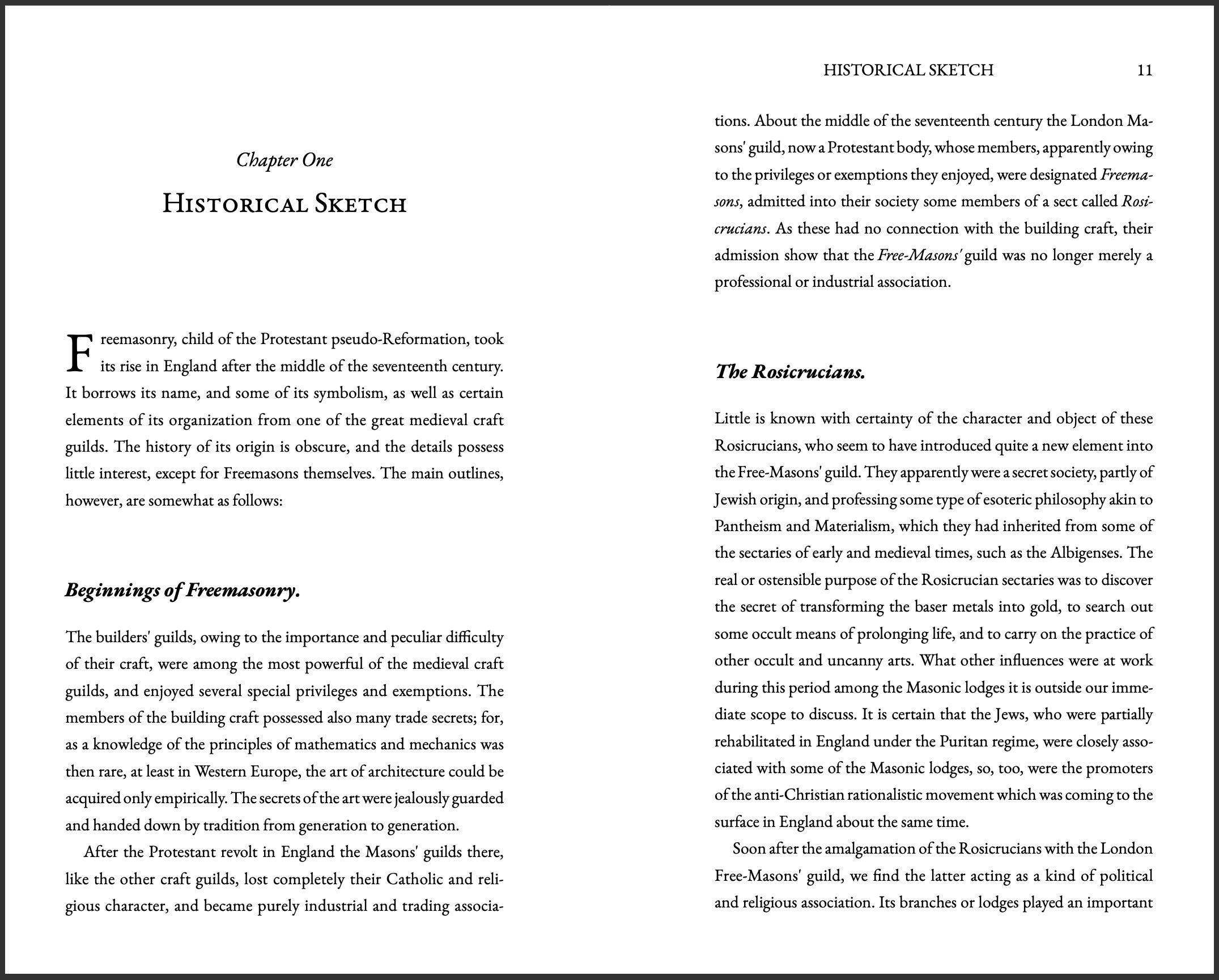
They also are engaged in restoring older texts. With a few exceptions, publishers releasing OCR scans of old texts can have low standards – and publish their Catholic works indiscriminately with very bad books (occult, masonry, heresy, and so on). Stabat Mater Press’s editions are avoiding both problems. You can see a sample of their quality in this preview of Fr Edward J. Cahill’s Freemasonry and the Anti-Christian Movement:
Regarding big print-on-demand publishers of good and bad OCR scans indiscriminately, SMP says:
As a family-owned publishing house, we take seriously the idea that Catholic books should be made by Catholics and for Catholics — those formed by the Faith, obedient to the Church, and committed to tradition.
Stabat Mater Press has already put together a small but impressive range of books in nice editions, including:
Freemasonry and the Anti-Christian Movement – Fr. Edward J. Cahill
To Restore All Things: Essays of Catholic Political Thought – de Maistre, Belloc, Dononso Cortes
The Heresy of Popular Sovereignty – Fr. Charles Maignen
The Social Kingship of Christ According to Cardinal Pie – Fr. Théotime de Saint‑Just, O.M.C.
The editor is planning to migrate all of the titles away from Amazon in due course, in accordance with the vision which Mr Theo Howard from The Two Cities Podcast called “The Little Way of Christendom” – which is explained in the video and One Peter Five articles below:
The Little Way of Christendom, Part 1
The Little Way of Christendom, Part 2
You can get Fr. Théotime’s book here:
The Social Kingship of Christ According to Cardinal Pie – Fr. Théotime de Saint‑Just, O.M.C.
HELP KEEP THE WM REVIEW ONLINE WITH WM+!
As we expand The WM Review we would like to keep providing free articles for everyone.
Our work takes a lot of time and effort to produce. If you have benefitted from it please do consider supporting us financially.
A subscription gets you access to our exclusive WM+ material, and helps ensure that we can keep writing and sharing free material for all.
You can see what readers are saying over at our Testimonials page.
And you can visit The WM Review Shop for our ‘Lovely Mugs’ and more.
(We make our WM+ material freely available to clergy, priests and seminarians upon request. Please subscribe and reply to the email if this applies to you.)
Subscribe to WM+ now to make sure you always receive our material. Thank you!
Read Next:
Follow on Twitter, YouTube and Telegram:
Twitter (The WM Review)
Honest question to you Mr. Wright. Can one still be an integralist and be republican? As in a republic without the separation of church and state. I come from the states. But I find it hard to found a monarchy in a country that has never had that in its history.
You could say the English crown, but I am more so referring to history after the separation from England.
Is integralism limited to just monarchical views or can the possibility of a republic be considered from a integralist viewpoint?