

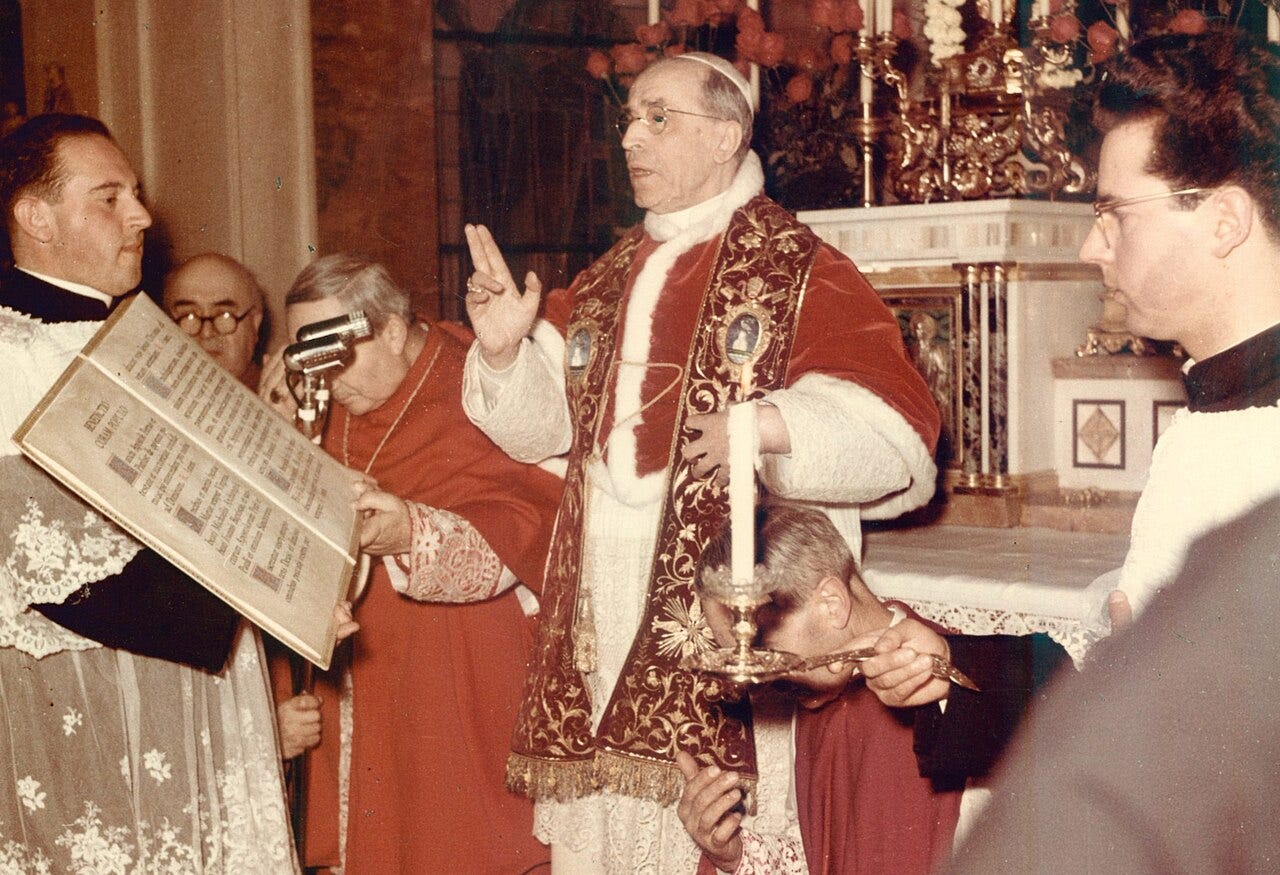
Following Leo XIV’s comments about ‘authentic laïcté’, some pointed to this speech in which Pope Pius XII appears to use the same terms. But it’s a very different speech to what you might expect...
Editor’s Notes
In the process of preparing some further material on laïcité and Leo XIV’s recent comments in France, I translated the following discourse of Pope Pius XII, delivered on 23 March 1958 – just a few months before his death.
In this discourse, delivered to the men of the Italian Marches living in Rome, Pope Pius XII appears to use a phrase very similar to that of Leo XIV – that of a “legitimate and sound secularity” (legittima sana laicità). The word laicità is, of course, very similar to laïcité – but as we shall see in due course, this is a case of linguistic “false friends” (when words in two languages look or sound the same, but have different meanings or nuances).
In the meantime, however, this discourse – delivered to the Marchigiani (people of the Italian region of the Marches) living in Rome – is of a markedly different character than was expected, given the way that it was presented this weekend.
First, “secularity” plays a very minimal role in the speech. It’s just a passing comment towards the end.
Secondly – and which was a surprise – the speech contains a strong emphasis on the importance of pride in one’s region, nation and even one’s blood – subordinated, of course, to the Church.
For example, Pope Pius XII speaks to the Marchigiani of their region:
“It therefore has a value of its own, which must be preserved and, insofar as is possible, increased. The region signifies, in the first place, a certain homogeneity of blood, because populations are generally accustomed to form their families in the place where they habitually live.
“And since man inherits, through his material part, a whole complex of inclinations, which the soul may freely transform but which nevertheless remain permanent in so many aspects, it follows that the virtues of your ancestors live again in you – that is to say, in certain of your inclinations.”
He tells the Marchigiani:
“[Y]ou should have a just pride in belonging to your region; that you should recall with satisfaction your glories and your memories; that you should cultivate with modesty and tenacity your traditional virtues […]”
He then tells them to take pride in being a region of Italy, in the following terms:
“[I]n order that this pride of yours and this legitimate love of predilection for the Marche may not degenerate into a form of inferior regionalism, it is necessary that you aim higher, that you look to the common fatherland, to Italy.”
He even critiques those who seek to eschew the language of “fatherland” [patria]:
“One encounters today at times citizens seized almost by a fear of showing themselves particularly devoted to their fatherland. It is as if love towards one’s own land could necessarily signify contempt for the lands of others; it is as if the natural desire to see one’s own fatherland beautiful, prosperous within, esteemed and respected without, must inevitably be a cause of aversion against other peoples. Nor are there lacking those who avoid even pronouncing the word ‘fatherland’, and attempt to substitute other names thought more suited, it is believed, to our times.”
What he says of pride in Italy is really quite striking.
We have previously published material on the proper ordering of patriotism and love of one’s nation, which must always remain subordinate to the law of God and supernatural charity:
Love of nation must be subject to the laws of God – Pope Pius XI
All in all, however, what Pope Pius XII says of the Church makes perfectly clear that his comments about laicità have nothing to do with Leo XIV’s praise for the distinct French notion of laïcité – as we shall explain in a future article.
S.D.Wr.
Discourse of His Holiness Pius XII to the Residents of the Marche living in Rome
Vatican Basilica – Sunday, 23 March 1958
Greetings and praise for the Marchigian people
We could no longer delay in responding to your filial request for a meeting with the common Father, beloved sons and daughters. The Pious Sodality of the Picenes, which carries out its own beneficent activity in the City and which gathers around itself the memberships and the support of the Marchigian colony in Rome, has wished to make itself the interpreter of all of you; reminding us with a courteous thought of the beginning of particular bonds between Our family and the Marchigian land of Sant’Angelo in Vado, it has requested this meeting which, while it gladdens Our spirit, brings joy to you as well.
Rome was indeed for a long time the almost exclusive destination of your internal migration; today, you are one of the largest communities here (as has been authoritatively noted), and to this community belong predominantly citizens who do honour to your land by the uprightness of their lives, the dedication of their work, and the conspicuous role that they not infrequently exercise. Whoever contemplates this solemn gathering can appreciate this, because he has the opportunity to observe the fervour of your faith, as well as the diversity and the merits of those present.
We therefore give you Our paternal welcome, and We congratulate you on the spirit of legitimate attachment to your land, to its values, to its traditions.
Praise for the Marches themselves
Your region presents itself with the enchantment of its sea, of its sky, with the richness and variety of its lands: in general, with its natural aspects, gentle to the sight as they slope down from the mountain ridges to the shores of the sea. On your hills, especially, there is an entirely varied and smiling vegetation; on the pleasant slopes the vine and the olive tree flourish everywhere, while in the southern plains, which Mount Conero shelters from the northern winds, the air is perfumed by orange blossoms.
In your cities (whether they lie on the plain, like Fano, Senigallia, Ascoli; or on a plateau, like Jesi; or in a valley, like Fabriano; or on a hill, like Osimo, Recanati, Fermo, Macerata; on the mountain, like Cingoli and Urbino, and, even higher still, Camerino; whether they lie between plain and mountain, like Tolentino and San Severino; or whether they stretch, finally, almost upon the slope of two mountains, like Ancona and Pesaro), all are built with taste and propriety, all appear clean and polished and full of serenity and peace to the eyes of those who visit them.
The Marches are called a “young land” by geologists, because they include some of the most recent formations of the peninsula. But whoever wishes to study your region in its geographical, geological, and historical aspect needs to consider the millennia, to encounter them. For your life – and therefore your history – is a life and a history of millennia; it suffices to look at the evident signs of the civilisation of stone, in the Palaeolithic and Eneolithic phases, and the signs of the Bronze Age and the Iron Age.
The populations of the Marches, who were once warlike – as vast findings of weapons in burial grounds attest – today appear sober, discreet, industrious; nor do they lack the merit of an innate gentleness and of a great, even if ordinarily composed, cordiality. There are today in the Marches, as in truth there always were, men who knew and know how to excel in the sciences and the arts in various ways; many have carried their fame throughout the entire world.
Pope Pius XII’s instruction to the Marchigians
Here We are, then, in your midst as Father of your souls; here We are to bless you with all the effusion of our heart; here We are to say to you a word of comfort and of instruction. Your presence, beloved sons, makes our thought turn to the problem of the Regional Authority, around which there is still division of opinions and an abundance of disputes. We leave to those whose duty it is (and therefore to many among those present, who have the qualities and the capacity to do so) the framing and the resolution of this problem. We should like instead to set before you some of Our reflections, which We hope may help you to be good Marchigians, good Italians, good Christians.
Be good sons of your region
1. The region is without doubt one of the many units which the force of circumstances, even more than the free will of men, has constituted within the various States. It therefore has a value of its own, which must be preserved and, insofar as is possible, increased. The region signifies, in the first place, a certain homogeneity of blood, because populations are generally accustomed to form their families in the place where they habitually live. And since man inherits, through his material part, a whole complex of inclinations, which the soul may freely transform but which nevertheless remain permanent in so many aspects, it follows that the virtues of your ancestors live again in you – that is to say, in certain of your inclinations. If these, let us suppose, are more easily subordinated to the spirit, it may be said that your fathers have been effective in creating in you a favourable inclination toward probity, toward uprightness of conduct, toward a sense of industriousness.
But there exists in the region a whole complex of strictly spiritual values, and these are the glories of the people: military glories, literary glories, scientific glories, artistic glories. There are moreover the specific graces bestowed upon it by God: graces of salvation, of sanctification, of apostolate.
The Marchigian population, perhaps favoured also by its geographical situation, has been able to preserve a homogeneous patrimony of its own and certain traditional virtues that are not easily found elsewhere. There is in you a sense of personal reserve and of modesty joined to frugality, which does not, however, make you averse to succour those most in need, and to succour them effectively, radically, as the beneficent activity of the Pious Sodality of the Picenes also attests. You have not felt so strongly as other regions the intermingling with universal history; but this has favoured in you a recollection which is without doubt also a richness. As for spiritual values distinctively your own, it suffices to think of the Holy House of Loreto, in order to see there a most special blessing of Mary, who has caused you to be visited (and continues to cause you to be visited) by innumerable souls who come to you bearing an attitude of sincere piety, of ardent faith, of profound humility, as well as a spirit of mortification proper to every truly devout pilgrimage.
That you should have a just pride in belonging to your region; that you should recall with satisfaction your glories and your memories; that you should cultivate with modesty and tenacity your traditional virtues; that you should maintain yourselves in noble competition with the other regions for the purpose of reaching certain goals alone – or, if that is not possible, first; that you should feel yourselves Marchigians even while living in Rome – this is what makes us say our first word to you, a word of affectionate paternal satisfaction.
Be good sons of your ‘fatherland’
2. But in order that this pride of yours and this legitimate love of predilection for the Marche may not degenerate into a form of inferior regionalism, it is necessary that you aim higher, that you look to the common fatherland, to Italy.
One encounters today at times citizens seized almost by a fear of showing themselves particularly devoted to their fatherland. It is as if love towards one’s own land could necessarily signify contempt for the lands of others; it is as if the natural desire to see one’s own fatherland beautiful, prosperous within, esteemed and respected without, must inevitably be a cause of aversion against other peoples. Nor are there lacking those who avoid even pronouncing the word “fatherland”, and attempt to substitute other names thought more suited, it is believed, to our times.
Certainly, beloved sons: it must be said that not the least among the signs of a disorientation of spirits is this diminished love of the fatherland, of this greater family given to you by God. When, moreover, the fatherland is called Italy, there is no one who does not see what special reasons there are for feeling oneself bound to it with the bonds of affectionate devotion. Situated in the midst of the sea which sees the crossroads of the world’s routes and joins the three greatest landmasses, Italy is, in a certain sense, the geographical centre of the globe; so that all peoples have passed and repassed through it, contributing to endow it with a universal, comprehensive, and open character such as is not easily found in other nations. It can indeed be said that Italy does not belong to the Italians alone, because it belongs to all peoples. So it was in past history; so it shall be in the future.
Roman Law is the patrimony of humanity; Thomistic Philosophy, which was born in Italy, is among all philosophies the most universal, because it presents and illustrates the hierarchy of being; the Divine Comedy is at once a national poem and a poem of the universe, just as humanity gathered in the anxious expectation of the judgement of God is the supreme expression of the art of Michelangelo. To this should be added that Greco-Italian culture is the initiator of the culture of Europe, and therefore of modern culture.
Italy, conceived and willed by God as the land in which the centre of His Church has its seat, was the object, as of a special love of His, so of a most special action of His. For no people has, like the Italian people, its destinies joined with the work of Christ.
Happy to be members of the great Marchigian family, be therefore no less solicitous of your belonging to Italy. Do generously all that you can to transform it or confirm it as a nation that lives and works in tranquillity and order. Some of your best men are in the front rank of this peaceful battle. But precisely because the heart of the Church is in Italy, it is easy to foresee that the enemies of God will work in every way to sow in it the tares of subversion, the poison of hatred. To place obstacles before the universal (and therefore Christian) mission of Italy is to betray Italy itself, because it is as though one wished to diminish and even destroy its true greatness.
Be good sons of the Church
3. But love of fatherland too can degenerate and become excessive and harmful nationalism. In order that this may not happen, you must aim far beyond even the fatherland itself; you must look to the world. But there is only one way to look at the world while continuing to love the region and to love the fatherland: one must become conscious of a supreme reality – the Church. One must be a living part of her.
Let individuals be a living part of the Church; let them subordinate everything to the divine grace that is to be preserved and increased; ready to overcome every obstacle, to face even death rather than lose the faith, rather than lose grace. So did a young girl born among you in the Marchigian land: Maria Goretti.
Let your families be a living part of the Church. In the most celebrated Sanctuary, the Holy House of Loreto, there shines forth the memory of the holiest of families: the Holy Family. Look to it as your model and imitate it: make Jesus the centre of your homes, the absolute ruler of your minds and of your hearts.
Let your cities be a living part of the Church. There are in Italy those who are agitated because they fear that Christianity takes from Caesar what is Caesar’s. As if to give to Caesar what belongs to him were not a command of Jesus; as if the legitimate and sound secularity (laicita*) of the State were not one of the principles of Catholic doctrine; as if it were not the tradition of the Church to make a continual effort to keep the two Powers distinct, yet also, always according to right principles, united; as if, on the contrary, the confusion between the sacred and the profane had not been most strongly brought about in history when a portion of the faithful separated themselves from the Church.
The cities will be a living part of the Church if in them the life of individuals, the life of families, the life of great and small communities, is nourished by the doctrine of Jesus Christ, which is love of God and, in God, love of neighbour – all of it.
Christian individuals, Christian families, Christian cities, Christian Marches.
Let the Marches become entirely like a great Holy House; and let the Marchigian family be one, great Holy Family!
HELP KEEP THE WM REVIEW ONLINE WITH WM+!
As we expand The WM Review we would like to keep providing free articles for everyone.
Our work takes a lot of time and effort to produce. If you have benefitted from it please do consider supporting us financially.
A subscription gets you access to our exclusive WM+ material, and helps ensure that we can keep writing and sharing free material for all.
You can see what readers are saying over at our Testimonials page.
And you can visit The WM Review Shop for our ‘Lovely Mugs’ and more.
(We make our WM+ material freely available to clergy, priests and seminarians upon request. Please subscribe and reply to the email if this applies to you.)
Subscribe to WM+ now to make sure you always receive our material. Thank you!
Read Next:


Follow on Twitter, YouTube and Telegram:
Twitter (The WM Review)