
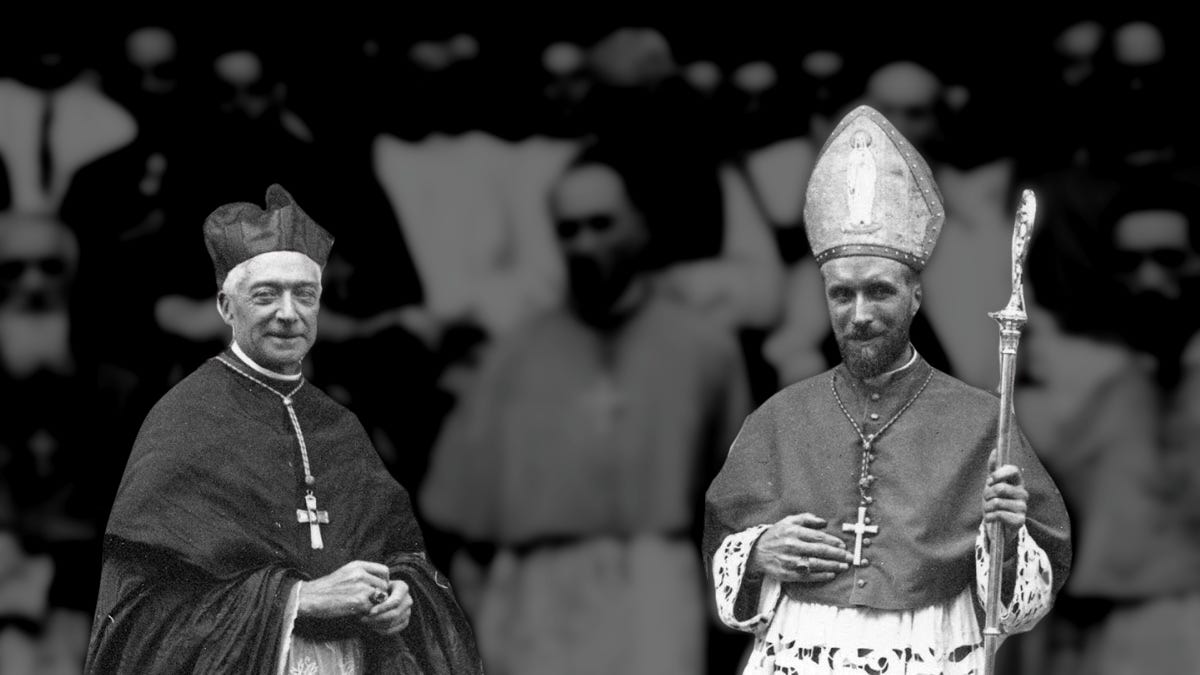
Some have asked whether Cardinal Achille Liénart had a proper sacramental intention when ordaining Archbishop Lefebvre. If not, dire consequences follow...
Editor’s Notes
We have recently been asked about the alleged issue with Archbishop Lefebvre’s priestly ordination.
Here is the argument itself, as expressed by the priest who uses the pen-name ZeloZelavi:
[Some] claim that Archbishop Lefebvre himself was not validly ordained. Their argument refers to the bishop who ordained Lefebvre, namely Cardinal Liénart; for he was said to be a Freemason, indeed a high-degree Freemason. As such, he could not possibly have had the proper intention when he performed the ordination (or even when he received ordination himself).
An appeal to the co-consecrators (according to the regulations of episcopal ordination there must be two further bishops acting as co-consecrators) does not help in this case, because Lefebvre also received his priestly ordination from Cardinal Liénart. If the priestly ordination was already invalid, so would be the episcopal ordination. For only a priest can be ordained a bishop, as we have already seen above.1
If such arguments are true, it would mean that all those whose orders derive from Archbishop Lefebvre are not certainly priests or bishops. This would have a wide effect, affecting categories including:
Novus Ordo clergy in Gabon, other parts of Africa, and elsewhere
Bishops and priests of the Society of St Pius X, whether ordained by Lefebvre or by the four bishops consecrated in 1988
Priests of the “Resistance”
Several priests of the Priestly Fraternity of St Peter
Bishops and priests affiliated with sedevacantist groups such as Bishop Donald Sanborn’s Roman Catholic Institute, and Bishop Daniel Dolan’s Saint Gertrude the Great
Howeer, Fr ZeloZelavi proceeds to explain why this is untenable:
The debate is old and, in essence, already obsolete. According to the principle “de internis Ecclesia non judicat” (the Church does not judge inner matters), the Church assesses the validity of the sacraments according to what is externally recognizable. If a sacrament is administered “recte et rite,” that is, properly according to the liturgical books, with the correct matter and form, the Church considers it validly conferred.
Any counter-intention would have to be manifest either at the time of the sacrament or, if it remained purely internal, proven in some other way—for example, by a confession from the minister of the sacrament.2
Index of resources
There are many problems with the Liénart argument, both in terms of the facts (e.g., Was Liénart actually a freemason? Did he actually withhold or exclude the necessary intention?) and in terms of the theology behind it.
We are here providing a list of texts which address these issues. We hope that readers who encounter this issue for the first time find this list useful.
John Daly, ‘The Validity of the Orders of Archbishop Lefebvre,’ from Michael Davies—An Evaluation (particularly pp 349-354), Tradibooks. Shortened edition below published with permission:
Fr Anthony Cekada, ‘Sacramental Intention and Masonic Bishops’
Fr Anthony Cekada, ‘Trad Controversies, Episode 4: Masonic Bishops and Sacramental Intention’ (Audio)
Fr Carl Pulvermacher, ‘On rumors and their source’
Christopher Conlon, ‘Cardinal Lienart & the Intention to Do What the Church Does’
Rama Coomaraswamy, ‘Cracks in the Masonry—Was Abp. Lefebvre invalidly ordained by a Mason?’
In addition, Francis Clark’s work Anglican Orders and Defect of Intention explains the principles behind this issue, and leaves no room for the sorts of doubts raised about Liénart’s intentions—even if he were indeed a Freemason.
The same doctrine is expressed by Cardinal Gasparri in his treatment of sacramental intention and holy orders. Although some criticise Gasparri on grounds unrelated to this issue, we should note that Clark demonstrates that various decisions of the Roman congregations were based around the same principles which he expressed:

Is this a case in which we need to “take the safer course”?
In 1679, Pope Innocent XI condemned the following proposition:
Condemned Error: In conferring the sacraments, it is not illicit to follow the probable opinion with respect to the validity of the sacrament, disregarding what is more certain [relicta tutiore] , unless it is forbidden by law, convention, or the danger of incurring grave harm. For this reason, it is only in the conferral of baptism (and) priestly or episcopal ordination that the probable opinion is not to be held.3
McHugh and Callan explain what this means:
There are cases, however, when we are obliged (because some law requires it) to follow a safer course, that is, not to expose ourselves or others to some great harm. Thus, we must follow the safer side […] when there is question of the validity or invalidity of a Sacrament, for the virtue of religion requires that the Sacraments be administered with fidelity, and be not exposed to the peril of nullity. Example: It is not lawful to consecrate matter that has probably been substantially adulterated.4
A priest who is not morally certain of the validity of his orders is not permitted to administer sacraments which depend on these orders (e.g., to absolve or to offer Mass, or administer any other sacrament requiring valid orders). As established elsewhere, the laity are also obliged to follow “the safer course” in such situations, which can involve a duty to avoid the sacramental ministrations of men whose orders are only doubtfully valid—until such doubt is removed.
However, such doubts must be positive and probable, based on some prudent reason; negative doubts—those which are based on “what if” questions, mere possibilities or simply inadequate reasoning—do not give rise to such a duty:
Repetition of a Sacrament on Account of Invalid Administration.
(a) This is unlawful when the fear of invalidity is groundless and foolish; for it is seriously disrespectful to a Sacrament and disedifying to others to repeat the rite without reason. But scrupulous persons are sometimes free of grave sin, since they mean well in repeating and are not accountable for their fears.
(b) This is lawful but not obligatory when there is a prudent misgiving about a useful Sacrament (Confirmation, Matrimony, anointing of one who is conscious); also when there is a slight reason of law or fact for fear about a necessary or more important Sacrament (Baptism, Orders, absolution of a dying person, anointing of an unconscious person, consecration of the Eucharist). For the Sacraments are for men. But if only a small loss or an unlikely loss will be caused by their non-repetition, the duty of repeating them cannot be insisted on.
(c) This is gravely obligatory when there is a prudent fear about a necessary or more important Sacrament; it is gravely or lightly obligatory (to be determined in each case) when there is a well-founded fear about a useful Sacrament, if charity, justice or religion calls for repetition and the inconvenience will not be too great. In Matrimony the alternate methods of convalidation or sanation may be used as the case demands. Again, the Sacraments are for men, and hence, if man will likely be subjected to a notable loss by the minister’s neglect of repetition, the duty of repetition is clear.5
While they hold that even a “slight reason of fact or law”—which we do not accept applies to Lefebvre’s orders—makes conditional repetition of ordination legitimate, McHugh and Callan do not suggest that it makes such a step necessary or obligatory. Those who wish to call Lefebvre’s orders into doubt (and want everyone to avoid those whose orders derive from him) are radically overstepping this.
Joseph Marie’s argument
In light of this, we can see the poverty of the argument made by one Bishop Joseph Marie. I shall briefly comment on each part of his summary of the argument:
That pope after pope have warned us that one of the major objectives of Masonry is the destruction of the Catholic Church.
WM: True.
That Marcel Lefebvre was both ordained a priest and consecrated a bishop by a well known, high-ranking Mason - Achille Liénart.
WM: Liénart’s alleged masonry is not “well known”; rumours of his alleged masonry are. Coomaraswamy suggests that even Lefebvre’s “admissions” that Liénart was a freemason are problematic, and based on a demonstrably false memory of a specific photograph.
That for a sacrament to be valid (including the sacrament of Holy Orders), the minister of the sacrament must have the minimal intention of doing what the Church does.
WM: True.
That it is highly improbable that a high-ranking Mason would have the sacramental intention of doing what the Church does, since one of their principle [sic] objectives is the destruction of the Church.
WM: Irrelevant, for the reasons discussed in the linked texts above.
Further, the defect needed to destroy the sacramental intention is the positive exclusion of a primary effect of the sacrament in question. Unless and until it is demonstrated, the use of the Catholic rite and the absence of a manifest positive contrary intention leads the Church to presume validity.
While it is indeed possible (or even probable) that the minister may have such an intention, it remains irrelevant if it is not manifested.
That this probable defect of intention would render Marcel Lefebvre's Holy Orders, at a minimum, doubtfully valid.
WM: False. Joseph Marie has made the mistake of equating the possibility/probability that a Freemason lacked the requisite intention (by positively excluding a primary effect of the sacrament) with the probability necessary to call the sacrament into question. But this is a non sequitur and the fallacy of equivocation.
Even the abstract probability of defective intention amongst Freemasons gives rise to nothing more than a possibility—a negative doubt—until the contrary is manifested.
Validity is presumed if a) the Catholic rite is used, and b) no positive contrary intention is manifested. But the Catholic rite was used, and no positive contrary intention was manifested. Ergo, etc. Even if we grant that it is probable in the abstract that some Masons lack intention, this does not establish that Liénart did—nor that Lefebvre’s orders suffer from any positive doubt.
The Church takes these matters seriously, but evidently does not permit a situation in which a deceased minister can be accused of being a Freemason, and presumed to have lacked the requisite intention in the administration of the sacraments. This would both violate the principle of not judging the internal forum, and cause incredible chaos in the process. In fact, this chaos based on speculations about hidden intentions demonstrates precisely why the Church does not judge the internal forum.
We can distinguish this from what we published elsewhere on baptisms in the Novus Ordo milieu in the following ways. First, the concerns raised about baptism do not pertain to intention, but to the defective use of matter and form. Second, there is actual evidence of widespread defective use of matter and form in that milieu. Third, the usual ways of securing moral certainty that the rite was used correctly have largely broken down in that milieu. All this gives rise at least to what McHugh and Callan call a “prudent misgiving” above.
That Church doctrine and Church law prohibits anyone possessing doubtfully valid Holy Orders from exercising these Orders and from functioning as a clergyman.
WM: True as a principle, but inapplicable here, since Joseph Marie’s arguments have not established that Lefebvre’s priestly orders are doubtfully valid.
That this prohibition applies not only to Marcel Lefebvre, but also to all of his progeny as well, and for the same reason.
WM: False, because the argument collapses at its root. Lefebvre’s orders are not doubtfully valid, and thus his ordinations and consecrations carry no inherited defect.
Conclusion: Lessons for traditionalists
When Fr Henry James Coleridge asked Fr John Henry Newman to explain his views on the related matter of Anglican orders, Newman prefaced his comments with the following:
The inquiry into Anglican Orders has ever been to me of the class which I must call dreary; for it is dreary surely to have to grope into the minute intricate passages and obscure corners of past occurrences, in order to ascertain whether this man was ever consecrated, whether that man used a valid form, whether a certain sacramental intention came up to the mark, whether the report or register of an ecclesiastical act can be cleared of suspicion.
Newman’s frustration here was not with sacramental theology, but with arguments that rest on speculative reconstructions of intention, hidden facts, or obscure associations. The same applies to the claim that Archbishop Lefebvre’s orders are doubtful due to Cardinal Liénart’s alleged Masonic affiliation, or to the defects of intention amongst those using the Novus Ordo rites.
Such arguments are both tedious and misdirected. They ignore the Church’s principle that sacraments are presumed valid when the rite is observed and no contrary intention is manifested. They take suspicion for evidence.
This is all quite different to the way in which Pope Leo XIII used an argument from defective intention in Apostolicae Curae, in addition to his arguments about defective form. Francis Clark demonstrates that much confusion has arisen about this argument from intention, which has almost nothing to do with our current situation today.
The more decisive argument for our day is based on the new rites themselves, and the putative authorities which promulgated them. Even though these arguments arrive at a conclusion of doubt, it is a certainty that there is doubt, arising from conclusive arguments, and requiring resolution.
This argument is presented in the following two articles:


See the full index on this matter here:


HELP KEEP THE WM REVIEW ONLINE!
As we expand The WM Review we would like to keep providing free articles for everyone.
Our work takes a lot of time and effort to produce. If you have benefitted from it please do consider supporting us financially.
A subscription from you helps ensure that we can keep writing and sharing free material for all. Plus, you will get access to our exclusive members-only material.
(We make our members-only material freely available to clergy, priests and seminarians upon request. Please subscribe and reply to the email if this applies to you.)
Subscribe now to make sure you always receive our material. Thank you!
Follow on Twitter, YouTube and Telegram:
NB: We are including this 1978 article for the sake of completeness, although we have grave reservations about the source. We note that the SSPX itself appears to have removed the author’s articles from its websites.
Fr ZeloZelavi, The Bishop in Our Time, Part I.
Ibid.
Sixty-Five Propositions Condemned in the Decree of the Holy Office, March 2, 1679. DH n. 2100.
John A. McHugh OP & Charles J. Callan OP, Moral Theology—A Complete Course Based on St. Thomas Aquinas and the Best Modern Authorities. Vol. I, n. 678(c). B. Herder, London, 1958.
McHugh and Callan, n. 2682.
"WM: Liénart’s alleged masonry is not “well known”; rumours of his alleged masonry are. Coomaraswamy suggests that even Lefebvre’s “admissions” that Liénart was a freemason are problematic, and based on a demonstrably false memory of a specific photograph."
Sorry, but that's very poor logic. There need only be sufficient evidence to establish positive doubt ... nor does "well known" (yea or nay) have anything to do with it. You pretty much admit at the outset that you don't want the conclusion to be true, due to its consequences, so it's easy to watch you twisting things such as right here to marshall in support of your pre-determined conclusion.
AND, you fail to define "presumption", that the Church PRESUMES a Sacrament to be valid. That just means you may frequent those Sacraments without troubling your conscience, but that doesn't make it valid.
Fr. Cekada's argument strawmans the position.
No one has adequatley refuted Bishop Joseph Marie's presentation ... because, everyone to a person has bungled the notion of what it means to have the (internal) intention to do what the Church does. HINT: it's the same issue people have in bungling the notion of what "internal assent" means.
Here's the actual answer: When +Lienart put on his vestments, and attended a ceremony that was understood to be that of an ordination of priests, pulled out the Ritual, and performed the Rite, by that very fact he had the internal intention to DO what the Church does. Everyone routinely bungles the notion of "internal intention" with intending to do what the Church intends.