
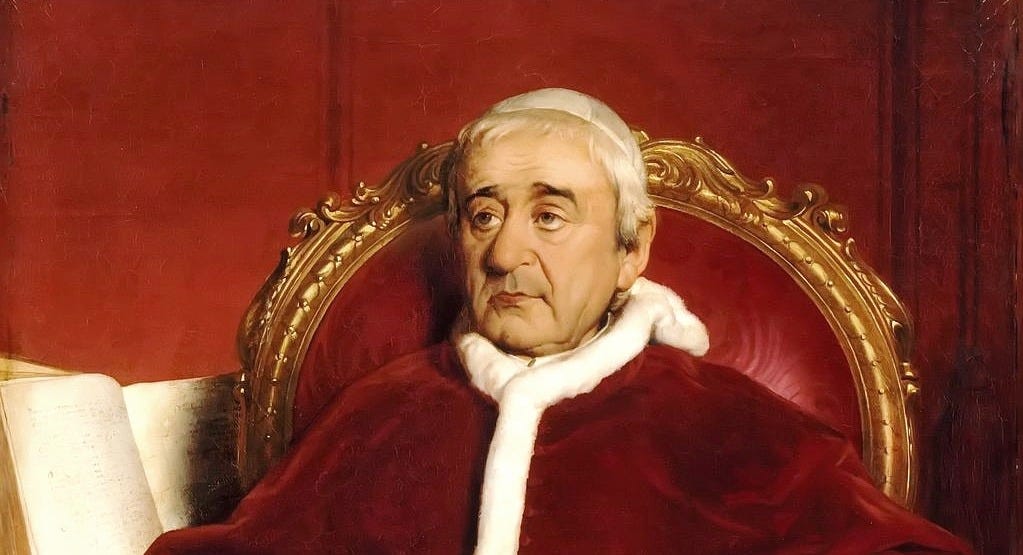
Shortly after his letter to the Bishop of Augsburg, Gregory XVI had cause to reaffirm the same points to a congregation of Benedictines.
Editor’s Notes
The following text is a translation of Pope Gregory XVI’s 1842 Epistola (Letter) to Rupert Leiss, the “President” of a group of Benedictine monks in Bavaria.
This letter, following on from the earlier letter of the same year to the Bishop of Augsburg, takes up the same themes regarding the use of Catholic rites for the funeral of a non-Catholic queen.
The letter reveals that a particular monastery was re-established “by royal piety,” and that one of the conditions for this was that deceased members of the royal family would celebrate the funerals and offer anniversary Masses for the deceased.
Following the earlier letter, Leiss considered it necessary to write to Rome – because the Queen Consort was a non-Catholic, like the Queen Dowager at the centre of the previous controversy. Gregory XVI replied, stating that he would not renew the constitutions of the monastery until the relevant condition was clearly restricted to the funerals of Catholic sovereigns.
In this letter, Gregory XVI:
States that the prohibition of Catholic funeral rites and prayers for non-Catholics “rests upon Catholic doctrine itself,” and not just indifferent legal provisions.
Calls this prohibition “that most grave interdict of Holy Church”
Warns that violating this prohibition constitutes “compromising the duties of religion.”
The “Catholic doctrine” in question here is the dogma that Outside the Church there is no salvation, which Gregory XVI himself links with the necessity of divine faith in another letter to Bavaria, written in 1832:
“You know how zealously Our predecessors taught that very article of faith which these dare to deny, namely the necessity of the Catholic faith and of unity for salvation.”
(Summo Iugiter, n. 5)
In the previous letter, he affirmed the same point, speaking of:
“[…] the Catholic dogma concerning the necessity of true Catholic faith for obtaining salvation […]”
In the notes to the previous letter on this topic, we also considered how applicable these cases are to the many Masses offered at the time of the late Queen Elizabeth II’s passing.
N.B.: Aspects of the state of the purely disciplinary side of this question may or may not have changed with the 1917 Code of Canon Law, but this is outside the scope of these Notes.
May the souls of the faithful departed, through the mercy of God, rest in peace.
Epistola Litteras
CLXV
Headings and some line breaks added.
To Rupert Leiss, president of the monks of Schyren of the Order of St Benedict. Writing to him, [the Pope] instructs him concerning the rites to be celebrated for the dead. He utterly rejects the proposal to offer the sacrifice in general for the Catholic royal family, in the case where the queen dies outside the communion of the Church; hence, should it come to pass that she ends her life outside the true faith, he must not allow the most grave interdict of the Church to be violated by the monks entrusted to her care.
To his beloved son, the religious man Rupert Leiss, president of the monks of Schyren of the Order of St Benedict.
GREGORY XVI, POPE
Beloved son, religious man, greeting and apostolic blessing.
We have received your letter, in which, beloved son, you inform us that in that monastery, long since restored through royal piety, the constitutions of the Bavarian-Benedictine congregation, approved by Innocent XI of happy memory, Our predecessor, as far back as the year of our Lord 1686, are observed faithfully, insofar as possible; and hence you humbly request from us that we should wish to confirm them again.
You also report that our most dear son in Christ, the King of Bavaria, when restoring the monastery to you, imposed the condition that the monks should be obliged to celebrate the funeral in their church for the King himself when he dies, and thereafter every year in perpetuity, and likewise for the Queen Consort, and for future kings and queens in turn, both at each one’s death and on the anniversaries days intervening until the death of the next.
You add, moreover, beloved son, that you had even then foreseen the difficulty likely to arise from the fact that the most serene wife of the King is estranged from Catholic rites; yet nonetheless, following the counsel of a certain prudent man (as you thought him), you resolved to accept that condition, on the understanding that if in future the same Queen should die outside Catholic communion, the Sacrifice of the Mass would be offered at her funeral, and for the Catholic royal family as a whole on her anniversaries.
However, upon the death of another non-Catholic lady – also a most serene queen and widow – there have recently arisen no small dissensions throughout the realm concerning her funeral; because of this, you have judged it your duty to refer to us concerning that condition and the manner in which you and your monks should act in such a case, and to request our judgement.
We, therefore, adhering to the most sacred rules of the Church, reply that this intention to offer the divine Sacrifice or other prayers for all the deceased of the Catholic royal family is by no means sufficient to legitimise a public funeral specifically requested and celebrated for a non-Catholic individual on the occasion of her death or its anniversary. Hence, although we regard you, beloved son, and your monks with fatherly affection, we shall not approve or confirm the arrangements pertaining to that monastery and its affairs until the condition incautiously accepted by you is restricted solely to the funerals of Catholic sovereigns.
For we cannot permit that fraud should be done in any way to that prohibition, which rests upon Catholic doctrine itself, concerning the celebration of sacred funeral rites for deceased non-Catholics.
Exert yourself, therefore, beloved son, and devote your full diligence and effort, that the most serene king, in his piety, may wholly assent to this; and then you will find us wholly ready, so far as the Lord grants us, to support you and your affairs with our apostolic authority.
Meanwhile, should it happen – may God avert it – that the most serene queen should die outside the true Catholic faith before the matter is resolved with His Majesty, you and your monks will need great strength of mind and prudence, so that you by no means violate that most grave interdict of Holy Church, and that the pious king may understand that it cannot possibly happen that you comply with him in this matter without compromising the duties of religion.
For the rest, continue, as you certainly do, beloved son, to attend with God’s grace to yourself and your monks, so that in that monastery there may flourish and daily increase more the study of religion, holiness of morals, keeping of discipline. Thus you will always please God, to whom you have proved yourselves, and by your example and labours you will deserve well there of the Catholic cause; you will win greater benevolence from the most clement king; and finally you will enhance the name of the Benedictine institute reviving in Bavaria among the Catholic people, and even those who are opposed will be afraid, having nothing fitting to say about you.
But we do not fail most humbly to supplicate the Father of mercies through Jesus Christ his only-begotten Son that he may grant you all things prosperous and salutary. And as pledge of this heavenly protection and witness of our most devoted goodwill, we impart the apostolic blessing to you, beloved son, religious man, and to your brother monks with intimate affection of heart.
Given at Rome, at St Mary Major, on the ninth day of July in the year one thousand eight hundred and forty-two (1842), the twelfth year of Our pontificate.
Latin text available here, taken from Acta Gregorii Papae XVI, Vol. III, pp 222-3. Ed. Vincento Vannutelli, S.C. de Propaganda Fide, Rome, 1902.
We share this text with acknowledgments to Br Peter Dimond for having first drawn public attention to this text, in his video No Latin Mass Or Prayers For Dead Non-Catholics – Papal Teaching (11 March 2023).1
HELP KEEP THE WM REVIEW ONLINE WITH WM+!
As we expand The WM Review we would like to keep providing free articles for everyone.
Our work takes a lot of time and effort to produce. If you have benefitted from it please do consider supporting us financially.
A subscription gets you access to our exclusive WM+ material, and helps ensure that we can keep writing and sharing free material for all.
You can see what readers are saying over at our Testimonials page.
And you can visit The WM Review Shop for our ‘Lovely Mugs’ and more.
(We make our WM+ material freely available to clergy, priests and seminarians upon request. Please subscribe and reply to the email if this applies to you.)
Subscribe to WM+ now to make sure you always receive our material. Thank you!
Read Next:


Follow on Twitter, YouTube and Telegram:
Twitter (The WM Review)