

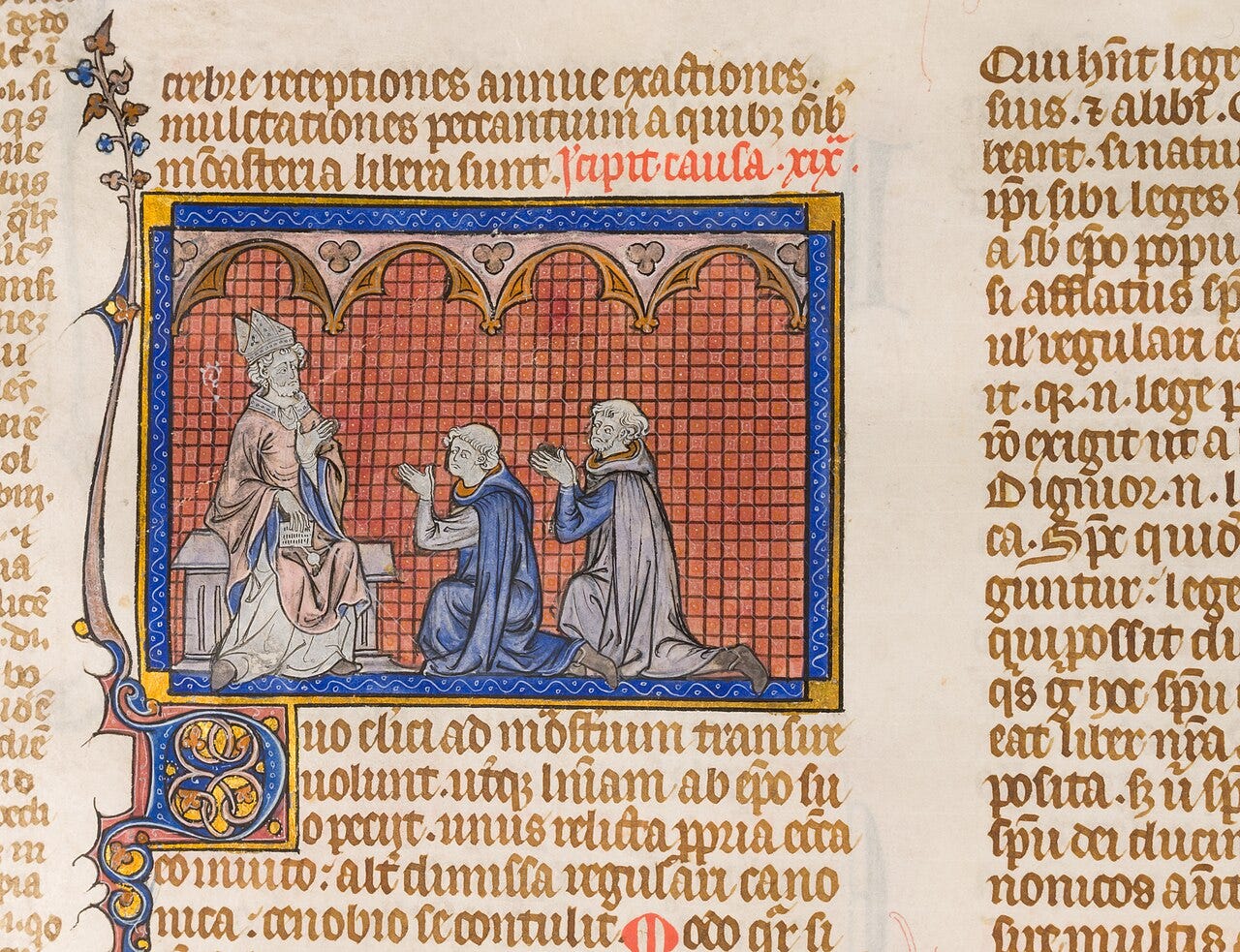
SSPX defenders would do well to read this explanation of the discussion in Gratian’s Decretum. It’s good news – if they’re prepared to do what is necessary...
Editor’s Notes
If Leo XIV excommunicates the SSPX following 1st July’s episcopal consecrations – and extends this excommunication to the priests and the faithful – what will this mean?
And what arguments might be cogent?
Around 1140 AD, an Italian monk named Gratian collected and ordered the great mass of canonical legislation which had built up over the centuries before. Prior to the codification of Canon Law in 1917, the Church’s law was considerably less neat and tidy – but Gratian’s work marked the beginning of a new period of order.
This work came to be known as Gratian’s Decree, or Decretum. In some ways similar to Denzinger’s work, Gratian’s Decretum was not an official work, but – as Bouscaren et al. put it – “it was so useful that it soon became the best-known book of canon law.” After Gratian’s death, it was supplemented with other collections, such as the Decretals of Gregory IX, and collections by Boniface VIII, John XXII and others.
The Decretum is far from being solely a book of legislation. It contains many theological texts from magisterial and patristic texts, as well as Gratian’s comments. Its influence is clear, when we consider that these theological texts are cited by theologians, with the references customarily assigned to them in the Decretum.
As already mentioned, the texts cited in the Decretum have their own intrinsic and theological authority, given that they are derived from Popes, saints and fathers. As such, the codification of Canon Law in 1917 – which abrogated various laws which it did not expressly contain – does not touch the theological reasoning and authority of various points cited in the Decretum, or the Decretum’s own witness to the tradition of the Church.
Causa XXIV is no exception. Doctor of the Church St Robert Bellarmine, as well as Cardinal Juan de Turrcremata OP and others, refer to this section of the Decretum, and in particular its canon Audivimus.
This canon, and the discussion as a whole, deals with the question of whether heretics can validly excommunicate non-Catholics.
The SSPX episcopal consecrations
As stated, this is a very relevant issue, given the imminent episcopal consecrations of the Society of St Pius X.
In 1988, John Paul II’s Vatican declared that these excommunications had taken place automatically (latae setentiae), and the SSPX provided arguments denying this.
It is very likely that Leo XIV’s Vatican will do the same, and declare that the new bishops, and their consecrators, have automatically excommunicated themselves.
However, it is rumoured that his Vatican will attempt to excommunicate the priests and other members of the SSPX; finally, it is also rumoured that this will be extended to anyone who attends Mass at SSPX chapels.
This may occur through condemning the SSPX itself as a schismatic sect, and allowing excommunications to take place automatically to those who adhere to it. Alternatively, it may involve the “active” or “positive” inflictions of excommunication (e.g. in “condemnatory sentences”).
The latter would appear to pose a different problem to the latae sententiae exommunications, or “declaratory sentences” of such, and a different line of argument would be necessary in the face of a positive infliction of excommunication.
To understand why, and the nature of the problem this would post, let us consider the following magisterial condemnations.
Unjust excommunications should be feared
Historically, some associated with the SSPX have given the impression that an unjust excommunication is null and void, and can be ignored.
St Thomas Aquinas taught the following of an unjust excommunication:
“[I]f the error on the part of the sentence be such as to render the sentence void, this has no effect, for there is no excommunication; but if the error does not annul the sentence, this takes effect, and the person excommunicated should humbly submit (which will be credited to him as a merit), and either seek absolution from the person who has excommunicated him, or appeal to a higher judge. If, however, he were to contemn the sentence, he would ipso facto sin mortally.”1
Before publishing this article, the canon lawyer Mr Marc Balestrieri (who also assisted with finding the best edition of Gratian) drew my attention to the following by the sixteenth century Dominican Bartolomeo Fumo:
“Excommunication, even if it be unjust – so long as it is not null,2 and even if it ought to be annulled – is to be feared, according to Petrus] de Paludanus (4. sent., dist. 18. q. 1. art. 3). [This is so] whether it be unjust on the part of the excommunicated person, who is innocent, or on the part of the one excommunicating, who does not issue it from zeal for justice but from hatred or some other bad motive, or on the part of the procedure, because it proceeded by false witnesses, or without a warning, or the like.
“And he who should despise it would sin mortally on account of disobedience to the Church and would incur the penalties of the law; and then it is just. Absolution is therefore to be sought, and [the excommunication] is to be observed.
“But if it is entirely null, and by not observing it no scandal follows, it is neither to be feared nor to be observed. If, however, by not observing it scandal follows for others, it is to be observed on account of the scandal. But if it is unjust but secret, see what is said under the actual effect of excommunication.”3
Thse principles are confirmed by the magisterium of the Church. Consider the following proposition of the English heretic John Wycliffe, condemned in the letter Super periculosis of 1377:
“A curse or excommunication does not bind absolutely except when it is given against an opponent of the law of Christ.” (DH 1131)
The same document condemned the following:
“Excommunication by the pope or by any prelate is not to be feared, because it is the censure of the Antichrist.” (DH 1180)
Wycliffe, like many Protestants, believed the papacy to be an Antichrist institution. Notwithstanding certain comments made by Lefebvre about recent claimants being “antichrists”, this is clearly not what the SSPX believe.
However, Pope Clement XI condemned the following propositions of the Janesnists in the Bull Unigenitus:
91. The fear of an unjust excommunication should never hinder us from fulfilling our duty; never are we separated from the Church, even when by the wickedness of men we seem to be expelled from her, as long we are attached to God, to Jesus Christ, and to the Church herself by charity. —Jn 9:22-23.
92. To suffer in peace an excommunication and an unjust anathema rather than betray truth is to imitate St. Paul; it is far from rebelling against authority or destroying unity. —Rom 9:3 (DH nn. 2491–2)
The global censure given the various condemned propositions is as follows:
“We declare, condemn, and reject ... the preceding propositions, as the case may be, as false, fraudulent, evil-sounding, offensive to pious ears, scandalous, pernicious, rash, injurious to the Church and her practice, insulting not only to the Church but also the secular powers, seditious, impious, blasphemous, suspect of heresy, and having the flavor of heresy itself, and, besides, favoring heretics and heresies and also schisms, erroneous, close to heresy, many times condemned, and finally heretical, clearly renewing many heresies respectively and most especially those that are contained in the infamous propositions of Jansen and, indeed, accepted in that sense in which these have been condemned.” (DH 2502)
Pope Pius IX later referred to these condemned errors in the following terms:
“[The ‘neo-schismatics’] follow the example of heretics of more recent times. They argue that the sentence of schism and excommunication pronounced against them by the Archbishop of Tyana, the Apostolic Delegate in Constantinople, was unjust, and consequently void of strength and influence. They have claimed also that they are unable to accept the sentence because the faithful might desert to the heretics if deprived of their ministration. These novel arguments were wholly unknown and unheard of by the ancient Fathers of the Church. For ‘the whole Church throughout the world knows that the See of the blessed Apostle Peter has the right of loosing again what any pontiffs have bound, since this See possesses the right of judging the whole Church, and no one may judge its judgment.’
“The Jansenist heretics dared to teach such doctrines as that an excommunication pronounced by a lawful prelate could be ignored on a pretext of injustice. Each person should perform, as they said, his own particular duty despite an excommunication. Our predecessor of happy memory Clement XI in his constitution Unigenitus against the errors of Quesnell forbade and condemned statements of this kind. These statements were scarcely in any way different from some of John Wyclif’s which had previously been condemned by the Council of Constance and Martin V.
“Through human weakness a person could be unjustly punished with censure by his prelate. But it is still necessary, as Our predecessor St. Gregory the Great warned, ‘for a bishop’s subordinates to fear even an unjust condemnation and not to blame the judgment of the bishop rashly in case the fault which did not exist, since the condemnation was unjust, develops out of the pride of heated reproof.’
“But if one should be afraid even of an unjust condemnation by one’s bishop, what must be said of those men who have been condemned for rebelling against their bishop and this Apostolic See and tearing to pieces as they are now doing by a new schism the seamless garment of Christ, which is the Church?” (Pope Pius IX, Quartus Supra, n. 10. 1873.)
In the face of such condemnations, what should we make of excommunications levelled by Leo XIV and his Vatican – whether against the SSPX, or anyone else?
The answer – and its implications – is found in the texts cited by the Decretum, Gratian’s comments, and the theologians who cite these texts.
The WM Review is free for readers. This is because we believe these ideas must reach as many people as possible.
However, we also provide WM+ articles – additional material for those who choose to support this work financially.
This helps us continue producing serious Catholic research, while ensuring that the main body of material remains accessible for all.
On this topic, see also:
‘Audivimus’, ‘Achatius’ and Causa XXIV: Heretics Excommunicating Catholics
Church teaching says you can’t be excommunicated by a heretic
Heretics REALLY can’t excommunicate: More clarifications in light of SSPX excommunications
Abp. Lefebvre and the ‘heretics can’t excommunicate’ argument
If you want to ensure that this continues, join WM+ today.
(Clergy and seminarians can contact us for free membership.)
The C. IV Audivimus
Audivimus (“We have heard”) appears in the second part of the Decretum, in Causa XXIV, Quest. I.
Gratian opens the discussion with the following:
“A certain bishop, having lapsed into heresy, deprived some of his priests of their office and marked them with a sentence of excommunication. After his death he is accused of heresy and condemned, together with his followers and his entire household.
“(Qu. I.) Here it is first asked whether one who has lapsed into heresy can deprive anyone of office or mark them with a sentence [of excommunication].
“(Qu. II.) Secondly, whether anyone can be excommunicated after death.
“(Qu. III.) Thirdly, whether an entire household is to be excommunicated for the sin of one person.”
Audivimus is the fourth canon in Quest. I, which starts with the following statement:
“That someone cannot be deposed or excommunicated by a heretic is easily proved.”
Here is Audivimus itself, which is taken from a letter of Pope Alexander II:
C. IV. [Audivimus] An excommunicated person cannot excommunicate another.
We have heard that Henry, called Archbishop of Ravenna, has attempted to excommunicate you. But since, being excommunicated, he could not excommunicate you, by apostolic authority we command you, absolving you and your people, never to trouble yourselves about it.
Audivimus is immediately followed by Gratian’s commentary. Having already explained at the outset that one who has “lapsed into a heresy already condemned” is condemned by the existing legislation, and cannot condemn others, Gratian also makes clear that the “excommunicated person” in question is especially one excommunicated for heresy.
He also and explains the canon in the terms mentioned in c. XXXV and XXXVI below – namely that the inability to excommunicate arises “from the moment [the heretic] began to preach such things” opposed to the faith:
“But if he fabricated a new heresy from his own heart, from the moment he began to preach such things, he could condemn no one – because one who is already prostrate cannot cast down another.
“For the power of binding or loosing was given by the Lord to true priests, not to false ones. For when He was about to say to the Apostles, ‘Whose sins you shall remit,’ etc., He first said, ‘Receive the Holy Ghost,’ so as to show clearly to all that he who does not have the Holy Ghost cannot retain or remit sins. Moreover, no one receives the Holy Ghost except within the Church, because the Spirit Himself creates that very unity through grace.
“§. 1. Whence, ‘Receive the Holy Ghost’ was said only to those gathered together in one place, nor did the Holy Ghost descend on the day of Pentecost except upon those gathered together in one place. And just as He is not received outside the Church, so He effects nothing outside her. Since, therefore, as the Apostle says, the Spirit makes us ask and the Spirit obtains, outside the Church He neither causes us to ask nor to obtain. Whence the Lord, about to say, ‘Whatever you shall ask,’ etc., first said, ‘If two of you shall agree on earth,’ etc. And again: ‘Wherever two or three are gathered in my name, there I am in the midst of them;’ showing clearly to all that He does not dwell in the hearts of those who, following the singularity of pride, tear themselves away from the structure of the Body of Christ.
“But in those in whom Christ does not dwell, the Holy Ghost, fleeing the divisions of minds, has no place. Since, therefore, to remit or retain sins, to excommunicate or reconcile, is the work of the Holy Ghost and the power of Christ, it is manifest that those who are outside the Church can neither bind nor loose, nor restore to ecclesiastical communion by reconciliation, nor deprive of that fellowship by excommunication – a fellowship which they themselves, polluted by heresy or schism or branded by sentence, are proved to lack entirely. Whence, when the Lord gave to all the disciples equal power of binding and loosing, He promised to Peter, for all and before all, the keys of the kingdom of heaven, saying: ‘I will give to you the keys of the kingdom of heaven.’
“Whoever, therefore, has been estranged from the unity of the Church (which is understood through Peter), cannot execrate, cannot consecrate; he has no power of excommunication or reconciliation. Whence the Apostle, when he wrote that the fornicator of Corinth was to be excommunicated, said: ‘I indeed, absent in body but present in spirit, have already judged as if present him who has so acted, in the name of our Lord Jesus Christ, you being gathered together, and my spirit, with the power of our Lord Jesus Christ, to deliver such a one to Satan for the destruction of the flesh.’
“In this, showing the form of excommunication, he taught that only a faithful person is to be censured, and only by a faithful person. For in the name of the Lord and with His power cooperating, only a faithful person can effect anything, since no one can say ‘Lord Jesus’ except in the Holy Ghost. Likewise, since the Lord forbids the lamb to be eaten outside the Catholic Church, those who by their profession of faith are estranged from her are not expelled from a participation which they abandoned of their own will, but are allowed to depart – just as those who, hearing ‘Unless you eat the flesh of the Son of Man and drink His blood,”’etc., said: ‘This is a hard saying, and who can hear it?’ and so went away backwards, not repelled but allowed to depart.
“Hence also the Apostle, when treating of those to be excommunicated, prefaced his words with: ‘If anyone who is called a brother;’ but regarding unbelievers he added, saying: ‘Those who are outside, God will judge.’ But regarding those who are within, He has committed judgment to us. Just as it is apparent from the Apostle’s word “brother,” and from what he added concerning believers and unbelievers, that only a believer is to be excommunicated, so from the fact that this is written only to the faithful – or rather, because just as he who blesses is greater than him who is blessed, so he who curses by office is greater than him who is cursed – it is perfectly clear that he who departs from the integrity of the Catholic faith has no power whatsoever of malediction or benediction.
“For he cannot curse a Catholic, since the Catholic is his superior; nor can he pass sentence upon one estranged from the faith, as upon one equal to himself.
“Now these things which have been said about heretics, schismatics, and excommunicated persons – namely, that they do not have the power of binding or loosing – are proved by the authorities of many.”4
In short, Gratian’s comment provides modern Catholics with everything they need to combat the modernists occupying our structures.
However, while the theological principles behind this ancient canon and its commentary are easily applicable to Leo XIV and his colleagues (and predecessors), it is incumbent on the SSPX and its defenders to make the argument – viz., to insist that it applies to them, and not simply seek refuge in arguments about “the salvation of souls” or “unjust excommunications.”
The conclusion that someone like Leo XIV has no power to excommunicate rests on the recognition that he is a heretic, and therefore not the superior of any Catholic. If one wishes to claim that he is one’s superior, it would seem to follow that he has the power in question.
Other authorities in Causa XXIV, Quest. I
Gratian proceeds to present many other authorities and comments about the status of the Roman Church, which can be found in the full text. However, nearly thirty canons later, he returns to the same subject again:
C. XXXI. Heretics utterly lack the power of sacred office.
Likewise Cyprian, greeting Magnus his son [Book I, Letter 6].
We say that absolutely all heretics and schismatics possess nothing of power or right.
For this reason Novatian neither ought nor can be exempted from himself being counted among the adversaries and antichrists, since he stands outside the Church and acts against the peace and love of Christ. […]
C. XXXV. From the moment a bishop teaches things contrary to the faith, he cannot despoil another.
Likewise Pope Nicholas writes to the Emperor Michael [Letter VII].
Pope Celestine says, writing to the Eastern bishops:
“If anyone has been excommunicated or stripped of the dignity of bishop or cleric by Bishop Nestorius, or by others who follow him, from the time they began to preach such things, it is manifest that this person has persisted and does persist in our communion; and we do not consider him removed, because the sentence of one who had already shown himself deserving of removal could not remove anyone.”
C. XXXVI. Those who are excommunicated by heretics are not to be considered excommunicated.
The same [Pope Celestine], to the Clergy of Constantinople.
“The authority of our See,” he says, “has openly decreed that no bishop, nor cleric, nor anyone of any Christian profession, who has been cast down from communion or from his position by Nestorius or those like him, from the time they began to preach such things, is to be regarded as having been cast out or excommunicated; but all of these continue to this day in our communion, because one who wavered in preaching such things could not cast down or remove anyone.
“Do you understand, Emperor, from the above-mentioned authorities, that those who had themselves long since been removed could not remove – I will not say their own superior – but anyone at all; nor could those already prostrate cast down anyone else?”5
Here again we see the principle that this inability arises “from the time they began to preach such things” – and not at some later date, or official intervention.6
This is indeed why, after the aforesaid Nestorius had begun preaching his heresy, certain monks of Constantinople approvingly reported (to the Emperors Flavius Theodosius and Flavius Valentinian) that the populace had begun exclaiming:
“We have an emperor, but we do not have a bishop.”7
Similarly, St Hypatius also ceased naming Nestorius in the diptychs of the Mass – whilst maintaining communion with Bishop Eulalius, who disagreed with this course of action.8
Other theologians addressing these authorities
How have the great theologians of the Church have understood these texts?
St Thomas Aquinas set out the principle, without reference to Gratian. He wrote:
“[T]he power of jurisdiction is that which is conferred by a mere human appointment. Such a power as this does not adhere to the recipient immovably: so that it does not remain in heretics and schismatics; and consequently they neither absolve nor excommunicate, nor grant indulgence, nor do anything of the kind, and if they do, it is invalid.
“Accordingly when it is said that such like persons [schismatics] have no spiritual power, it is to be understood as referring either to the second power [viz., jurisdictional], or if it be referred to the first power [viz., sacramental], not as referring to the essence of the power, but to its lawful use.”9
The fourtheenth century Dominican William Peter de Godino OP, in his Tractatus de causa immediata ecclesiastice potestatis (often attributed to Peter de Paludanus OP) recognised the application of the principle in question, citing Causa XXIV and Audivimus. In his defence of the premise Christ did not confer any power of jurisdiction upon the other Apostles apart from Peter, he wrote:
“Fifthly, neither through the sacerdotal power of consecrating [the Eucharist], which they received at the Supper, because even a degraded cleric, a schismatic, and a heretic possesses that power, and all of them truly confect the Body of Christ, among whom nevertheless there is no power of jurisdiction.
Because they cannot loose or bind, as is said in 24 q. 1 Audivimus (Gratian, C.24 q.1 c.4), where it reads: ‘Those who are outside the Church can neither bind nor loose’ – yet they can confect true sacraments, as Augustine says Contra Faustum, and it is found in q. 4, Quid faciat (Gratian, C.23 q.4 c.25).”10
St Robert Bellarmine, Doctor of the Church, refers to C. XXXV and XXXVI (citing Pope St Celestine) in his treatment of the “heretical pope” question as part of his case for the fifth opinion. They form part of his evidence that “the Holy Fathers teach unanimously not only that heretics are outside of the Church, but also that they are “ipso facto” deprived of all ecclesiastical jurisdiction and dignity.”
He also refers to these texts and C. IV Audivimus in his tome De Ecclesia, in which he discusses the differences between open and secret heretics:
“Next the same thing [viz. that secret heretics remain members of the Church] is proven from the testimonies of those Fathers who teach in a common consensus that those who are outside the Church have no authority or jurisdiction in the Church. Moreover, right reason manifestly teaches the same thing: By what arrangement can it be devised or imagined that one might have jurisdiction and hence be the head of the Church, who is not a member of the Church? Whoever heard of a head which was not a member?
“Moreover it is certain, whatever one or another might think, a secret heretic, if he might be a Bishop, or even the Supreme Pontiff, does not lose jurisdiction, nor dignity, or the name of the head in the Church, until either he separates himself publicly from the Church, or being convicted of heresy is separated against his will; for this reason, Celestine and Nicholas say (loc. cit.) that a heretical Bishop, to the extent that he began to preach heresy, could bind and loose no one although without a doubt if he had already conceived the error, were it before he began to preach publicly, he could still bind and loose.
“The fact is likewise confirmed from the canon Audivimus, 24, quaest. 1, where we read: ‘But if he will have devised a new heresy in their heart, to the extent that he begins to preach such things, he can condemn no man.’”11
Before Bellarmine, Cardinal Juan de Turrecremata (Torquemada) OP also referred to Audivimus (and the wider Causa XXIV, and a later gloss on its C. I, Achatius) in the context of a heretic “pope” ceasing to be Pope:
“Fourthly, this is gathered from the same St Thomas in the fourth book, distinction 19, where he states that if the pope falls into heresy he becomes less than any of the faithful whatsoever. And the Gloss on cap. Achatius, 24 quaest. 1, has the same, saying thus: ‘This is the case in which a pope can bind a pope, in which the pope falls under a canon of latae sententiae.’ Nor does the rule stand against this: an equal cannot loose or bind an equal; because if the pope is a heretic, insofar as he is a heretic he is less than any Catholic. So says the Gloss.
“Fifthly, this appears to be gathered from many chapters in the Decree: such as from cap. Quod autem, and cap. Achatius, and cap. Audivimus, 24 quaest. 1; whence in cap. Audivimus it is expressly stated: ‘But if he has devised in his heart a new heresy, from the moment he began to preach such things, he was unable to condemn anyone, because he who is already cast down cannot cast down another.’ Likewise from cap. Omnis qui recedit et non permanet in doctrina Christi, etc., cap. cau. et quaest., and from cap. Didicimus, in the same place, where blessed Cyprian says thus: ‘We say that all heretics and schismatics whatsoever have no power or right.’ Likewise from 6, with these authorities, in the same cause and question, where it is stated thus: ‘By these authorities it is plainly shown that from the moment anyone begins to teach anything against the faith, he can neither cast down nor condemn anyone.’
“Whence, properly speaking, a pope is not deposed by a council on account of heresy, but rather is declared not to be pope, when it is shown that he has fallen into heresy and perseveres in it obstinately and incorrigibly. Whence the Gloss on cap. 1, extra, De schismaticis, on the word careant firmitate, says: ‘Because when the Church has a heretical or schismatic pastor, it is understood to be vacant,’ above, De praescrip., cap. 1. But that one who has pertinaciously fallen into heretical depravity is deprived ipso iure of all ecclesiastical power, we shall show more fully, God helping, in the fourth book of this work, when the discussion concerns heretics.”12
He makes the same argument in Book IV, Part II, Chapter XVIII:
Sixthly, to the same effect there is c. Achatius, C. 24, q. 1, where Gelasius says that whosoever falls into a heresy once condemned involves himself in its condemnation. The gloss says: “Here is a case in which a pope can bind a pope, in which the pope falls under a sentence latae sententiae. Nor does the rule oppose this — ‘an equal cannot loose or bind an equal’ — because if the pope is a heretic, in that he is a heretic he is less than any Catholic” (C. 12, q. 1, Scimus, § Promulgator), “because the law marks the deed even without a sentence” (cf. Dig., De ritu nupt., l. Palam, § ult.).
Seven, to the same effect, in c. 2 Achatius, § Si ergo, it says thus: “If therefore that bishop fell into a condemned heresy, one who is condemned by an established excommunication cannot condemn others; for an excommunicated person cannot excommunicate others.”
Eight, to the same effect there is c. Audivimus, where it says thus: “If however he has devised a new heresy in his heart, from the moment he began to preach such things he could condemn no one, because one who is already prostrate cannot cast down another.”
Nine, [sic; continuing from Audivimus] to the same effect is what is read at the end of the same chapter, where it says thus: “It is clear that he who has departed from the integrity of the Catholic faith has in no wise the power of cursing or blessing — inasmuch as he who cannot curse one superior to himself cannot pass sentence upon one who, as an alien from the faith, is as it were his equal.”
We see here that the principle that the absence of the power to excommunicate rests of the fact that the preacher of heresy is not the superior of the Catholic; although the inability to excommunicate is the more fundamental fact, and can perhaps be accepted whilst continuing to hold that the preacher is one’s superior, the loss of office and jurisdiction appears to be the only consistent way of explaining it.
Eric Hoyle’s study of the “pope heretic” question reveals that Audivimus was also treated in this connection by Revs Juan Azor SJ, Eugene Roquette de Malvies, and D. Craisson. Although they leaned towards the “fourth position” (viz. that the heretic Pope should be deposed), the latter two followed Azor in treating Audivimus and the principle in question as evidence for an ipso facto loss of office.13
Conclusion
Causa XXIV Quest. I contains many other interesting matters, which can be found in the full text. But as we arrive at the end of this survey, we can summarise its relevance for the Society of St Pius X – or anyone else excommunicated by modernists.
The idea that one should simply ignore an unjust excommunication, and continue to fulfil one’s duties for the salvation of souls, seems to be condemned by the Church.
It is not clear that this condemnation applies to alleged automatic (latae sententiae) excommunications, or even to the declaratory sentences of such excommunications; abstracting from declaratory sentences, acts which ordinarily incur automatic censures may be without this effect under certain circumstances. In such a scenario, one is not looking at an unjust excommunication, but no excommunication. Further, a declaratory sentence simply declares that a latae sententiae excommunication was incurred, and is not considered to be infallible; as such, it may be issued in error. This would not create an excommunication, although it may create a duty to treat the sentence as valid until such time as it can be overturned.14 However, such a duty would seem to be a question of prudence, and to turn on the facts.
A different situation appears to apply to a condemnatory sentence of excommunication, or an act which inflicts the penalty. This seems to be the situation discussed at the Council of Constance, as well as in Unigentius and Quartus Supra: it seems that, even if the excommunication is unjust, it remains valid, with effect, and binding.
If the SSPX’s priests or faithful were to be excommunicated by the Vatican, it would probable take place in the latter way; and the alleged injustice of the penalty would not appear to be a grounds for ignoring it.
However, it would appear that they may have recourse to the principle discussed in this article: that the preachers of heresy cannot excommunicate Catholics.
But to have recourse to this principle, it would be necessary to assert that Leo XIV et al. are indeed preachers of heresy, at least in some sense.
The heresy preached is not even slightly difficult to establish, but it may be difficult for some to hold, given the necessary implications for these heretics’ supposed legitimacy, or previous rejections of the possibility of establishing heresy without a declaration from authority.
Similarly, Gratian’s Decretum makes clear the reason heretics have no authority to excommunicate: “he cannot curse a Catholic, since the Catholic is his superior” (comment on C. IV); because “heretics utterly lack the power of sacred office” (C. XXXI); because they are not “able to have the weight of ecclesiastical authority against those same persons” (Comment at C. XXXVII).
Similarly, the Church’s theologians – including St Robert Bellarmine and Cardinal Juan de Turrecremata – make the same point, and explain futher: the heretic cannot excommunicate a Catholic because he is not a Catholic, has lost jurisdiction, and has no authority.
As should be clear, this is not a canonical argument on behalf of the SSPX. A canonical argument would have to have reference to the Code of Canon Law, and not the Decretum of Gratian; instead, it is a theological argument, based on the underlying theological principles expressed by the authorities in the Decretum.
Further, and more importantly, such an argument would only make sense on behalf of the SSPX if they wish to recognise that Leo XIV is a heretic – and accept the consequences of such a conclusion.
Without such a recognition, it is difficult to see how they could consistently disregard a positive condemnation of excommunication from him and those whom he has putatively empowered.
But aside from any utilitarian reasons, based on the need for a strong argument…
… and for the simple love of truth…
Just do it!
HELP KEEP THE WM REVIEW ONLINE WITH WM+!
As we expand The WM Review we would like to keep providing free articles for everyone.
Our work takes a lot of time and effort to produce. If you have benefitted from it please do consider supporting us financially.
A subscription gets you access to our exclusive WM+ material, and helps ensure that we can keep writing and sharing free material for all.
You can see what readers are saying over at our Testimonials page.
And you can visit The WM Review Shop for our ‘Lovely Mugs’ and more.
(We make our WM+ material freely available to clergy, priests and seminarians upon request. Please subscribe and reply to the email if this applies to you.)
Subscribe to WM+ now to make sure you always receive our material. Thank you!
Read Next:
Can heretics excommunicate? Foundational canonical text says they cannot
‘Audivimus’, ‘Achatius’ and Causa XXIV: Heretics Excommunicating Catholics
Church teaching says you can’t be excommunicated by a heretic
Heretics REALLY can’t excommunicate: More clarifications in light of SSPX excommunications
Abp. Lefebvre and the ‘heretics can’t excommunicate’ argument
Follow on Twitter, YouTube and Telegram:
Twitter (The WM Review)
Summa Theologica III, Sup., Q21. A4. See also:
Article 4. Whether an excommunication unjustly pronounced has any effect?
Objection 1. It would seem that an excommunication which is pronounced unjustly has no effect at all. Because excommunication deprives a man of the protection and grace of God, which cannot be forfeited unjustly. Therefore excommunication has no effect if it be unjustly pronounced.
Objection 2. Further, Jerome says (on Matthew 16:19: “I will give to thee the keys”): “It is a pharisaical severity to reckon as really bound or loosed, that which is bound or loosed unjustly.” But that severity was proud and erroneous. Therefore an unjust excommunication has no effect.
On the contrary, According to Gregory (Hom. xxvi in Evang.), “the sentence of the pastor is to be feared whether it be just or unjust.” Now there would be no reason to fear an unjust excommunication if it did not hurt. Therefore, etc.
I answer that, An excommunication may be unjust for two reasons. First, on the part of its author, as when anyone excommunicates through hatred or anger, and then, nevertheless, the excommunication takes effect, though its author sins, because the one who is excommunicated suffers justly, even if the author act wrongly in excommunicating him. Secondly, on the part of the excommunication, through there being no proper cause, or through the sentence being passed without the forms of law being observed. In this case, if the error, on the part of the sentence, be such as to render the sentence void, this has no effect, for there is no excommunication; but if the error does not annul the sentence, this takes effect, and the person excommunicated should humbly submit (which will be credited to him as a merit), and either seek absolution from the person who has excommunicated him, or appeal to a higher judge. If, however, he were to contemn the sentence, he would “ipso facto” sin mortally.
But sometimes it happens that there is sufficient cause on the part of the excommunicator, but not on the part of the excommunicated, as when a man is excommunicated for a crime which he has not committed, but which has been proved against him: in this case, if he submit humbly, the merit of his humility will compensate him for the harm of excommunication.
Reply to Objection 1. Although a man cannot lose God’s grace unjustly, yet he can unjustly lose those things which on our part dispose us to receive grace. for instance, a man may be deprived of the instruction which he ought to have. It is in this sense that excommunication is said to deprive a man of God’s grace, as was explained above (Article 2, Reply to Objection 3).
Reply to Objection 2. Jerome is speaking of sin not of its punishments, which can be inflicted unjustly by ecclesiastical superiors.
What might make an excommunication null? St Joan of Arc’s trial, condemnation and excommunication were declared null, following a retrial in 1456. This led to the declaration of the Archbishop of Reims
“I’n consideration of the request of the d’Arc family against the Bishop of Beauvais, the promoter of criminal proceedings, and the inquisitor of Rouen... in consideration of the informations... and juridical consultations... in consideration of the facts, in consideration of the defamatory (or dishonourable) articles...
“We, in session of our court and having God only before our eyes, say, pronounce, decree and declare that the said trial and sentence (of condemnation) being tainted with fraud (dolus malus), calumny, iniquity, contradiction and manifest errors of fact and of law, including the abjuration, execution and all their consequences, to have been and to be null, invalid, worthless, without effect and annihilated... We break and annul them and declare that they must be destroyed (lit. lacerated)...
“‘In consideration of Joan’s appeal to the Holy See... in consideration of the threats of torture ... We proclaim that Joan did not contract any taint of infamy and that she shall be and is washed clean of such and, if need be, we wash her clean of such absolutely...”
“One of the original copies of the articles of accusation was then symbolically torn-up (”lacerated”’); the whole court and assembly then moved to the cemetery of Saint-Ouen where the ‘abiuration’ had taken place, and the verdict just given was repeated. On the following day this was done yet again, this time at the Old Market, where there also took place a solemn preaching and the erection of a cross ‘in perpeutal memory and that prayer for the salvation of her soul and those of the other dead be here offered up.’”
It is difficult to see how these grounds could benefit those who may be excommunicated under the current circumstances – if Leo XIV is the Pope. For a start, St Joan appealed to the Pope, which should have stayed her execution; but if Leo XIV is the Pope, and excommunications are inflicted by his Holy See and with his approval, then no verbal appeal can stay the penalty.
From Régine Pernoud, Joan of Arc by Herself and Her Witnesses, p. 269. Trans. Edward Hyams, Heron Books, 1962.
Bartolomeo Fumo OP, ‘Excommunicatio’, n. 10., Summa aurea armilla, p. 367. Venetia, 1578.
Comment on C. IV, Causa XXIV, Quest. I, n. 40–67. p. 967. The base translation was created from Claude AI from the text at Münchener DigitalisierungsZentrum, and verified against Aemilius Friedberg’s Corpus Iuris Canonici, Pars Prior (Decretum Magistri Gratiani), Akademische Druck, U. Verlagsanstalt, Graz, 1959, pp. 965–983. With thanks to Mr Marc Balestrieri for his advice and pointers in this matter.
Gratian himself comments on these canons – explaining why heretics retain certain powers but not others.
“By these authorities it is clearly shown that, from the moment anyone begins to teach anything against the faith, he can neither cast down nor condemn anyone.
Ҥ. 1. However, the following statement of Augustine is objected:
“‘Those departing from the faith lose neither baptism nor the power of baptising.’
“Since, therefore, both powers – namely, that of baptising and that of excommunicating – follow the priestly anointing, those departing from the faith will either retain both or lack both.
“But the power of office is one thing, and its execution is another. Often the power of office is either received without its execution – as by monks in the priestly anointing – or, once received, is retained without its execution – as by the suspended, from whom administration is taken away but power is not removed.
“From those departing from the faith, therefore, the power is not taken away, just as it is not restored to those returning, lest injury seem to be done not to the man but to the sacrament. Whence those baptised or ordained by heretics, when they return to the unity of the Catholic faith, if perchance for the sake of ecclesiastical peace they are received in their own orders, the sacrament will not be repeated that is proved to have been administered in the form of the Church; but through the imposition of hands the virtue of the sacrament will be bestowed, which outside the Church is taught to have been conferred on no one.
“Since, therefore, both powers remain in heretics, if a heretic excommunicates a Catholic or another heretic, in order to draw him into communion with his heresy, the sentence lacks force, because it is unjust.”
(Comment on C. XXXVII, Causa XXIV, Quest. I, n. 588b–598. p. 981)
This section contains some phrases which appear problematic – although this arises from the ambiguity inherent in earlier uses of the terms jurisidiction and potestas – and a careful examination of texts resolves this. In the meantime, let us recall that the texts of St Celestine in question are explained and deployed by St Robert Bellarmine as evidence for the proposition, “the Holy Fathers teach unanimously not only that heretics are outside of the Church, but also that they are ipso facto deprived of all ecclesiastical jurisdiction and dignity.” The concepts under discussion – the retention of the radical potestas and the loss of its exercise – are entirely consistent with this conclusion, and supply its explanation: the potestas (radical capacity) remains because it is indelible and sacramental; the jurisdiction ceases because the communion on which it depends has been dissolved by the nature of the act of public heresy. Further, even prescinding from the foregoing analysis, the true authority of the canonical texts under discussion is derived from the relevant Popes; further, St Robert Bellarmine, a Doctor of the Church, is an authority of greater weight than Gratian.
Gratian then considers the distinct question of whether heretics have the power to excommunicate wicked Catholics, or other heretics.
Ҥ. 2. But if he passes sentence upon a Catholic living wickedly, or upon a heretic given over to shameful deeds or crimes, so that each may return to the rule of right living, whether both, or only the heretic, is bound by his sentence seems a question worthy of investigation.
“But it can be said that a Catholic is by no means bound by the sentence of a heretic. For he cannot strike with the sword of the mouth one whom he cannot accuse, or against whom he cannot testify.
“For if those whom divine testimonies do not support – because they are outside the Church – have lost the weight of human testimony against those who appear to be in the Church, neither will those who have been proved to have departed from her faith – and have therefore been condemned by the Church – be able to have the weight of ecclesiastical authority against those same persons.
“But a heretic seems to have power over a heretic, just as the devil too has power over the wicked, as over his own flock. (Comment on C. XXXVII, Causa XXIV, Quest. I, n. 597–602. p. 981)
He then proceeds to give examples in which the Church should respect the judgements of heretics against other heretics – for example, when a heretic seeking reconciliation with the Church has been censured by another heretic for disciplinary matters or crimes. In such a circumstance, their sentences themselves are reckoned as null, but the “sentenced” should still receive some penance.
St Cyril of Alexandria also bears witness to Nestorius’ inability to excommunicate, in his third letter to Nestorius himself:
“With all those who have been excommunicated or deposed by your devoutness on account of the faith, both laymen and clergy, all of us are in communion, for it is not right that those committed to orthodox tenets should be wronged by your verdicts, because they acted admirably in opposing you; this fact you mentioned in the letter you wrote to our colleague the most holy Celestine bishop of great Rome.”
Doc 20., Third Letter of Cyril to Nestorius. The Council of Ephesus 431, Documents and Proceedings, (Translated Texts for Historians, Vol. 72) pp. 162. Trans. Richard Price, Liverpool University Press, Liverpool, 2020.
Doc. (27), ‘Petition from Basil the Deacon and Other Monks’, in The Council of Ephesus 431, Documents and Proceedings, (Translated Texts for Historians, Vol. 72) pp. 190-1. Trans. Richard Price, Liverpool University Press, Liverpool, 2020.
St Hypatius’ disciple Callinicus writes:
“And having learnt that Nestorius thought otherwise than ought to be thought, Hypatius immediately, in the church of the Apostle, removed his name, so that it should not be exalted in the oblation [i.e. not commemorated in the liturgical offering, equivalent to the Canon of the Mass].
“The most circumspect Bishop Eulalius having learned this and fearing the outcome of the event and since the word was out, and Nestorius ordered him to rebuke Hypatius, for that man was still in control in the city, and Eulalius spoke thus to Hypatius: ‘Why have you removed his name without considering the probable outcome?’
“To which Hypatius said, ‘Ever since I learned that he prattles unjust things about my Lord [i.e. makes heterodox statements about Christ], I am not in communion with him neither do I exalt his name [i.e. commemorate him liturgically in the Eucharist], for that man is not a bishop.’
“Then the bishop said in anger, ‘Away with you and put right what you have done, for I shall be taking action against you.’
“But Hypatius answered: ‘Do as you wish, for I have made up my mind to suffer all things [rather than desist] and thus I did this.”
And yet, both Bishop Eulalius and St Hypatius were preset at the Council together when Nestorius was condemned.
Life of Saint Hypatius of Bithynia, Abbot of Rufiniana, translated by Mr John Daly from the 1895 Leipzig edition of the Greek life of Saint Hypatius, written c. 447-50 by his disciple the monk Callinicus.
Summa Theologica, IIa IIae, Q. 39, A3
Guillaume de Pierre Godin, ‘Tractatus de Causa Immediata Ecclesiastice Potestatis’, 2.945–951. In The Theory of Papal Monarchy in the Fourteenth Century, p. 151, ed. WM. D. McCready, p. Pontifical Institute of Mediaeval Studies, Toronot, Ontario, 1982.
St Robert Bellarmine, from De Controversiis: Tomus II, On the Church Vol. I, Book III (On the Church Militant), Ch. X, Secret Infidels. Trans. Ryan Grant, Mediatrix Press, Post Falls ID, 2017, p 294–5.
Juan de Turrecremata, Summa de Ecclesia, Book II, Chapter CII.

By analogy, St Thomas writes the following about the duty to observe “unjust laws”, which are, of course, no laws at all:
Laws framed by man are either just or unjust. If they be just, they have the power of binding in conscience, from the eternal law whence they are derived, according to Proverbs 8:15: “By Me kings reign, and lawgivers decree just things.” Now laws are said to be just, both from the end, when, to wit, they are ordained to the common good—and from their author, that is to say, when the law that is made does not exceed the power of the lawgiver—and from their form, when, to wit, burdens are laid on the subjects, according to an equality of proportion and with a view to the common good. For, since one man is a part of the community, each man in all that he is and has, belongs to the community; just as a part, in all that it is, belongs to the whole; wherefore nature inflicts a loss on the part, in order to save the whole: so that on this account, such laws as these, which impose proportionate burdens, are just and binding in conscience, and are legal laws.
On the other hand laws may be unjust in two ways: first, by being contrary to human good, through being opposed to the things mentioned above—either in respect of the end, as when an authority imposes on his subjects burdensome laws, conducive, not to the common good, but rather to his own cupidity or vainglory—or in respect of the author, as when a man makes a law that goes beyond the power committed to him—or in respect of the form, as when burdens are imposed unequally on the community, although with a view to the common good. The like are acts of violence rather than laws; because, as Augustine says (De Lib. Arb. i, 5), “a law that is not just, seems to be no law at all.” Wherefore such laws do not bind in conscience, except perhaps in order to avoid scandal or disturbance, for which cause a man should even yield his right, according to Matthew 5:40-41: “If a man . . . take away thy coat, let go thy cloak also unto him; and whosoever will force thee one mile, go with him other two.”
Secondly, laws may be unjust through being opposed to the Divine good: such are the laws of tyrants inducing to idolatry, or to anything else contrary to the Divine law: and laws of this kind must nowise be observed, because, as stated in Acts 5:29, “we ought to obey God rather than man.” [Emphasis added]
St Thomas Aquinas, Summa Theologica, Ia IIae, Q. 96, A. 4.
Thanks for this article Sean, really well written. I will be sharing it around. I'll need to come back to read the footnotes.
Your article is exceptionally detailed and full of practical, common sense conclusions such as, the heretic pope who places himself outside the Church has less ecclesial authority than the least, lay, baptised Catholic and even becomes his inferior. Life would be much less complicated for the SSPX if they eould just admitt the truth that Leo isn't Catholic and instesd of treating him like the "Holy Father" they should be admonishing him for his treachery instead of subjecting themselves to his judgements. In this case the ttuth would resolve many issues and set them free from this perennial abuse.