
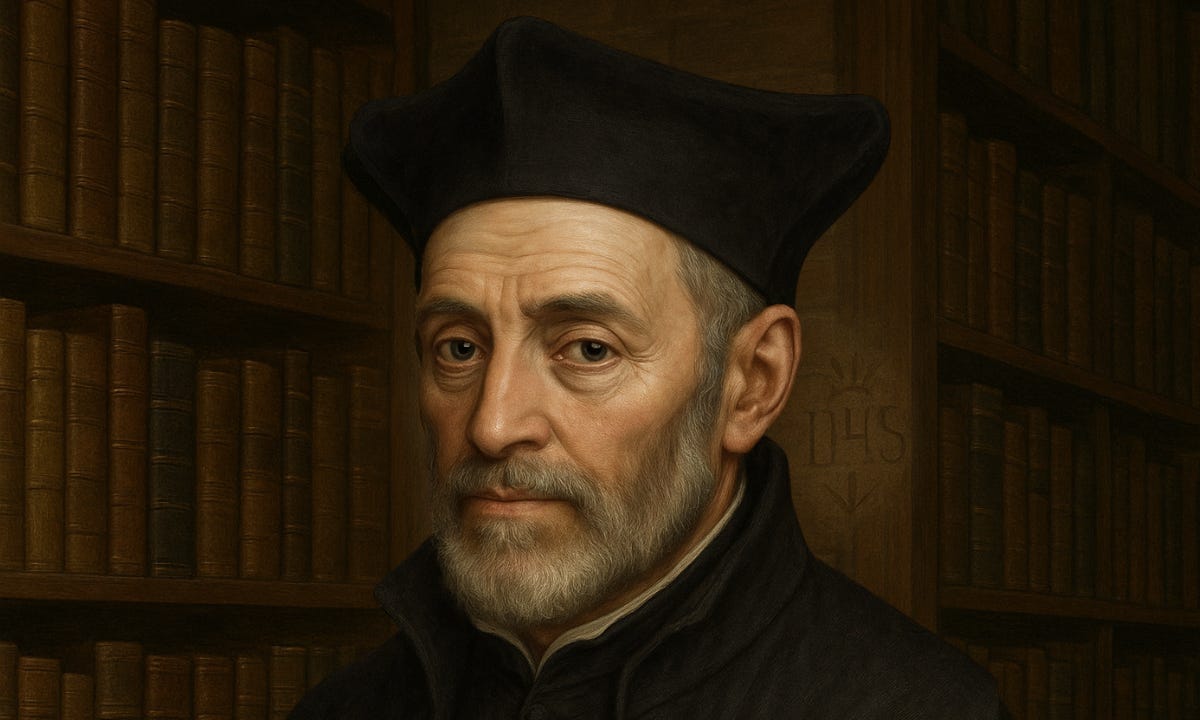
Benedict XIV shows why fortitude outside the Church cannot lead to eternal glory.
Giving Tuesday
Forgive us for sending a second email today.
We need to keep up some of our schedule and finish off our translation from Benedict XIV.
We shall definitely be keeping double email days to the absolute minimum during this 33-day preparation for St Louis de Montfort’s Total Consecration to the Blessed Virgin Mary…
See the latest here:

But, it’s also “Giving Tuesday.” The best way you can support The WM Review is taking out an annual subscription to WM+:
You can also give a one-time donation to The WM Review:
Another really great way to support us is to subscribe to our project, Father Coleridge Reader:
Thank you for your generosity!
Editor’s Notes
The following text is an excerpt of Pope Benedict XIV’s De Servorum Dei Beatificatione et de Beatorum Canonizatione, newly translated.
For more on Benedict XIV, his expertise on this subject, and the authority of this text, see Part I.
Previously, Benedict XIV had considered the status of non-Catholics in general, and heretics and schismatics in particular – as well as the difference between true and false martyr. Now he explains that even the most resolute endurance of suffering does not suffice to prove true martyrdom unless it be for the Catholic faith and within the unity of the Church.
Miracles, fortitude, and external signs may accompany the witness of the saints – but without the right cause, these sufferings belong not to martyrs, but to those who perish outside the fold.
On the False Martys of the Heretics and Schismatics
Benedict XIV’s On the Beatification of the Servants of God and the Canonisation of the Blessed
Chapter 20, from Book III, 1743
The courage of the martyrs – and the pseudo-martyrs
The multitude also of those who die with unconquered courage is a mark of the true Church, provided that there is no want of a cause worthy of death; as Theophilus Raynaud proves from Saint Athanasius and other Fathers of the Church (in the cited chapter 4, number 9). Among the genuine and select Acts of the Martyrs collected by Ruinart, ‘The Passion of Saints Montanus, Lucius, and other African martyrs’ is found, which took place in the third century of the Church. Concerning Saint Montanus these words occur:
“He crushed also the pride and wicked stubbornness of the heretics, declaring to them that even from the abundance of martyrs they might recognise the truth of the Church, to which they ought to return.”
Cardinal Gotti pursues the same argument at greater length in the cited volume (Vol. I De vera Ecclesia, chapter 3, §1), where he vigorously refutes Jacobus Piceninus, who maintained that the multitude of martyrs is not a sign of the true Church, because it is not continuous. For, as the most eminent author rightly replies, it is not necessary that the multitude of martyrs be continuous for it to be a sign of the true Church; it is enough that it has not been lacking, and is not lacking, when tyrants persecute the true faith. And this all the more, since according to the teaching of Saint Thomas, the faithful must at all times be ready to face death for the Catholic faith, but they are not bound actually to suffer it except when the occasion of confessing that faith arises (IIa–IIae, Q.124, A.1, ad tertium).
The heterodox strive to evade the examination of the cause, as is abundantly drawn from the author of the Apologia already cited. For they would wish the entire judgement on the truth of martyrdom to rest on the external conjectures and presumptions mentioned above. Then they add that the question of the cause ought not to be raised, since that controversy cannot so easily be settled, and meanwhile there should not be lacking arguments by which true martyrs may be distinguished from false. In holding such a view, it cannot be denied that they are acting consistently with their own purpose; and they hold it because they know full well that they would fall by their own cause, if enquiry were made not only into their suffering but also into the cause of that suffering in order to determine the truth of their martyrdom. They also know that their errors have been condemned by the Church, and their own authors made a separation from the unity of the Church, and that they persist obstinately in execrable contumacy. Moreover, they know that Saint Augustine stands against their pseudo-martyrs in Epistle 50 to Count Boniface, where he says:
“These men rave, who divide the members of Christ, blow away the sacraments of Christ, and glory in persecution because they are forbidden by the laws of the emperors to do these things – laws which were established for the unity of Christ – and they falsely vaunt their innocence, and seek from men the glory of martyrs which they cannot receive from the Lord.”
Saint Cyprian also stands against them in the Book on the Truth of the Church:
“He cannot be a martyr who is not in the Church; nor can he reach the kingdom who abandons her who is destined to reign.”
It must be added that martyrdom is an act of the virtue of fortitude, elicited by this virtue and commanded by charity, according to the teaching of Saint Thomas, which theologians commonly follow (IIa–IIae, Q. 124, A. 2). Thus, how can true fortitude be distinguished from false, unless the cause is examined for which a person steadfastly offers himself to death? Even the philosophers have taught that fortitude arising from anger or fury is utterly different from true fortitude: for true fortitude inclines one to endure evils and face terrors for the sake of what is honourable, whereas fortitude arising from anger or fury endures evils and faces terrors out of a desire for vengeance, or out of love or hatred, without any regard for what is honourable.
The WM Review is free for readers. This is because we believe these ideas must reach as many people as possible.
However, we also provide WM+ articles—additional material for those who choose to support this work financially.
This helps us continue producing serious Catholic research, while ensuring that the main body of material remains accessible to all.
If you want to ensure that our work continues, join WM+ today.
You can see our Testimonials page for what some of our readers are saying about the WM Review.
(We offer free membership on request for clergy and seminarians – please contact us for details.)