
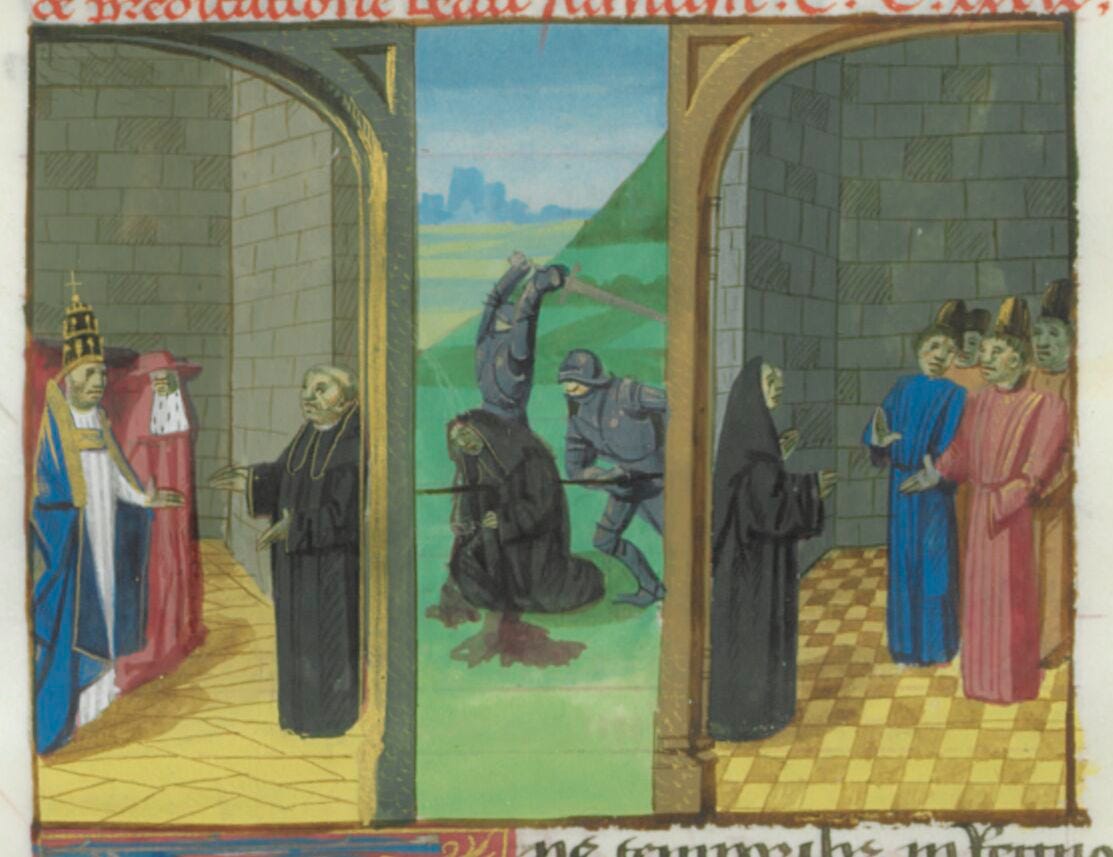
Bl. Pierre de Castelnau was slain for defending the rights of the Church and against the tyrannical rule of Count Raymond VI of Toulouse. How the world responded is very telling.
Editor’s Notes
This is Part II of a trilogy of extracts taken from The History of St Dominic, Founder of the Friars Preachers (1891) by the English author Augusta Theodosia Drane – also known as Mother Francis Raphael. You can see more about Drane in Part I.
This trilogy is intended to illustrate what a society becomes when imbued with Christian principles – in which Christ is King.
As mentioned in the previous part, the doctrine in question may be summarised as follows:
Our Lord Jesus Christ is not only the King of individuals who choose the accept Him; He is King over the whole of Creation, including nations and states. Civil authority is not only obliged to work for the common good of civic society, namely peace and the common good of the nation; it is also obliged to recognize Our Lord Jesus Christ, His Divinity and His Kingship, to offer Him appropriate homage and public worship, and to govern in accordance with the Gospel.
In the previous part, we saw the situation in Toulouse under Count Raymond VI, and the stern warnings which were issued to him by Pope Innocent III. We also saw the way in which the Church had drastically mitigated the barbarities of European wars through “the truce of God” – and that these warnings and customs were, as a rule, respected by the civil rulers. Exceptions such as Raymond VI simply prove the rule, and the Church’s reaction to such exceptions demonstrates the power, efficacy and necessity of Christ’s Kingship over society.
In this part, we will read about how Bl. Pierre de Castelnau was martyred for his strong stance for the Church, the faith, and for justice. This is necessary context for the third part, in which we consider how Raymond VI was treated for his role in this assassination.
The previous part ended as follows:
For the spiritual censure, Raymund cared little enough; but in the thirteenth century excommunication, by the common law of the Church, bore with it certain temporal penalties. At any moment the decree might go forth which would deprive him of his territories, and already a league was formed against him among certain of his barons who would joyfully have put such a sentence into execution. It was necessary therefore to temporize.
Here, “temporize” means, effectively, to “waste time” negotiating the conditions for submission, due to the possibility of temporal consequences for the excommunication he had incurred. But as Drane makes clear, this temporizing did not last long. Bl Pierre’s prediction was fulfilled and his prayers were quickly answered: he watered the soil of Languedoc with his martyr’s blood, the condition which he had said was necessary in order for religion to rise again there.
Bl Pierre was beatified by Pope Innocent III in 1208.
From
The History of St. Dominic, Founder of the Friars Preachers
Augusta Theodosia Drane
Longmans, Green and Company, London, 1891. pp. 70–72
Why the Kingship of Christ is the best set-up for society: War and Tyrants
The martyrdom of Bl. Pierre de Castelnau – what the reaction shows us about the Kingship of Christ
The Murder of the Legate
[Raymund] invited the Legate to meet him at St. Gilles, near the mouth of the Rhone, under the pretence of seeking a sincere reconciliation with the Church. Peter de Castelnau accepted the invitation, and repaired to the place appointed in company with one of his brother Legates.
But it soon became apparent that nothing was further from Raymund’s intention than any kind of submission. He desired indeed to be relieved from his sentence, and threatened the Legates with death if they attempted to leave the town without giving him absolution. But as to giving any pledges that would bind his future conduct, he utterly refused to do so. He would neither make peace with his neighbours, dismiss the Routiers from his employment, or withdraw his protection from the Albigenses.
These were the three heads to which the Legates reduced their demands, requiring not only his acceptance of them, but some security that the conditions would be observed. As to oaths, too well did they know what was their value in his eyes.
“A renegade to his faith,” says Peter de Vaulx-Cernay, “worse than an infidel, and incapable of observing his oaths, he had already sworn, and foresworn himself many times.”
All negotiations therefore failing, Peter de Castelnau boldly confronted the tyrant, and reproached him with his crimes and perjuries. Then, despising his threats, the two Legates left the town accompanied by an escort given them by the civic magistrates.
That night they slept in a little inn by the shore of the Rhone, and next morning, having said Mass and dismissed their escort, they prepared to cross the river. At that moment two men approached them, one of whom, squire to the Count of Toulouse, plunged a lance into the side of Peter de Castelnau. He fell to the ground mortally wounded, exclaiming, “May God pardon you; as for me, I pardon you!”
These words he repeated several times, adding as he addressed his companions, “Keep the faith and serve God’s Church without fear and without negligence.” They carried him into the poor wayside inn, where he lay raising his hands and eyes to heaven, and from time to time praying God to pardon his murderer.
“Towards cock-crow,” says the author of the Song of the Crusade, “he died after receiving Holy Communion. His soul departed to God, and his body was carried back to St. Gilles, and buried with lighted candles and the chant of the Kyrie eleison sung by many clerks.”
Its Consequences
The slaughter of an ambassador has in all times, and among all peoples, been reckoned among the most heinous of crimes. But as Rohrbacher observes, Peter of Castelnau was the ambassador from the Head of the Church, despatched to restore peace to a distracted country by exclusively peaceful means. His murder was therefore an outrage on the whole Christian world, and, according to what was then the universally acknowledged law of Christendom, the author of such a crime, as well as his accomplices and protectors, forfeited all social rights, and was to be regarded as an outlaw.
Nor could the death of the Legate be separated from the cause in the defence of which he fell. Although the Count of Toulouse had contrived to incur the censures of the Church on many grounds, yet it was mainly by his protection of the Albigenses and his connivance at their crimes, that he, the Christian knight and noble, stood charged before the chief tribunal of the Christian world.
In judging the question, we must regard it as it was then regarded by the whole of Christendom, when the interests of the faith took precedence of every other interest, and the abettor of heresy stood convicted of the crime of lèse-majesté against God Himself.
The policy of the Holy See in dealing with the Albigenses had hitherto been marked with nothing but patience and moderation. As we have seen, it was by the intervention of the Pope that the temporal sword had been held for ten years from falling on the guilty provinces. During that time, while apostolic missioners had sought the conversion of the heretics by no other means than by preaching and disputation, the Legates of the Holy See had with unwearied patience endeavoured to recall Count Raymund to the obligations binding on him as sovereign of a Catholic people.
It was not until the murder of the Legate had rendered all further compromise impossible that Pope Innocent consented to an appeal to arms.
Appeal to Arms
In the letter which he addressed to the knights and barons, the archbishops and bishops of Narbonne and the adjacent provinces, after enumerating the crimes of the Count of Toulouse, he declares that the time of endurance has passed, and that the censures long withheld must now fall on the author of so many offences. In other letters he called on the kings of France and England to forget their private quarrels and, girding on their swords, to march against the enemies of the faith.
“Suffer not the Church to perish in this unhappy country,” he writes, “but come to her assistance, and combat valiantly against these heretics, who are worse than the Saracens themselves.”1
This appeal found a response in the hearts of those to whom it was addressed, a vast number of princes and nobles took up arms, and thus there opens before us the history of that bloody war which, while strictly speaking it forms no part of the life of St. Dominic, yet from its association with the cause to which he had devoted himself must first be briefly traced, before we can take up the thread of our narrative and follow him in his apostolic career.
From: The History of St Dominic, Founder of the Friars Preachers
Why the Kingship of Christ is the best set-up for society: War and Tyrants
The martyrdom of Bl. Pierre de Castelnau – what it shows us about the Kingship of Christ
HELP KEEP THE WM REVIEW ONLINE WITH WM+!
As we expand The WM Review we would like to keep providing free articles for everyone.
Our work takes a lot of time and effort to produce. If you have benefitted from it please do consider supporting us financially.
A subscription gets you access to our exclusive WM+ material, and helps ensure that we can keep writing and sharing free material for all.
You can see what readers are saying over at our Testimonials page.
And you can visit The WM Review Shop for our ‘Lovely Mugs’ and more.
(We make our WM+ material freely available to clergy, priests and seminarians upon request. Please subscribe and reply to the email if this applies to you.)
Subscribe to WM+ now to make sure you always receive our material. Thank you!
Read Next:

Follow on Twitter, YouTube and Telegram:
Twitter (The WM Review)
Innocent, Epist. 26–32.