
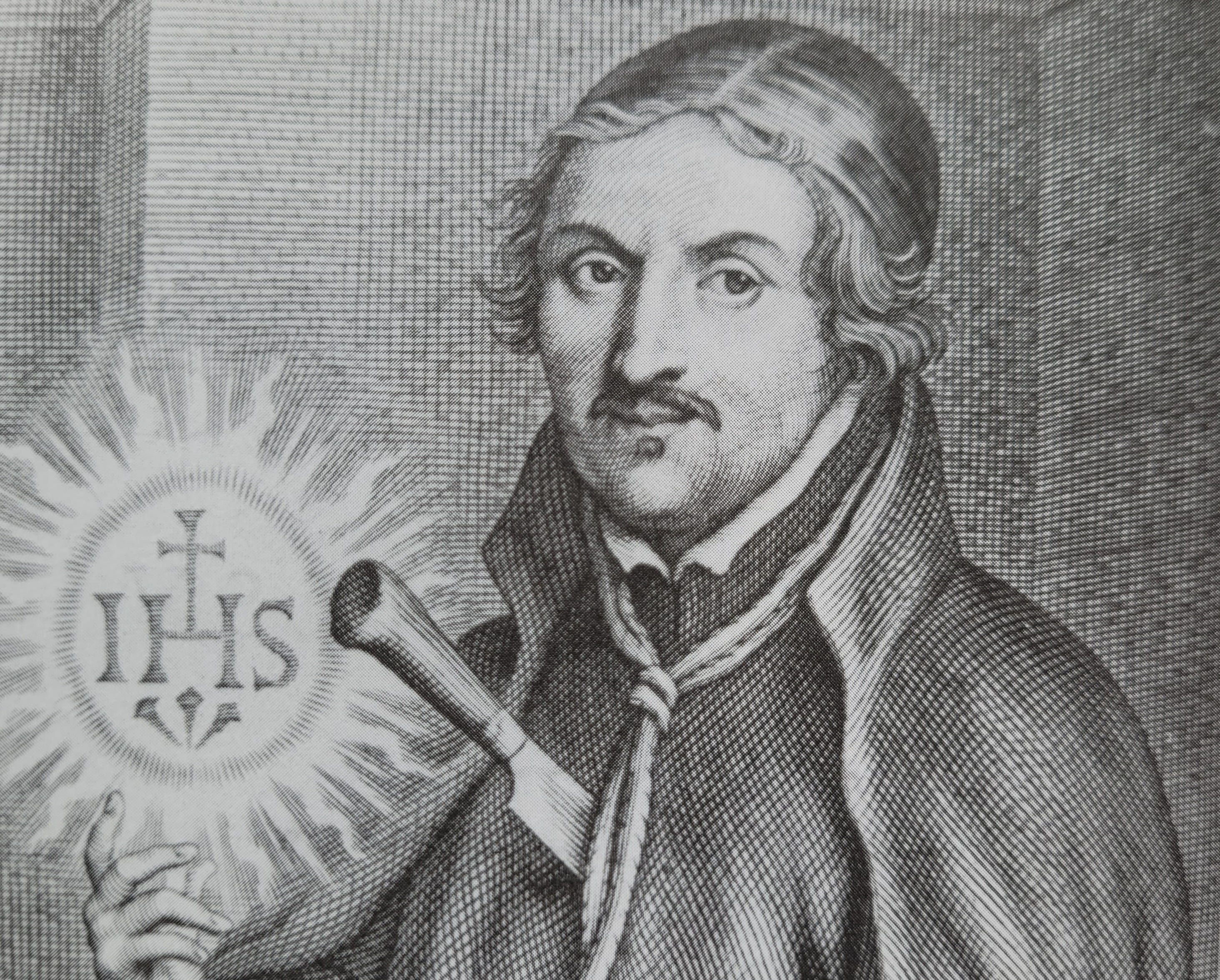
The great Bishop Richard Challoner provides a summary of the life and martyrdom of the English Jesuit Priest Bl. Peter Wright SJ.
Editor’s Notes
On 19 May, 1651, Bl. Peter Wright SJ achieved the palm of martyrdom in London, England. The following account of his life is taken from Bishop Richard Challoner’s Memoirs of the Missionary Priests.
Bishop Challoner was the Vicar Apostolic of the London District during the eighteenth century, and most famous today for his revision of the Douay-Rheims version of the Holy Scriptures, which are still used by Catholics today. He was also responsible for many important works, including The Garden of the Soul, Meditations for Every Day of the Year, and catechisms, as well as translations of The Imitation of Christ and St Augustine’s Confessions.
There is a significant detail to the martyrdom that Bishop Challoner does not make explicit. While he notes that Bl. Peter expired whilst hanging, he does explain that this was permitted – in place of being cut down and disembowelled whilst alive – due to the respect and admiration felt by so many for the martyr. This is further shown by the permission for his friends to bury his body with dignity – rather than his body parts being displayed at the gates of the city. J.R. Betts also notes:
“The Sheriff of London then demanded, in a loud voice, but with evident humanity, if any relations or friends of ‘the noble gentleman’ were present. Great numbers came forward and were allowed to take away all the sacred relics for honorable burial.”
Betts also mentions that Bl. Peter was not mocked on his way to execution, and that even the press praised his courage.
Challoner also does not mention that Bl. Peter actually said to the Anglican minister, who had tried to have him recant his faith: “Get thee behind me Satan.”
Bl. Peter was beatified by Pope Pius XI on 15 December 1929.
Unfortunately, I have no evidence of being related to Bl. Peter Wright – but I am happy to invoke him as a patron of my family.
S.D.Wr.
Peter Wright, Priest, S.J.
By Bishop Richard Challoner
From Memoirs of the Martyrs, Memoirs of missionary priests, as well secular as regular, and of other Catholics of both sexes, that have suffered death in England on religious accounts from the year of Our Lord 1577–16841
His early life
PETER WRIGHT was born of poor but virtuous parents at Slipton in Northamptonshire. His father dying when he was very young, the circumstances of his mother, left with a great family of children, obliged him to seek his bread in service.
He had for his master a country lawyer with whom he lived several years; and being young, and amongst Protestants, quickly forgot the pious admonitions of his dying parent, and lost his religion.
However he was by degrees reclaimed after he came to man’s estate; and going abroad, was fully reconciled by the English fathers of the Society [of Jesus] in their College in Liege, to which Providence had brought him whilst he was designing a pilgrimage to Rome.
From Liege he was sent to Ghent recommended by Father Rector to the English Catholics there, and for two years diligently applied himself to his humanity studies in the College of the Flemish Jesuits; till in the year 1629 he was pitched upon by the English fathers, to be one of the number who were to be sent that year from St. Omers to the Seminary of Rome.
But Mr. Wright petitioned that he might rather be admitted into the Society; and was accordingly received to the noviceship at Watten; where, in the two years of his stay, he gained that perfect mastery over his passions, that whereas by nature he was hasty and passionate, from that time he was remarkably calm and sedate.
It was also noted that he took great pleasure, as well here at Watten as afterwards during the course of his studies at Liege, in making excursions into the neighbouring villages, and catechising the children.
From Prefect of Novices to Military Chaplain
Having finished his divinity studies, and his third year’s noviceship in the Tertian House at Ghent, he was made prefect over the scholars in the College of St. Omers; though nothing could suit less with his inclinations than this troublesome office, as he himself acknowledged.
But he made a sacrifice of his own will to the will of God notified to him by his superiors; and that he might the more perfectly overcome this repugnancy of nature, after having prostrated himself to God in prayer, he went to the rector of the College, and generously offered to continue prefect, if the superiors thought proper, during the whole remainder of his life.
But not long after, his provincial destined him to an employment, not less laborious indeed, but much more agreeable to his zeal, viz., to a mission amongst the English soldiers; where he behaved in such manner as to gain the esteem and affection of all, and to reclaim great numbers of them from their errors and vices.
He was particularly dear to Sir Henry Gage their Colonel, who after their first acquaintance would not part with him, but had him for an inseparable companion for seven years, partly in Flanders, and partly in England; till Sir Henry (who was governor of Oxford for the King) being killed in the civil wars in 1644, the Marquis of Winchester and his lady desired to have Father Wright in their family, with whom he lived till his apprehension, which was on Candlemas Day, 1650–1.
His arrest
As the privileges of the peers were not regarded in those times of confusion, the priest-catchers watched their opportunity of rushing into the Marquis’s house on Candlemas Day in the morning, at the very time that Father Wright was going to Mass, and had not the Marquis stopped them for a while upon the stairs, they would have seized the good man in the chapel, if not at the altar itself.
But this delay gave him an opportunity of getting out of the window upon the leads; where, nevertheless, he could not be long concealed; for the pursuivants finding, upon their coming into the oratory, the altar dressed, and all things ready laid out for Mass, concluded the priest could not be far off; and perceiving the window open, imagined he had gone out that way, and found it to be so by sending a boy the same way, who discovered the father upon the leads.
Thus he fell into their hands, and was carried before the Lord Chief Justice Roules, and by him committed to Newgate as a suspected priest, where he had for companions, besides two priests that lay under sentence of death, five others lately apprehended upon the same suspicion; and amongst them the Rev. Mr. Cheney, a priest of the secular clergy, who was his bedfellow, and has given an edifying account of Father Wright’s behaviour in prison, extant in his printed life.
Fr Wright’s trial
In the first sessions after the apprehension of our confessor he was not called to the bar; and two of his companions who were tried, viz., Mr. Baker and Mr. Cheney, were brought in not guilty by their jury, which gave the Catholics great hopes that Father Wright would be set at liberty, without being brought to his trial; and very industrious they were to procure his discharge.
But when the following sessions were coming on, they began to apprehend that those who were in power had other designs; for it was then given out that the Lord Chief Justice had sent into the country for the apostate Thomas Gage, to come up and appear as witness against Father Wright, and Father Dade, superior of the English Dominicans, at that time also prisoner in Newgate.
To divert this blow, the Rev. Mr. George Gage, an eminent clergyman, used his best endeavours to prevail on the apostate, who was his brother, not to involve himself in any further guilt by having a hand in the blood of the innocent. He promised he would not, and, as to Father Dade, was as good as his word; for though he appeared in court against him, and testified that he knew him to be superior of the Dominicans, yet he qualified this testimony by adding that though he was their superior, possibly he might be no priest, as St. Francis was superior of his order, and yet was no priest; upon which Father Dade was acquitted by the jury.
But as to Father Wright, the wretch notoriously broke his promise, and swore that he knew him to be a priest and a Jesuit, and had often seen him say Mass; alleging for the reason of his appearing against him, an old grudge that he had against the father, for having done him an ill office, as he pretended, with his elder brother, Sir Henry Gage.
Fr Wright’s reply
The good man being asked by the Lord Chief Justice what he had to reply to this testimony, and those of the other witnesses, Mayo, Wadsworth, &c., would make no other answer than this:
‘My Lord, I give Almighty God thanks, from the bottom of my heart that He has been pleased I should be here arraigned (to use the words of St. Peter), not as a murderer, nor as a thief, nor as a reviler, nor as guilty of any other crime but my religion; even the Catholic religion, which was, is, and ever will be illustrious over all the earth; and I have nothing more to say.’
The judge told him it was not for religion he was arraigned, but for returning into England after having received the order of priesthood, and seducing the people.
Father Wright replied that the persecutors of old might, with as good a grace, have objected to the apostles and the primitive priests, their coming into heathen countries and preaching the faith, contrary to the laws of those countries, and have called it treason, and seducing the people.
‘But they preached the Gospel,’ said the judge, ‘you preach errors contrary to the Gospel.’
‘That is the very point in question,’ said Father Wright, adding at the same time that all manner of errors and heresies were tolerated in England, and none persecuted but the Catholic religion, which was a sign of its being God’s truth.
The guilty verdict
The jury going out to consult about their verdict, after some deliberation, returned him guilty; upon which the confessor made a low reverence with a serene and cheerful countenance, and said aloud, ‘God Almighty’s holy name be blessed now, and for evermore.’
The next day, being Whitsun-eve, he received the sentence of death, to his own great comfort, but to the great affliction of his friends and penitents, who saw themselves now like to be deprived of so zealous and virtuous a pastor.
No endeavours were neglected to save his life, or at least to obtain a reprieve for him, by the means of the Spanish ambassador and others; but nothing could be obtained; the less, because it being the Whitsun holidays neither Council nor Parliament met.
In the meantime great was the concourse of Catholics of all ranks to the prison from morning till night to see the servant of God; many desired to make their confessions to him; others begged some little thing which they might keep in memory of him; all were edified with his words and comportment, and departed with his blessing, finding a certain spiritual joy in their souls from having seen and spoken with him.
As for his own part he prepared himself for his exit by a general confession of all his life to Mr. Cheney; and waited for death with so much unconcernedness, that, as the same gentleman took notice, the two last nights of his life he slept far more quietly than ordinary, and so sound that it was not without difficulty they awaked him at the appointed hour of five o’clock, when he arose the last morning to celebrate the sacred mysteries.
And he declared in confidence to a priest of the Society sent to him by the provincial, that he never in all his life had experienced so much joy as he then found in his soul at the approach of his dissolution.
The day of the martyrdom
Whitsun-Monday in the morning he celebrated Mass with the assistance of Mr. Cheney, with great devotion.
And when the time was drawing near when he was to go down in order for execution, hearing the knocking at the iron grate, he took it as a summons from heaven, and cried out, ‘I come, sweet Jesus, I come.’ Then embracing Mr. Cheney, ‘Farewell,’ said he, ‘my chamber-fellow and bedfellow, before it is long we shall see one another again in heaven.’
When he was called out to the hurdle, he went with so much alacrity and speed that the officers could scarce keep pace with him; and here turning to Mr. Cheney, ‘Upon this bed, says he, I shall lie alone, as you also henceforward will have your bed to yourself.’
Then being placed on the hurdle he made a short act of contrition; and in the midst of mutual embraces was absolved by Mr. Cheney, and then drawn away to Tyburn through the streets crowded with an innumerable multitude of people.
My author writes that he himself was eye-witness of this last procession of Father Wright, who was drawn on the hurdle more like one sitting than lying down; his head was covered, his countenance smiling, a certain air of majesty, and a courage and cheerfulness in his comportment, which was both surprising and edifying, not only to the Catholics who crowded to ask his benediction, but to the Protestants themselves, as many of them publicly declared.
He adds that when the hurdle came over against the house where the Marquis of Winchester with his lady, children, and other Catholics of distinction were waiting to see him from a balcony, he lifted himself up as much as his pinions would permit, and making the sign of the cross gave them his last blessing, which they all received with their heads bowed down.
The crowd at Tyburn
The number of people that met at Tyburn, to be spectators of the triumph of this confessor of Christ, was computed to have been no less than 20,000, and amongst them near 200 coaches and 500 horsemen.
Thirteen malefactors were appointed to die with him, to whom the father endeavoured to give seasonable advice for the welfare of their souls, but was continually interrupted by the minister, and therefore desisted, betaking himself to silent prayer, in which he employed about an hour, standing with his eyes shut, his hands joined before his breast, his countenance sweet and amiable, and his whole body without motion as one in deep contemplation.
The minister took occasion to tell him it was not yet too late, that he might save his life, if he would renounce the errors of Popery; but Father Wright generously answered him, If he had a thousand lives he would most willingly give them all up in defence of the Catholic religion.
His final address
The hangman having fitted the rope to his neck, the confessor made a short speech to the spectators, in these or the like words:—
‘Gentlemen, this is a short passage to eternity; my time is now short, and I have not much to speak.
‘I was brought hither charged with no other crime but being a priest. I willingly confess I am a priest; I confess I am a Catholic; I confess I am a religious man of the Society of Jesus, or as you call it, a Jesuit.
‘This is the cause for which I die; for this alone was I condemned, and for propagating the Catholic faith, which is spread through the whole world, taught through all ages from Christ’s time, and will be taught for all ages to come.
‘For this cause I most willingly sacrifice my life, and would die a thousand times for the same, if it were necessary; and I look upon it my greatest happiness, that my most good God has chosen me most unworthy to this blessed lot, the lot of the saints.
‘This is a grace which so unworthy a sinner could scarce have wished, much less hoped for.
‘And now I beg of the goodness of my God with all the fervour I am able, and most humbly entreat Him that He would drive from you that are Protestants the darkness of error, and enlighten your minds with the rays of truth.
‘And as for you Catholics, my fellow soldiers and comrades, as many of you as are here, I earnestly beseech you to join in prayer for me and with me till my last moment; and when I shall come to heaven I will do as much for you.
‘God bless you all; I forgive all men. From my heart I bid you all farewell till we meet in a happy eternity.’
Permitted to die hanging as a mercy
Having spoken to this effect, he again recollected himself a while in prayer, and then the cart was drawn away, and he was suffered to hang till he quietly expired.
His dead body was cut down, headed, bowelled, and quartered. His friends were permitted to carry off his head and quarters, which were translated to Liege, and there honourably deposited in the college of the English Jesuits. He suffered the 19th of May, 1651, ætatis forty-eight, Societatis twenty-two.
As Father Wright’s comportment in this last stage of life was admired by the generality of the Protestants that were spectators of his death, so it gave occasion to several conversions, a thing very usual in the like occasions.
HELP KEEP THE WM REVIEW ONLINE WITH WM+!
As we expand The WM Review we would like to keep providing free articles for everyone.
Our work takes a lot of time and effort to produce. If you have benefitted from it please do consider supporting us financially.
A subscription gets you access to our exclusive WM+ material, and helps ensure that we can keep writing and sharing free material for all.
You can see what readers are saying over at our Testimonials page.
And you can visit The WM Review Shop for our ‘Lovely Mugs’ and more.
(We make our WM+ material freely available to clergy, priests and seminarians upon request. Please subscribe and reply to the email if this applies to you.)
Subscribe to WM+ now to make sure you always receive our material. Thank you!
Read Next:
Memoirs of the Missionary Priests – Bishop Challoner
Blessed Peter Wright SJ – J.R. Betts


Follow us elsewhere:
Twitter (The WM Review)
Ven. Peter Wright.—From his Life, printed at Antwerp the very year he suffered, by an eye-witness of his death; see also Foley, Records, ii.; Catholic Encyclopædia; D.N.B.
Thank you for this piece. I had not heard of brave Father Wright 🙏
A gripping storyl And this: That is the very point in question,’ said Father Wright, adding at the same time that all manner of errors and heresies were tolerated in England, and none persecuted but the Catholic religion, which was a sign of its being God’s truth. -- And even now all manner of errors and heresies are tolerated by Rome, and none persecuted but the traditional Catholic faith.