

Suggesting that the ‘faith experience’ of those who took part in the Synod is a ‘theological place,’ the Synthesis Report turns personal experiences into a source of future theological developments.
The three-year “Synod of Synodality” emphasizes “listening” to the experiences of a variety of groups to help resolve theological questions that are regarded – by the architects of the synod at least – as “open.”
The Synthesis Report of the 2023 “Synod of Synodality” contains the following recommendation in a section entitled “Ecclesial Discernment and Open Questions”:
We identified a need for reflection on the conditions that enable theological and cultural research that takes as its starting point the daily experience of God’s Holy People and places itself at its service.
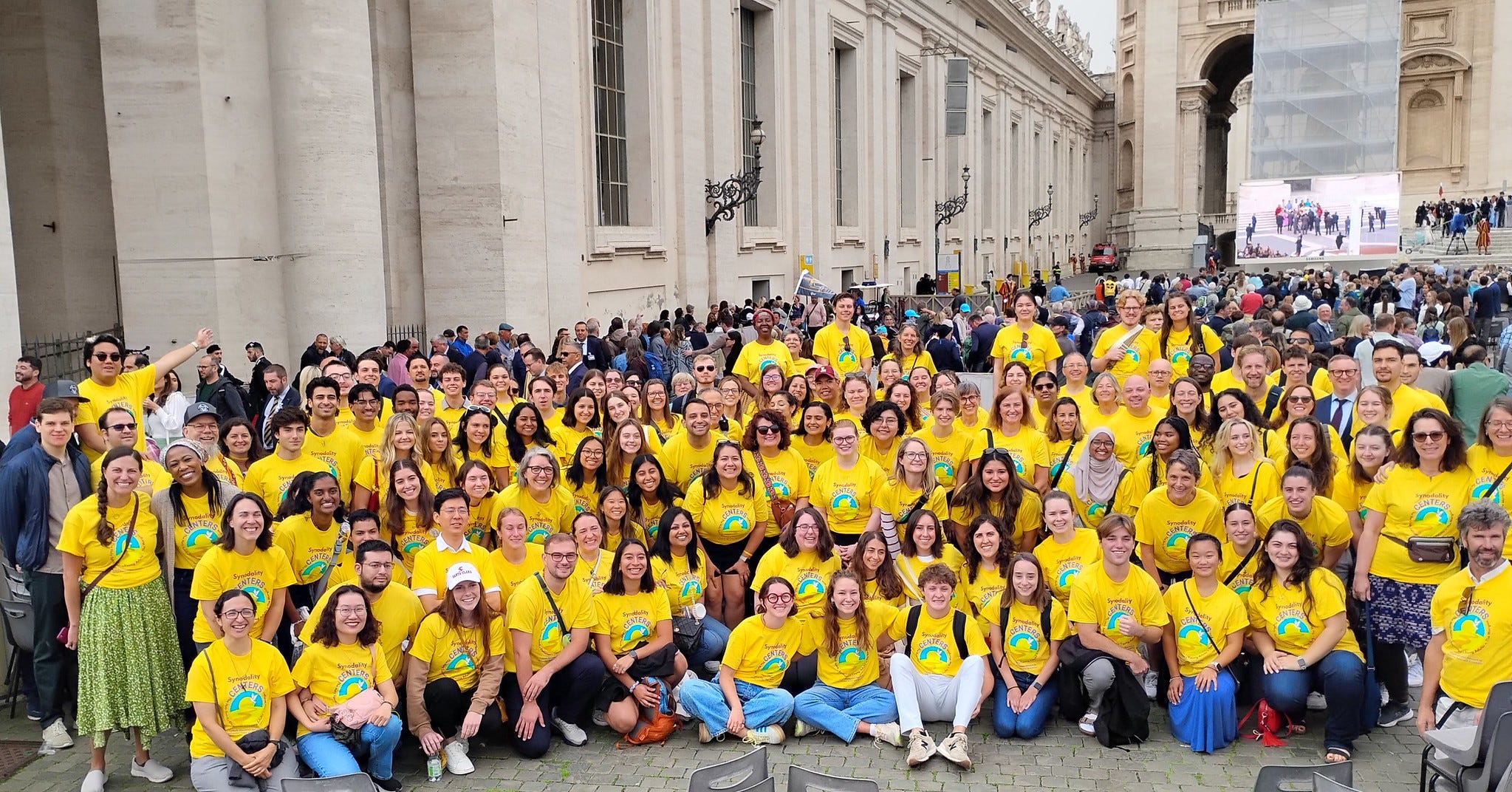
The synod accepted as members, not just bishops, but also lay people:
Lay people, those in consecrated life, deacons and priests were, together with the bishops, witnesses of a process that intends to involve the whole Church and everyone in the Church. Their presence reminded us that the Assembly is not an isolated event, but an integral part and a necessary step in the synodal process. The multiplicity of interventions and the plurality of positions voiced in the Assembly revealed a Church that is learning to embrace a synodal style and is seeking the most suitable ways to make this happen.
The Instrumentum Laboris of the 2023 Synod identified the internal experience the participants as the primary way of recognizing the voice of God, with the Magisterium of the Church and the science of sacred theology, playing only a secondary role:
The more each participant has been nourished by meditation on the Word and the Sacraments, growing in familiarity with the Lord, the more he or she will be able to recognize the sound of His voice (cf. Jn 10:14.27), assisted also by the accompaniment of the Magisterium and theology.
The document stressed the significance for theology of the personal experiences of the participants:
The questions that the IL poses are an expression of the richness of the process from which they were drawn: they bear the imprint of the particular names and faces of those who took part, and they bear witness to the faith experience of the People of God and thus reveal the reality of a transcendent experience… The first phase enables us to understand the importance of taking the local Church as a privileged point of reference, as the theological place where the Baptized experience in practical terms ‘walking together.’
What is a theological place?
The last sentence of the paragraph above uses the term “theological place.” This is a technical theological term, with a specific meaning, and its use here is no accident.
A “theological place” is a source for the science of theology. By suggesting that the “faith experience” of the particular individuals who took part in the synod is a “theological place,” the drafters of the text are trying to turn their personal experiences into a source for future theological developments.
But can personal “faith experience” be recognized as a “theological place”?
The sources of revelation
In a previous article I have explained that sacred theology is “the science about God and about divine realities.”1 The data studied by sacred theology are revealed by God.
To know what God has revealed about himself, we go to the sources in which this revelation is to be found, which are, as St. Paul has told us:
[T]he traditions you have learned, in word or in writing, from us. (2 Th 2:15)
The traditions handed down by writing, are the Sacred Scriptures, and those which have been handed down by “word” are Sacred Tradition.
The sources of revelation are, therefore, Scripture and Tradition.2
1. Sacred Scripture
Sacred Scripture is the inspired word of God contained in the books the Old and the New Testaments. These books, according to the First Vatican Council, were “written by the inspiration of the Holy Ghost, have God as their Author and, as such, have been handed down to the Church itself.”3
The Sacred Scriptures are the inerrant word of God, and the teaching authority of the Catholic Church is their proper interpreter.
2. Sacred Tradition
Sacred Tradition is that body of doctrine, which was taught by the apostles, but was not contained in the inspired writings of the Old and New Testaments. It has been handed down from generation to generation by those who succeeded the apostles in their office as teachers of the faith. The successors of the apostles are (i) the popes and (ii) all other bishops by divine right, that is, bishops with ordinary jurisdiction – the bishops who head the local churches. (Bishops who succeed only to the power of order, but not to the power of jurisdiction – such as auxiliary bishops – are not successors of the apostles.)
The pope and the bishops by divine right exercise the teaching authority (magisterium) of the Church and, by the assistance of the Holy Ghost, faithfully transmit the fullness of the Catholic faith to each new generation. As the theologian Mgr G. Van Noort states:
Christ, the Ambassador of God, brought the truth from heaven to earth and established the Catholic Church as an indestructible and infallible institution which would preserve and teach his doctrine until the end of time. It follows from this that the teaching of the Church in each generation was designed by Christ Himself as the norm of faith for the people of that generation.4
But from where do the later generations of bishops obtain the doctrine which they preach? They have not personally heard Christ and His Apostles preach, nor have they received a special personal revelation. Rather, they have received the sacred doctrine from the previous generation of bishops, and those whom those bishops deputed to teach the faith, such as parish priests and seminary professors, as well as, of course, other sources such as their own parents and grandparents, who have themselves ultimately received it from the magisterium of the Church.
However, and very importantly, they also find the Sacred Tradition in a variety of written documents which have been handed down to them from previous generations. These sources are among the theological places.
The theological places of Sacred Tradition
There are two primary places where Sacred Tradition is to be found: (i) the Acts of the Magisterium and (ii) the Witnesses of Tradition.
1. Acts of the Magisterium
These are the acts by which the successors of the apostles teach the Catholic faith through the exercise of the teaching authority bestowed on them by Our Lord Jesus Christ.
Some Acts of the Magisterium are extraordinary such as the creeds and doctrinal definitions of the Roman Pontiffs and the Ecumenical Councils. Others are ordinary such as the non-definitive teaching of the Roman Pontiff and the teaching acts of local bishops and synods. The Church’s liturgical and sacramental rites are also to be considered acts of the ordinary magisterium and are rich and authoritative sources of sacred doctrine.
The extraordinary acts of the magisterium are infallible. And when a doctrine has been taught in an ordinary way, throughout the universal church, this has also been taught infallibly.
2. Witnesses to Tradition
While Sacred Tradition is transmitted by the extraordinary and ordinary teaching acts of the pope and the bishops by divine right, that same teaching can be found in other sources. These are “witnesses” to what the popes and bishops have taught. A useful subdivision is that which follows:
(a) Consensus of the Fathers
The Fathers of the Church are those writers – some of whom were successors of the apostles and some of whom were not – who “in the early ages of the Church, recorded Catholic doctrine and explained and defended that doctrine by their writings.”5 In addition to the fathers of the Church we can add the Doctors of the Church, who “were outstanding for orthodoxy, learning, and holiness, and have been honored with this title by the Church.”6
The writings of the fathers and the doctors are a sound source of sacred doctrine because they sought to set down faithfully that which they had received from the teaching authority of the Catholic Church. And thus, as Van Noort writes:
The unanimous agreement of the fathers on a doctrine as revealed is a sure argument for divine tradition.7
(b) Consensus of the Theologians
The theologians are “those writers of the post patristic period and especially of the period following the twelfth century who produced more systematic works on sacred doctrine under the aegis of the Roman Catholic episcopate.”8
Of these men Pope Leo XIII said:
[They] undertook a task of great magnitude, namely, to harvest with reverent care the abundantly rich sheaves of doctrine from the extensive writings of the holy fathers, to bind them together and to store them in one place for the use and convenience of later ages.9
The theologians undertook their work under the direction and guidance of the magisterium of the Church. As with the fathers of the Church, “the unanimous and constant agreement of theologians on a doctrine is a sure criterion of divine tradition.”10
(c) Consensus of the Faithful
In this context the term faithful refers to the Church taught rather than the teaching Church and includes all those who do not exercise the teaching authority of the Church.11 The faithful are not just lay people, but also auxiliary bishops, priests, deacons, subdeacons, those in minor orders, and members of religious orders. They are those who receive the doctrine taught by the pope and the bishops by divine right. Just as the body of bishops as a whole can never fail in the transmission of the Catholic faith, neither can the body of the faithful as a whole fail to receive the true faith.
Therefore, the unanimous and constant agreement of the faithful on a particular doctrine is a witness to the fact that such a doctrine has been proposed for their belief by the magisterium of the Church.
However, the value of this testimony is like the value of a reflection in a mirror. What is seen in the mirror may be seen accurately and clearly, but the mirror is not the source of the image. In the same way, the faithful are never the source of divine revelation, however clearly they may witness to it. The source is always God, who has made it known to us through Scripture and Tradition, which has been transmitted to us by the magisterium of the Church.
The personal “faith experience” of the individual – whatever value and meaning it may have in other contexts – is not a “theological place” in which we discover a source of God’s revelation to man.
HELP KEEP THE WM REVIEW ONLINE WITH WM+!
As we expand The WM Review we would like to keep providing free articles for everyone.
Our work takes a lot of time and effort to produce. If you have benefitted from it please do consider supporting us financially.
A subscription gets you access to our exclusive WM+ material, and helps ensure that we can keep writing and sharing free material for all.
You can see what readers are saying over at our Testimonials page.
And you can visit The WM Review Shop for our ‘Lovely Mugs’ and more.
(We make our WM+ material freely available to clergy, priests and seminarians upon request. Please subscribe and reply to the email if this applies to you.)
Subscribe to WM+ now to make sure you always receive our material. Thank you!
Read Next:


Follow on Twitter, YouTube and Telegram:
Twitter (The WM Review)
Michaele Nicolau SJ, Sacrae Theologiae Summa IA, Trans. Kenneth Baker SJ, p12.
These are the proper places which constitute God’s revelation to man, and which are the object of man’s theological reasoning. For completeness we can also note the existence of adjunct places, which are not sources of divine revelation but rather disciplines which can help us understand it more deeply. Many sciences have something to offer to theology, but among the most important are philosophy, history and law.
Vatican Council I, The Dogmatic Constitution ‘Dei Filius’
Mgr G. Van Noort, Dogmatic Theology Volume III: The Sources of Revelation, (translated by Castelot and Murphy, 1960), p3.
Van Noort, Vol. III, p170.
Van Noort, Vol. III, p171.
Van Noort, Vol. III, p172.
Van Noort, Vol. III, p176.
Pope Leo XIII, Encyclical Letter Aeterni Patris
Van Noort, Vol. III, p177.
This is, of course, not to deny that the successors of the apostles are also bound to submit to the teaching authority of the Church, especially as exercised by the Bishop of Rome, and the Bishop of Rome is bound to receive and teach the whole of the tradition which he has received.