

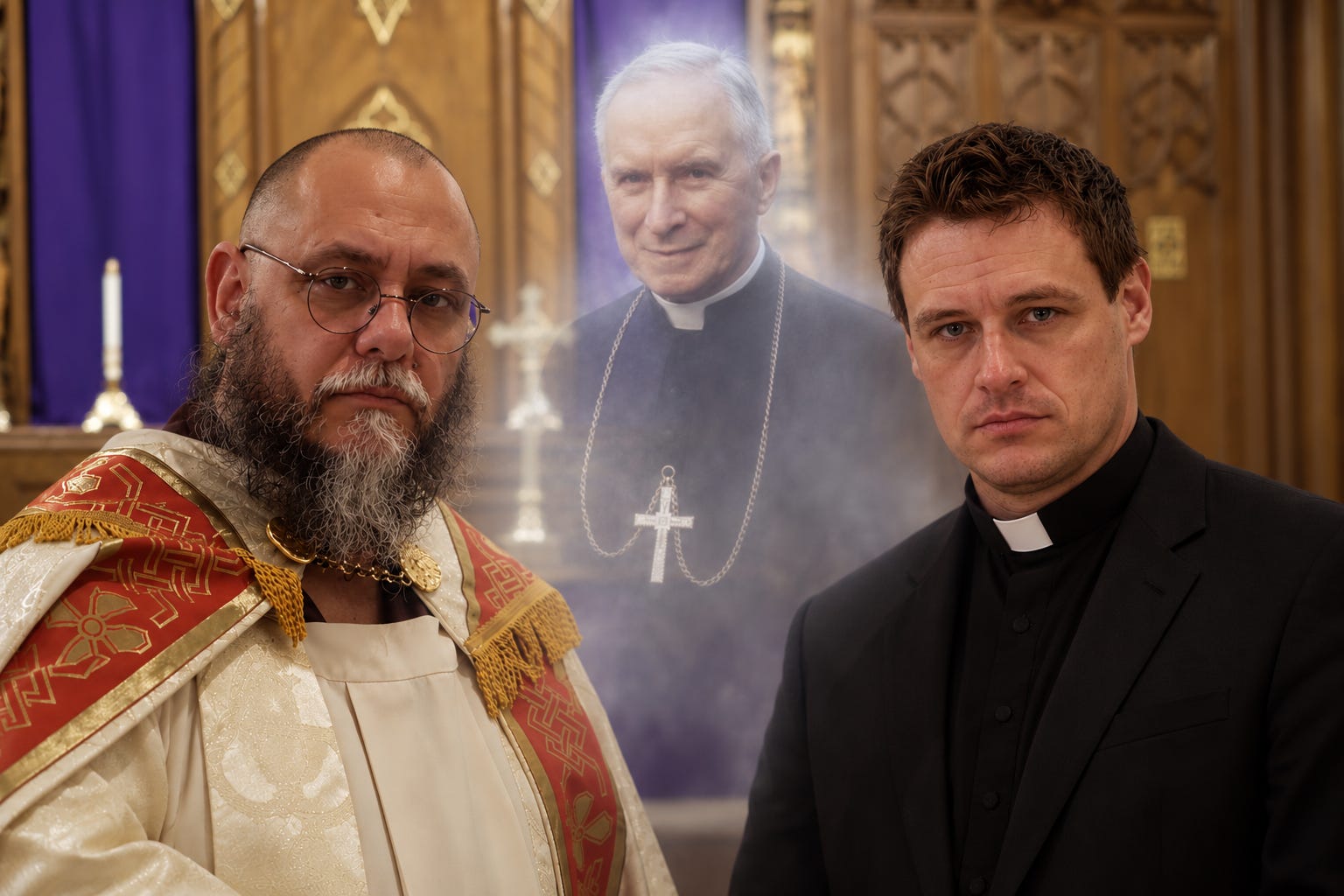
The priests’ departures from their dioceses come as the SSPX faces reprisals across the world. But what is the thought within the SSPX about such priests?
(WM+) – In the space of a single week, two Novus Ordo priests have left or been removed from their respective dioceses, due to associating with the Society of St. Pius X (SSPX) – prompting swift canonical reprisals from their bishops.
Although they have widely been reported as having joined the SSPX as priestly members, it is not yet clear that this is the case.
Father Philip Conklin
Father Philip Conklin was ordained with the new rite of priestly ordination by Archbishop Bernard Hebda just two years ago (25 May 2024), for the Archdiocese of St. Paul and Minneapolis.
Before entering the Novus Ordo seminary, he joined the Air Force, with a view to a future career in air traffic control.
Following a sabbatical earlier this year to discern his vocation, Conklin informed his archbishop that he had decided to be “affiliated” with the SSPX.
Hebda announced the move in a letter to the parishioners of St. Michael and St. Mary in Stillwater, where Conklin had served since his ordination in 2024. Hebda stated that, because of this “affiliation” with the Society and Conklin’s refusal to end it, he has opened a canonical process to “clarify the situation and his status.”
“At the same time, I have also informed Father Conklin that he is not to exercise any public priestly ministry,” the archbishop wrote.
As of this writing, neither Conklin nor the SSPX has released a public statement confirming the nature of his “affiliation”.
Father David Mary of Our Lady of Sorrows
Days later, Bishop James Beckman of Knoxville, Tennessee revoked all faculties, permissions, and authorizations previously granted to one Father David Mary of Our Lady of Sorrows – a Franciscan living and operating in his diocese.1
A statement, dated 2 October 2026, said that the diocese had “become aware of ministerial activity associated with and supportive of the Priestly Fraternity of Saint Pius X (SSPX) being organized within the territory of the Diocese by Rev. David Mary Engo and other members of the laity.”
“He is not authorized to exercise public priestly ministry anywhere within the Diocese of Knoxville,” the diocese declared.
Beckman went further than Hebda, actively discouraging the faithful from contact with Fr David Mary:
“[T]he Bishop of Knoxville has not authorized, condoned, or approved the establishment within the Diocese of any priory, mission, chapel, foundation, or other apostolate intended to advance the purposes or ministry of the Society of Saint Pius X.
“The faithful are therefore strongly urged not to attend Masses, sacramental celebrations, retreats, conferences, or other religious activities organized or conducted by Fr. David Mary or in connection with this unauthorized ministry, and not to provide material or organizational support for his ministry or the establishment or maintenance of an SSPX apostolate within the Diocese.”
The Diocese of Knoxville had already suppressed all diocesan Traditional Latin Masses on January 1 of this year, in accordance with Pope Francis’s Traditionis Custodes.
It is unclear what exactly prompted these measures – but it does not seem certain from the statement that he is about to join the SSPX as a priestly member. In July 2026, he broadly expressed support for their positions in his “Friar Side Chats” podcast on the Franciscan Hermitage Foundation website.
But what should we make of these moves – and the possibility that these two men may become “affiliated” with the SSPX in the near future?
What follows is essentially Part IV of our series on Archbishop Lefebvre and the Novus Ordo Sacramental rites. The first three parts address the following topics:
Archbishop Lefebvre & Conditional Confirmations—His pastoral practice explained
Archbishop Lefebvre & Conciliar Sacraments—Do they ‘come from the Church?’
As Part IV rounds the series off by considering how the views expressed by Archbishop Lefebvre were continued within the Society which he founded, this part could be titled:
The SSPX and Conciliar Ordinations – Survey of opinions
Following this part, we will consider the following in further articles:
Why moral certainty is necessary when it comes to conferring, receiving or facilitating the conferral of the sacraments
Current praxis with regard to this question
The continuity of this praxis
The role of videos and investigations
Investigations into baptismal validity as an analogy
What an investigation would need to involve
The varying circumstances in which conditional repetition is justified
The faithful and their rights
Conclusion: The true reason to doubt
The following text is for WM+ members.
It’s both the final part of a previous series, and the first part of a new one, offering a challenging and substantial analysis (around 10,000 words) of the issues raised by men ordained in the Novus Ordo joining organisations like the SSPX.
It addresses these developments in light of our long-standing position:
“To preserve sacramental integrity, safeguard the common good, and secure peace of conscience for all, the only possible course is a systematic programme of (at least) conditional ordination/consecration of clerics whose orders depend on the validity of the Novus Ordo rites.”
The WM Review is free for readers. This is because we believe these ideas must reach as many people as possible.
However, we also provide WM+ articles – additional material for those who choose to support this work financially.
This helps us continue producing serious Catholic research, while ensuring that the main body of material remains accessible for all.