

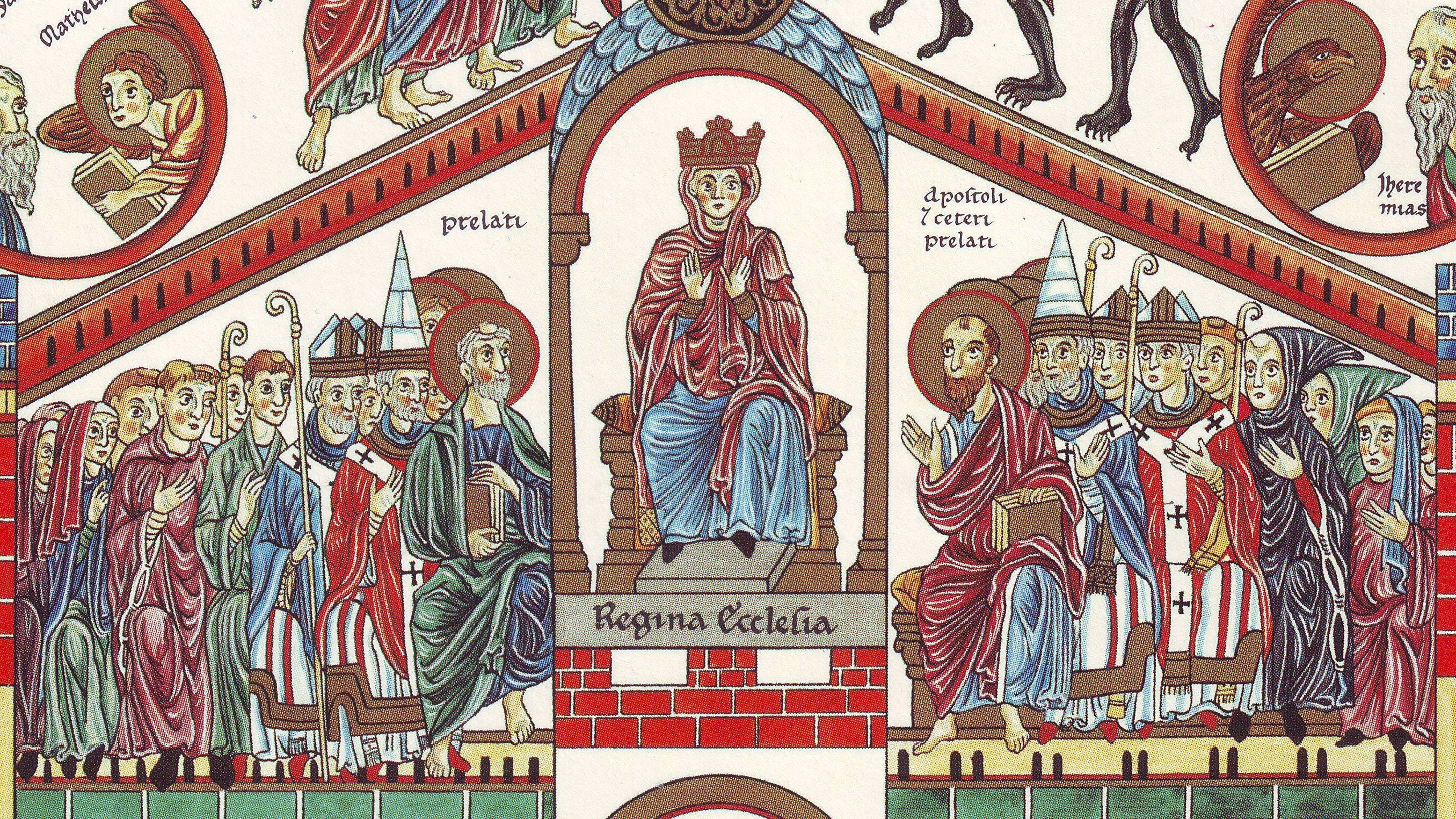

We are not ready to enter Passiontide and Holy Week until we have passed through the Sundays of Lent beforehand.
The Sundays of Lent—Preparing for Passiontide
Over the four Sundays leading up to Passiontide, the Church presents Christ in a particular way: not yet as the suffering Victim, but as the divine Conqueror.
These Sundays are key to our preparation for Passiontide and Holy Week, when we enter into what Pope Pius XII calls “the principal mystery of our redemption” – the glorious passion and sufferings of Christ.1 The four presentations of Christ on these Sundays create a tone and “atmosphere” which is different to certain other aspects of our Lenten observance and devotions.
Christ revealed in the Sundays of Lent
Throughout these weeks, Christ is presented as:
The Warrior resisting Satan in the desert
The transfigured Son on Mount Tabor
“The stronger man” driving out demons and defeating evil
… and, on this fourth “Laetare Sunday,” as Lord over matter itself, multiplying bread in the wilderness – a miracle he refused to work in his temptation, when it would have been for his own benefit.
Each of these images reveals not only Christ’s divinity, but also his trustworthiness. This is especially relevant in light of the ancient catechumenate. As discussed previously, Lent has a special focus on the catechumens who are to be baptised at Easter. In the early days of the Church, when the texts of the Roman liturgy were being assembled, baptism had the potential to mark a decisive break with one’s previously comfortable life. It could result in the loss of friends, family, position, status, freedom, or even life itself.
This is the reason for the four presentations of Our Lord on these Lenten Sundays, each one inspiring confidence, admiration and love for him in the hearts of the catechumens, as well as in those already baptised. It is a preparation for what lies ahead, both in our own lives, and in Holy Week. They teach us that it is no ordinary man who suffers on Good Friday. He is worthy of our love, our loyalty, and our self-denial.
But while the Church spends these Sundays of Lent presenting Christ as the truly worthy reason for dying to ourselves in baptism and in fasting, it is on on Laetare Sunday that she finally unveils her own face. She shows herself as the destination of the baptised and the mother of the faithful, and she allows us to express our love for her in the liturgy.
Laetare Sunday—The Church unveiled
The Mass of Laetare Sunday presents the Church to us, in all her dignity, and we are encouraged to grow in love for her and her Lord. At the start of the Mass, we sing in the Introit:
Introit: Rejoice, O Jerusalem, and be glad with her, all you that love her: rejoice for joy with her, all you that mourn for her. That you may suck, and be filled with the breasts of her consolations (Is. 66.10-1). V. I rejoiced at the things that were said to me: We shall go into the house of the Lord. (Ps. 121.1)
Here, the Church is not speaking of the earthly Jerusalem, but of herself. The liturgical writer Johannes Pinsk highlights a comment from St Ambrose on this passage:
“What are the breasts of the Church? Are they not the sacrament of baptism as often as it is administered?”2
He continues:
“How must such words have sounded in the ears of the catechumens! This, then was their destiny, their vocation!
“Were they uprooted from home and family? They would find a new heart and home through the Mother Church and among the people of God.
“Were they to be politically disenfranchised, ostracized? They rejoiced to know that they were on the way to the House of God, to that new city in which there would be peace and prosperity in security.
“And this overcame all those primordial fears that had been engendered by their decision to take their stand for Christ and the Church.
“Face to face with such a Church, mother of life and city of peace eternal, the catechumens confess in exultant joy, together with the whole Christian community, their ultimate assuagement, the slaking of all their fears and longings. […]
“Whatever the baptized Christian has renounced in his break with the world, he finds it again in the holy city of God, in the shelter and sanctuary of Mother Church.”3
In the propers for Laetare Sunday, “Jerusalem” does not refer to the city in which Christ died, nor to the city in modern day Israel: it refers to the Holy Catholic Church herself. In this Mass, the Church presents us with prophecies made about her as the “New Jerusalem”, and allows us to sing her praises:
Gradual: I rejoiced at the things that were said to me: we shall go into the house of the Lord. V. Let peace be in thy strength: and abundance in thy towers.
Tract: They that trust in the Lord shall be as Mount Sion: he shall not be moved for ever that dwelleth in Jerusalem. V. Mountains are round about it: so the Lord is round about his people, from henceforth now and forever.
Communion: Jerusalem, which is built as a city, which is compact together: for thither did the tribes go up the tribes of the Lord, to praise thy name, O Lord.
In these texts, the Church is always “the pillar and ground of the truth” (1 Tim. 3.15). She is the safe, secure and unmoving stronghold of God, wherein her children will have eternal life, even if they suffer persecution and trials for Christ’s sake.
Jerusalem is our Mother
This theme is also appears in the Epistle, which refers to the children of Abraham; one born to the slave Agar, and one to the free woman, Sarah.
St Paul also identifies Jerusalem with the Church, and notes the remarkable fruitfulness manifested in the number of her children:
“[T]hat Jerusalem which is above is free: which is our mother. For it is written: Rejoice, thou barren, that bearest not: […] for many are the children of the desolate, more than of her that hath a husband.”
In their approaching baptisms, the catechumens are to be made into the children of the Church: “not the children of the bondwoman, but of the free: by the freedom wherewith Christ has made us free.”
The reason for the rejoicing, which so characterises Laetare Sunday, is the glory of Christ’s Church, presented to us in this Mass. It is all about the Church, and how Christ nourishes us through her, and how he has her live his own life. As Pope Pius XII taught in Mystici Corporis Christi:
“Christ our Lord wills the Church to live His own supernatural life, and by His divine power permeates His whole Body and nourishes and sustains each of the members according to the place which they occupy in the body, in the same way as the vine nourishes and makes fruitful the branches which are joined to it.”4
St Thomas Aquinas summarises this doctrine of the saints:
“The head and members are as one mystic person.”5
And St Augustine says in turn:
“[Christ] is the Head of the Church, and the Church is His Body, [and the] Whole Christ is both the Head and the Body.”6
This is why Fr Faber writes:
“[A] man’s love of the Church is the surest test of his love of God.”7
And this in turn is because, as Fr John Kearney pithily summarises the matter:
“To love the Church is to love Christ.”8
It is through the Church that Christ forms us, teaches us how to put him on and abide in him, and it is the Church which guides us into his divine life through her teaching, laws, tradition, sacraments and liturgy. This is why Pius XII teaches thus of our annual commemoration of the events of Christ’s life on earth:
“[T]he liturgical year, devotedly fostered and accompanied by the Church, is not a cold and lifeless representation of the events of the past, or a simple and bare record of a former age. It is rather Christ Himself who is ever living in His Church.”9
In all this, the Church is Christ’s spouse, and our mother.
It is right that we love and honour our mother.
Loving the Church during her passion
The words of the Introit pertains especially to us, the sons of the Church:
Introit: Rejoice, O Jerusalem, and be glad with her, all you that love her: rejoice for joy with her, all you that mourn for her. That you may suck, and be filled with the breasts of her consolations: (Is. 66.10-1)
In the Church, we are this Jerusalem, and we are the ones “that love her.” This remains true even though, today, the men who assault her maternal dignity (and those who defend these men) castigate us as her enemies and renegade children.
We are also the ones “that mourn for her.” How could anyone who love the Church not mourn for her today, especially those who exist in a kind of Babylonian Exile, as we discussed in relation to Septuagesima?
We have seen the Church wracked and riven by wicked men over the course of these past sixty years. Their betrayal of her has perhaps never been clearer than today.
We have seen so many of her children (even our own friends and family) abandon her through heresy, schism, and apostasy, despite the fact that they “were once illuminated, have tasted also the heavenly gift and were made partakers of the Holy Ghost, [and] have moreover tasted the good word of God and the powers of the world to come.” (Heb. 6.4-6).
Even amongst who remain with the Church, we see brother turn against brother in misguided defence of those trying to destroy her.
As we sing with her, at Tenebrae in Holy Week:
“O all ye that pass by the way, attend, and see if there be any sorrow like to my sorrow.”
You’ve seen the sorrow. The Church betrayed, wounded, and in exile – yet this is not the end of the story.
The WM+ article goes further, showing how the Church’s own liturgy reveals her future vindication.
Read on as we explore the promise of restoration—and what it means for those who remain faithful today.