
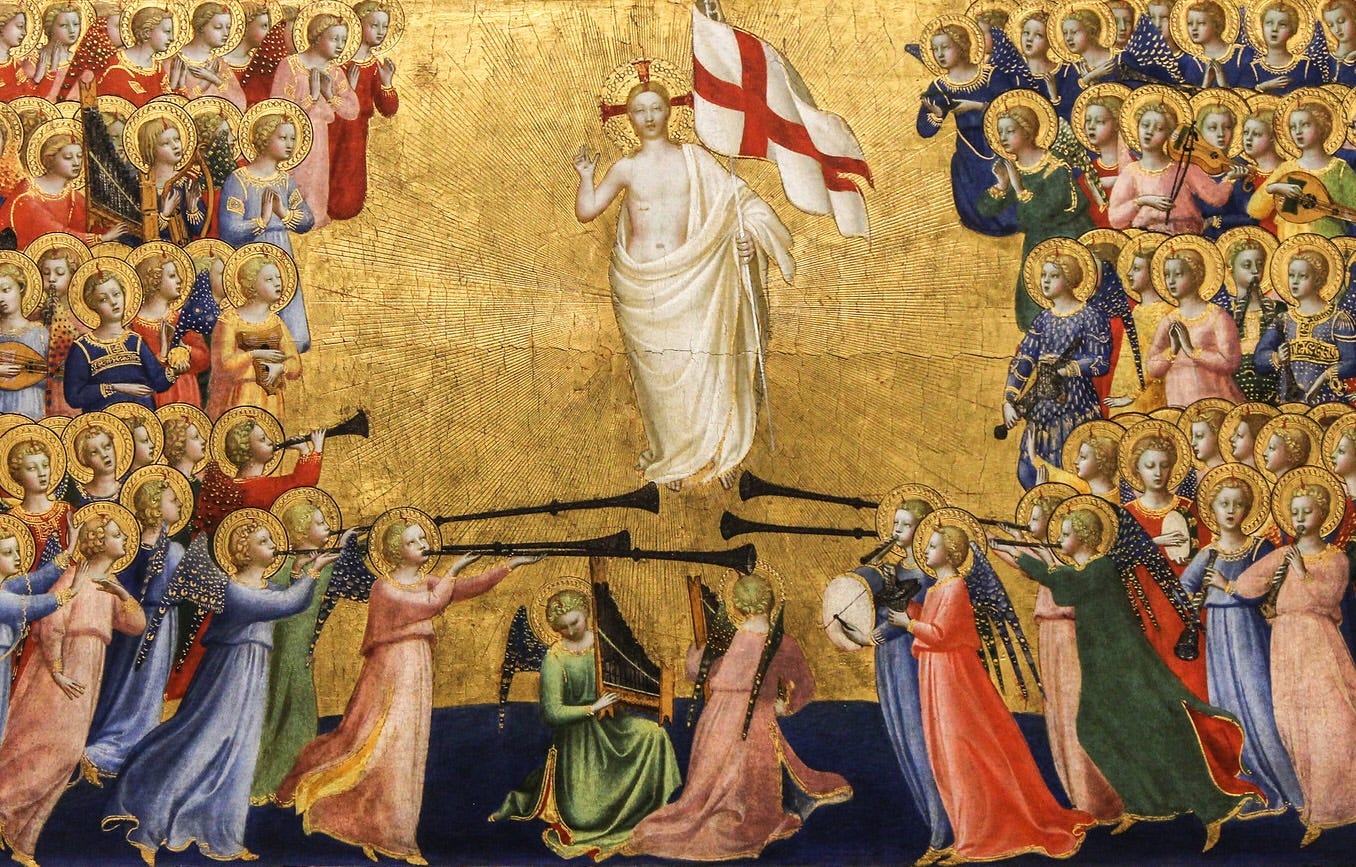
What happened at the moment of the Resurrection? Fr Peter Gallwey SJ presents us with a number of points to consider.
Editor’s Notes
To mark Easter Sunday, we are reproducing the reflections on the moment of the Resurrection from Fr Peter Gallwey SJ’s Watches of the Sacred Passion.
For more information about Fr Gallwey and this work, see the previous part.
See also our audio recording od Fr Aloysius Ambruzzi's meditation on the Resurrection here:

And see Fr Coleridge in the same subject:

Christ Rises from the Grave
Fr Peter Gallwey SJ
The Watches of the Sacred Passion, Vol. II, pp 603-616
Art and Book Co., London, 1896
SCENE XXIV.
THE TOMB.
Station I.
The third day He shall rise again (St. Matt. xvii. 22).
And now His will Who stilled the winds on the lake, and lulled the waves to rest, in an instant hushes the jubilant anthem. There is silence, a holy happy silence, throughout the host of Heaven, and all that vast assemblage, and the prisoners of hope gaze in rapture on the Most Blessed Soul of Christ, as it enters into the Sacred Tomb, and in an instant is united once more, indissolubly now and for ever, with its faithful partner, the sinless, and most obedient helpmate which rendered to His Soul good, and not evil, through all the days of (its) life. Thus, in a moment, in the twinkling of an eye, as the Apostle afterwards wrote (1 Cor. xv.), Jesus Christ, the Eternal Son of God, and the Son of the Ever-Blessed Virgin Mary, He Who is Master of power (Wisdom xii.), and reacheth from end to end mightily, and ordereth all things sweetly (Wisdom viii.), and with tranquillity (Wisdom xii.), awakes from the sleep of death, and on His new birthday is once more made Man – Jesus Christ, God and Man.
“O God, O My Father, to Thee do I wake at the dawning of the new Sabbath-day. I give Thee thanks, My Father, because Thou (hast) not left My Soul in Hell; nor given Thy Holy One to see corruption.”
No hand does He need to unbind Him, and let Him go. With tranquillity He lays aside the grave-clothes. No angel comes to roll away for Him the stone, though it is great. In silence and with tranquillity He rises, and passes in His glorified Body noiselessly through the stone vaulting of the Sepulchre. The Body sown in dishonour rises in glory; sown in weakness, it rises in power; sown a natural Body, it rises a spiritual Body (1 Cor. xv.). O death, where is (now) thy victory?
Silence, deep silence still reigns throughout the great company of angels and of blessed souls gathered from Heaven and from Limbo to witness the glorious Resurrection. All are waiting and watching for what the Lord will do and say.
Station II.
He is risen, as He said (St. Matt. xxviii. 6).
A. And what does the Lord do or say as He rises from the Tomb? Of the strong man, Samson, we read, that when he found the honeycomb in the dead lion’s mouth, he ate of it, and coming to his father and his mother, he gave them of it, and they ate (Judges xiv.).
A stronger and a better and a more loving Son is here. From the jaws of death He has taken back the honeycomb, the sweetness and the joy of life. Whither shall He go but to share it quickly with the same Mother who has shared all His sorrow? The first Adam, as he woke out of the deep sleep cast on him by God, saw coming towards him the woman that God had formed to be his helpmate. So now the waking eyes of the second Adam, as He rises through the rock, are resting on His Blessed Mother. He sees her draw irresistibly towards Him, and He makes haste to meet her, and most reverently and lovingly embraces her, saying: “My Mother, ‘Resurrexi, et adhuc tecum sum’ – I am risen, and am with thee still” (Psalm cxxxviii.).
Then it is that an alleluia loud and full and perfectly becoming, bursts from the delighted choirs. Alleluia! alleluia! For hope is changed into ineffable fulfilment.
Sit laus plena, sit sonora,
Sit jucunda, sit decora,
Mentis jubilatio.
Oh, full and loud the song shall be,
Seemly and sweet the minstrelsy,
The anthems of the soul.
And as the Ever-Blessed Mother sinks down to adore, saying once again, “Ecce ancilla Domini!” He adds: “Arise, My Mother, arise; make haste, My love, My dove, My beautiful one, and come. For the winter is now past, the rain is over and gone, the flowers have appeared in our land” (Cant. ii.).
Louder and fuller and more jubilantly bursts out again the response of the entranced spirits, Amen, amen, alleluia, alleluia!
And as the Lord goes on: (She) is My dove! My perfect one is but one! (Cant. vi.); thou art all fair, My loved one, My faithful one, Mother ever Blessed; thou art all fair, and no spot is in thee” (Cant. iv.); their irrepressible gladness breaks forth once more: “Hail, full of grace, the Lord is with thee. Worthy is our Queen, the Mother of the Lamb that was slain, to receive with her Son benediction, and honour, and glory, and power, for ever and ever (Apoc. v.). For God has joined them, and parted they must not be.”
And Holy Mary, overflowing with perfect love, which drives out all fear and all sorrow, responds in that same hour, as she gazes on the beauty of her glorified Son: It is enough for me if my Son and my Lord be living (Genesis xlv.). My God, my Lord, my Son, already in this hour, according to the multitude of my sorrows in my heart, Thy consolations have given joy to my soul (Psalm xciii.). My spirit exulteth in God my Saviour.
B. He is risen, as He said.
Our Blessed Lord will be well pleased, and His Holy Mother will be well pleased, and the rejoicing saints and angels will be well pleased, if we also try to take part in this great gladness for the Resurrection and glorification of Christ Jesus crucified.
Gratias agimus Tibi propter magnam gloriam tuam – “We give Thee thanks for Thy great glory.”
St. Ignatius teaches us in his Exercises, when he comes to this mystery, to pray earnestly that we may rejoice intensely on account of the great joy and glory of our Master.
This is not at all a selfish prayer. For if it is love to weep with those who weep, so is it love to rejoice with those who rejoice. Loving compassion does both.
“Cantate Domino,” the Holy Ghost says to us, “canticum novum.”
This scene at the Sepulchre calls for a new canticle. But if we sing with a new heart the old songs, they become a new canticle.
Hail, full of grace, the Lord is with thee. Every word is new, and has to-day a new meaning. The Lord is with her now in quite a new way.
And we can practise our souls too in learning how to say better and better her canticle, My soul magnifieth the Lord, blessing God for what He has done for Holy Mary. For thus we can give her a help which she needs; since there is one thing that she never can do as much as she wishes. She cannot bless and thank her God sufficiently.
Regina cœli, lætare, alleluia.
Quia quem meruisti portare, alleluia.
Resurrexit sicut dixit, alleluia,
Ora pro nobis Deum, alleluia.
Rejoice, O Queen of Heaven and earth, alleluia.
For He to Whom thou gavest birth, alleluia,
Is risen as He said, alleluia,
This third day from the dead, alleluia.
Oh, pray for us for whom He bled, alleluia.
C. He is risen, as He said.
Look attentively at Jesus risen: the same Jesus, as on the Good Friday; and yet how changed! Death is swallowed up in victory. And not only death, but all that went before death. For we remember, there was no beauty in Him then; nor comeliness, nor sightliness. We were not drawn to Him. We could not be desirous of Him. Now He is beautiful above (all) the sons of men; and the angels and blessed saints are desiring to look on Him: and, in quite a new sense, are crying out, O God, look on the Face of Thy Christ, the beautiful Face of Thy Christ, and out of love for Him, be propitious to His poor sinful brethren – the children of His Mother.
D. He is risen, as He said.
St. Ignatius counsels us to note well the great change wrought in Him.
When we see a martyr mangled and tortured, or a holy servant of God suffering on a death-bed, it is hard to believe that they are soon, very soon, to be blessed in Heaven.
Is this calm and beautiful and majestic Lord Jesus the same that on Friday was writhing on the ground in His Blood, a worm and no Man?
He was crucified through weakness, St. Paul writes, yet He liveth by the power of God (2 Cor. xiii.). And while looking on His beauty, and strength, and majesty to-day, we understand better that the weakness of Good Friday was all voluntary. He loved me and delivered Himself up for me.
E. He is risen.
He was dead, truly dead: but it was He Himself Who said of Lazarus: (He) is not dead, but sleepeth. And what to Him now is His Passion, His Death, nay, His whole weary Life, but a short dream? As the dream of them that awake, O Lord (Psalm lxxii.). The things that are seen are temporal: but the things that are not seen are eternal (2 Cor. iv.).
St. Chrysostom writes: “The glory of the Resurrection has buried in oblivion all the bitterness of death.”
F. He is risen.
We have to believe by faith that He is the same Jesus; the scourged Jesus; the crowned Jesus; the crucified Jesus of Good Friday. “Ecce Homo!” He is the same Man; God made Man; the Son of God and the Son of Holy Mary.
St. Leo writes: “The Resurrection did not put an end to the former Body, but only changed its condition. The substance is not destroyed. Some qualities have passed away; but its nature is not gone. That which could then be crucified is now a Body impassible. That which could then be slain is now become immortal. That which could be wounded is made invulnerable.”
And St. Paul writes: If we knew Christ according to the flesh: but now, we know Him no longer. St. Leo, to explain these words, adds: “With reason it is said: that the flesh of Christ is no longer recognised as what it used to be. Because now there is nothing left passible, and nothing that is weak. So that in nature and essence it is the same; but in its glorious condition not at all the same.”
G. He is risen.
St. Paul, the Apostle of the Resurrection, suggests many holy thoughts to entertain our souls while we contemplate our Lord Jesus risen, and His Holy Mother’s consolation.
(a) We are buried with Him by baptism unto death; that as Christ is risen from the dead by the glory of the Father, so we also may walk in newness of life (Romans vi.).
The old man of sin was buried in the waters of Baptism. This was more clearly signified in the Baptism by immersion. The Christian rises out of the water regenerated, and a new man. All through my life, then, I ought to have been walking in newness of life. Have I lived the life of a risen man, such as Lazarus lived after coming to life? Has my heart been clean? Has a right spirit been renewed in my bowels?
H. He is risen.
(b) But not to stand alone and exceptional. Christ is risen from the dead, the FIRST FRUITS OF THEM THAT SLEEP. For by a man came death, and by a Man the resurrection of the dead. And as in Adam all die, SO ALSO IN CHRIST ALL SHALL BE MADE ALIVE (1 Cor. xv.).
One cause, then, of the great joy to-day of Christ our Lord and of His Holy Mother is that we are all, through His Death and Resurrection, to rise again.
They are rejoicing for our joy. Is it much if we rejoice at their joy?
Our poor sinful bodies are to rise. Let us not be slaves to them in their corruption, now; but reverence and cherish them as they will be when risen.
I. He is risen.
(c) And therefore our bodies shall rise. If the dead rise not again, neither is Christ risen again (1 Cor. xv.). Credis hoc? Credo Domine.
(d) But what boots it that our bodies rise, if our souls be not risen?
Behold, I tell you a mystery: we shall all indeed rise again: but we shall not all be changed. Why not? Because flesh and blood cannot possess the Kingdom of Heaven; neither shall corruption possess incorruption (1 Cor. xv.).
Alas! alas! Are we to rise with our bodies still quite capable of suffering and of corruption; immortal indeed, but suffering such everlasting misery, that better had it been for him if that man had not been born? (St. Matt. xxvi.).
Is that to be the outcome of Christ’s Death and Resurrection? Absit! Domine. Absit! Mater Dei. Tantus labor non sit cassus. – “Not so, O Lord, not so, Holy Mother. May the Passion of thy Son and thy compassion not be made void.”
J. He is risen.
(e) Christ our Pasch is sacrificed (1 Cor. v.). Our Pasch, our Passover. The name was to remind Israel of the crossing over the Red Sea from slavery into freedom. Christ is our Pasch: because He has made it possible for our souls through His plentiful redemption and all the provision He has earned for His Church to pass from death to life.
St. Bernard writes that if we go back to sin, “We rob the Resurrection of Christ of its name of Pasch, since we do not pass over, but go back.” To each of us He says most compassionately: Arise, make haste, My beautiful one, and come. For winter is now past; the rain is over and gone. The flowers have appeared in our land. For each one of us is His Bride, built up out of the water and the blood from His Side; and, though perchance disfigured now, yet He sees us as we are to be: Make haste, My beautiful one, and come.
K. He is risen.
(f) Christ rising from the dead, dieth now no more.
Therefore, under either kind in the Holy Eucharist Christ must be living. Men sometimes say that Holy Church only gives half the Sacrament to the faithful. As long as this heresy prevails, Holy Church fears to countenance it by giving the Blessed Sacrament to the faithful under both kinds. For if Christ is divided, and he who receives the Sacred Body does not receive also the Precious Blood, then Christ is still dead, for His Body and His Blood are separated.
Christ rising from the dead, dieth now no more. Death has no more dominion over Him. The Blessed Mother has obtained for many of her children to rise from sin and die no more. They persevere till death, walking in the newness of life. The lust of the flesh, the lust of the eyes, and the pride of life have no more dominion over them. Thanks be to God, Who gave us the victory through Christ our Lord.
“O Holy Mother of God, thy power is still the same. Thy Mother’s heart, too, is unchanged. Pray for us sinners, that we may die no more.”
L. He is risen.
(g) Who was delivered up for our sins, and rose again for our justification (Romans iv.).
The sense is not that Christ by His Death merited forgiveness for us, and by His Resurrection merited an infusion of sanctifying grace. For after His Death our Lord no longer merited. But St. Paul teaches us that His Death and His Resurrection are both to be useful to us; both teach us; both are our models.
His Death teaches us to die to sin, to destroy sin. His Resurrection, to walk in newness of life.
M. He is risen.
If you are risen with Christ, seek the things that are above: mind the things that are above, not the things that are on the earth (Coloss. iii.).
Our good Angel is ever whispering: Sursum corda.
Where is wisdom to be found? Job asks. Where are peace and happiness and hope and love to be found?
And where is the place of understanding? If I go down into the rich mine, the depth says: it is not in me. If I look for it on the sea-shore, the sea saith: it is not with me. If I try to buy it, the finest gold will not purchase it, neither shall silver be weighed in exchange for it. Gold or crystal cannot equal it: neither shall any vessels of gold be changed for it.
Whence, then, cometh wisdom?
Sursum corda! Our Angel whispers, God understandeth the way of it: and He knoweth the place thereof (Job xxviii.).
N. He is risen.
(h) Christ our Pasch is sacrificed: therefore let us feast: not with the old leaven, nor with the leaven of malice and wickedness, but with the unleavened bread of sincerity and truth (1 Cor. v.).
That is, let us in our Paschal time use unleavened bread: not the bread seasoned with the old leaven palatable to our nature. Let us not indulge in conversations leavened with malice and wickedness; but let us feast our minds and hearts with innocence and truth.
O. He is risen.
An early Father, Minucius Felix, writes: “Observe how, for our consolation, all creation is ever contemplating (and imitating) the future resurrection. The sun sets in the sea, sets to rise again. Stars disappear and return. Flowers droop and die, to come to life again. Shrubs are withered by age, but blossom again. Seeds must die in the ground before they spring up in beauty. It is with our bodies in this world as with those trees which in the winter season hide all their vigour under a feigned decrepitude. Why wish impatiently that the tree come back to life and bourgeon while the winter is still bleak? Even so, must we wait for the spring-time of our bodies.”
SCENE XXV.
THE TOMB. THE EARTHQUAKE.
Station I.
And behold there was a great earthquake (St. Matt. xxviii. 2).
A. A great earthquake.
Very loud, but perhaps not of long continuance. Holy Church applies to it the words of the 75th Psalm: The earth trembled and was still, when God arose in judgment, to save all the meek of the earth.
To save all the meek of the earth. The earthquake is not a chastisement sent in anger to destroy; but a voice announcing that the kingdom of this world is no longer under Satan’s power: that Christ the King has conquered all His enemies; and, to-day, the last of them, death – and the enemy death shall be destroyed last (1 Cor. xv.). He is risen now to continue His work of saving all the meek of the earth.
B. A great earthquake.
The loud earthquake awakes the drowsy guards and tells them the tidings, and fills them with terror.
The loud earthquake, coming unexpectedly, awakens the attention of the disciples, and prepares their minds to believe.
The earthquake, short, loud, and without preparation, speaks to the sleeping city. He who hath ears, let him hear, our Lord used to say.
C. A great earthquake.
At the ancient Pasch, the deliverance out of Egypt, nature spoke more loudly: The sea saw and fled: Jordan was turned back. The mountains skipped like rams, and the hills like the lambs of the flock. At the presence of the Lord, the earth was moved (Psalm cxiii.). O God, when Thou didst go forth in the sight of Thy people the earth was moved, and the heavens dropped at the presence of the God of Sinai (Psalm lxvii.). Why is there less demonstration now? Perchance, because less is wanted now. Christ has wrought better wonders and quite sufficient wonders on Calvary. He, on His cross, with His Blessed Mother by His side, is the wonder that will awaken and attract the hearts of men. I, if I be lifted up from the earth, will draw all things to Myself (St. John xii.). He is the Fruit hanging on the tree of knowledge and of life, that will lure us all.
The Psalmist speaks of the God of the first Pasch as the God of Sinai. He spoke in the thunder and lightning of Sinai. Our Lord Jesus, the God of Calvary, says: I will draw them with the cords of Adam, with the bands of love; and I will be to them as one that taketh off the yoke on their jaws; and I put his meat to him that he might eat (Osee xi.).
“By Thy glorious Resurrection, deliver us, O Lord. Do not, on account of graces abused and our hardness of heart, cease to speak; do not be silent.”
Alas! after having loved us with an everlasting love, and drawn us to Calvary to witness His Death and Resurrection, and to know Him and His Blessed Mother, shall our Lord be obliged to say to us in the end: The Lord thy God hath carried thee, as a man is wont to carry his little son, all the way that you have come, until you came to this place. And yet for all this you did not believe the Lord your God? (Deut. i.).
Station II.
For an Angel of the Lord descended from Heaven, and coming rolled back the stone, and sat upon it. And his countenance was as lightning, and his raiment as snow. And for fear of him the guards were struck with terror and became as dead men (vv. 2–4).
A. An Angel of the Lord descended.
The context is: There was a great earthquake. For an Angel descended.
Hence commentators conclude that the earthquake is produced by the action of God’s Angel. Some men, deluded by the father of lies and by their own pride, deify the laws of nature. Nature is with them supreme. We believe firmly that our God is the Creator and Lord of nature and nature’s laws. He commandeth both the winds and the sea, and they obey Him. So does the earth: The world is Mine, and the fulness thereof (Psalm xlix.); and the firmament above: And all things serve Thee (Psalm cxviii.). For great power always belonged to Thee alone; and who shall resist the strength of Thy arm? For the whole world before Thee is as the least grain of the balance, and as a drop of the morning dew, that falleth down upon the earth. But Thou hast mercy upon all, because Thou canst do all things (Wisdom xi.).
B. The guards became as dead men.
Our Lord is risen: to save all the meek of the earth. The voice of the earthquake is really a message of peace. The guards, indeed, were filled with terror; but this fear will to many be the beginning of wisdom, and perchance afterwards to themselves.
The shock of the earthquake and the aspect of the Angel leave no room for doubt in their souls, whatever bribes the Priests may offer. “Great is the truth, and it gains the day.” These guards set by the Priests and Ancients will be most useful apostles of the truth. Unjust witnesses have risen up against Me, and iniquity hath lied to itself (Psalm xxvi.), that is, against itself, to its own confusion. There is no wisdom, there is no prudence, there is no counsel against the Lord (Prov. xxi.).
C. An Angel of the Lord descended, and coming rolled back the stone.
Some commentators think that the earthquake caused by the Angel rolled back the stone. But perhaps this may have been a distinct effort of the Angel’s power.
D. The guards became as dead men.
See the guards, at the sound of the earthquake, starting to their feet and grasping their swords; but at the sight of the Angel, all their courage and strength is gone, they sink down to the earth and swoon away through excessive fear. The Resurrection is intended to bring life to the dead, but here we see the living fall down as if dead men. This is Simeon’s prophecy concerning Jesus Christ: This Child is set for the fall and the resurrection of many.
Mors est malis, vita bonis – “Death to the wicked; Life to the good.”
“Mother of God, show us the blessed fruit of thy womb, that to us He may be Life.”
E. The guards became as dead men.
If the earthquake and the aspect of the Angel can cause fear like to death, what wonder that when the great day of the Lord shall come, and men shall see the sign of the Son of Man coming in a cloud with great power and majesty, they shall be withering away with fear?
To-day He rises in mercy, only to save all the meek of the earth. But then He will come to judge justly.
Quantus tremor est futurus,
Quando Judex est venturus,
Cuncta stricte discussurus.
Oh! what trembling then shall be,
When the Lord in majesty,
Comes to judge the sins of men.
“O Lord, my God, pierce Thou my flesh with Thy fear” (Psalm cxviii.).
NB: We must not forget that the Angel does not roll away the large round stone in order that the Lord may come forth. The Resurrection is already accomplished. The Body that was a natural Body has risen a spiritual Body, and can pass through walls and rocks and bolted doors.
Read Next:
HELP KEEP THE WM REVIEW ONLINE WITH WM+!
As we expand The WM Review we would like to keep providing free articles for everyone.
Our work takes a lot of time and effort to produce. If you have benefitted from it please do consider supporting us financially.
A subscription gets you access to our exclusive WM+ material, and helps ensure that we can keep writing and sharing free material for all.
You can see what readers are saying over at our Testimonials page.
And you can visit The WM Review Shop for our ‘Lovely Mugs’ and more.
(We make our WM+ material freely available to clergy, priests and seminarians upon request. Please subscribe and reply to the email if this applies to you.)
Subscribe to WM+ now to make sure you always receive our material. Thank you!
Follow on Twitter, YouTube and Telegram:
Twitter (The WM Review)
He is risen..
He is risen indeed.