
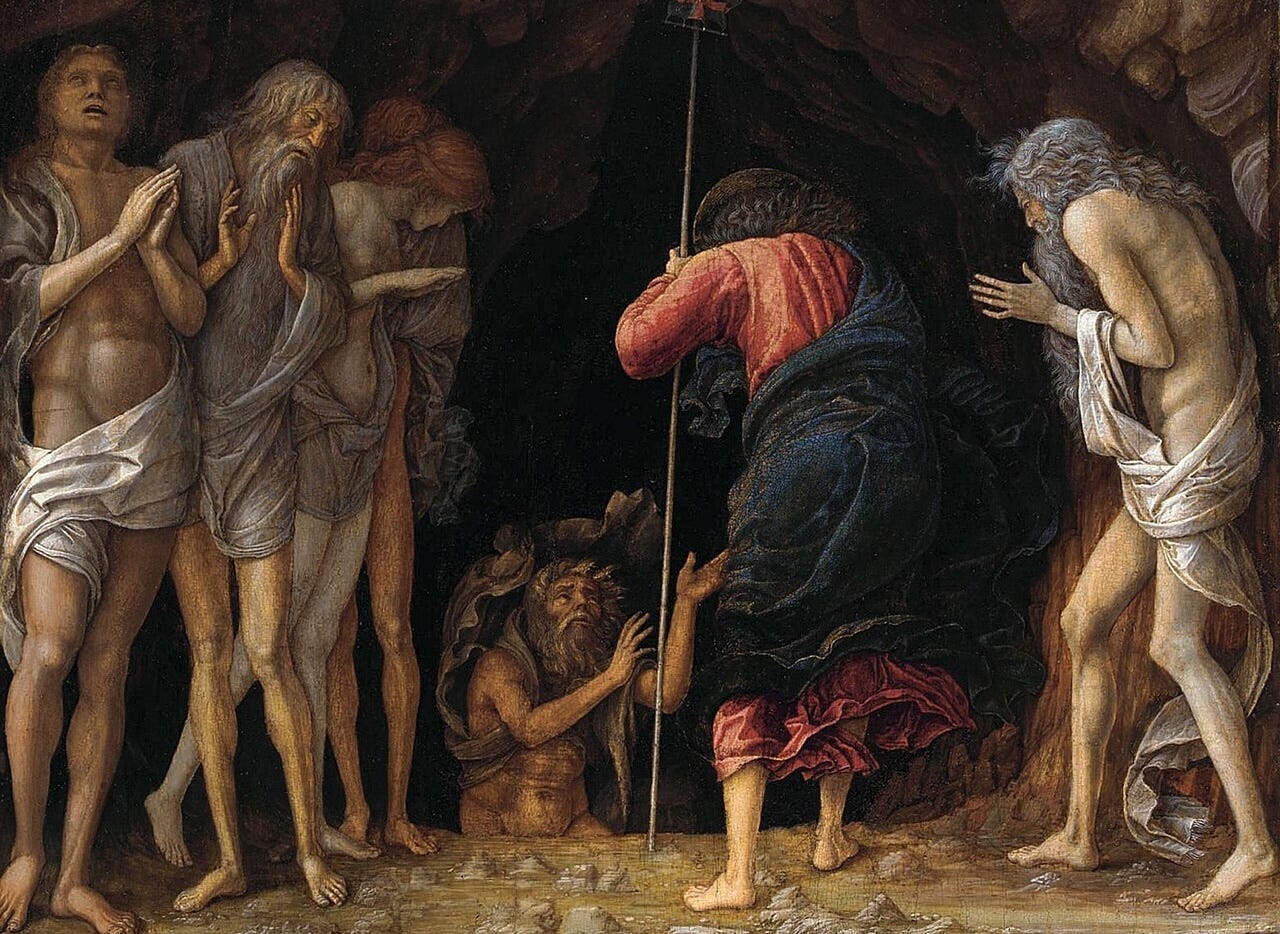
What happened when Our Lord’s soul descended to the Limbo of the Fathers? Fr Peter Gallwey presents us with a number of points to consider.
Editor’s Notes
To mark Holy Saturday, we are reproducing the reflections on the Harrowing of Hell from Fr Peter Gallwey SJ’s Watches of the Sacred Passion.
John S. Daly has said of this wonderful two-volume work:
“What a gem! Here is a book which I did not wait thirty years to read and which I warmly recommend everyone else to read as soon as possible. Admittedly these two thick volumes cover only the closing days of Our Lord’s timer on earth, but of course there is no period of His life which more richly repays study and meditation than His Passion. Fr. Gallwey has set out the book to facilitate regular meditation, but the reader can use it as he pleases. He cannot fail to acquire not only a profound knowledge of Our Lord’s sufferings and death in their minutest circumstances, but also an invaluable understanding of the lessons they must teach us. If you are ever condemned to prison and allowed only a handful of books, this would be one to insist on having! There is not a page of this book but will make every reader a better person.”
Fr Gallwey was an Irishman, and a contemporary of Fr Henry James Coleridge SJ – both men lived and worked at the Jesuit Church of Farm Street, London. The Catholic Encycopaedia says of him:
Born at Killarney, 13 Nov., 1820; d. in London, 23 Sept., 1906; one of the best-known London priests of his time. He was educated at Stonyhurst, joined the Society of Jesus at Hodder, 7 Sept., 1836, was ordained priest in 1852, and professed of four vows in 1854. As prefect of studies at Stonyhurst, 1855-1857, he made important improvements in the method of study. In 1857 he was sent to the Jesuit church in London, where — except for an interval of eight years during which he held the provincialate and other offices — he spent the rest of his life. He was a man of deep spirituality, much venerated as a preacher, spiritual director, and giver of retreats; he was also noted for his love of the poor and his earnest advocacy of almsdeeds. So great were his energy and enterprise that he set his stamp on all he undertook. Several London convents and Catholic institutions owe largely to his zeal and encouragement both their first foundation and their successful subsequent development. His writings comprise among others: “Salvage from the Wreck”, sermons preached at the funerals of some notable Catholics (1890); “Watchers of the Passion”, (1894), a series of meditations on the Passion, embodying the substance of his retreats; a number of sermons, tracts and other small publications, mostly of a topical kind.
Tomorrow, we will present his reflections on the moment of the Resurrection.
Christ in Limbo
Fr Peter Gallwey SJ
The Watches of the Sacred Passion, Vol. II, pp 590-603
Art and Book Co., London, 1896
SCENE XXI.
NEAR THE TOMB.
Station I.
He descended into Hell.
A. At the ninth hour yesterday our Lord died loving, loving to the end; giving alms by word, by incessant prayers with tears, and by every extremity of suffering. No sooner is His Blessed Soul separated from His Sacred Body than, without any break, He continues at once His work of loving and giving alms; for with infinite love He gives His angels a command concerning His Blessed Mother; and then on an errand of love long desired by His Heart, He descends into Hell, to the Limbo of the Fathers, where He has been for ages the desire of the everlasting hills (Genesis xlix.). This name given by the dying Patriarch Jacob to Jesus Christ, according to some learned commentators signifies that Christ would be the desire of the holy Patriarchs who in their sanctity out-topped the people, like hills upon the plain.
B. He descended into Hell.
He goes down then to the place called Limbo, where all the ancient saints are detained. But He is not to remain there. Thou wilt not leave My soul in Hell, nor wilt Thou suffer Thy Holy One to see corruption (Psalm xv.).
If there are also Holy Souls in Purgatory, doubtless to them also Jesus crucified brings indulgence and eternal rest.
The Prophet Zachary, who foretold the humble triumph of Palm Sunday – Behold the King will come to thee, the just and Saviour. He is poor and riding on an ass – and who also bequeathed to us the precious promise – They shall look on Me Whom they have pierced – seems also to tell us something of our Saviour’s visit to His patient servants in Limbo: Thou also by the blood of Thy Testament hast sent forth Thy prisoners out of the pit, wherein is no water. Return to the stronghold, ye prisoners of hope. I will render thee double, as I declare to-day (c. ix.). How justly may these blessed souls, who have so patiently waited for the desire of the everlasting hills, be called prisoners of hope!
They have been exiled from God’s home and their home; and now our Saviour is coming to say to them: Return to the stronghold. Come out of the land of oblivion, and take your place in the Church of Christ; not now to suffer in the Church militant, but to enter into the joy of your Lord in the Church triumphant. There I will render thee double. Yes, the long, long delay will seem but a short dream, when they are once in the house of their eternity.
C. He descended into Hell.
The words of Ecclesiasticus also may be a prophecy of this visit. I will penetrate to all the lower parts of the earth, and will behold all that sleep, and will enlighten all that hope in the Lord (c. xxiv.).
All that sleep: because the Holy Souls in Limbo are not tormented, but “sleep the sleep of peace”. But still, they are not in possession; they are only hoping and desiring. And assuredly, here on earth at least, hope that is deferred afflicteth the soul (Prov. xiii.).
The inspired writer adds: Desire when it cometh is a tree of life.
The coming of our Lord Jesus is the tree of life to these saints. Hence Jesus said to St. Dismas: This day thou shalt be with Me in Paradise. He knew that Limbo as soon as He entered there would become Paradise. For what have I in Heaven (Psalm lxxii.) better than the Lord Jesus? The Lamb is the lamp thereof (Apoc. xxi.). The Lord shall be to thee for an everlasting light, and thy God for thy glory (Isaias lx.).
D. He descended into Hell.
St. Peter also writes: Christ died once for our sins, being put to death indeed in the flesh, but enlivened in the Spirit; in which He preached to those spirits who were in prison, which had been some time incredulous (1 St. Peter iii.).
He preached to those (who) had been some time incredulous.
From these words some ancient writers inferred that certain more exemplary heathens who died without faith received the gift of faith at this visit of our Lord, and were saved. One of these writers relates that when a certain Christian had been reviling Plato, that philosopher appeared to him by night and said: “Do not revile me; for no one embraced the faith, when Christ preached to the dead, more readily than I did.”
But this opinion and this story are not accepted by our holy Doctors. St. Gregory writes: “Christ going down to Limbo only delivered those by His grace who had believed in Him to come, and in their lives adhered to His precepts.” A more common interpretation is that those some time incredulous were those who would not believe Noe’s warning that the Deluge was coming; but afterwards when it came became penitent and were saved.
He preached to those spirits: explaining to them the mystery of the Redemption.
SCENE XXII.
LIMBO.
Station I.
And Jesus having cried out with a loud voice, gave up the ghost (St. Mark xv. 37).
It is the ninth hour, the hour of the evening sacrifice, and in that same hour His Blessed Soul descends into Hell.
Of a sudden is heard the loud cry of the angels of the Lord who attend upon Him from Calvary, as knocking at the long-closed gates they say with unspeakable jubilation: Lift up your gates, O ye princes; and be ye lifted up, O eternal gates, and the King of glory shall enter in (Psalm xxiii.).
From inside, the bright spirits who have charge of the prisoners of hope, make their thrilling answer that resounds through the prison and is heard by all there: Who is the King of glory? Promptly from the outside comes the reply: The Lord Who is strong and mighty, the Lord mighty in battle (Psalm xxiii.). For the blessed legions have been watching with glad amazement how the strength, the virtus, the manliness, the ineffable power of Christ’s suffering meekness, and His Blessed Mother’s untiring compassion, baffled and conquered and crushed under foot Satan and all his rebellious spirits. Once more, therefore, they repeat their exulting challenge: Lift up your gates, O ye princes, and be ye lifted up, O eternal gates, and the King of glory shall enter in. And once again with increasing delight the angels of the prisoners cry out: Who is the King of glory? in order that all may hear the grand response: The Lord of hosts, He is the King of glory! Jesus Christ, the Eternal Son of God and the Son of the Virgin Mary, at Whose name every knee shall bow, in Heaven, on earth, and under the earth – He is the King of glory.
The devout women will be asking, at daybreak: Who will roll away the stone? for it was very great. Year by year, and age by age, the blessed angels, in their charity for the prisoners of hope, have been looking wistfully on these huge everlasting doors, and saying: Who can ever roll these barriers away? But now, no word shall be impossible with God. Instantly, in the twinkling of an eye, they are lifted up, and the King of glory, Jesus crucified, is in the midst of His prisoners of hope. And as they sink down overwhelmed with the excess of the unexpected joy, He says to them, as holy Joseph to his brethren: Be not afraid: come nearer to Me (Gen. xlv.). I am Jesus, your Brother. My Mother is your Mother. My brethren, see that it is My mouth that speaketh to you.
But, alas, alas! these are but foolish words. What can we do but again and again make use of the words St. Paul borrowed from a Prophet before him? The manner of that meeting between Jesus crucified and His prisoners, eye hath not seen. The tones of His greeting, and the music of their response, no ear on earth hath ever heard. And how the gladness crowded into that moment obliterated all remembrance of the ages of their exile and imprisonment, no heart in this world can conceive!
Station II.
He descended into Hell.
A. He that (sowed) in tears is now come to reap with infinite gladness and contentment the beginnings of His harvest.
B. He descended into Hell.
Great as is the gladness of these prisoners now that hope long delayed is changed into fulfilment, yet the gladness in the Heart of our Lord is greater inconceivably, as He says to these holy captives: “Come, ye blessed of My Father: Come, ye faithful and prudent servants: Come, ye well-tried friends, come and share the joy of your Lord and your Brother.”
C. He descended into Hell.
And now, helped by the grace of the Holy Spirit, we may in contemplation try to conjecture what manner of special greeting He has for each of those who had been most faithful and devoted. With what words of love, for instance, does He now in one moment give back to St. Joseph a thousand-fold for all the fidelity with which he guarded the family of God committed to him, and acted as the proxy of the Eternal Father!
D. He descended into Hell.
Star differeth from star, St. Paul writes (1 Cor. xv.). So now, also, no two saints in all this company have the same joy poured into them. In each one our Lord creates a new heart; and the gladness of one heart, though like, is still different from the gladness of another.
The martyred Precursor has his own full outpouring of love. Abraham and Isaac and the chaste Patriarch Joseph, and each of the Prophets slain in Jerusalem, all become at once wonderful images and counterparts of Christ Jesus, yet each with his own individual glory. What word of special welcome has our Saviour for the faithful mother of the seven martyrs, for Judith, and for Esther, the types of Holy Mary? for His own St. Anne, and for Elizabeth, the holy mother of His Precursor? And what manner of tenderness has He ready for the patient suffering of holy Job and the faithful charity of Tobias?
E. He descended into Hell.
Then, a little while, and suddenly into the prison of hope, now changed into a Paradise, is ushered by the crowd of blessed angels, their new companion, the first-born on Calvary, the first child of the new family of the second Eve, the penitent and purified and sanctified soul of Dismas, washed in the Blood of the Lamb. Oh, wonder! Our Blessed Lord’s gratitude to Dismas for having pleaded for Him is greater beyond measure than the redeemed Saint’s thanksgiving to his Redeemer.
F. He descended into Hell.
But among all the vast gathering of the Blessed here to-day, there are two on whom all eyes are fixed: our first father, Adam, and our mother, Eve. They have a reason beyond all the rest to lie absorbed in grateful adoration, saying: “We adore Thee, O Christ, and we bless Thee; because by Thy Death Thou hast undone the evil wrought by us, and hast redeemed the world.”
SCENE XXIII.
PARADISE ON CALVARY.
Station I.
Thou hast sent forth the prisoners out of the pit (Zach. ix. 11).
How long does the Soul of Christ tarry in Limbo? Some commentators answer, only an instant, and straightway leads out the prisoners of hope. Others argue from the words: So shall the Son of Man be in the heart of the earth three days and three nights (St. Matt. xii.), that the Most Holy Soul remains in Limbo till near the moment of the Resurrection. But the argument does not seem weighty, as these words may be sufficiently verified by the fact that the Sacred Body remained buried till the third day. We are therefore free, in contemplation, to assume that it is at the Sacred Tomb that our Blessed Saviour, in part at least, preaches to the Holy Spirits, explaining to them as they gaze on the crucified Body, and also on the second Eve, the desolate Mother, the Admirable Mother, the Mother of God, and Mother of men, how grace and salvation has been won for the fallen race.
Station II.
Thou hast sent forth the prisoners out of the pit (v. 11).
A. The third day then is come, and the prophecy must be fulfilled: Three days and three nights the Son of Man shall be in the heart of the earth.
Three days and three nights! If this be so, our cold-hearted human wisdom will calculate, not till the ninth hour of the second day of the week can the Resurrection take place. But there is a power at work strong enough to upset all human calculations.
To Daniel, the Blessed Virgin’s Archangel, Gabriel, said of old: I am come to show it to thee, because thou art a man of desires, (that) seventy weeks are shortened upon thy (captive) people (Daniel ix.). The soul of this man of desires is present now, yearning with a longing that he never felt on earth, that the Resurrection may come speedily. But Daniel is only one of the gathering of Holy Souls from Limbo; and the blessed angels from Heaven who are gazing on the Body of the second Adam and the bruised heart of the second Eve, are all consumed with a longing that justice may be done quickly to the Sacred Body and to the separated Soul which are awaiting their reunion. God joined these two together, and no other power had right to sever them. Love alone, Infinite love, above all law, broke the sacred bonds, and in death they are divided.
B. Thou hast sent forth the prisoners.
And then, too, all the immense choir of Blessed Spirits are pleading with an irresistible concord for justice to the bruised heart of the Immaculate Mother, who, with the Eternal Father, so loved the world that she gave her only Son for man’s redemption.
C. Thou hast sent forth the prisoners.
Add to this longing for justice to their King their own bereavement. They cannot be at rest till they possess Him; and, if they may not yet have their Queen also, till at least they see her consoled ineffably. Thou wilt arise (O God), is their cry, and have mercy on Sion; for it is time to have mercy on it, for the time is come (Psalm ci.). “If we may not yet possess our Queen, it is time that we be allowed to look on the face of Thy Christ, our Lord, our Redeemer, our King, our God.”
Station III.
There stood by the Cross of Jesus, His Mother (St. John xix. 25).
But there is a cry going up to the throne of the Eternal Trinity more powerful than this stupendous supplication of all the choirs of angels and all the liberated just. Ever since that ninth hour, wherever she bent her steps, the Immaculate Heart of the Mother of Sorrows has been, with groanings unspeakable, pleading that the Holy Soul and Sacred Body, which had paid a debt they did not owe, and been afflicted by a parting so cruel and so undeserved, may be most speedily brought together again.
Once before, the Lord Jesus said to the Blessed Woman of desires: Woman, My hour is not come (St. John ii.): and yet her will prevailed, and it was done according to her wish, for her grateful God never forgets the hour when she said: Be it done unto me according to Thy word. Now, therefore, when her heart cries out: “O God, O Lord, O my Son Jesus, incline unto my aid, make haste to help me; O Lord, hearken, and do; delay not for Thy own sake,” He answers: Mother, My hour is not come; but all the while He does not forget His promise: No word shall be impossible with God, now that the second Eve is become My Mother. And the adorable Trinity, in their wisdom and loving charity, see how the hours can be abbreviated and truth remain undamaged.
Now, therefore, as has been said, for His own sake, for the sake of His Divine Son made Man, for the sake of the Blessed Mother of God, for the sake of the expecting saints and angels, for the sake of the afflicted Church on earth, the days are shortened, as far as may be consistently with the due fulfilment of prophecy. The Vesper hours of Good Friday, from the ninth hour to sundown, are accepted as one day. The Great Sabbath is the second. And now the hours from the end of the Sabbath to the beginning of the early twilight of the first day after the Sabbath, are admitted as the third day.
Station IV.
Return to the stronghold, ye prisoners of hope. I will render thee double (Zach. ix. 12).
A. Ye prisoners of hope.
The Holy Souls, then, released from Limbo, and all the choirs of angels, are now around their Queen, near the glorious Sepulchre. We have a saying that “coming events cast their shadows before.” In this hour, it is not a shadow that is the harbinger, but a growing hope, and a joy becoming every moment more intense. The hour of suspense is a heavenly day-dawn such as this world has never seen, preparing the way for a glorious sunburst such as angels or men have never conceived.
To the soul of Holy Mary her Archangel is sent to whisper the message: Yet a little and a very little while, and He that is to come will come, and will not delay (Hebrews x.). Meanwhile we may in our poor way contemplate these hoping and expecting and desiring saints and angels, whose eyes are ever turning to the Mother of God, to learn of her what they are to wish, and what to do. If we may use a human word, she is the leader, and ruler, and precentor of this vast and glorious choir which the Eternal God has prepared for Himself and His own home.
Holy writers assume that at the Resurrection, angels and the liberated souls are visible to our Lady.
B. Prisoners of hope.
What, then, are the thoughts of this expecting company which no man can number?
As we have already seen, one dominant thought is an intense longing that the hours be abbreviated.
But besides this, we know enough from revelation to be able to penetrate a little more behind the veil that hides these blessed choirs from the eyes of this world. The recording angels have, without failing for one moment, kept most diligently an exact register of every deed, every word, every thought of Jesus, God made Man, from His conception to the ninth hour, when He bowed His head and died. Not for one moment have they slumbered or slept over this task of love and joy. Now all the blessed spirits know, and they remind one another of it, that His own teaching was that not even one cup of cold water given as an alms shall lose its reward.
What manner of reward, then, they ask, in transport of reverent wonder and delight, will the adorable Trinity create for all the works of the Lord Jesus? For all His words and thoughts while on earth are, not only an almsgiving, and an almsgiving of that kind which is most precious, the almsgiving that costs much, but also an almsgiving raised to an infinite value by the love that burns in the Heart of Jesus, God made Man, And God, Who is the true Father, the good Father, the most loving Father of all this large family of His children, is not displeased at their holding happy counsel together on this question. Let the just feast and rejoice before God, and be delighted with gladness (Psalm lxvii.). And so they consider in detail what shape and form of recompense will have been planned in the eternal counsels of their God, for the Son of Man, Christ Jesus.
We read how King Assuerus, when he was enduring a night without sleep, commanded the chronicles of his reign to be brought to him, that they might help to pass the weary hours. There, on a page long overlooked, they read for him how Mardochai, the Jew, had saved his life from traitors. What honour and reward, he asked, hath Mardochai received for this fidelity? His servants answered: He hath received no reward at all. He called therefore his chancellor, Aman, and put this question to him: What ought to be done to the man whom the King is desirous to honour? (Esther vi.).
This is precisely the question that occupies this vast assembly of the blessed now, and the question which the Eternal Trinity wish them to meditate.
We too are permitted, in our poor contemplation, to consider in our hearts the same question: What ought to be done to our Redeemer, the Lord Jesus crucified, Whom our God is desirous to honour? What reward do we wish Him to have?
C. Prisoners of hope.
Leaving aside, then, that immense record of His thirty-three years on earth, which the whole world could not contain: “What manner of recompense,” the blessed saints and angels are wondering, “will be given to our King even for His last night and His last day on earth?”
The Eternal Father has, if we may use our human language, through ages that had no beginning, been meditating on this same question: What shall I give (My Son) for all He hath given to Me? (Psalm cxv.).
“If the cup of cold water is to have a lavish reward,” the Cherubim and Seraphim argue, “what shall be given for each drop of His own life-blood?” “We have numbered,” the recording angels say, “most faithfully, all these wounds upon His Body; in what way, think you, will each of them be made good and compensated with ample measure, flowing over?”
“And all those times when He fell down helpless!”
Perhaps even we here on earth know already something of the way in which this weary exhaustion is to be made right. For we see in the great mystery of His existence in the Blessed Eucharist, how His Sacred Body which was on the Way of Sorrow so powerless, henceforth can be in every corner of the world at the same moment.
“Blessed be the Holy and Undivided Trinity, that has planned this recompense for this lifeless and motionless Body.”
“What,” asks one, “shall be the joy and delight given to His eyes for every tear they shed?” “Yes,” another adds, “and for the charity of His eyes? and for the reverence also of His eyes when closed in prayer?”
“And can any one conjecture what can be done to glorify His sacred mouth for every word He spoke, and for His admirable silence? For not one word spoken nor one word meekly held back can pass away without its eternal recompense.”
“And what kind of delight will be created to make compensation for His thirst?”
“And His sacred feet that were so weary, and yet so untiring! and His hands, ever open to bless and to give! Even if the nails had never passed through these feet or hands, what can be thought of to pay all that they have earned?”
“But above all, His Sacred Heart that loved with a boundless love from the moment of His conception till He expired! What new kind of honour have the adorable Trinity planned to make up to It for all Its sorrows and the sorrows of His Ever-Blessed Mother?”
“Then besides, what think you will be done as a recompense for the gratitude of His Heart? for the meekness of His Heart? for the humility of His Heart? and for the never-ceasing obedience of His loving Heart?”
What can be done? “O Lord, our God, Thou knowest. It is well: for we know not.” And then, that last wrench of separation which parted the Sacred Body and the Holy Soul! O mystery! How shall that parting ever be made up to both?
D. Prisoners of hope.
So do they wonder and contemplate, and they turn their eyes to the Blessed Mother.
But here, instead of finding help, they have to begin again a new range of wonder and calculation. For is it not written: According to the multitude of My sorrows, Thy comforts have given joy to My Soul (Psalm xciii.). If her sorrows have been great as the ocean, how will her heart be enlarged to hold the joy in store for her? O Lord our God, Thou knowest. Blessed be our God. He is faithful in all His words and holy in all His works. The eyes of all hope in Thee, O Lord (Psalm cxliv.).
Thus do the blessed spirits muse in boundless gladness in presence of their God; and the Blessed Mother, united with them, is from the depths of her heart crying out: Come, Lord Jesus (Apoc. xxii.); and her cry prevails.
E. Prisoners of hope.
But first, the Holy Spirit breathing where He wills, sweetly whispers into her soul, as to the precentor of the heavenly choir, the answer to all their musings, and at the same moment inclines them too to take up from her the new anthem which answers their own manifold questions. Beginning, then, with the Ever-Blessed Mother of God, and rising sweetly and solemnly, and “full and loud, and most becoming,” from this vast choir, the new canticle is on a sudden heard: Worthy is the Lamb that was slain to receive power, and divinity, and wisdom, and strength, and honour, and glory, and benediction (Apoc. v.). And in that hour, with a full comprehension, they grasp the special reasons for every word in that glorious and unanimous verdict.
Power He shall have, because He was so helpless and so subject.
Divinity must burst forth in a perfect revelation, because His aspect was so hidden, and He was known only as a Man, and as a Man of Sorrows – a worm and no Man.
Wisdom must shine as the sunlight, because He was mocked as a fool.
Strength shall beyond measure be multiplied, because He lay down powerless upon the ground, and became as a Man without help.
Honour shall be His, because He was glutted with reproaches; and glory He shall have, because as the sinner He endured all shame.
Yes, and Benediction! Blessing be for ever to His Name above all names, for He was hooted by His people whom He loved.
F. Prisoners of hope.
And now the heart of the Blessed Mother with supreme earnestness cries out: Arise, O my glory. O Lord, make haste to help me. Arise, my Son, and have mercy on Sion, for the time is come to have mercy on it.
With one heart they respond, “Amen, amen.”
Read Next:

HELP KEEP THE WM REVIEW ONLINE WITH WM+!
As we expand The WM Review we would like to keep providing free articles for everyone.
Our work takes a lot of time and effort to produce. If you have benefitted from it please do consider supporting us financially.
A subscription gets you access to our exclusive WM+ material, and helps ensure that we can keep writing and sharing free material for all.
You can see what readers are saying over at our Testimonials page.
And you can visit The WM Review Shop for our ‘Lovely Mugs’ and more.
(We make our WM+ material freely available to clergy, priests and seminarians upon request. Please subscribe and reply to the email if this applies to you.)
Subscribe to WM+ now to make sure you always receive our material. Thank you!
Follow on Twitter, YouTube and Telegram:
Twitter (The WM Review)
Wondering how well Mel Gibson’s upcoming movie will be able to depict all this. I have high hopes.