

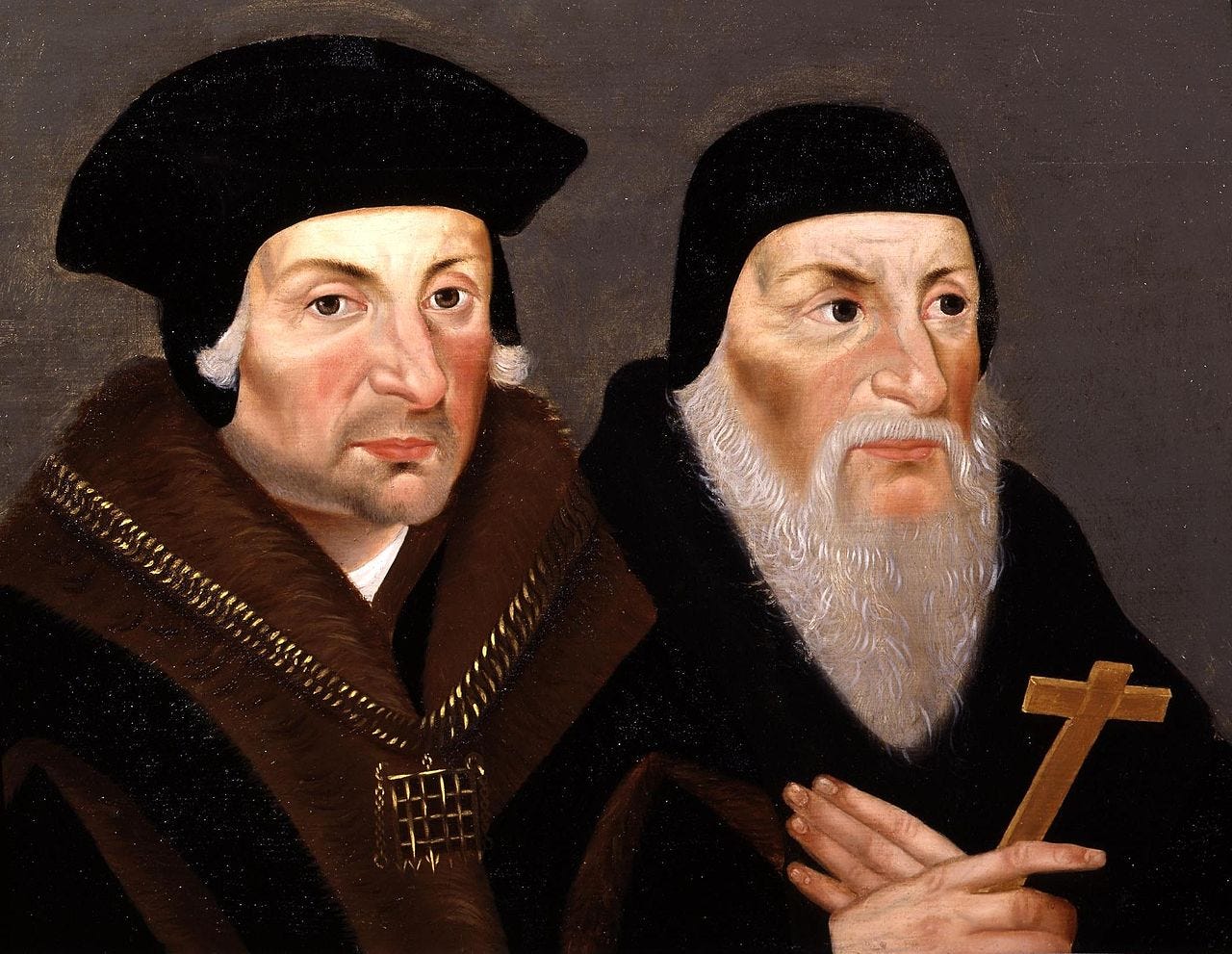
‘I wish he better understood Fr. Cekada’s arguments and addressed them’, was a response to Hudson’s previous study on the ‘una cum’ question. Here is his response.
Editor’s Notes
In the summer of 2025, The WM Review published three articles about the question of the so-called “una cum Mass”. Needless to say, this was (and is) a highly controversial topic.
The debate revolves around the legitimacy – or otherwise – of attending the Masses, and receiving the sacraments, from priests who name the post-conciliar claimants to the Papacy when they offer Mass.
But while it is a controversial topic, it is also an important topic, affecting lay Catholics throughout the world. As I wrote in the introduction to the first of those articles, by Michael Hudson:
“We all agree that some Masses must be avoided. In a crisis like ours, each Catholic needs to form his own conclusions on these matters, and to act on them. However, it is necessary that we be realistic about the consequences of such a decision, wherever one draws the line.
“We must acknowledge that the deprivation of the sacraments comes with serious risks and dangers – even when this occurs for proper, unavoidable reasons.
“As a result, we should be on our guard in such discussions, and scrutinize the arguments presented to us very carefully.”
Fr Okerulu’s invitation
Following the publication of Hudson’s article engaging with the “strict NUC position” – that lay “sedevacantists” may not attend Masses offered by “sedeplenist” priests, or receive the sacraments from them – Fr John Okerulu, a member of the Salesian Sacerdotal Society ministering in Nigeria, criticised the author for failing to address “the most authoritative study to date”, namely Fr Anthony Cekada’s ‘The Grain of Incense’.
“The Hudson article examined the question of sedevacantist attendance at an ‘una cum’ Mass without reference to the most authoritative study to date on the subject, Fr. Cekada’s ‘Grain of Incense’ article. For this reason, his article fails to address the crux of Fr. Cekada’s argument, framing the issue instead as one cooperation with the personal sin of the celebrating priest. With this erroneous reduction, he brilliantly applies moral principles and distinctions to argue one may attend such a Mass without sinning by cooperation.
“I wish he better understood Fr. Cekada’s arguments and addressed them.”
His explanation of Fr Cekada’s article is available here:


In response to this criticism – which might also be interpreted as a challenge to engage with Fr Cekada’s paper, or even an invitation – Hudson said the following:
“The purpose of my article was to critique the positions and policies of the ICR, not Fr. Cekada’s arguments. I may do so in an exhaustive manner at a future date.”
What follows is an executive summary of Michael Hudson’s Cum Grano Salis – his response to Fr Okerulu’s tacit invitation.
Given the gravity of what the “strict NUC position” requires of “sedevacantist” laity, we have a right to be sure that it is based upon cogent and certain grounds. It is to this end that Cum Grano Salis examines each authority cited by Fr Cekada, presenting them in their wider context, and their force examined.
Such a project necessarily takes many more words than the original citations – which is why the study runs to nearly 59,000 words (150 pages).
Some comments
First, after publishing those articles in 2025, I was taken to task for stating that the “strict NUC (non-una cum) position” is “among the most formidable” obstacles to consideration of the “Pope Question”.
This comment is clear in itself; and even if it was not, the context would have made it so. I believe that the statement is true regardless of whether the “NUC position” is true or false. It is based on my experience of talking with “sedeplenists” over many years, and it does not, in itself, exclude the idea that the “NUC position” is true. Still less does it indicate anything about those who adopt this position.
Next, Hudson’s study is focused specifically on the question of the “una cum Mass” itself – without direct regard for the fact that many such Masses are offered by men ordained in the Novus Ordo rites of Paul VI. As established elsewhere, the validity of such men’s orders is at least subject to doubt. Further, even if the minister offering the Mass has been validly ordained, there may be other reasons which make attending his Mass impossible.
Finally, it is important to acknowledge that the advocates of the “strict NUC position” have understandable reasons for not wanting the faithful to attend “una cum Masses”. This position is held by some of the most zealous and hard-working clergy today. I have agreed to publish this executive summary, hoping that good will and Christian charity can continue in spite of disagreements about a matter as serious as this one. As Hudson himself wrote in the previous essay:
“No ill-will or malicious intent is meant towards those so mentioned in this analysis […] If any errors are present in this article, we wish to have them pointed out to us so that they may be corrected.”
S.D.Wr.
The editors of the The WM Review do not necessarily endorse all views or modes of expression in external submissions, and welcome serious responses to Hudson’s paper.
Cum Grano Salis – A Critique of Fr. Cekada’s Position on the ‘Una Cum’ Question
Executive Summary
Michael Hudson
Introduction
This is an executive summary of my study “Cum grano salis: A Critique of Fr. Cekada’s Position on the “Una Cum” Question.” The study is around 150 pages long, and divided into three parts.
Rev. Anthony Cekada (d. 2020) wrote three articles on the subject of the so-called “una cum Mass” (hereafter “UCM”). He argued that it is absolutely forbidden, under pain of mortal sin, to in any way actively assist or take part in a Mass1 at which the celebrant prays for the man currently occupying the Apostolic See materialiter as “Thy servant, our Pope” in the first prayer of the Canon, the Te igitur.2 In addition, he also argued that a priest is obliged to refuse the Sacraments to those who attend the UCM,3 and drew a variety of other related conclusions. (E.g., that one could not adore the Blessed Sacrament while an UCM was being said,4 that one could not receive Viaticum if the Host were consecrated at an UCM,5 etc.)
‘Part I: The Grain of Incense’.
The fundamental claim supporting these arguments is as follows: those who participate in a public act of religious worship give a quasi-approbation of the exercise of worship, and consequently implicitly consent to all that is said and done by the one leading the worship.
From this, he concludes that ten crimes and/or sins are to be morally imputed to those who participate in such a Mass. We can reduce the ten to these seven:
Pernicious lying
Forbidden communication in sacris with heretics
Implicitly professing a false religion
Disobeying the legislative authority of the Church in Her regulation of divine worship
Recognizing a usurper of an ecclesiastical office
Giving scandal
Implicitly committing the sin of schism.
These could be further reduced to three sins contrary to three distinct virtues:
Faith
Justice
Charity.
One can easily see that, if this were true, those who attend the UCM would be by that very fact heretics, schismatics, and consequently separated from Christ and His Church – and, additionally, bound to make restitution for their acts.
However, the citations provided by Fr. Cekada to substantiate these claims fail to establish them as certain. He also overlooks the following:
It is sometimes licit to dissimulate about what is in one’s own mind6
It is not always and in all circumstances forbidden to communicate in sacris with heretics7
The judgement of prudent persons and the common estimation of men is to be considered when affirming that a given action constitutes an implicit denial of the faith8
It is not so certain that there is a universal obligation to omit the names of all unsentenced heretics and undeclared excommunicates from the diptychs of the living (viz. where the “una cum” clause appears)9
It is not so certain that the man currently occupying the Apostolic See materialiter is, properly speaking, a “usurper”10
It is sometimes legitimate to give scandal indirectly to others, or to permit them to take scandal at one’s otherwise blameless conduct11
It is not necessarily a schismatic act to recognize mistakenly someone as Pope, who in fact is not.12
Each case must be evaluated separately with its own particular, complex set of circumstances, and no absolute rule can be laid down for all. All of this is addressed in depth in Part I.
In addition, the central claim that “presence equals consent” is not only oversimplifying the matter, but also relies upon citations which are of questionable relevance, and an objective misrepresentation13 of the writings of the Fathers and the decrees of the Roman Congregations. Fr. Cekada also implicitly concedes that his principle is not universal or absolute and admits of exceptions, since he claims that one is not bound under pain of sin to avoid the Mass of a priest who violates the preceptive rubrics of the Missal through inadvertence or error.14
Furthermore, if his claim is to be taken to its logical conclusion, it would lead many if not most Catholics to become stay-at-home Catholics or “home aloners,” since one could never tolerate a priest saying or doing something materially wrong during the course of the Mass – for example:
A “sacramental bishop” commemorating himself in the Te igitur
A priest using rubrics that have been superseded by subsequent reforms, (i.e., disregarding feasts that are part of the universal calendar, omitting the Leonine Prayers, etc.).
Evidently this would be a species of rigorism and scrupulosity, and those who accept the claim, and yet continue to tolerate these other disagreeable practices find themselves involved in inconsistency (“a sure sign of error”) or even, if they advert to the matter, hypocrisy.
Further, the theoretical conclusion to be drawn from Fr Cekada’s arguments, taken as a whole, is that the true Church of Jesus Christ, which is necessarily visible, visibly lacked for a time acceptable worship and a pleasing sacrifice productive of grace.15 This conclusion is heretical, since a visible, acceptable, pleasing and efficacious Sacrifice is essential to Her existence.16 St. Paul said, “You shall shew the death of the Lord, until he come.”17
Calling this conclusion “heretical” is not meant to insinuate in any way that those who hold to the strict “non una cum“ view are themselves heretics; rather it is to say that, in the opinion of the present author, the necessary conclusion of this view is, in the theoretical order, contrary to faith.
Fr. Francesco Ricossa of the IMBC18 and Frs. Nicolás Despósito19 and Damien Dutertre20 of the ICR have attempted to answer the objections to this conclusion, but in the estimation of the present author, these answers are unsatisfactory, for they either focus on subjective innocence and the moral impossibility of knowing that the Roman See was formally vacant until the late 1960s (which does not affect the objective nature of the act, in their system), or on the suppliance of a canonical delegation due to common error (which does not address the chief difficulties of the objections).
Part II: ‘An Ex-Sede, the Motu Mass and Refusing Sacraments’
As far as denying the Sacraments to those who hold and act upon the contrary opinion, Fr. Cekada does not establish a substantial difference between the policy he advocates and that of the SSPV which he criticized, and even refuted in a debate with Fr William Jenkins in 2002.21 Both positions fail to respect the requirements of moral theology and canon law for the denial of sacraments; both effectively amount to a usurpation of authority by binding the consciences of others; and both end in treating those who disagree as if they were guilty of grave public sin and even non-Catholics, all of which is gravely unjust. All of this is addressed in depth in Part II.
Part III: Mass in Union with the ‘Pirate Pope’: Some Questions
Finally, Fr. Cekada’s claims regarding Eucharistic adoration, receiving Holy Viaticum, etc. end in being stricter than some theologians were with regard to visiting the churches of heretics and schismatics and receiving the Sacraments from them in danger of death. All of this is addressed in depth in Part III, which also discusses the subject of public prayers being offered for non-Catholic civil rulers.
In this part, we see that his arguments are not established as certain from his premises, authorities or historical analogies. Instead of being a self-evident application of general principles to particular facts, it instead amounts to the imposition of an arbitrary law by private authority. But as St James wrote:
“There is one lawgiver, and judge, that is able to destroy and to deliver. But who art thou that judgest thy neighbour?” (Jas iv. 12, 13)22
All of this is demonstrated in the analysis which we give below. We will reproduce here part of the conclusion:
“Although cases could be envisioned in which a Catholic would be obliged to avoid another Catholic in matters of divine worship, it cannot be said that in all cases are they obliged to avoid Masses during the course of which the celebrant prays for Prevost and the local Conciliar bishop as ‘Thy servant, our Pope Leo’ and ‘our Bishop,’ respectively.
“It is up to the prudent estimation of the faithful to determine if the circumstances warrant dissimulation, permitting others to take scandal, as well as material cooperation in the wrongdoing of others. No absolute prohibition has been issued by any competent authority against communicating in sacris with sedeplenist clergy, nor have they been condemned by name or declared excommunicated as ones to be avoided, nor have they given their names to a non-Catholic sect known and condemned as such by the authority of the Church, nor are they (in all cases) commissioned by a false sect to act in its name as its ministers.”
The full study is available here:
Cum grano salis: A Critique of Fr. Cekada’s Position on the “Una Cum” Question
HELP KEEP THE WM REVIEW ONLINE WITH WM+!
As we expand The WM Review we would like to keep providing free articles for everyone.
Our work takes a lot of time and effort to produce. If you have benefitted from it please do consider supporting us financially.
A subscription gets you access to our exclusive WM+ material, and helps ensure that we can keep writing and sharing free material for all.
You can see what readers are saying over at our Testimonials page.
And you can visit The WM Review Shop for our ‘Lovely Mugs’ and more.
(We make our WM+ material freely available to clergy, priests and seminarians upon request. Please subscribe and reply to the email if this applies to you.)
Subscribe to WM+ now to make sure you always receive our material. Thank you!
Read Next:


Follow us elsewhere:
Twitter (The WM Review)
We are assuming for the sake of this discussion that the celebrant is validly ordained and that he observes the essential rite necessary for validity in the celebration of Mass. The issue of doubtful or invalid Masses is broader than our specific topic and will not be considered here.
Fr Cekada wrote:
“Since you know he’s not the pope, this is sinful.”
“Fr. Romanus was obliged to refuse the sacraments to Titus.”
See: https://www.fathercekada.com/2008/06/24/an-ex-sede-the-motu-mass-and-refusing-sacraments/
“It would be wrong [to make a visit to the Blessed Sacrament while a ‘una cum’ Mass is being said] because during Mass such an act connotes active participation.”
See: https://www.fathercekada.com/2017/09/20/some-questions-on-una-cum-masses/
“Yes [it is wrong] — it has been consecrated in a rite that — because it professes communion with a public heretic and proclaims him a preacher of the Catholic faith — is objectively sinful.”
Ibid.
Fr Cekada cites the Dominican moral theologian Merkelbach as follows:
“The gravest of all lies is one that harms God in a matter concerning religion.… The pernicious lie is a mortal sin by its very nature due to the evil attached to it, either because of its matter, if it concerns religious doctrine… or because of its end, if it is uttered to the injury of God or to the notable harm of neighbor.”
From Cum Grano Salis:
The specific vice we are concerned with here is a defect of veracity, i.e. lying, which he defines as “speech against one’s own mind (locutio contra mentem).” “Speech” here refers to external speech, meaning any external sign which manifests our mind; “against our own mind” means external speech “which proceeds from the intention of stating what is false (quae procedit ex intentione falsum enuntiandi),” i.e. as contrary to what we hold to be true in our own mind. The intention of deceiving is implicitly included, being the proper effect of a lie, but no explicit intention to deceive is necessary for the sin of lying to be committed.
There are three kinds of lies: officious, jocose and pernicious. The pernicious lie is the one which concerns us here, which Merkelbach defines as a lie “told for the sake of inflicting special harm (prout fit causa specialis nocumenti inferendi).”
The specific kind of pernicious lie we are concerned with is the lie which harms God in a matter of religion, which Merkelbach calls “the most grave of all (omnium gravissimum).” This is due both to the matter, viz.“a matter of religious doctrine (doctrina religionis),” and the end, viz. “in injury of God (in iniuriam Dei).” Since the supposed “lie” in question is being effected by deed rather than by the spoken or written word, it would not be lying strictly so called, but rather simulation. Formal simulation “is a lie by deeds, whereby someone by external actions intends to signify something other than what he has in mind (est mendacium per facta, quo quis per actiones externas aliud intendit significare quam habet in mente),” while material simulation “is dissimulation, or an ambiguous action directed to concealing the truth, which is lawful from a just cause, whenever others can gather from the circumstances the mind of the one dissimulating (est dissimulatio seu actio ambigua ad celandam veritatem, quae licita est ex iusta causa, semper ac alii ex adiunctis colligere possunt mentem dissimulantis).”
If a person does not intend to deceive anyone into believing that he agrees with the celebrant’s commemoration of Prevost by attending an “una cum Mass,” despite it being ordinarily presumed that he consents to all that is said and done by the celebrant during the course of the Mass, then he is not guilty of formal simulation. He has just cause, viz. “an honest end directed to preserving goods useful to the spirit or body (est finis honestus ad servanda bona spiritui vel corpori utilia),” for attending (i.e., to participate in the Sacrifice, to receive the fruits of Mass, to receive Holy Communion, etc.), his action is ambiguous (actively participating primarily signifies concurrence in the offering of the Sacrifice, only secondarily is it presumed by custom that consent is given to all of the parts of the surrounding ceremonies) and it can be gathered from the circumstances that he does not agree with the commemoration.
As far as whether or not Prevost is formally the Pope, this is not properly speaking a matter of religious doctrine, nor does the one who dissimulates about the matter by attending an “una cum Mass” intend to inflict special harm on God. Firstly, because the status of Prevost is not directly a matter of faith and morals, but rather a certain theological conclusion dependent on contingent facts, and secondly, because no one can be credibly believed to intend to do harm to God’s honor by tolerating a mistake on the part of the celebrant in order to participate in the Sacrifice.
From the full study:
As far as forbidden communication in sacris with heretics is concerned, Fr. Cekada argues that the attendant congregation put themselves in communion with a heretic by the very fact that they actively participate in the Mass. To prove this, he draws an analogy from the Acacian schism and the Formula of Pope St. Hormisdas.
After giving an account of the history of the Acacian schism and the formula, the study concludes:
The purpose of this historical digression is to contrast the difference between the Acacian schism and the crisis of authority we presently find ourselves in. On one hand, the persons who were being commemorated in the diptychs during the Acacian schism were excommunicated, deposed and anathematized by the Pope himself. He positively forbade their names to be uttered in the sacred mysteries, even excommunicating his own legates for communicating at a liturgy which violated this prohibition. On the other hand, Prevost and the Conciliar bishops have neither been excommunicated nor deposed by competent authority, and no positive prohibition from the same has forbidden that they be commemorated by name in the liturgy. The cases are, therefore, not equivalent.
So, too, the priests who commemorated sentenced heretics during the Acacian schism differ from the priests who commemorate unsentenced heretics during the present crisis of authority: those during the schism were Eutychians or monophysites that rejected the teaching of the Ecumenical Council of Chalcedon and were condemned by the Pope as a sect, whilst those during the present crisis of authority are traditionalists mistaken about the status of Prevost and the Conciliar bishops and have not been condemned by competent authority as a false sect. One group are non-Catholics, the other are Catholics, and we are permitted to communicate in divinis with Catholics, even if the same Catholics mistakenly communicate in divinis with a person whom they suppose to be a Catholic and whom we consider to be a non-Catholic.
See also the following articles by John Daly:
From the full study:
As far as implicitly professing a false religion is concerned, Fr. Cekada argues that the attendant congregation profess communion with the “ecumenical, One-World church” and consequently profess the false faith of this entity. To prove this, he cites Merkelbach’s Summa Theologiae Moralis, where he discusses the external act of faith and the vices opposed to it as well as a comment of Abp. Marcel Lefebvre, FSSPX after his suspension a divinis by Paul VI in 1976 for ordaining priests and deacons without dimissorial letters from their Ordinary or a valid canonical title.
After explaining the affirmative and negative precept of confessing the faith, and the importance which Merkelbach places on the circumstances and “the common estimation” of men, we conclude:
Firstly, the status of Prevost and the local Conciliar bishop is not a matter of divine and Catholic faith, so it cannot pertain directly to the external act of faith. It is a certain theological conclusion dependent on contingent facts, as was already said.
Secondly, the examples given (the Calvinist supper, the Jewish rite of circumcision, praying or singing together with the enemies of the Church, etc.) all refer to false worship, in particular heretical worship. Fr. Cekada frequently uses the burning of a grain of incense before a pagan idol as an example. There is no equivalence between these things and a Catholic liturgical rite during the course of which the minister mistakenly signifies something factually incorrect, viz. that Prevost is a member of the Church and formally the true and legitimate Roman Pontiff.
As we saw before, there is a kind of ambiguity in what the assisting faithful are exactly consenting to by their presence. It is up to prudent judgment to determine whether or not a proportionate reason justifies dissimulation in this instance.
The primary reason why there is no equivalence is that actively participating in a Mass during the course of which the celebrant prays for Prevost is not, on account of the circumstances, commonly estimated to indicate that one confesses the false faith of the conciliar church. Rev. Robert Parsons, S.J., whose text we will be reproducing and commenting on in the third part, says, “For what doth make a thing to be a proper and peculiar sign, but the judgment and opinion of men?”
Only those who agree with the arguments presented in this article and those like it, who constitute a very small minority of men, hold to this view.
E.g., Canon 10 of the Fourth Ecumenical Council of Constantinople says:
As divine scripture clearly proclaims, Do not find fault before you investigate, and understand first and then find fault, and does our law judge a person without first giving him a hearing and learning what he does? Consequently this holy and universal synod justly and fittingly declares and lays down (definit et statuit) that no lay person or monk or cleric should separate himself from communion (a communione se separet) with his own patriarch before a careful enquiry and judgment in synod (diligentem examinationem et synodicam sententiam), even if he alleges that he knows of some crime perpetrated by his patriarch, and he must not refuse to include his patriarch’s name during the divine mysteries or offices (licet criminalem quamlibet causam eius se nosse praetendat, sed neque recuset nomen ipsius referre inter divina mysteria vel officia).
From the full study:
“In the case of Prevost and the Conciliar bishops, in addition to the absence of a judicial process with regard to their alleged heresy and excommunication, there is at least common error of fact with regard to their having a title to the offices they occupy. In addition, those who adhere to the Thesis of Cassiciacum hold that Prevost has been validly elected to the Roman See, as well as the Conciliar bishops with respect to their diocesan bishoprics, therefore they are not properly speaking usurpers or intruders, but rather the lawful occupants.”
Merkelbach says that we are obliged to avoid passive scandal from the law of charity (ex lege charitatis) which obligation is grave of its kind (ex genere suo gravis), which means “omitting those things from which one’s neighbour is about to take occasion of sin, whenever there is no sufficient reason (ratio sufficiens) for placing the act and permitting (permittendi) the spiritual ruin of one’s neighbour.”
Cf. the texts provided from Fr Joachim Salaverri SJ in S.D. Wright, ‘Zero Marks’, The WM Review, fn. 35: https://www.wmreview.org/p/crean-ii
By calling this an objective misrepresentation, I am specifically not accusing Fr Cekada of any intentional misrepresentation.
“If a priest were to habitually and deliberately violate a preceptive rubric in a grave matter when offering Mass (omitting some of the Offertory prayers, altering the Canon, etc.) the faithful — assuming they were aware of this and understood its gravity — would be obliged to avoid his Mass, because they would be actively participating in his sin. This is simply an application of the general principle on cooperation in the sin of another.”
Fr Anthony Cekada, Mass in Union with the “Pirate Pope”: Some Questions
See my replies to Rev. Nicolás E. Despósito, ICR here, which did not receive an answer, as well as my back-and-forth with him in this thread. The ICR did not publicly comment on my criticisms of their position, beyond Bp. Donald J. Sanborn, ICR saying:
“Well, actually I didn’t read it, so I don’t even know what he says, but the problem of ‘una cum’ has been already solved and answered many times.”
Later on he says, concerning all of the Masses said between 1958-1969:
“I would say those Masses were objectively schismatic, [Roncalli and Montini] were false Roman Pontiffs, and so the same principles apply.”
After this answer, Mr. Stephen Heiner effectively argues for the existence of hidden “non una cum” priests during this period, as a solution to the difficulty. It is ironic that strict “non una cum” adherents would argue for a “non una cum” priest “in the woods” – given that Fr Cekada himself mocked the notion that the Church cannot lose formal successors of the Apostles with the phrase “bishop in the woods.”
Despite this, Mr. Heiner himself said in his article, “What Serious Catholics Should Know About the CMRI”:
“In the aforementioned publicly available (and linked) 2002 letter elliptically defending the case for attending una cum Masses (by stating that attendance at such Masses cannot be forbidden, which isn’t the point), Bishop Pivarunas concludes his remarks by saying that if una cum was such a big issue, why did it not come up earlier?
“The answer is not immediately obvious. When Vatican II happened, a kind of bomb went off and clerics and laity struggled to find their bearings and each other in the rubble. Once they treated the wounded and reestablished an unblemished offering of the Son to the Father, they were free to turn their minds to other things.” (bold and italics added)
Perhaps this was written in haste without adverting to the implications, but we are only concerned here with the objective import of his words, not with assessing Mr Heiner’s character.
This is indeed the only logical conclusion of the strict “non una cum” view. A thing is not able to be reestablished unless it has first ceased to exist; therefore, the claim is that “an unblemished offering of the Son to the Father” ceased to exist for a time, and was restored at some later date. Is this not the very definition of defection?
Peter the Venerable (d. 1156) said:
“If your teaching were universally accepted, that is, if Christians were to abolish the holy sacrifice of the Mass, that would come to pass in this season of grace which never came to pass in the season of wrath: God would no longer be worshiped upon earth. Therefore, O ye enemies of God, listen when the Church of God tells you that a divine sacrifice is essential to her existence, and that in this sacrifice she offers the body and blood of the Saviour, and that alone; and what He did in His death, that she does whenever this offering is made.” (bold added)
Rev. Cornelius a Lapide, S.J. comments on this verse from St. Paul:
“Lastly, S. Hippolytus (de Consumm. Mundi.) says, with S. Chrysostom and Theophylact, that the sacrifice and sacrament of the Eucharist will publicly last till the second coming of Christ and the coming of Anti-Christ, who will remove it, as Daniel foretold (12:11), and prevent it from being publicly celebrated at all events. S. Paul implies this when he says, ‘Until He come,’ that is, till the glorious Lord come to judgment. Hence, as S. Thomas says, it appears that the celebration of the Eucharist will last to the end of the world.”
Fr Ricossa claims that, since the proposition that denies John Paul II is formally the Pope does not pertain directly to the deposit of Faith, those who affirm the contrary are not consequently outside the Church. He argues that, in the same way, although Mass celebrated in communion with John Paul II is objectively sacrilegious, it remains nevertheless the Holy Mass, in the same manner as those Masses which are celebrated by the Greek schismatics.
He draws a further analogy from the case of St. Vincent Ferrer who, despite (as he says) being objectively and in the external forum a schismatic, continued to bear witness to the Faith and to offer Sacrifice pleasing to God, although in communion with a (probable) Antipope. This was due to his good faith, invincible ignorance and his belonging, at least in voto, to the Church.
This argument, although admitting the essential holiness of the Mass despite the auspices under which it is celebrated, still focuses too much on the subjective dispositions of the celebrant, rather than addressing the problem which arises from claims about the objective nature of the act.
Fr. Despósito claims that “at the time when it was morally impossible to know that Vat2 popes were not true popes, una cum Masses were pleasing to God” – i.e. “until it became evident that Vat2 was heretical, una cum Masses were lawful & pleasing to God.”
However, he also says that “[t]hrough invincible ignorance an act which is materially wrong can be formally right & pleasing to God,” indicating that this argument is dependent on the subjective dispositions of the celebrant, not the objective reality of the situation. This is a textbook case of the informal logical fallacy known as “moving the goalposts,” since it is the objective reality which is always insisted on and highlighted by the proponents of the strict “non una cum” position, and not the mental state of the celebrant.
See here.
Fr. Dutertre claims that:
“[T]heologians have often and very commonly argued that Christ could temporarily supply His authority to a false pope, for the good of the Church. Certainly Christ could not supply authority for something which is evil, such as Vatican II and the New Mass. But certainly Christ could supply authority for the continuation of the sacred mission of the Church to teach, rule and sanctify the faithful, which mission includes first and foremost the celebration of the Holy Sacrifice of the Mass. Hence, an invalid canonical delegation given to celebrate the traditional Mass could be supplied either by the Church or by Christ, during the intermediary period between the death of Pope Pius XII and the overthrow of the Catholic religion by Vatican II and the New Mass. The mention of the ‘una cum’ during this time is thus perfectly in accordance with the Church’s law, and perfectly justifiable, theologically.”
The most significant problem with this argument is that it hinges the Catholicity of the Mass on the canonical mission possessed by the celebrant, rather than on his being respectively both a member and an ordained minister of Christ through baptism and ordination. It also obliges us to assert that “non una cum“ priests have been supplied a mission by Christ to offer the Holy Sacrifice of the Mass as legitimate ministers, which is tantamount to an extraordinary mission.
Although in this system, no sacrilegious lies were told in the “una cum Masses” offered from 1958 till around 1969, still, if John XXIII and Paul VI were false “popes” (i.e. deprived of the habitually communicated and Divinely-assisted authority to teach and rule) from the acceptance of their elections until their deaths, then those Masses in which they were commemorated were still, objectively and unavoidably, tainted with the indirect crime of capital schism.
To use Fr. Dutertre’s own words:
“But we have also explained that for the Mass to be of any benefit, it ought to be offered by the Church, through a priest who truly is acting as minister of the Church. And this is where the problem of the ‘una cum‘ is important. By being ‘una cum‘ the ‘Vatican II popes and bishops’ a priest would explicitly make himself their inferior and delegate. He would be a minister of the Church inasmuch as he is united to their hierarchy.
“But if they are not in fact, formally, the hierarchy of the Catholic Church, then to attach oneself to them does not make one a minister of the Church. In fact, the very opposite is true: one would profess participation in their false religion, one would recognize them as the rule of faith and authority of the Church. One would become a minister of their false mission and apostolate, but not a minister of the Church.” (Emphasis added.)
Fr. Cekada argued that it is unjust and contrary to the principles of canon law and moral theology to refuse the Sacraments to the faithful simply because they make use of the ministrations of ordained ministers who derive their Orders from Abp. Pierre Martin Ngô Đình Thục.
For an overview, see: https://traditionalmass.org/wp-content/uploads/2025/05/GreatExcommunicator.pdf
The 2002 debate between Fr Cekada and Fr Jenkins is available on YouTube.
Abp. John MacEvilly paraphrases these verses as follows:
“12. (Thou dost, therefore, usurp a function, which does not belong to thee) for, there is (only) one lawgiver and judge, who can alone affix a proper sanction to his law, who can save those who obey his law, and can destroy the refractory. 13. But who art thou, what right, or authority or control hast thou over any other, thus to presume to sit in judgment on him?”

I am grateful to see this here. Though I do not rejoice in Fr. Cekada's death, when he was alive, it was nearly impossible to have any sort of critique, study, or discourse surrounding his works. On one hand, it is a shame he is not able to be shown his mistakes but it is refreshing to see a work such as this without fear of being banned, ridiculed, or having a post removed. I hope this work is widely read and helps those who are unnecessarily depriving themselves of the sacraments.
I know it’s 150 pages long, but Zero Marks is 35,000 words long so why can we not read this study in its entirety on substack? It seems a real shame to keep it on google drive which I cannot access due to network restrictions.
Also, could we please move the off topic discussion on jurisdiction somewhere else? Like here: https://t.me/c/2353585305/29118