

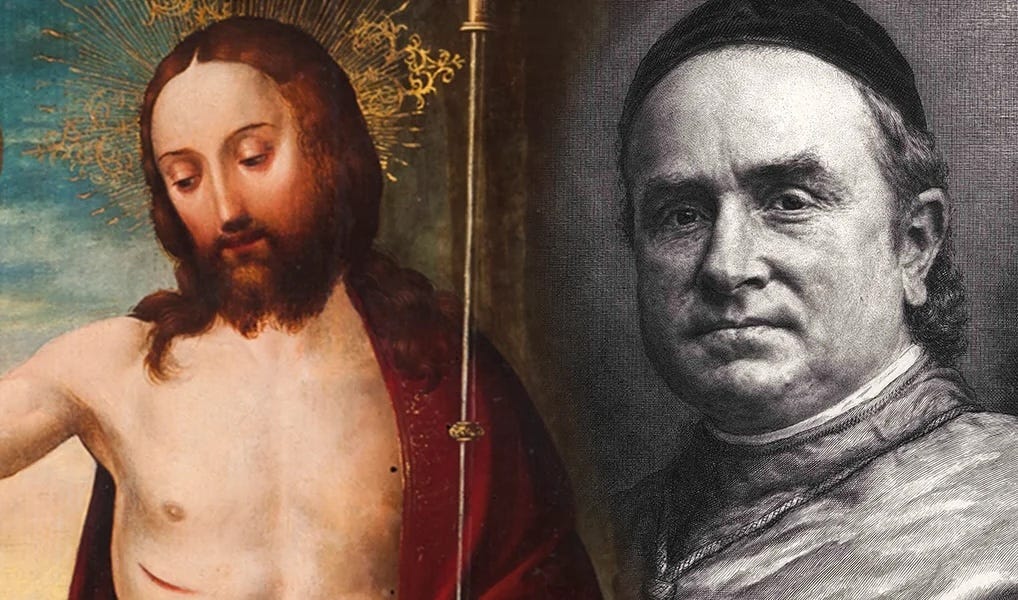
Stabat Mater Press’ new edition of ‘The Social Kingship of Christ According to Cardinal Pie’ gives comprehensive explanation of why Christ is King.
Stabat Mater Press just released a new translation of Fr. Théotime de Saint-Just’s classic work, The Social Kingship of Christ According to Cardinal Pie.
This book is a synthesis of Cardinal Pie’s writings, sermons, and addresses on the topic. Fr Théotime provides an extensive selection of long extracts (along with commentary), which results in a full exposition of the doctrine or Christ’s Social Kingship.
I had the honour of providing the foreword for this handsome new edition, available in both hardback and paperback.
The foreword, which is 25 pages long, situates Fr. Théotime’s work in our own ecclesiastical crisis – in which the doctrine of Christ’s Kingship has been so transformed as to constitute a denial of the original teaching.
It sets out why Vatican II’s doctrine of religious liberty is central to this transformation, how it has been interpreted by Vatican authorities (in ways quite contrary to those who seek to reconcile it with tradition), and the practical effects on our world – dealing with issues as varied as COVID-19 church closures, train crashes in Spain (in which the last rites were prevented in case they “interfere” with the emergency services), and the stated reasoning behind the SSPX’s 1988 episcopal consecrations.
This is the first such foreword I have provided. If you would like to read it then get the book from Stabat Mater Press:
The Social Kingship of Christ According to Cardinal Pie – Fr. Théotime de Saint‑Just O.M.C.
(NB: I am not receiving any commission or benefits from sales.)
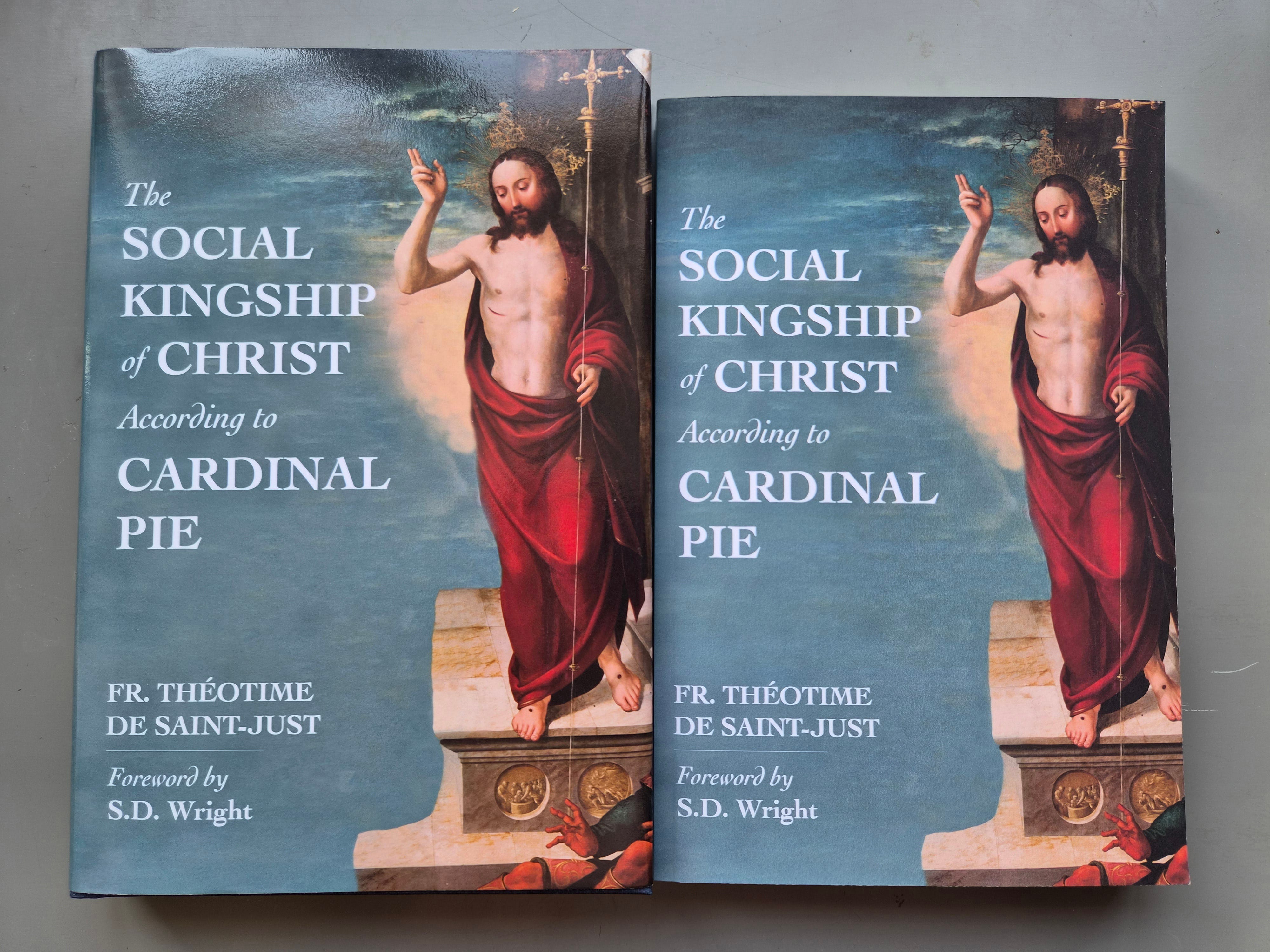
Who was Cardinal Pie?
Louis-Edouard-Désiré Pie (1815-80) was born in Pontgouin, France, in 1815. He rose in the ecclesiastical ranks until he was made bishop of Poitiers in 1849 and was elevated to cardinal by Pope Leo XIII in 1879, almost exactly a year before he died. He was an extremely energetic prelate, and his legacy was appreciated by several popes – as is recounted in Capuchin monk Fr. Théotime de Saint-Just’s introduction to the work. Pope St. Pius X, in particular, praised Cardinal Pie’s work publicly, calling him “my master.”
Cardinal Pie is one of the great, neglected voices in Catholic theology. His work provides a comprehensive exposition of the Social Kingship of Christ – and yet he remains almost unknown to English-speaking Catholics.
This is a great loss to us because the questions Cardinal Pie addressed in the 19th century – the duties of states toward God, the rights of Christ over civil society, the consequences of national apostasy from the Faith – are precisely the questions that confront us today.
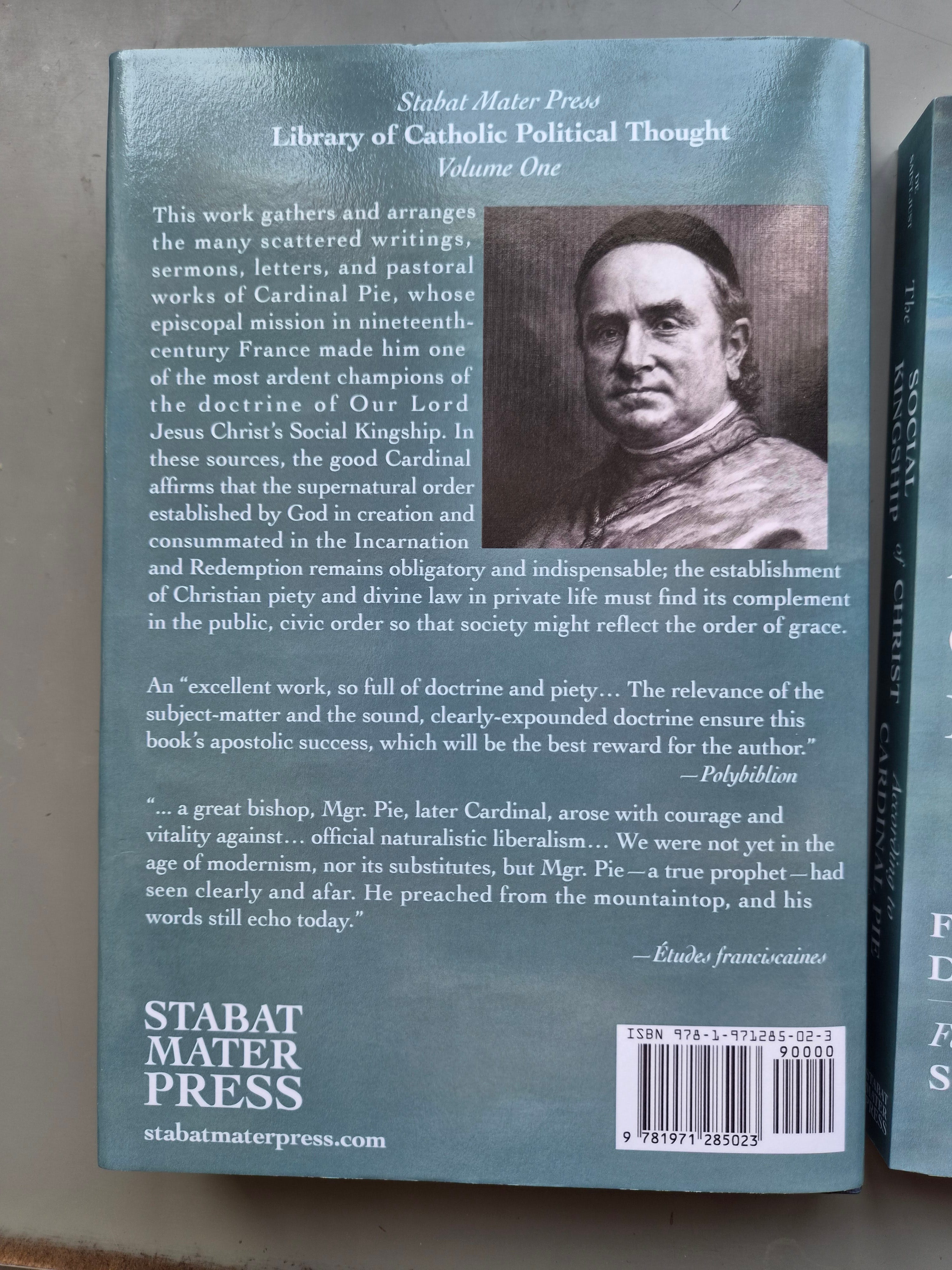
About the book
The central question that Christ’s Social Kingship answers is expressed by Fr. Théotime in the introduction to the work:
Our Lord Jesus Christ – did He come to earth to sanctify souls, or did He also come to impose His will upon social institutions, codes of law, assemblies, and sovereigns themselves, thus becoming the supreme King of nations and peoples?
Cardinal Pie sets out the nature of Christ’s Kingship, showing that Our Lord did not come solely for sanctification of souls but also to “impose His will upon social institutions,” etc.; indeed, the latter is a necessary consequence of the former. For if Christ is King over all individuals, then He is their King whether they are alone or gathered as families, societies, and nations. All such gatherings of men have a duty to recognize this Kingship, and Christ has a right to their homage.
The WM Review and its editors have published many articles on this doctrine and its implications for our day.
Enthronement of the Sacred Heart of Christ the King, the antidote society needs
Liberalism vs. Christ the King: the defining battle of our age
Leo XIV openly rejects the reign of Christ the King over states and nations
Ted Cruz is wrong: Christ must reign over every state and nation
Report: Leo XIV says ‘our task is not to build a Christendom’
At a time in which the Kingship of Christ is reduced to largely individualistic terms and the phrase “Christ is King” is thrown around as a slogan emptied of its original doctrinal content, this synthesis could not have been re-translated and published at a better time.
The order of the book
Fr. Théotime’s work proceeds in an orderly manner, starting with Cardinal Pie’s exposition of the doctrine and its implications for societies and nations. He then proceeds to the cardinal’s analysis of the rebellion against Christ’s Kingship, and the consequences of this rebellion. He presents Cardinal Pie’s explanation of how Christ’s Social Kingship can be restored – examining the duties of different classes of men. The work ends with Cardinal Pie’s “prophecies” of the two outcomes that await mankind, depending on whether Christ is “allowed” to reign, or whether mankind replies by saying, “We will not have this man to reign over us.”


What makes this synthesis by Fr. Théotime so valuable is Cardinal Pie’s integration of Scripture, the Fathers, and the magisterium into a single, coherent manifesto. He demonstrates why Christ’s Kingship extends necessarily to civil society, how the refusal to acknowledge it leads to ruin, and what the restoration of this Kingship requires of each class of men.
In particular, Cardinal Pie’s analysis of the consequences of the rebellion against Christ’s Kingship reads like a description of our world – making this work especially important for our time.
How the book was received at the time
Fr. Théotime received much praise for this work.
Fr. Josephus Antonius a Persiceto, the Master General of the Order of Friars Minor Capuchin praised it, speaking of the “greatest satisfaction” that he had reading this “fine work.”1
Fr. Théotime provides a number of reviews in the preface to the second edition. For example, Cardinal Mercier described it as “an illuminating synthesis,” and a professor at the Catholic University of Paris praised Fr. Théotime for having put Cardinal Pie’s work “into scholastic form,” and having given it “its full effectiveness against contemporary error.”2
He also provides the comments of a diocesan superior of a congregation:
Please accept my deepest gratitude and also my complete admiration for your perfect work. It is a well-organized, lively, illuminating, concise book which is both interesting and edifying to read. Not a word too many.
I read it with enthusiasm and with the desire that it be known and become the bedside book of all those who have authority over society, bishops, priests, legislators, and social leaders.3
Fr. Adhémar d’Alès, SJ, wrote the following in his review for Études4 in 1924:
The Rev. Fr. Théotime de Saint-Just had the very happy idea of gathering (Cardinal Pie’s teachings on the Social Kingship) so that they might be heard by the present generation.
He establishes, through textual quotations borrowed from the Bishop of Poitiers: (1) the right of Jesus Christ to reign over societies; (2) the all-too-certain fact of general apostasy; (3) the means for a possible restoration of this reign; (4) the future that is promised to him.
We must hope for the widest possible dissemination of these pages of sound doctrine and valiant faith.5
La France franciscaine said:
The work will be read with great profit.6
The Nouvelle revue théologique (which has nothing to do with the nouvelle théologie) wrote:
In today’s society, which is in the throes of a profound crisis of authority, Fr. Théotime … presents an ideal program.
The Revue des lectures praised the work by explicitly linking it with the encyclical Quas Primas:
“We are pleased to recommend this book in the wake of the Encyclical (Quas primas) on the Social Kingship of Jesus Christ … Fr. Théotime’s work will be very useful to priests and educated laymen in understanding the views of the Pope.”7
Lastly, Polybiblion featured the following review:
(An) excellent work, so full of doctrine and piety … The relevance of the subject-matter and the sound, clearly expounded doctrine ensure this book’s apostolic success, which will be the best reward for the author.8
The Social Kingship in our time
As mentioned above, the foreword explains why the doctrine of Fr Théotime’s work is so important for our own day, in terms of the attacks which it has sustained, and the consequences.
But there is another aspect to its contemporary relevance which we shold consider. The book ends with a discussion of whether we may reasonably hope for a restoration of Christ’s Kingship before the end of the world.
While firmly teaching that it is the duty of Christians to work for this restoration, Cardinal Pie was “neither overly optimistic nor discouragingly pessimistic about the future.” It seems that he did not expect a “very long period of social renewal in Christ before the end of the world” but that he nonetheless nurtured a hope for a possible “brilliant autumn for Christian society at the end of the world.”9
Also referring to Mgr. Delassus’ La Conjuration antichrétienne (The Anti-Christian Conspiracy, currently being translated and published by Shield of Faith Press), Fr. Théotime provided the following comments from Cardinal Pie:
What are the Lord’s thoughts on the Church, on society, on Rome, on France, on the world? Must we now descend a slippery slope to the bottom of the abyss? Must we climb back up to the light? It gives me pleasure to repeat: the predictions of the saints, the premonitions of the good, seem to allow us to hope yet for days of triumph, at least temporary, for the Church militant.10
(Incidentally, Fr Théotime refers positively to the great Mgr Delassus twelve times throughout the work, indicating where his sympathies lie.)
He also cites the following warning from Cardinal Pie, parts of which seems chillingly appropriate for our time:
[W]hat is certain is that as the world approaches its end, the wicked and the seducers will have more and more of an advantage. Faith will be almost impossible to find on earth – that is to say, it will have almost completely disappeared from all earthly institutions.
Believers themselves will hardly dare to make a public and social profession of their beliefs. The schism, the separation, the divorce of societies from God – which St. Paul gives as a sign preceding the end, nisi venerit discessio primum – will be consummated day by day.
The Church, a society that will undoubtedly always be visible, will be increasingly reduced to simply individual and domestic proportions. She, who said in her early days, ‘The place is too small for me, make room for me to dwell,’ Angustus mihi locus, fac spatium ut habitem, will find herself fighting for ground inch by inch, surrounded and hemmed in on all sides: as much as the centuries had made her great, so much will be done to restrict her.
Finally, there will be a veritable defeat for the Church on earth, and the Beast will be given power to wage war against the saints and defeat them. The insolence of evil will reach its peak.
Now, in this extreme situation, in this desperate state, on this globe given over to the triumph of evil and soon to be engulfed in flames, what should all true Christians, all good people, all saints, all men of faith and courage still do?
The very moving answer to this question will be found in the book.
Ultimately, Cardinal Pie’s teaching – as presented by Fr. Théotime – is both the accusation and the antidote for what has been ailing the world since Vatican II, and even before. As the Cardinal himself said:
The only hope for our social regeneration lies in the study of religion … the first step back to peace and happiness will be a return to the science of Christianity.
You can get Fr Théotime’s book here:
The Social Kingship of Christ According to Cardinal Pie – Fr. Théotime de Saint‑Just O.M.C.
Postscript: About Stabat Mater Press
Stabat Mater Press was founded in 2024 as a publishing house for traditional Catholic books and “dedicated to the restoration and preservation of the Church’s intellectual and spiritual patrimony.”
“We prioritize,” they say, “works that are expressly related to, or can shed light on, the Social Kingship of Our Lord.”
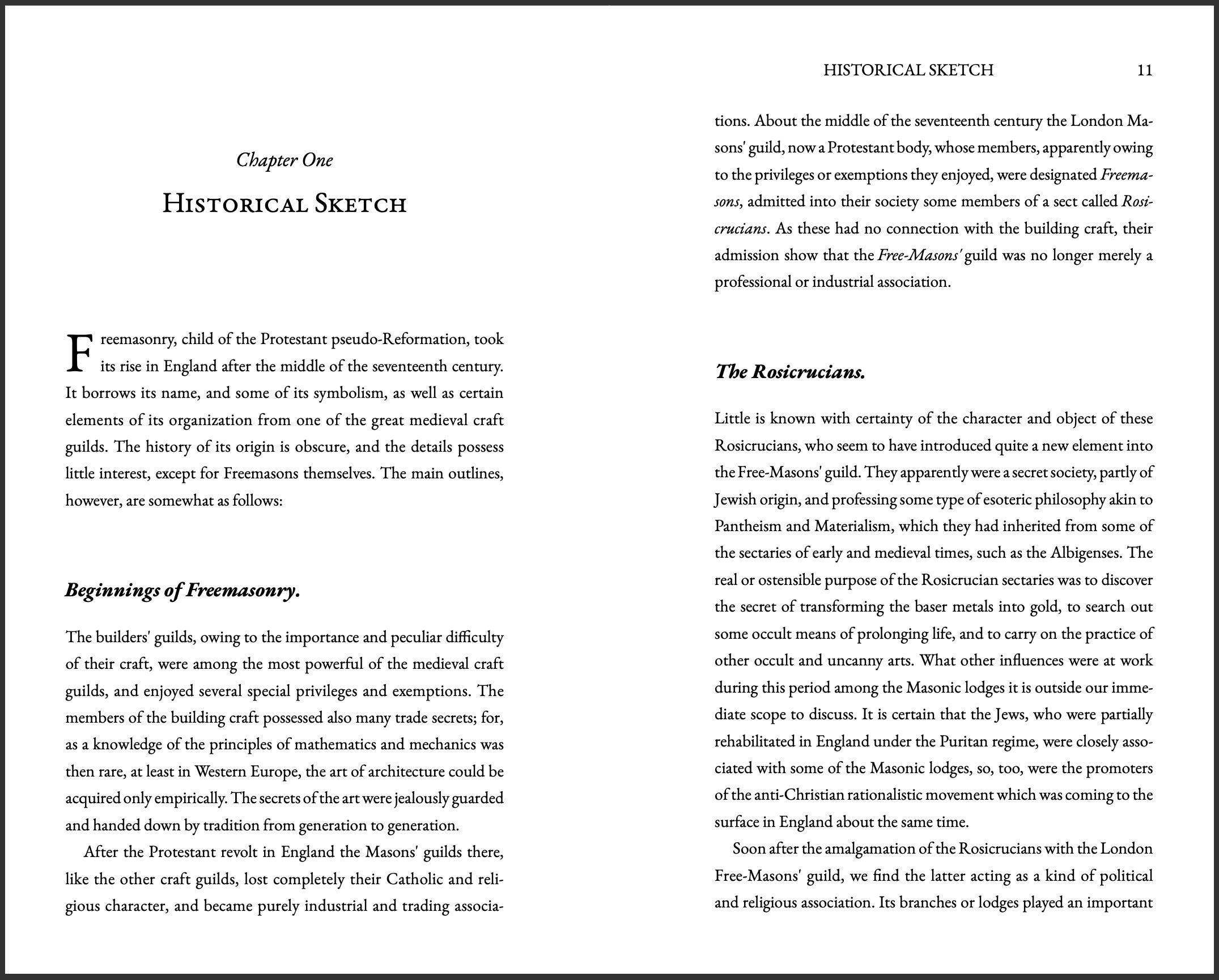
They also are engaged in restoring older texts. With a few exceptions, publishers releasing OCR scans of old texts can have low standards – and publish their Catholic works indiscriminately with very bad books (occult, masonry, heresy, and so on). Stabat Mater Press’s editions are avoiding both problems. You can see a sample of their quality in this preview of Fr Edward J. Cahill’s Freemasonry and the Anti-Christian Movement:
Regarding big print-on-demand publishers of good and bad OCR scans indiscriminately, SMP says:
As a family-owned publishing house, we take seriously the idea that Catholic books should be made by Catholics and for Catholics — those formed by the Faith, obedient to the Church, and committed to tradition.
Stabat Mater Press has already put together a small but impressive range of books in nice editions, including:
Freemasonry and the Anti-Christian Movement – Fr. Edward J. Cahill
To Restore All Things: Essays of Catholic Political Thought – de Maistre, Belloc, Dononso Cortes
The Heresy of Popular Sovereignty – Fr. Charles Maignen
INFERNO: A Journey Through Modern Hell in Search of Eternal Truth – Augustine Virgil
The Social Kingship of Christ According to Cardinal Pie – Fr. Théotime de Saint‑Just, O.M.C.
The editor is planning to migrate all of the titles away from Amazon in due course, in accordance with the vision which Mr Theo Howard from The Two Cities Podcast called “The Little Way of Christendom” – which is explained in the video and One Peter Five articles below:
The Little Way of Christendom, Part 1
The Little Way of Christendom, Part 2
You can get Fr. Théotime’s book here:
The Social Kingship of Christ According to Cardinal Pie – Fr. Théotime de Saint‑Just, O.M.C.
HELP KEEP THE WM REVIEW ONLINE WITH WM+!
As we expand The WM Review we would like to keep providing free articles for everyone.
Our work takes a lot of time and effort to produce. If you have benefitted from it please do consider supporting us financially.
A subscription gets you access to our exclusive WM+ material, and helps ensure that we can keep writing and sharing free material for all.
You can see what readers are saying over at our Testimonials page.
And you can visit The WM Review Shop for our ‘Lovely Mugs’ and more.
(We make our WM+ material freely available to clergy, priests and seminarians upon request. Please subscribe and reply to the email if this applies to you.)
Subscribe to WM+ now to make sure you always receive our material. Thank you!
Read Next:


Follow on Twitter, YouTube and Telegram:
Twitter (The WM Review)
p. xxxix
p. xli
Ibid.
Revue des Lectures, 4th year, no. 1, 1926, pp. 60 f.
Revue des Lectures, 4th year, no. 1, 1926, pp. 60 f.
pp. 210-211
p 215
The first two book links don't seem to work correctly.
"Freemasonry and the Anti-Christian Movement – Fr. Edward J. Cahill. To Restore All Things: Essays of Catholic Political Thought – de Maistre, Belloc, Dononso Cortes"
Another excellent book (ebook here) on the world's need for the social reign of Christ the King, as well as on its Judeo-Masonic enemies, is The Kingship of Christ and Organized Naturalism by Fr Denis Fahey (d. 1954): isidore.co/misc/Res%20pro%20Deo/ITOPL_OCR-layer-only/15.%20Supplementum%20-%20Dogma%20&%20Moral/Moral/Fahey%20-%20The%20Kingship%20of%20Christ%20and%20Organized%20Naturalism_OCR.pdf
It contains many quotes from Pope Pius XII (1939-58) & his 19th & 20th C. predecessors, as well as from the traditional enemies of God & of humanity.
Fr Fahey would almost certainly be silenced today by the fake church hierarchy under false popes which embraces false ecumenism, even religious indifferentism as with the present papal pretender & Judeo-Masonic asset, Leo & his predecessor, Francis. What most Catholics find it too hard to accept, however, is that all 6 of his predecessors were Judeo-Masonic assets as well. novusordowatch.org