
Fr Reid Hennick sets out the proper place of private revelations in the life of Catholics.
Editor’s Notes
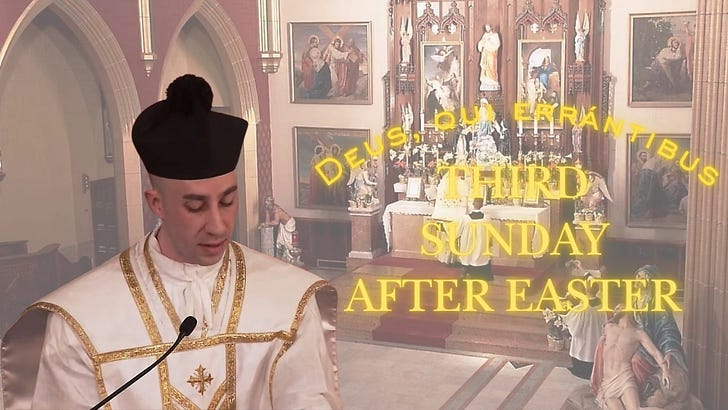
Fr Reid Hennick RCI has kindly given us permission to publish the sermon which he preached on the Sixth Sunday after Pentecost, 2026.
This sermon deals with a topic we have considered on several occasions at The WM Review – namely the place that private revelations and extraordinary phenomena should play in the life of a Catholic.
Fr Hennick is a personal friend, and you can read more about his recent move to Massachusetts here.
‘Bread from their Hands’
Fr Reid Hennick RCI
Sixth Sunday after Pentecost
Headings added by The WM Review for ease of reading.
The role of the Apostles in feeding the multitude
He broke and gave to his disciples for to set before them. And they set them before the people.
A great crowd has followed Our Lord into the desert, and for three days they have had nothing to eat. Now despite these hunger pangs, they do not grumble. They do not clamor for a sign. They wait on Our Lord. And Our Lord has compassion on them.
Our Lord, of course, could have fed them in any way He pleased. Bread could fall from the sky, it could fill each hand at once. But see how He chooses. See how He chooses to feed them. He multiplies the loaves and then hands them to His disciples. The apostles set them before the people. The apostles. No man in that desert is fed except from hands appointed by Christ. This image captures the entirety of today’s sermon.
With that in mind, mark what it is Our Lord truly feeds the multitude today, because the loaves are the lesser gift, the lesser gift. For three days, Our Lord has been feeding them on His doctrine. A much more nourishing bread. This was His entire purpose in dealing with the people to begin with. This was His mission, and to continue this mission beyond a few thousand men in the desert, He founded a Church. And He entrusted to this Church His teaching, the apostles to guard it, their successors after them, that this greater bread might be set before every generation until the end of time. We Catholics do not take Our Lord’s words straight from His own lips. We receive it from the Church.
The role of the miracle
And now, what of the miracle? Well, we should appreciate that the miracle today is worked not so much, not chiefly, to fill stomachs. Remember, the loaves are the lesser gift. The miracle today is God’s own testimony that the teaching they have been fed on for the past three days was from Heaven. Not from man. For how were they to know? How were they to know that this preaching was God’s word and not only a man’s? Well, they knew because they saw seven loaves feed four thousand. This visible marvel vouched for the invisible food.
The truth is, we human beings sometimes need these impressive visual prompts to point out to us what is worth listening to, to begin with. And God caters to this need by teaching us with miracles. St. Thomas puts it thus:
“The preached word needs to be confirmed in order that it be rendered credible. This is done by the working of miracles.”
Vatican I says the same thing. It calls miracles, quote, “the most certain signs of revelation, suited to the understanding of all.” It seems everyone can understand that God alone can work a miracle. Therefore, the miracle is His selective endorsement of that to which it is attached.
Our Lord’s miracles are meant to draw our attention to His revelation. They are a means to that end. Our jumping to that end, our embracing His teaching without some sort of external proof, would be rash. It would be rash on our part. Why? Because we ought to hold high critical standards in this world of lies. We ought to. In every age, dubious messengers are competing for our attention. And their words, by themselves, are cheap. Our Lord knows these confusing surroundings of ours, and therefore He doesn’t leave us with bare assertions. He pays us the courtesy of proving the authority of His own words. Hence today’s multiplication. Our Lord says of His miracles elsewhere,
“The works that I do in the name of my Father, they give testimony of me. If I do not the works of my Father, believe me not.”
Once again, Our Lord’s teaching is the food. The miracle is the certification of that food. The miracle encourages us to listen in faith to Christ, to Christ’s teaching, to Him teaching in His Church. “He that heareth you, heareth me.” We are fed from her hands. The Church is our doctrinal reference point, and no later wonder could possibly unseat her for us.
The role of the Church in our faith
Imagine the absurdity of this scenario: someone puts his faith in the Church after witnessing the miracle of the morning of Pentecost, and then later reneges on that faith because he witnesses one of the wonders wrought by Simon the magician. This is absurd. A Catholic should know well that not every wonder is from God. St. Paul foretells, quote, “one whose coming is according to the working of Satan, in all power, and signs, and lying wonders.” Any spectacle that would pull us from what the Church teaches is, by that fact, a lying wonder. No real miracle could certify a food other than that of the Magisterium’s.
Public and private revelation
And the bread of the Magisterium is none other than “the faith once delivered to the saints.” That’s how St. Jude puts it. The Church teaches us by drawing from this once-delivered faith, this revelation, which ended with the death of the last Apostle. This is called Public Revelation. It’s the revelation that Our Lord intended for the entire human race. The Catholic Church is the guardian and the interpreter of this revelation.
All revelations made since then are, by default, private revelations, even if they pertain to the spiritual benefit of the Church at large, even if they serve this broad, social function.
Some examples: the voices that led St. Joan of Arc to the deliverance of France; the Holy Face devotion; Our Lady of Lourdes, La Salette, Fatima — all private revelations, full stop. Why? Because we are not bound to receive them without qualification. This is the hinge of the whole matter: however true a particular private revelation may be, it adds not one word to the faith once delivered.
And with that in mind, we should see how relatively little weight a private revelation can bear, even a good one. When the Church comes across a private revelation, one that meets certain standards of orthodoxy, she may, let us say, acknowledge it by degrees.
First, she may tolerate it, or perhaps permit it. This is when she is not fully at ease with it, but she would rather not condemn it outright, lest she unnecessarily upset faithful who are innocently attached to it.
Secondly, she may approve it negatively. This means that she has found nothing in its immediate message or happenings that is contrary to faith and morals. And in that case, the faithful may receive it without fear of believing or doing anything unauthorized by the Church. Here we might group many of the revelations recorded in the lives of canonized saints.
And thirdly, she may approve it positively. This is when she’s actually asserting its divine origin. She might even endorse it by, for instance, including it in encyclicals or catechisms, or by weaving it into her liturgy, or by granting indulgences for pilgrimages. A most uncontroversial example here, the Sacred Heart.
Now, after such approval, after this kind of public approbation, to despise a revelation, a private revelation, would be reprehensible on our part. Because for a loyal son or daughter of the Church, this would be to fail in piety. It would be to fail in the respect due to Holy Mother Church.
The different types of assent owed
Nevertheless, the highest assent we could give to this private revelation does not rise above human faith. This is the teaching of Pope Benedict XIV. He teaches about private revelations in general:
“It is not obligatory nor even possible to give them the assent of Catholic faith, but only of human faith.”
This all goes to say that we may be very much certain of a private revelation’s divine origin, and at the same time, very much less certain of the authenticity of all its details. Unlike Sacred Scripture, these details are neither inspired nor infallible. Insofar as they’re merely repeating what the Church has already definitively taught, as much of the message of the Sacred Heart does, that much is certain, that much is inerrant.
But this goes to say that even though a revelation may be true in the main, it may gather errors on its long road to us. God surely gives the seer, the visionary, the recipient, much light, but this recipient often cannot grasp the whole of what’s been revealed. Misunderstanding and misinterpretation are possible even here, at its source. A good example is in the life of St. Joan of Arc. Even when her martyrdom was foretold to her explicitly, St. Joan of Arc nevertheless held on to the word “deliverance.” She told her interrogators:
“I do not know if this will be to be delivered from prison, or if some disturbance may happen by which I shall be delivered.”
She was thinking literally — she was thinking this meant her escape, her temporal escape. When the truth was, she was to be delivered by the victory of her martyrdom. And that was the case all along.
Now, added on top of this source, we have the hazardous transmission process. It often falls to others, non-recipients, to “clarify” what was seen, originally seen, or recorded. And again, misunderstanding, misinterpretation. And mistranslation as well.
The Catholic attitude towards these revelations
This might sound a bit deflating, but the reality is that there is a lot less certainty in this domain than we might like to believe. Which is perhaps why someone like Anne Catherine Emmerich could say:
“In spiritual things, I never believed anything except what was revealed by God and proposed for my belief by the Catholic Church. What I saw in visions, I never believed in this way.”
These words, from someone whose visions were far from ever being positively approved, they nonetheless show forth a profoundly Catholic spirit, profoundly Catholic estimation of things. At bottom, they are attesting to this: no vision, no locution, no dream could bring a baptized soul one step closer to God than a simple act of faith, hope, and charity. Our goal in this life is simple union with God by means of these three theological virtues.
This is attested to with one voice by the spiritual giants, by the spiritual giants of our tradition — St. Catherine of Siena, St. Teresa of Ávila, St. John of the Cross. St. John of the Cross is actually quite severe with the appetite that would look past the ordinary way. He writes, “The desire for revelations” – he means private revelations –
“… deprives faith of its purity, develops a dangerous curiosity, which becomes a source of illusions, fills the mind with vain fancies, and often proves the want of humility and of submission to Our Lord, Who, through His public revelation, has given all that is needed for our salvation.”
That kind of warning falls squarely on a certain type of soul.
Warnings for Catholics
While this type might not request from God revelations for itself — which, by the way, St. John of the Cross calls a venial sin — this type does seem to live vicariously through the revelations made to others. Let us call this type, for lack of a better word, the apparitionist. The Church has never meant to breed the apparitionist and his or her single-minded agitation. It’s a very bad fruit, because this disposition tends to carry men away from the very hands that feed them. Here is a good synopsis, but a stern one, from a moral theologian of the highest regard:
“There are many persons endeavoring to lead a holy life who occupy themselves a great deal with so-called revelations made to pious persons, even to the exclusion of all other spiritual reading matter. Sometimes such persons study the revelations made to some particular saint, drawing all their spiritual nourishment from them; then, having their appetite whetted by the perusal of one book of this kind, they eagerly devour anything of the same nature that they are able to lay hold of. They believe in these revelations as firmly as they believe in the Gospels, and are strongly disposed to brand as heretics, or at least as suspects, all who do not put the same faith in them as they do themselves. This disposition alone is sufficient to prove that the perusal of these private revelations is not a healthy spiritual exercise for all indiscriminately.”
We need only beware of this danger. Because of our own narrowness, we may derive from these revelations, even approved ones, a rather one-sided spirituality. And that’s on our part. We may end up laying great stress on things of secondary importance, sometimes trifles, and, taken to the extreme, otherwise pious people can become quite silly in the process. Sometimes pitiable. They begin to fancy themselves as further advanced in the ways of perfection than others, or further advanced in the knowledge of faith and morals than their clergy. Cardinal Ottaviani lamented exactly that. He writes:
“Persons who do not know the first words of the Creed make themselves the apostles of an ardent piety. They are not ashamed to speak of the clergy in terms of open reprobation, then become indignant when the latter do not share their ardor or join in the furor of certain popular movements.”
How to avoid these pitfalls
How do we preserve ourselves from this outcome? Quite simply, we go to the appointed hands. Our religious impulse must be guided by the Church, not our curiosity — guided like the whole of our lives, but even more severely. We should not be hankering after the higher things before we have grasped and put into practice the ordinary, necessary things. So we strive to stay in a state of grace, to stay close to the Mass and the sacraments. We settle on simple reading — a catechism first of all, accessible writings of the saints, a Catholic edition of Holy Scripture with an edifying commentary, the Gospel, the Psalms.
This sermon should not be construed as anti-private revelation. The approved ones can, in a very real, healthy way, accentuate our devotional lives. That’s their merit. This sermon is meant only to encourage a sense of proportion, a Catholic sense of proportion. Obsessing over the “true meaning” of some message, or chasing the latest turn in the Fatima saga, as if these things were indispensable to our sanctification – this is laying on our shoulders a burden heavier than the light one Our Lord intended. Far heavier.
I hope that we can all see, rather, what it is I am extolling. Extolling. Because there is an ascending nobility to what we know. All things equal, I’m sure we can appreciate this: a grasp of geopolitics, a grasp of the world’s affairs, outranks knowledge of sports results or celebrity gossip. Moving along, a knowledge of approved private revelation outranks geopolitics. But the knowledge a child draws from his catechism surpasses them all. Infinitely. And why? Cardinal Ottaviani answers, and recaps everything we’ve covered:
“A good Christian knows, and knows from his catechism, that true religion is in Revelation, which ended with the death of the last Apostle and was confided to the Church, who is its interpreter and guardian. Nothing else could be revealed to us which would be necessary for our salvation… Even if the most respectable of visions could furnish us with new motives of fervor, they would give us no new elements of life and of knowledge.”
So the irony here is that the apparitionist gorges in his feeding frenzy and is never filled. The child eats plainly from the appointed hands and is filled. And that is because there is no surer food on earth.
In the name of the Father and of the Son and of the Holy Ghost. Amen.
HELP KEEP THE WM REVIEW ONLINE WITH WM+!
As we expand The WM Review we would like to keep providing free articles for everyone.
Our work takes a lot of time and effort to produce. If you have benefitted from it please do consider supporting us financially.
A subscription gets you access to our exclusive WM+ material, and helps ensure that we can keep writing and sharing free material for all.
You can see what readers are saying over at our Testimonials page.
And you can visit The WM Review Shop for our ‘Lovely Mugs’ and more.
(We make our WM+ material freely available to clergy, priests and seminarians upon request. Please subscribe and reply to the email if this applies to you.)
Subscribe to WM+ now to make sure you always receive our material. Thank you!
Read Next:



Follow on Twitter, YouTube and Telegram:
Twitter (The WM Review)
Thanks
Wonderful.