

Bishop Donald Sanborn referred to S.D. Wright’s article on slavery as ‘excellent’ and suggested that Leo XIV should read it. With our additional comments comparing slavery with the gladiatorial games.
(WM Round-Up) – In a special edition of Questions with the Rector on Leo XIV’s first encyclical Magnifica Humanitas, Bishop Donald Sanborn praised my article critiquing its treatment of slavery.
In response to Stephen Heiner reading the relevant section from the encyclical, Bishop Sanborn replied:
“Well, Seán Wright wrote an excellent article refuting that.”
The article in question – titled ‘The Church ended slavery. So why is Leo XIV apologizing?’ – was published on LifeSiteNews, on 29 May 2026.
After Bishop Sanborn and Mr Heiner gave an overview of the history of slavery and the Church, largely along the same lines as that related in my article, Mr Heiner asked what the Bishop made of Leo XIV’s “apology” for “the delay with which both society and the Church came to denounce the scourge of slavery”.
His answer led to the following exchange:
Bishop Sanborn: Well, he doesn’t know his history, I would say. Let him read Seán Wright’s excellent article, and he’ll find out a lot of things.
Stephen Heiner: I think Seán knows... he can send that on to Rome – to “His Holiness.”
Bishop Sanborn: Yes, send it to Rome. And check that out.
I am grateful for these words of encouragement from Bishop Sanborn and Mr Heiner.
What did Leo XIV actually say?
In paragraph n. 176 of Magnifica Humanitas, Leo XIV characterises certain contemporary labour conditions as a kind of slavery, before stating that:
“In continuity with the tradition inaugurated by Leo XIII, the Church renews her firm condemnation of all forms of slavery, trafficking and the commodification of persons.” (n. 174)
However, he adds that “the Church has gradually come to a deeper awareness of the gravity” of slavery, and related issues, and describes this as a “development of her doctrine.”
“The delay with which both society and the Church came to denounce the scourge of slavery” is a source of lamentation for Leo XIV. He states that “there was not always consistency” between the Church’s affirmation of “the dignity of every human being” and her practical attitude towards the institution of slavery – “given that slavery was long tolerated before being unequivocally condemned.”
“[I]t took eighteen centuries,” he claimed, “for [this affirmation’s] full incompatibility with slavery to be explicitly recognized.”
This “delay” was because, Leo XIV says, “the moral criteria that matured over time” were not “available” to the Church in previous ages.
“It was only in the nineteenth century,” Leo XIV states, “that a formal, absolute and universal condemnation of slavery was clearly articulated.” In this, he refers to Leo XIII’s encyclical In Plurimis.
His explanation offered for this “delay” appears in one of the footnotes:
“Political and, at times, even economic needs overcame the demands of the Gospel. The need for evangelization was frequently compromised or at least misunderstood with regard to the needs of worldly powers, thus relativizing the problematic incompatibility of slavery with the Christian conscience.” (fn. 174)
The “delay,” he says, “constitutes a wound in Christian memory, one from which we cannot consider ourselves detached.” It is for this reason, and the “immense suffering and humiliation endured by so many in contrast to their immeasurable dignity as persons infinitely loved by the Lord,” that Leo XIV writes:
(I)n the name of the Church, I sincerely ask for pardon.
The article to which Bishop Sanborn refers addresses all of the points raised by Leo XIV. Here is the overview which I provided in the article itself:
The Church was responsible for the progressive eradication of slavery, and a society in which socio-economic conditions were so radically improved that slavery became obsolete;
The term “slavery” is equivocal and encompasses a broad range of practices: traditional Catholic doctrine holds that the institution itself is an evil suffered and to be ended, and (to put it mildly) far from the ideal of how humans should live; but that, while some of the practices denoted by the term are indeed intrinsically evil, others are not;
The Church condemned intrinsically evil forms of slavery and worked to render slavery obsolete long before the 19th century;
While Pope Leo XIII exhorted Catholics to support, in principle, universal emancipation – an exhortation we are bound to accept – he did not articulate “a formal, absolute and universal condemnation of slavery” in the cited encyclical;
The assertions that the Church lacked “moral criteria that matured over time,” failed to condemn an intrinsically evil institution, and that due to a lack of “mature moral criteria,” “political” and “economic” factors “overcame the demands of the Gospel,” are gravely deleterious to the indefectibility and holiness of the Church – as well as undermining of Leo XIV’s own doctrine.
I would like to thank American Reform for the advice and suggestions he provided in writing the article in question. He also wrote an article on the matter for Integrity Magazine:
Magnifica Humanitas distorts Church teaching on slavery (American Reform)
In addition to this article, my colleague Matthew McCusker wrote an overview of the encyclical itself:
Leo XIV’s Magnifica Humanitas: a blueprint for the destruction of the Catholic Church (Matthew McCusker)
In the past, McCusker and myself have also written other analyses of issues Leo XIV addresses in the encyclical:
Has Leo XIV contradicted Catholic teaching on just war? (Matthew McCusker)
Report: Leo XIV says ‘our task is not to build a Christendom’ (Matthew McCusker)
What does the Catholic Church say about immigration? (S.D. Wright)
And here, again, is the article mentioned by Bishop Sanborn:
The Church ended slavery. So why is Leo XIV apologizing? (S.D. Wright)
Bishop Sanborn’s mention of gladiatorial games
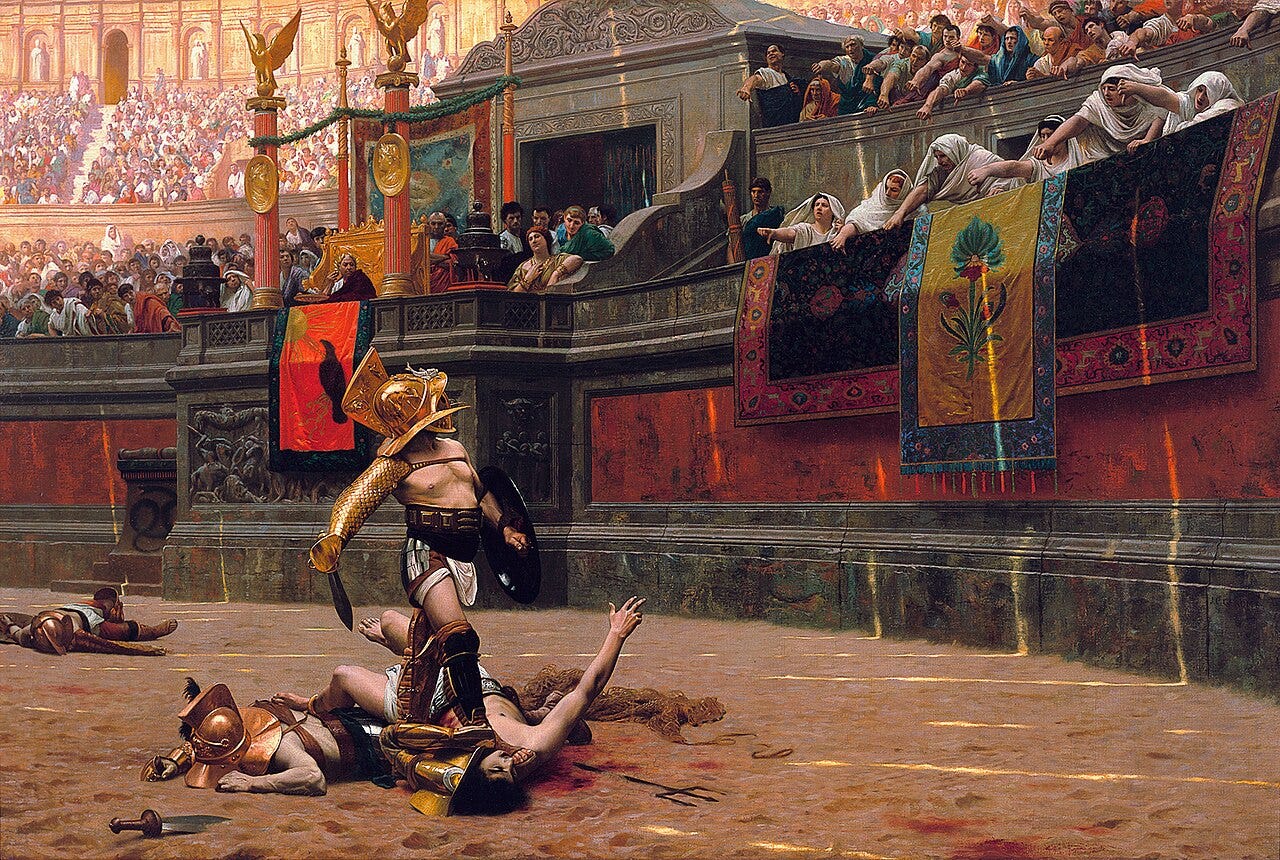
Bishop Sanborn also raised a point of comparison, which I had already regretted not including:
“The Church didn’t succeed in suppressing the gladiatorial games until the 500s AD.”
This example is interesting, because it has points of similarity and difference with the Church’s treatment of slavery – and these points illuminate the Church’s mode of proceeding in the latter case.
In the article, I wrote:
“That which is intrinsically evil – such as abortion, or the human sacrifice of the Aztecs – cannot be subject to concerns about ‘political agitation’ or the ‘human rights’ of those responsible. It must simply and immediately end.”
Although, as Bishop Sanborn said, the brutal and bloodthirsty gladiatorial games were not successfully suppressed for some time, this is how the Church viewed them. The Church and the Fathers were very clear: gladiatorial combat was intrinsically immoral; slavery was not.
The following comments about GLADIATORIAL BLOOD-SPORTS are for WM+ members.
The WM Review is free for readers. This is because we believe these ideas must reach as many people as possible.
However, we also provide WM+ articles – additional material for those who choose to support this work financially.
This helps us continue producing serious Catholic research, while ensuring that the main body of material remains accessible for all.
If you want to ensure that this continues, join WM+ today.
(Clergy and seminarians can contact us for free membership.)