
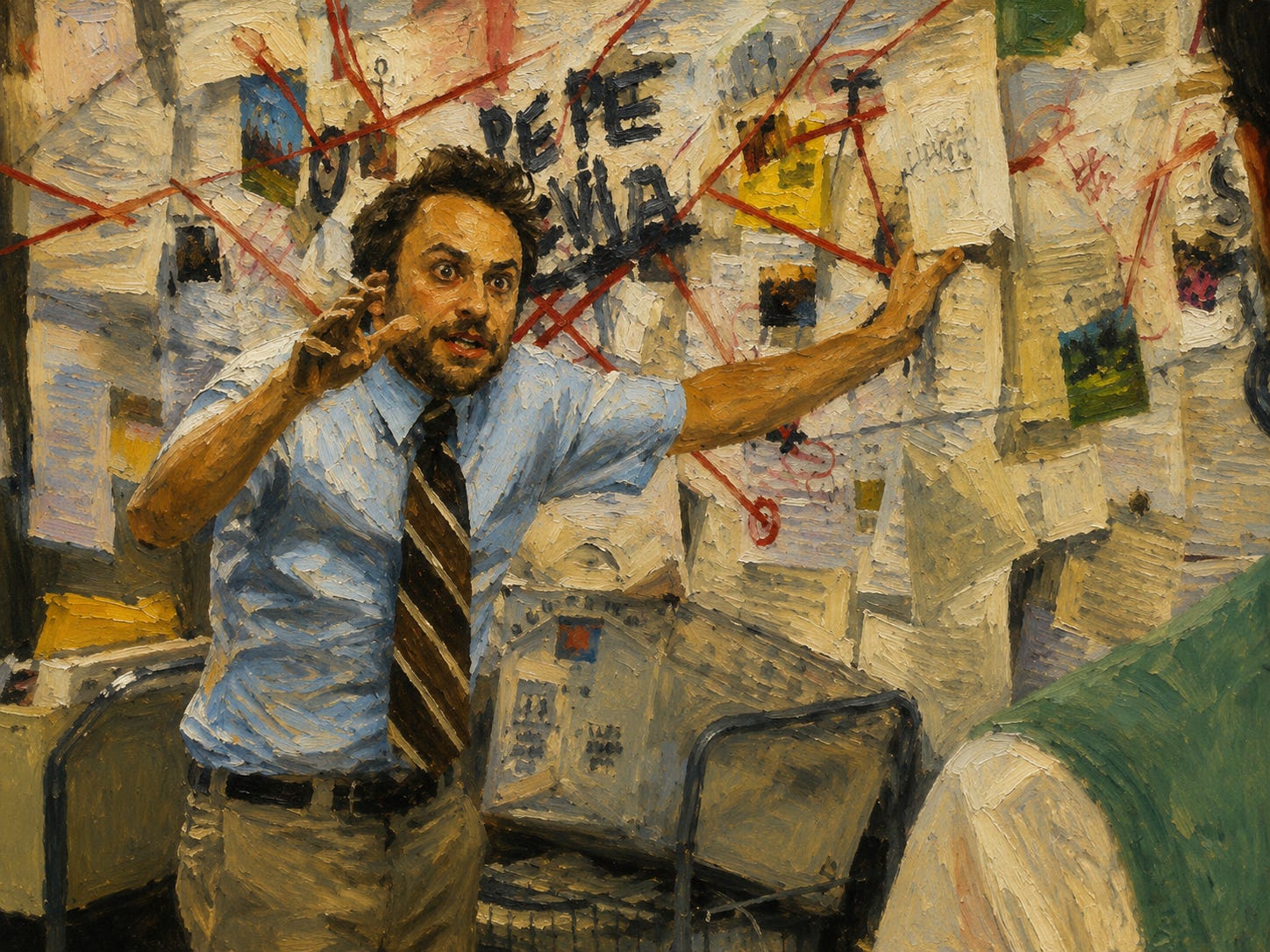
In his classic work ‘Orthodoxy’, G.K. Chesterton paints a portrait of the madman – and shows him how to escape his fate.
Editor’s Notes
Following on from the extended quote from G.K. Chesterton in my article on suicide, here are the famous English convert’s thoughts on lunatics and lunacy.
These comments pertain to conspiracy theories.
History is full of men conspiring together in order to advance their ends – often at the expense of the common good. Those who dispute this, or think that something can be refuted by calling it a “conspiracy theory” are living in denial.
It is not necessary to prove conclusively the existence of a given conspiracy in order to justify acting as if it is or could be true (i.e., acting by taking certain prudent steps to protect oneself, proportionate to the probability established).1
However, while it is not necessary to have complete documentary evidence of a conspiracy in order to take such steps, it is necessary to have some evidence before accusing others, and for this evidence to be more than intuition, fantasy, paranoia, and coherence with one’s prejudices. The graver and more specific an accusation, and the more publicity which it is to receive, and the more harm which it will cause, the stronger such evidence and reasons must be.
We are all bound by the usual standards of the moral law – such as the Eighth Commandment:
“Thou shalt not bear false witness.”
Similarly, we are all obliged not to harm a person’s reputation without just cause, and to avoid the sins of detraction, calumny and rash judgment. Believing oneself to have special insights into how the world “really” works does not dispense from these obligations.
The relevance of this to Chesterton’s comments will be clear upon reading the latter.
The Maniac
G.K. Chesterton
Orthodoxy, Chapter II, pp. 23–35. Lane, New York, 1909.
Headings and some line breaks added for ease of reading online.
Insanity, a fact of life
Though moderns deny the existence of sin, I do not think that they have yet denied the existence of a lunatic asylum. We all agree still that there is a collapse of the intellect as unmistakable as a falling house. Men deny hell, but not, as yet, Hanwell [a lunatic asylum in London]. For the purpose of our primary argument the one may very well stand where the other stood. I mean that as all thoughts and theories were once judged by whether they tended to make a man lose his soul, so for our present purpose all modern thoughts and theories may be judged by whether they tend to make a man lose his wits.
It is true that some speak lightly and loosely of insanity as in itself attractive. But a moment’s thought will show that if disease is beautiful, it is generally some one else’s disease. A blind man may be picturesque; but it requires two eyes to see the picture. And similarly even the wildest poetry of insanity can only be enjoyed by the sane. To the insane man his insanity is quite prosaic, because it is quite true. A man who thinks himself a chicken is to himself as ordinary as a chicken. A man who thinks he is a bit of glass is to himself as dull as a bit of glass. It is the homogeneity of his mind which makes him dull, and which makes him mad. It is only because we see the irony of his idea that we think him even amusing; it is only because he does not see the irony of his idea that he is put in Hanwell at all.
In short, oddities only strike ordinary people. Oddities do not strike odd people. This is why ordinary people have a much more exciting time; while odd people are always complaining of the dulness of life. This is also why the new novels die so quickly, and why the old fairy tales endure for ever. The old fairy tale makes the hero a normal human boy; it is his adventures that are startling; they startle him because he is normal. But in the modern psychological novel the hero is abnormal; the centre is not central. Hence the fiercest adventures fail to affect him adequately, and the book is monotonous. You can make a story out of a hero among dragons; but not out of a dragon among dragons. The fairy tale discusses what a sane man will do in a mad world. The sober realistic novel of to-day discusses what an essential lunatic will do in a dull world.
Insanity is more prosaic than thought
Let us begin, then, with the mad-house; from this evil and fantastic inn let us set forth on our intellectual journey. Now, if we are to glance at the philosophy of sanity, the first thing to do in the matter is to blot out one big and common mistake.
There is a notion adrift everywhere that imagination, especially mystical imagination, is dangerous to man’s mental balance. Poets are commonly spoken of as psychologically unreliable; and generally there is a vague association between wreathing laurels in your hair and sticking straws in it. Facts and history utterly contradict this view. Most of the very great poets have been not only sane, but extremely business-like; and if Shakespeare ever really held horses, it was because he was much the safest man to hold them. Imagination does not breed insanity. Exactly what does breed insanity is reason.
Poets do not go mad; but chess-players do. Mathematicians go mad, and cashiers; but creative artists very seldom. I am not, as will be seen, in any sense attacking logic: I only say that this danger does lie in logic, not in imagination. Artistic paternity is as wholesome as physical paternity. Moreover, it is worthy of remark that when a poet really was morbid it was commonly because he had some weak spot of rationality on his brain. Poe, for instance, really was morbid; not because he was poetical, but because he was specially analytical. Even chess was too poetical for him; he disliked chess because it was full of knights and castles, like a poem. He avowedly preferred the black discs of draughts, because they were more like the mere black dots on a diagram. Perhaps the strongest case of all is this: that only one great English poet went mad, Cowper. And he was definitely driven mad by logic, by the ugly and alien logic of predestination.2
Poetry was not the disease, but the medicine; poetry partly kept him in health. He could sometimes forget the red and thirsty hell to which his hideous necessitarianism dragged him among the wide waters and the white flat lilies of the Ouse. He was damned by John Calvin; he was almost saved by John Gilpin.
Everywhere we see that men do not go mad by dreaming. Critics are much madder than poets. Homer is complete and calm enough; it is his critics who tear him into extravagant tatters. Shakespeare is quite himself; it is only some of his critics who have discovered that he was somebody else. And though St. John the Evangelist saw many strange monsters in his vision, he saw no creature so wild as one of his own commentators.
An excess of ‘reason’
The general fact is simple. Poetry is sane because it floats easily in an infinite sea; reason3 seeks to cross the infinite sea, and so make it finite. The result is mental exhaustion, like the physical exhaustion of Mr. Holbein. To accept everything is an exercise, to understand everything a strain. The poet only desires exaltation and expansion, a world to stretch himself in. The poet only asks to get his head into the heavens. It is the logician who seeks to get the heavens into his head. And it is his head that splits.
It is a small matter, but not irrelevant, that this striking mistake is commonly supported by a striking misquotation. We have all heard people cite the celebrated line of Dryden as “Great genius is to madness near allied.” But Dryden did not say that great genius was to madness near allied. Dryden was a great genius himself, and knew better. It would have been hard to find a man more romantic than he, or more sensible. What Dryden said was this, “Great wits are oft to madness near allied”; and that is true. It is the pure promptitude of the intellect that is in peril of a breakdown.
Also people might remember of what sort of man Dryden was talking. He was not talking of any unworldly visionary like Vaughan or George Herbert. He was talking of a cynical man of the world, a sceptic, a diplomatist, a great practical politician. Such men are indeed to madness near allied. Their incessant calculation of their own brains and other people’s brains is a dangerous trade. It is always perilous to the mind to reckon up the mind. A flippant person has asked why we say, “As mad as a hatter.” A more flippant person might answer that a hatter is mad because he has to measure the human head.
And if great reasoners are often maniacal, it is equally true that maniacs are commonly great reasoners. When I was engaged in a controversy with the Clarion on the matter of free will, that able writer Mr. R. B. Suthers4 said that free will was lunacy, because it meant causeless actions, and the actions of a lunatic would be causeless. I do not dwell here upon the disastrous lapse in determinist logic.
Obviously if any actions, even a lunatic’s, can be causeless, determinism is done for. If the chain of causation can be broken for a madman, it can be broken for a man. But my purpose is to point out something more practical. It was natural, perhaps, that a modern Marxian Socialist should not know anything about free will. But it was certainly remarkable that a modern Marxian Socialist should not know anything about lunatics. Mr. Suthers evidently did not know anything about lunatics.
‘Everything is connected, hiding in plain sight’
The last thing that can be said of a lunatic is that his actions are causeless. If any human acts may loosely be called causeless, they are the minor acts of a healthy man; whistling as he walks; slashing the grass with a stick; kicking his heels or rubbing his hands. It is the happy man who does the useless things; the sick man is not strong enough to be idle. It is exactly such careless and causeless actions that the madman could never understand; for the madman (like the determinist) generally sees too much cause in everything.
The madman would read a conspiratorial significance into those empty activities. He would think that the lopping of the grass was an attack on private property. He would think that the kicking of the heels was a signal to an accomplice. If the madman could for an instant become careless, he would become sane. Every one who has had the misfortune to talk with people in the heart or on the edge of mental disorder, knows that their most sinister quality is a horrible clarity of detail; a connecting of one thing with another in a map more elaborate than a maze.
If you argue with a madman, it is extremely probable that you will get the worst of it; for in many ways his mind moves all the quicker for not being delayed by the things that go with good judgment. He is not hampered by a sense of humour or by charity, or by the dumb certainties of experience. He is the more logical for losing certain sane affections. Indeed, the common phrase for insanity is in this respect a misleading one. The madman is not the man who has lost his reason. The madman is the man who has lost everything except his reason.
The madman’s explanation of a thing is always complete, and often in a purely rational sense satisfactory. Or, to speak more strictly, the insane explanation, if not conclusive, is at least unanswerable; this may be observed specially in the two or three commonest kinds of madness.
If a man says (for instance) that men have a conspiracy against him, you cannot dispute it except by saying that all the men deny that they are conspirators; which is exactly what conspirators would do. His explanation covers the facts as much as yours. Or if a man says that he is the rightful King of England, it is no complete answer to say that the existing authorities call him mad; for if he were King of England that might be the wisest thing for the existing authorities to do. Or if a man says that he is Jesus Christ, it is no answer to tell him that the world denies his divinity; for the world denied Christ’s.
Why the madman is wrong
Nevertheless he is wrong. But if we attempt to trace his error in exact terms, we shall not find it quite so easy as we had supposed.
Perhaps the nearest we can get to expressing it is to say this: that his mind moves in a perfect but narrow circle. A small circle is quite as infinite as a large circle; but, though it is quite as infinite, it is not so large.
In the same way the insane explanation is quite as complete as the sane one, but it is not so large. A bullet is quite as round as the world, but it is not the world. There is such a thing as a narrow universality; there is such a thing as a small and cramped eternity; you may see it in many modern religions. Now, speaking quite externally and empirically, we may say that the strongest and most unmistakable mark of madness is this combination between a logical completeness and a spiritual contraction.
The lunatic’s theory explains a large number of things, but it does not explain them in a large way. I mean that if you or I were dealing with a mind that was growing morbid, we should be chiefly concerned not so much to give it arguments as to give it air, to convince it that there was something cleaner and cooler outside the suffocation of a single argument. Suppose, for instance, it were the first case that I took as typical; suppose it were the case of a man who accused everybody of conspiring against him.
If we could express our deepest feelings of protest and appeal against this obsession, I suppose we should say something like this:
“Oh, I admit that you have your case and have it by heart, and that many things do fit into other things as you say. I admit that your explanation explains a great deal; but what a great deal it leaves out! Are there no other stories in the world except yours; and are all men busy with your business?
“Suppose we grant the details; perhaps when the man in the street did not seem to see you it was only his cunning; perhaps when the policeman asked you your name it was only because he knew it already. But how much happier you would be if you only knew that these people cared nothing about you! How much larger your life would be if your self could become smaller in it; if you could really look at other men with common curiosity and pleasure; if you could see them walking as they are in their sunny selfishness and their virile indifference!
“You would begin to be interested in them, because they were not interested in you. You would break out of this tiny and tawdry theatre in which your own little plot is always being played, and you would find yourself under a freer sky, in a street full of splendid strangers.”
Or suppose it were the second case of madness, that of a man who claims the crown, your impulse would be to answer:
“All right! Perhaps you know that you are the King of England; but why do you care? Make one magnificent effort and you will be a human being and look down on all the kings of the earth.”
Or it might be the third case, of the madman who called himself Christ. If we said what we felt, we should say:
“So you are the Creator and Redeemer of the world: but what a small world it must be! What a little heaven you must inhabit, with angels no bigger than butterflies! How sad it must be to be God; and an inadequate God! Is there really no life fuller and no love more marvellous than yours; and is it really in your small and painful pity that all flesh must put its faith? How much happier you would be, how much more of you there would be, if the hammer of a higher God could smash your small cosmos, scattering the stars like spangles, and leave you in the open, free like other men to look up as well as down!”
Casting out a devil
And it must be remembered that the most purely practical science does take this view of mental evil; it does not seek to argue with it like a heresy but simply to snap it like a spell.
Neither modern science nor ancient religion believes in complete free thought. Theology rebukes certain thoughts by calling them blasphemous. Science rebukes certain thoughts by calling them morbid. For example, some religious societies discouraged men more or less from thinking about sex. The new scientific society definitely discourages men from thinking about death; it is a fact, but it is considered a morbid fact.
And in dealing with those whose morbidity has a touch of mania, modern science cares far less for pure logic than a dancing Dervish. In these cases it is not enough that the unhappy man should desire truth; he must desire health. Nothing can save him but a blind hunger for normality, like that of a beast. A man cannot think himself out of mental evil; for it is actually the organ of thought that has become diseased, ungovernable, and, as it were, independent. He can only be saved by will or faith.
The moment his mere reason moves, it moves in the old circular rut; he will go round and round his logical circle, just as a man in a third-class carriage on the Inner Circle will go round and round the Inner Circle unless he performs the voluntary, vigorous, and mystical act of getting out at Gower Street.
Decision is the whole business here; a door must be shut for ever. Every remedy is a desperate remedy. Every cure is a miraculous cure. Curing a madman is not arguing with a philosopher; it is casting out a devil.
HELP KEEP THE WM REVIEW ONLINE WITH WM+!
As we expand The WM Review we would like to keep providing free articles for everyone.
Our work takes a lot of time and effort to produce. If you have benefitted from it please do consider supporting us financially.
A subscription gets you access to our exclusive WM+ material, and helps ensure that we can keep writing and sharing free material for all.
You can see what readers are saying over at our Testimonials page.
And you can visit The WM Review Shop for our ‘Lovely Mugs’ and more.
(We make our WM+ material freely available to clergy, priests and seminarians upon request. Please subscribe and reply to the email if this applies to you.)
Subscribe to WM+ now to make sure you always receive our material. Thank you!
Read Next:

Follow on Twitter, YouTube and Telegram:
Twitter (The WM Review)
In a November 2020 article, Professor Robert de Mattei claimed that those who were sceptical about masks and lockdowns were “frankly ridiculous”, dominated by emotion and imagination, and suffering from mental illness. He wrote:
The Coronavirus (according to them) is but a simple influenza and the measures recommended by both progressive and conservative governments throughout the world, like the lockdown, face coverings and social distancing, are instruments and symbols of this plot to destroy individual freedom, and in the end to exterminate the whole of humanity.
He mischaracterises those who do not meet his historian’s standard for evidence as having nothing to do with the ‘tradition of Catholic thought’, as being governed by emotions and imagination, and as suffering a sort of mental illness called “apophenia”:
“We must say firmly that these hypotheses have nothing at all to do with the great tradition of Catholic thought, which, when it addresses the existence of an anti-Christian conspiracy, substantiates every affirmation with precise documentation and, above all, does not ever substitute faith and reason with the imagination. The impression at times one has is that of being faced with the phenomenon of cognitive dissonance, where reality is deformed by an emotional condition of apophenia, a psychic state that seeks to establish significant connections between events devoid of any causal relationship.”
In another article, titled ‘True and False Conspiracies in History’ and published in Corrisponenza Romana in January 2021, he compared certain conspiracies that had been exposed with extensive documentation, with those that had not:
“The existence of this conspiratorial tradition is documented and indisputable. The proofs exist. Among historians, Catholics or anti-Catholics, from the right or the left, there may be divergence in the interpretation of the facts, but not about their reality.
“On the contrary, the characteristic of false conspiracy theories is that they cannot offer any documentation or certainty. To compensate for their lack of proofs, they use the technique of narration, which takes hold of the emotions, more than reason, and seduces those, who by an act of faith, have already decided to believe the far-fetched, propelled by fear, anger and rancor. These sentiments are fostered in times of crisis, as is happening in the Coronavirus pandemic, currently taking place […]
“The existence of a conspiracy aiming at the destruction of the Church and Christian Civilization is in no need of new theories, since it has already been proven by history; neither does it need secrecy, since the Revolution now acts boldly, openly. A criteria furthermore is essential. The only true conspiracy worth fighting against is that of the forces of darkness against the Catholic Church. All the rest is secondary.”
It is difficult to understand how someone could make such arguments in good faith. While he has correctly identified a phenomenon – the “narrative thinking” behind certain conspiracy theories – it is absurd to think that we must deny the existence of any conspiracy which has not yet been definitively proved, or forbidden to observe prudent caution in regard to such cases. In many cases, such documentary evidence is not available at the outset, when non-compliance or even resistance may be most necessary. Sometimes such evidence does not appear for decades. This standard makes the possibility of self-defence against conspirators dependent on their inability to keep their plans secret. But this is absurd.
If applied to everyday life, such thinking could forbid locking (or even closing) our front doors without documentation establishing that the house will be burgled tonight. Locking one’s door as a precaution, under de Mattei’s standard, would be to engage in a false conspiracy theory, based on narrative thinking.
Similarly, the idea that “the only true conspiracy worth fighting against is that of the forces of darkness against the Catholic Church” is also absurd. It would mean that it is not worth fighting against group of men conspiring to destroy one’s business, or to steal artefacts from a museum, or carry out any other crime. He says “all the rest is secondary”: but something being secondary does not mean it is not worthy of engagement.
Chesterton wrote this text as a non-Catholic. Catholic doctrine entails predestination, although in a sense distinct to that of John Calvin, whom he criticizes here.
Or better, rationalism.
Robert Bentley Suthers was a socialist journalist.
I always thought myself crazy, then to my disappointment found myself among the sane during covid.
Then again, most horrible people I've ever met were very adamant precisely on their reason, moderate sensibilities and rationality. Spiritual pride, I guess. Fr. Coleridge was spot on when he said true friends warn you at the first sign of it.
I see chemtrails over the comments section.